Ved and Upnishad -Part 3

Relevance of the Shrutis for modern society

What relevance do these ancient scriptures of the Hindus hold for the present society? I examine this in the following paragraphs:

3.1 The caste system

The first mention of the caste system anytime in the scriptures is to be found in the Purushsukta of the Rig Veda. Purushasukta (10.090.11 and 12) asserts: ‘When they divided the purusha how many portions did they make? What did they call his mouth, his arms? What did they call his thighs and feet? The Brahman was his mouth, of his both arms the Rajanya made, His thighs became the Vaishyas, from his feet the Sudra was produced (Griffith, 1896:)[1]. Accordingly, one can see that the Varna’s were just labels given to the body parts of the same Purusha.  As they were just the designations of the different parts of the Purusha, the question of inequality therein is irrelevant.  The Brihad-aranyaka Upanishad notes that ‘at the beginning there was only one caste or class, the Brahmana differentiations were not’ (Radhakrishnan, 1992:169)[2]. Consequently, it may not be wrong to surmise that this merit-based system got corrupted down the track.  But this is an issue that needs a separate paper.

‘Vedic period had a total of five castes: Brahmin, Kshatriya, Vaishya, Shudra and Nishada. It was a categorisation according to the capacities and aptitudes of the individual and similar features can be seen in the Iranian literature as well as in the Indo-European nations (Raja, 2006)[3].  Altekar (2006:225) notes ‘there is, however, hardly any evidence to show that these three principal classes [brahmana, kshatriya, and Vaishya] had become hereditary’.   Migration from one caste to the other has been reported from the Vedic period and the system was not set in stone as it happened in subsequent years. Kshatriyas such as Vishwamitra, for example, became Brahmins. Though originally envisaged as merit-based classes or categories (Varna system) in the scriptures as Ambedkar (1916)[4] notes ‘that classes have become Castes through imitation and excommunication’.

Accordingly, one can conclude that there was no birth-based [inheritance-based] but worth-based classification system during the Vedic period and that meritocracy was the norm. Interestingly, the Brihad-aranyaka Upanishad asserts that in the beginning ‘there was only one caste or class, the Brahmana: differentiations were not’ (Radhakrishnan, 1992:169)[5].

3.2 Status of women

During the Vedic period women enjoyed equal status with the men. Raja (2006) notes a ‘complete equality between men and women is found in all parts of Vedic literature, from Samhitas to the Upanishads’.  Not only the gods and goddesses but some of the Vedic poets were women.  Furthermore, there is no mention of child marriage anywhere in the Vedas.  The Manu Smriti (Ch. IX.90) specifically indicates that let the girl wait for three years after she becomes marriageable (attains puberty), but after that let her choose a bridegroom as appropriate (Buhler, 1886)[6]. Accordingly, the choice is given to the girl.  Many women were Rishis (called Rishikas). They include Gargi, Maitreyi, Lopmudra and others.  Prem (2017)[7] has well summarised the status of women in the Vedic period. Many goddesses are women starting from the Usha (the dawn), Saraswati, Laxmi, Durga and others.  Parvati becomes the guru of Shiva. “When Parvati asks the questions and Shiva answers them the treatise is called an Agama; when Siva asks the question and Parvati answers them the treatise is called a Nigama (Bernard, 1947:14)[8].

3.3 Focus on spiritualism NOT proselytization

In some faiths there is an injunction to the adherents to convert others to their faith.  In such faiths the assumption is their God gave monopoly distribution rights of his message to a person called the Prophet to spread Gods message.  One wonders why God was so discriminatory. Hindu scriptures don’t take such divisive outlook. Every individual is free to explore and connect with the divine in his own way.  Hindus don’t have a Prophet, they have Gurus who are teachers, the teach some basic spiritual stuff and thereafter the pupil is on his own.  This is like present education system where the teacher will teach say basic physics but thereafter the student explores and researches in her own way. The focus of Hindu scriptures is the emancipation of the entire humanity from the limited personal world in which they are caught and to raise their thinking to the cosmic consciousness. Accordingly, our scriptures don’t engage in blame-game and myopic world view of pushing their world view but exhort an individual to apply critical thinking and find her/his own way towards divinity.  Accordingly, Hinduism shows the way to end inter-religious strife which is the handywork of proselytizing faiths.  Adopting such liberal attitude shows the maturity of Hindu scriptures vis-à-vis the faiths that have yet to fully develop the cosmic perspective and are only engaged in market share capturing gimmicks.

3.4 Ethical (including work ethics) message

The Isha Upanishad highlights certain ethical values to be imbibed. These include (a)  don’t covet what belongs to others (b) enjoy what is your lot, don’t seek more than what is given (c) don’t be greedy (d) everything you have is given by the Lord, having a craving for wealth means one is yet to open up to the supreme consciousness (e ) don’t claim ownership of anything because the only true owner is the only the Lord (f) do your duty assuming you are going to live for 100 years (g) perform work (duty) as service to the Lord in which case it will not bind you and (h) true happiness can be found when one sees in all beings in his own Self and his own Self in all beings. Furthermore, in the Taittariya Upanishad after Veda teachings is over the guru advises the student to (a) speak the truth (b) practice virtue (c) don’t neglect welfare (d) don’t neglect prosperity and (e) don’t neglect duties (f) don’t neglect law (g) don’t neglect health (h) don’t neglect wealth (i) treat your mother like god (j) treat your father like god (k) treat your guru like god (l) treat your guest like god (m) practice the deeds that are blameless (Olivelle, 1996)[9]. If you are in doubt how to conduct yourself behave yourself as the Brahamna will. The Brahamana have ‘tenderness of sentiment and enlightened conscience [which] should be our standard’ (Radhakrishnan, 1992:539)[10].

The Isha Upanishad tells us that work should be performed as a worship to the Lord and accordingly when the individual acts with the cosmic purpose in mind, the act doesn’t bind her.  The gist of this Upanishad is the unity between the empirical world and the transcendental world. It also underlines that work must be performed as normal keeping contemplative Self alongside.

3.5 Becoming immortal

The Katha Upanishad tells us that by overcoming desires and focussing on the Self can one become immortal and realise the Supreme.  So long as our senses are motivated outwardly, it is difficult to find poise.  It is important to bring the mind and the will in harmony with the universal purpose of God (Radhakrishnan, 1992)[11].  Understanding the Self (Atmajnana) can make one immortal. When such a realisation takes place, one doesn’t grieve on death since only the body is cast off.

3.6 Highest good

The God of Death (Yama) tells Nachiketa, the highest good of a man is not pleasure but moral goodness (Radhakrishnan, 1992)[12].  Before one can realise the Self, purity of the heart is essential. For control of the senses, the parable of the chariot is given in the Katha Upanishad. The intellect should be used to control the mind and through it the senses.

3.7 Standing up for justice

It is interesting to note that even in that age, the Brihad-aranyaka Upanishad shows concern for justice and stands by the weak. ‘There is nothing higher than justice. So, a weak man hopes (to defeat) a strong man by means of justice as one does through a king’ (Radhakrishnan, 1992:170)[13].  The Upanishad asserts that death and disease are to be considered as tapasya (penance).

3.8 Overcoming the fear of death

One can overcome the fear of death when one doesn’t associate the Self with the body.  The body is perishable, but the Self is immortal the Katha Upanishad tells us.  ‘One becomes freed from the jaws of death by knowing That which is soundless, touchless, colourless, undiminishing, and also tasteless, eternal, odourless, without beginning and without end, distinct from Mahat, and ever constant’ (PB, 2011:711)[14]. Similarly, the Svetashwatara Upanishad asserts “His form does not exist within the range of vision; nobody sees this One with the eye. Those who thus know this One as existing in the heart, through a pure intellect and mind, they become immortal” (PB, 2011:711)[15].

3.9 The secret of happiness

The central aim of Hinduism is realisation of the divinity within.  “Know Thy Self’ is the take-away from Hinduism. In Chandogya Upanishad, Svetaketu asks his father ‘What is that by knowing which all can be known?’ The father replies ‘By knowing yourself’. ‘You are that’ divinity Svetketu (Max Muller, 2014:183)[16].

4. Conclusion

 The Shrutis provide the template for the subsequent development of Hindu thought. The metaphysical, epistemological, logical and ethical aspects discussed in this essay demonstrate how advanced the Vedic thought was. ‘Philosophy in India is not simply a search for spirit, it is also a critical analysis (anviksiki) of the data provided by perception’ (Gupta, 1999:539)[17]. The Shrutis offer two important constructs Dharma and Karma to the world philosophical thought. It is in the Upanishad that one finds Hindu philosophical thought fully developed. Hindu metaphysics, ethics, epistemology and logic, find themselves grounded in the Vedas. The Vedas adopt a very positive attitude towards life and pray for a happy life of one hundred years and beyond.  Early on Vedic people proclaimed the unity of gods in the form of Aditi – which is the infinite and immanent Principal. Ten principal Upanishads were briefly reviewed to understand the central message of each.  There are several take-aways for modern man and modern society from these ancient scriptures. 

Notes

[1] Griffith, R. (1896) op. cit.

[2] Radhakrishnan, S. (1992). Op cit

[3] Raja, CK. (2006) op. cit.

[4] Ambedkar, B. (1916) Castes in India: Their genesis, mechanism and development, Retrieved: http://www.columbia.edu/itc/mealac/pritchett/00ambedkar/txt_ambedkar_castes.html

[5] Radhakrishnan, S. (1992) op cit

[6] Buhler, G. (1886) The Laws of Manu, The Clearendon Press, Oxford.

[7] http://indiafacts.org/clarifying-role-women-sacred-feminine/

[8] Bernard, T. (1947) op cit

[9] Olivelle, P. (1996) Upanisads, Oxford University Press, Oxford.

[10] Radhakrishnan, S (1992) op cit

[11] Radhakrishnan, S. (1992) op cit

[12] Radhakrishnan, S. (1992) ibid

[13] Radhakrishnan, S. (1992) op cit.

[14] [PB] Prabuddha Bharat, vol. 116, no. 12 Advait Ashram, Kolkata

[15] [PB] Prabuddha Bharat, vol. 116, no. 12 Advait Ashram, Kolkata

[16] Max Muller (1899) The Six systems of Indian Philosophy, Forgotten Books 2014, London.

[17] Gupta, B. (1999) The contemporary Indian situation, in (ed.Deutsch and Bontekoe) A companion to world philosophies, Blackwell, USA.

Featured Image: Detechter

Disclaimer: The opinions expressed within this article are the personal opinions of the author. IndiaFacts does not assume any responsibility or liability for the accuracy, completeness, suitability, or validity of any information in this article.

Milind Sathye is an Australian academic.

The Vedas and the Principal Upanishads – II

The purpose of the Upanishads is to raise the human from the outer rituals towards the quest of the inner-self to make her/his life happier and the society around harmonious.

141

The metaphysical and theological ideas in the Upanishads

The Upanishads are the end portion of the Vedas and it is difficult to separate the metaphysical ideas in the Vedas from those of the Upanishads. However, the Upanishads are the place where the metaphysical inquiry really begins and ends in a fully grown Hindu philosophy (Max Muller, 1892)[1]. Aurobindo (1998:5)[2] notes, ‘the Upanishads……. [could be] conceived as a revolt of the philosophical and speculative minds against the ritualistic materialism of the Vedas’.

Different names of the same Brahman

The Upanishads addressed metaphysical questions such as what is the Reality?  What is that by knowing which everything can be known?  What is Brahman? What is Atman? The Upanishads, however, use the words Brahman, Atman, Being or Supreme Being alternately to mean the same Absolute or Pure consciousness or the Principle.  An important development from metaphysical perspective is the focus of the Upanishads on the Self rather than on the Vedic gods.  The Brihadaranyaka Upanishad (1.4.10) contains one of the brahmavakyas: Ahum Brahmsi (I am the Brahma).  ‘If a man knows. ‘I am Brahman’ in this way, he becomes this whole world….So when venerates another deity, thinking, ‘He Is one and I am another’, he does not understand’ (Olivelle, 1996:15)[3].

Panchkosha

The Real Self is covered by five koshas or sheaths (De Long, 2016:164-165)[4].  As per the Taittariya Upanishad, these are the anna-maya-kosha (physical body), prana-maya-kosha (vital energy or breath), mano-maya-kosha (mind), vijnana-maya-kosha (intellect) and anand-maya-kosha (bliss) notes Ramakrishnaaiyar (2016)[5].

Goal of life

According to the Upanishad, realisation of the Self (atmanjnana) is the highest of all knowledges. ‘The method of self-realisation lies through the control of the lower Self, its deep-rooted interests and impulses and through the study, reasoning and repeated meditation (sravana, manana and nididhyasana) till the forces of the past habits and thoughts are completely overcome by a firm belief in the truth learnt’ (Chatterjee and Datta, 1984:357).  The Upanishads also exhort us to choose sreyas (good or beneficial) instead of preyas (pleasurable).

Against rituals

Upanishads lay stress not on rituals but on jnana.  The Mundaka Upanishad, for example, warns us rituals are ‘inferior karma’ and not to get deluded by them (Radhakrishnan, 1992)[6]. Upanishads tell us the superiority of knowledge vis-à-vis the empty rituals. It is only through the acquiring of supreme knowledge about the Self or the Brahman can one get out of the cycle of Samsara.

The Ultimate Bliss

The Upanishads tell us that the greatest bliss or infinite joy can only be obtained by a seer by Knowing Thy Self. In the Brihadarnayaka Upanishad (4.3.32) Yajnyavalka tells King Janaka ‘This is his highest goal, this is his highest attainment, this is his highest world, this is his highest bliss’ (Olivelle, 996:62)[7].  In the same Upanishad (4.5.6), Yanjnavalkya tells Maitreyi his wife that it is the ‘Self’ which is the source of all joy and bliss. ‘One loves another person or thing because he identifies himself with that person or thing, regards him or it as his own self’ (Chatterjee and Datta, 1984:359)[8]. Similarly, the desire to live and the survival instinct really comes from the joy the Self gets from living.  As the Self or the Atman or the Brahman is where bliss or joy originates, being one with the Self would be the Ultimate Bliss. ‘All through the Upanishads, they speak of Brahman, then it is said that Brahman exists

in you as your consciousness, as your Self’ (Ranganathanand, 2016:301)[9].

Epistemology in the Shrutis

The six systems of Vedic philosophy show a great concern for the nature, source and valid ways of acquiring knowledge. A systematic treatise on the Vedanta epistemology is the one by Dharmaraja. Consisting of eight chapters, six of these are devoted to methods of knowing while the seventh discusses ‘tat’ and ‘tvam’ while the last discusses ‘moksha’ (Rambachan, 1984:[10]). Similar to present day research methods, novelty (anadhigatatva) and non-contradictedness (abädhitatva) are considered to be the essential conditions for valid knowledge – the latter test is considered to be the crucial test for knowing the truth according to Advait Vedanta. ‘It is held to be valid until it is falsified by a superior pramäna (Rambachan, 1984)[11]. Similarly, the Advait Vedanta borrows the epistemological theory of swatah-pamanya-vada (intrinsic and self-evident validity of knowledge) from poorva mimansa.

In the Kena Upanishad, ‘the term Kena shows that the critical investigation called epistemology started in India long, long time ago’ (Baneshanand, 2002:37)[12]. The Upanishad tells us that though the Brahman is infinite it is reflected in the vritties. The latter are, however, finite but this indicates that the Brahman can be comprehended by our mind. As our senses are limited and everyone looks at things through his own subjective prism.  The knowledge thus acquired is not complete or real since it is subject to the limitations imposed by the senses. Accordingly, one must go beyond sensory perception to know the Reality or to get the complete knowledge. The Upanishad puts to test belief, information and philosophy. Such a critical examination is called adhyatma vidya which is considered to be the best among all branches of knowledge ‘because it enquires about the inquirer who is not distanced by time and space – it is in me and ever present’ (Baneshanand, 2002: 37).

One comes across the epistemology of the Self in the Upanishads. Adi Sankara asserts that Upanishads are the pramanas for the knowledge of the Self.  ‘The ultimate philosophic fact is no doubt to be known through the testimony of the Upanishads; but if the knowledge conveyed by it is to bring real freedom, one should verify it by one’s own living experience in the form ‘I am Brahman’ or Aham Brahma Asmi. It is this immediate experience or direct intuition of the Absolute which is described as vidvadanubhava to distinguish it from lay experience, that accordingly becomes the final criterion of Truth here’. Sankara considers Shrutis as the main source to gain knowledge about Brahmajnana. ‘It is clear that in relation to the gain ofBrahmajnana, Sankara saw all other sources of knowledge, as being subordinate to the Shrutis and supported his views by detailed and well-reasoned arguments’ (Rambachan, 1984:2)[13].

In the Advaita epistemology, one finds that Adi Sankara made a distinction between paramarthik (the Real from transcendental perspective) and vyavaharik (the Real from the practical or empirical perspective) knowledge. From the Absolute Reality perspective, the knower and the known are One. But from the empirical perspective, the subject-object dichotomy arises. ‘The Atman is Pure Consciousness, although, as it were. It views itself as a knowing subject in relation to a known object’ (Grimes, 1991:291)[14]. Vivekanand considered the knowledge gained from the Shrutis not enough as it needed to be verified by self-experience (anubhava)[15]. Devaraja (1972)[16] provides a detailed account epistemology of Advaita for those interested.

Ethics in the Shrutis

With the conception of Vedic gods – Mitra and Varuna- the discussion of moral power ensued in the Vedas.  ‘The conception of Varuna as a moral power is particularly striking and the hymn in the Atharva Veda (IV.16) is describing his power which extends beyond the physical universe to the moral world, where his laws are equally strong and inviolable, expresses his omniscience and omnipresence as no other Vedic hymn does’ (Ghananand, 2006:335)[17].  Later, the responsibility is transferred to Indra without undermining the position of Varuna. Bloomfield (1908:122)[18] writes Varuna ‘sees all the past and all the future, he is present as the third wherever two men secretly scheme, his spies do not close their eyes’.

Logic in the Shrutis

When describing the Reality, philosophy introduces reasoning and the laws of logic. It is logic that distinguishes religion / mythology from philosophy. The Shrutis present to us the early attempts by Vedic Rishis in the use of logic to provide an explanation of the Ultimate Reality. As per the Shrutis, as the Brahma (consciousness) permeates everything, it can be present in non-human’s as well. Modern science appears to accept this view now. ‘The integrated information theory….leaves open the possibility that  non-human creatures can have some level of consciousness’ (Ball, 2017:3)[19]. Furthermore, the concept of Maya is interestingly getting some traction now in the modern science. “It assumes that there is this one external world out there which is ultimately responsible for our experiences. My approach starts without assuming such a world” (Muller cited by Ball, 2017)[20]. Non-assumption of such an external world is the latest advance of quantum physics, though at a very nascent stage still.

Swami Vivekanand emphasizes that the logical conclusion of a religion is Advaita.  Our body is a changing entity and the oneness experienced by the Self with the Brahman is the logical conclusion from Shrutis (Ray, 2016)[21]. Mundaka Upanishad, introduces basic logic. It asserts that the nature of reality is to be known by induction.  “…by one clod of clay all that is made of clay is known….by one nugget of gold all that is made of gold is known” (Radhakrishnan, 1923:263)[22].

Shrutis acknowledge that the Ultimate Reality can’t be known by logic alone.  The Advaita position is that the Self is the innermost and deepest reality. The Self is its own knower as the distinction between the knower and known disappears. This, however, requires Nididhyasana (contemplative meditation) so that the idea of Brahman obtained logically can be perceived spiritually (Radhakrishanan, 1923)[23]. As the absolute monism of Adi Shankara and subsequent idealism of Buddha and Mahavira was found to be rather cold, the need for a personal God was felt.  It is here that the Bhagvad Gita comes in picture where ‘Krishna is represented as an incarnation of Vishnu as well as the eternal Brahman of the Upanishads…’ (Radhakrishnan, 1923:276)[24].

Among the Shad Darsanas (six-philosophical systems of Hinduism), the Nyaya system of Gautama is exclusively about the logical foundations of Hindu thought.

The Principal Upanishads: A brief survey

The purpose of the Upanishad was to raise the human from the outer rituals towards the quest of the inner-self to make her/his life happier and the society around harmonious.  The Aitareya Upanishad classifies men into three types. First, those that were turned away from worldly pleasures and sought to know the Truth. For this class the study of Upanishads was suggested. Second, those who wanted to gradually liberate themselves from the worldly things, focus on ‘prana’ was suggested and for those engrossed in worldly pleasures, a study of the Samhita’s was intended (Radhakrishnan, 1992)[25].  The central message of each of the principal Upanishads is summarised below which would help an individual to lift herself/himself to a higher plane.

Brihad-aranyaka: This is the oldest of the Upanishads and is contained in the Satpath Brahmana of the Shukla Yajurveda. The shanti mantra (purnam adah, purnam idam…) is from this Upanishad.  The Upanishad conceptualises the whole universe as a horse and meditate thereon.  The head of the horse is the dawn, the sun are his eyes, fire is his mouth, the year as his soul, the earth the hoof etc.  The Upanishad deals with issues such as the creation of the universe from the Self and asserts the superiority of the breath among all bodily functions. The gods and the demons are our senses – when directed inward towards the Atman they are the gods or good but when these are drawn outward to worldly things the same become demons.  The Upanishad contains one of the most beautiful prayers ‘asato ma sad gamaya, tamaso ma jyotir gamaya, mrtyorma amritam gamaya’ meaning lead from the unreal to the real, from the darkness to light and from death to immortality (Radhakrishnan, 1992)[26].  It is the nama and rupa (name and form) that leads to differentiation.

Chandogya: Is from the Samveda and elucidates the five-fold saam worship that causes rainfall. It is followed by another five-fold worship of water. The importance the Rishis attached to water can be seen from this Upanishad. Water continues to be a major issue facing the world today. Similar to the Mandukya, this Upanishad too extols the superiority of aum. Like the Brihad-aranyaka Upnishad, the Chandogya also underlines the importance of the Gayatri chant prayer which is a sacred verse from the Rig Veda. The Upanishad also discusses the course of the soul after death, the Universal Self and Uddalaka’s teaching concerning the oneness of the Self.  One the grandest concept of life as a sacrifice is found in this Upanishad.

Ramakrishnan (2003)[27] considers that these Brihand-aranyaka and Chandogya Upanishads are the longest, oldest, most comprehensive and most important among the Upanishads.

Mandukya: This shortest of the Upanishads belongs to the Atharvaveda and contains only twelve aphorisms (verses) but has great philosophical significance. It contains the very essence of the Vedanta. It deals with the sacred syllable OM and identifies it with the entire universe, the Brahman and the Atman. The A, U, and M of the syllable represent respectively the past, present and the future. The dot that one puts on the syllable OM represents the transcendent -something that is beyond past, present and the future time (Ranganathanand, 2016)[28].  OM represents both the phenomenal and the transcendental Brahman. According to Radhakrishnan (1992)[29] the A, U and M represents the three states, that is, vaisva (jagrut or waking), taijasa (Swapna or dreaming), prajna (sushupti, deep or dreamless sleep) as well as the fourth, the transcendental consciousness (turiya). The vaisva stage involves outward-moving consciousness, the taijasa,inward-moving consciousness, prajna involves consciousness that has no sense of external or internal objects and only knowledge and bliss are present while ‘in the turiya there is permanent union with the Brahman… a mystical ecstatic union with the Absolute’ (Radhakrishnan, 1992:699)[30]. Lao Tze calls the Ultimate Reality or the Brahma as the Tao.

Mundaka:  Munda or mundane means shaving off.  The Upanishads that shaves off ignorance, the Mundaka, belongs to the Atharva Veda. It makes the distinction between what is higher knowledge (para vidya) and what is the lower knowledge (apara vidya).  The knowledge about Brahman is the former and that about the empirical world is the latter. The Mundaka exhorts ‘to meditate on aum as the self..may you be successful in crossing over to the farther shore of darkness’ (Radhakrishnan, 1992:684)[31]. The Upanishad contains the famous verse ‘bhidyate hrdaya-granthis, chidayante sarva-sansayah, ksiyante casya karmani tasmin drste paravare’ which can be loosely translated as with the realisation of the Brahma, the knot of the heart is put asunder, all doubts are dispelled, and one experiences the bliss. Another of the verse is satyam eva jayate or Truth alone triumphs which is inscribed on the seal of India. The Upanishad also tells us that unfulfilled desires lead to re-birth.

Kena: What is it that propels the mind towards its objects? What is that which makes the life-force move? These are the questions which this Upanishad asks.  Men ordinarily concern themselves with the little bodily circle made by the senses without any thought of what is behind the senses.  However, that can’t be known by the mind that is guided by the senses since in that case the Brahman would be finite and knowable.  Yet it can be known if the mind is withdrawn from the senses and is purified. It is only in the light of the cosmic intelligence that the mind can fathom the first cause. However, understanding the Brahman at the intellectual level is not enough, the Upanishadic teacher tells the discipline to experience it and only then s/he can understand the real nature of the Brahman. It is the union of the subject and object that leads to true knowledge. When the Brahman is known it is known in all stages of consciousness (Paramanand, 1919)[32].  The dialogue of Indra and Uma is famous.  Uma tells Indra, the Brahman is the agent you are only an instrument in his hands.

Isha: This Upanishad brings home the core of Hindu philosophy. The core matra (isavasyam idam sarvam…)or ‘all this is…. enveloped by God is from this Upanishad. Therefore, find your enjoyment in renunciation; do not covet what belongs to others’ (Radhakrishnan, 1992:567)[33]. Enjoy everything with the conviction that all belongs to God and you have no proprietary rights.  Sri Ramakrishna explained this beautifully. “As a maid in a rich family brings up the child of her master, loving the baby as if it were her own, yet knowing well that she has no claim upon it; so also, should you think that you are but trustees and guardians of your children, whose real father is the Lord Himself” (RKM, Delhi, n.d.)[34]. ‘By cultivating the fact that the giver of all is the Supreme Lord, we cultivate the quality of detachment vairagya’ (Radhakrishnan, 1992:568)[35].

Katha: This Upanishad contains the famous interaction between Nachiketa and Yama (the Lord of Death). Nachiketa reveals the inadequacy of rituals. ‘True prayer and sacrifice are intended to bring the mind and the will of the human being in to harmony with the great universal purpose of God’ (Radhakrishnan, 1992:506)[36].  The theory of rebirth can be found in the dialogue of Nachiketa with Yama. Human life is transitory like that of vegetation which springs up, grows, decay, death and rebirth or rejuvenation again. The unity of all life points to similar course being followed by humans.  Nachiketa is given three boons by Yama who promises him all wealth and all pleasurable things in life but Nachiketa insists that he is interested only in the Atmavidya –the knowledge of the Self.   Yama finally agrees and tells the secret. The sreya (good) and the preya (pleasant). ‘The highest good of man is not pleasure but moral goodness…the wise chooses the good in preference to the pleasant’ (Radhakrishnan, 1992:607,608)[37].  A worldly being typically runs after materialism and life swings like a pendulum, happiness, sorrow, neutrality and back.  To attain complete poise, it is important to focus on the real or the transcendental or spiritual wisdom, but this requires purity of heart.  By refusing the temptations of the material world offered by Yama, Nachiketa demonstrates that his thirst and hunger is only for the eternal.  Yama highlights the significance of the mystic word aum.   The immortality of the Self is emphasized like the Bhagvad Gita.  When an individual realises that beyond the nama and rupa (name and form) is the real Self which is unborn, eternal and indestructible it is then s/he acquires lasting peace. So, the answer to Nachiketas question is there is no death to the Self – know this. Consequently, the wise man should not grieve by the destruction of the body -only an outer cover. The thought line of this Upanishad one finds carried forward in the Gita. The Upanishad compares body to a chariot, buddhi the driver, senses the horses and mind the rein.  Using intellect control the mind and rein in senses.  The Upanishad calls for the control not suppression of the senses. The Self is of the size of a thumb and resides in the middle of the body. The Upanishad describes the world-tree rooted in the Brahman.  The tree of life has unseen roots in the Brahman.  One can become immortal only when all desires residing in human heart are cast off.    

Tattariya: The Upanishad has three parts.  The first part Siksa-valli includes the advice that a teacher gives to the disciple about right conduct post his Vedic studies. The second part, Brahmanda-valli, describes Brahma and the course of its evolution.  The order of creation is described.  Brahman is described as bliss.  There is also an inquiry concerning bliss. The third Bhrgu-valli, undertakes the investigation of the Brahman. It equates Brahman with matter, life, mind, intelligence and bliss. It also describes the importance of food, earth, water and ether.

Aitariya:  The central message of this Upanishad is the unity of Atman and Paramatman.  It describes the creation of the cosmic person. The relation between the cosmic power and the human persons is described. The secret of birth and how the Self enters the body has been described. Interestingly, the Upanishad describes the biology of humans and how life is created.  The embryo is formed by the union of a man and woman (first birth), the Upanishad notes and advises that the pregnant woman should be nourished. The nourishing that she does is the second birth and when the man finally departs after doing his work here that is his third birth.

Prasna: The Upanishad contains six fundamental question which are mainly metaphysical in nature.  The first question is how life began. The answer is the union between the riya (matter or feminine) and prana(spirit or masculine) which were created by Prajapati led to the creation of life. To the second question, what is a living being, the answer is it consists of five gross elements, five senses and five organs of actions. Pranais considered the most essential part for life. The next question is what the nature of a man and the answer is: from the Atman life begins. The Atma then empowers other bodily functions. The Upanishad does recognise the value of married life. ‘Brahmacarya or chastity is not sexual abstinence but sex control. With all their exaltation of celibacy the Upanishads recognise the value of married life’ (Radhakrishnan, 1992:655)[38]. The fourth set of questions, among others, is who is that sleeps in a man and who is that who becomes happy? The answer is when everything circles in to the mind then the person doesn’t see, doesn’t hear etc or stated simply he sleeps. When the Atman is in a state of calm then happiness is established. The fifth set of questions is about meditation. The answer is one who meditates on the syllable aum becomes one with the light. The last or the sixth question is about a person with sixteen parts.  The answer is every human being is in the image of the Prajapati (shodashin) and is in sixteen parts. Furthermore, just as a river loses its form and name as it merges with the ocean similarly when the individual merges with the Supreme Purusha it loses all the sixteen parts.

Svetaswatara: This Upanishad declares Shiva to be the creator, preserver and destroyer. The Upanishad discusses issues such as the ultimate cause, the divine wheel, and god world and man (‘this universe which consists of a combination of the perishable and the imperishable, the manifest and the unmanifest’[39]). It also discusses the process of meditation, the realisation, the parable of the two birds, the avenue of peace, the hidden truth and such other issues.

Notes

[1] Max Muller, (1892) India: What it can teach us, Longmans, Green & Co, London. (Reprinted by Forgotten Books 2016). Lectures delivered at Cambridge University.

[2] Aurobindo (1998) The secret of the Vedas, Shri Aurobindo Ashram Trust, Pondicherry, India.

[3] Olivelle, P. 1996. Op.cit.

[4] De Long, J. (2016) Tantra: A much misunderstood path to Liberation, Prabuddha Bharat, vol. 121 No. 1. Pp, 157-167.

[5] Ramakrishnaiyar, L. (2016) Consciousness Revisited, Prabuddha Bharat, vol 111, pp. 640-644.

[6] Radhakrishnan, S. (1992) op cit

[7] Olivelle 1996, op. cit.

[8] Chatterjee and Datta, 1984 op.cit.

[9] Ranganathanand, S. (2016) Mandukya Upanishad, Prabuddha Bharat, vol. 121, no. 2, Advait Ashram, Kolkata.

[10] Rambachan, R. 1984. Op. cit.

[11] Rambachan, R. 1984. Op. cit.

[12] Baneshanand, S. (2002) Kena Upanishad, Prabuddha Bharat, Vol. 107. No. 2. Advaita Ashrama, Kolkata

[13] Ramabachan, A. (1984) The attainment of Moksha according to Shankara and Vivekananda with special reference to the significance of the scriptures (sruti) and experience (anubhava). PhD thesis, University of Leeds, UK

[14] Grimes, J. (1991) Some problems in the Epistemology of Advaita, Philosophy East & West, vol. 31, no 3. pp. 291-301.

[15] Ramabachan, A. (1984) op. cit.

[16] Devaraja, N. (1972) An introduction to the Sankara’s Theory of Knowledge, Motilal Banarsidass, New Delhi.

[17] Ghananand, S. (2006) The dawn of Indian philosophy, in the Cultural Heritage of India, The Ramakrishna Mission Institute of Culture, Kolkata.

[18] Bloomfield (1908) The religion of the Veda, Putnam’s sons, New York. [Forgotten Books, 2016].

[19] Ball, P. (2017) Reality? Its what you make it, New Scientist, November 11.

[20] ibid

[21] Ray, S. (2016) Vivekananda’s Addresses at the Parliament of Religions: Reflections on the Historic Significance of A Landmark Document, Prabuddha Bharat, vol. 121, issue 11.

[22] Radhakrishnan, S. (1923) Indian Philosophy Vol 1, George, Allen and Unwin, London.

[23] ibid

[24] ibid

[25] Radhakrishnan, S. (1992) op. cit.

[26] Radhakrishnan, S. (1992) op cit

[27] Ramakrishnan, C. (2003) The charm of the Upanishads, Prabuddha Bharat, vol. 108, no. 6, Advaita Ashram, Kolkata.

[28] Ranganathanand, S. (2016) op.cit.

[29] Radhakrishnan, S. (1992). Op. ct.

[30] Radhakrishnan, S. (1992), ibid

[31] Radhakrishnan, S. (1992) ibid

[32] Parmanand, S (1919) The Upanishads, The Vedanta Centre, Los Angeles.

[33] Radhakrishnan, S. (1992) op cit.

[34] http://www.rkmdelhi.org/about-us/our-inspiration/sri-ramakrishna/

[35] Radhakrishnan, S. (1992) op cit

[36] Radhakrishnan, S. (1992) op cit

[37] Radhakrishnan, S. (1992) op cit

[38] Radhakrishnan, S (1992) op cit

[39] http://sivanandaonline.org/public_html/?cmd=displaysection&section_id=590

Featured Image: Detechter

Disclaimer: The opinions expressed within this article are the personal opinions of the author. IndiaFacts does not assume any responsibility or liability for the accuracy, completeness, suitability, or validity of any information in this article.

Milind Sathye is an Australian academic.
Vedas and Upnishads

The Veda provide two different perspectives for examining the Ultimate Reality: the phenomenal (everyday experience perceptible by the senses) and the transcendental (abstract or beyond sense perception).

765

The Rig Veda summarises the chief purpose of Vedic knowledge thus: ‘Assemble together, speak with one voice, let your minds be all of one accord…. Let all priests deliberate in a common way. Common be their assembly, common be their mind, so be their thoughts united…. United be the thoughts of all, that all may live happily, that ye may all happily reside” (Sharvanand, 2006: 198)[1].

‘In the world, there is no study so beautiful and so elevating as the Upanishads. It has been the solace of my life, and will be the solace of my death,” from the great nineteenth-century German philosopher Arthur Schopenhauer, paying homage to the sublime ideas that have been animating the Hindu tradition for almost three millennia’ (Idaho, n.d.)[2] 

Abstract

The purpose of this paper is to provide further insights into the Vedas and the Upanishads (called Shrutis), that were referred to in the paper on the general framework of Hinduism, to develop our understanding of the core message of these texts. Such an understanding is crucial as the Shrutis provide the foundation for Hindu philosophical thought. Accordingly, this paper deals with the question: What is the central message of the Shrutis? How did the subsequent philosophical development take place using the thoughts from the Shrutis and what value do, if any, these thoughts have for the modern society? To answer these questions, many relevant sources were examined.  I found that the central message of the Shrutis is that one must perform the duties ordained on her /him.  Subsequent development of Hindu thought took place using the two main constructs offered by the Shrutis, that is, Jnana and Karma.  Both these constructs are outstanding contribution of Hinduism to the world philosophy.  The Shrutis encourage us to become better specimen of human beings for own good and for the good of the society.

  1. Introduction

Though the Upanishads are a part of the Vedas, I present these separately.  Upanishads are the place where one finds the full-fledged Hindu philosophy developed.

The Vedas

The Vedas (or knowledge) are the earliest available record of the Hindus.  According to Bal Gangadhar Tilak – known as the ‘Father of Indian Unrest’ – the Vedas date back to 4,000 BCE but Max Muller, considers their age to be 1,200 BCE (Dasgupta, 1922)[3].  Max Muller (1899: 46) notes ‘Whatever may be the date of Vedic hymns, whether 1500 or 15000 BC they have their own unique place and stand by themselves in the literature of the world’.  Accordingly, all the branches of Hindu philosophy, when considered in parts such as the metaphysics, ethics, epistemology and logic, owe their origin to the Vedas and use them as their source material. The Vedas are called apaurusheya, that is, not man-made but present eternally.  They are the thoughts heard (Shruti) by spiritual scientists called Rishis in deep meditation during the quest of the Self.  ‘The Vedas are described as apaurusheya, that is, written by no man. They were transmitted down from one generation to the next [by oral tradition] without anyone having a clue as to who wrote them’ (Narlikar, 2011: n.d.).[4]

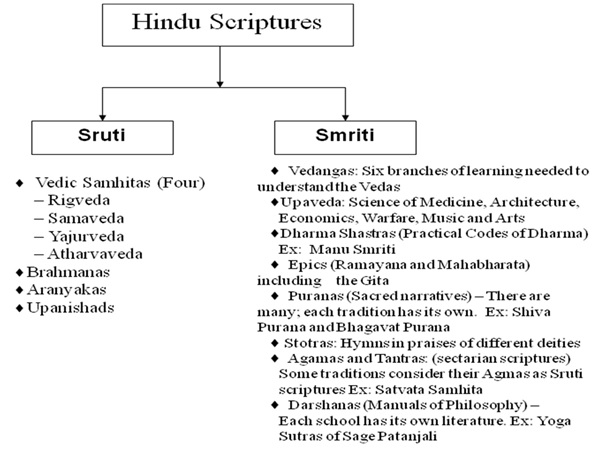
There are four Vedic texts: Rigveda, Yajurveda, Samaveda and Atharvaveda.  The Rig Veda Samhita is considered as the oldest of the four Veda. It has 1028 hymns in 10,500 verses approx. grouped in 10 chapters (mandalas). The Yajurveda Samhita is mainly prose work and is about two-third of the size of Rig Veda while the Sama and the Atharva Veda are each half the size of Rig Veda. Sama Veda borrows considerably from the Rig Veda while the Atharva Veda has no connection with sacrifices and instead addresses issues such as how to drive away diseases or how to ensure domestic harmony. It has 20 chapters or books and draws about one-fifth of Rig Veda (Raja, 2006)[5]. The other Vedas refer to the Rig Veda Samhita quite often and draw on it heavily.  Vedic mantras (aphorisms) are used right from conception till the death rituals. Each of these texts are further divided in four parts. The ‘Samhita’ or a collection of verses, and the ‘Brahmana’ or the prose that explains the meaning of the verses.  One section of the Brahmanas was called the Aranyakas and the other the Upanishads. Both deal with the esoteric portion of the Brahmanas. ‘Cosmological and metaphysical topics generally occupy a more central position in the Upanishad’ (Oliville, 1996: xxxii)[6].  The ritualistic part of the Samhita and Brahmana are called karma kand, the Aranyakas as upasana kand, or the meditational part, while the Upanishads are called as Jnana kand or the portion dealing with supreme knowledge.  To understand the Vedas, Vedanga texts were created consisting of phonetics (siksa), rituals (kalpa), grammer (vyakarana), etymology (nirukta), metre (chhandas) and astronomy (jyotisha).

Oliville (1996) provides a schema of the Vedic corpus as below:

Rigveda Yajurveda Samaveda Atharvaveda
  Black (Krishna) White (Shukla)
Samhita Rigveda Taittiriya, Kathaka Vajasaneyi Samaveda Atharvaveda
Brahmana Aitareya, Kausitaki, Sankhayana Taittiriya Satpatha Jaiminiya, Chandogya Gopatha
Aranyaka Aitareya,  Sankhayana Taittiriya
Upanishad Aitareya, Kausitaki Taittiriya, Svetaswatara, Katha Brihadaranyaka, Isa Jaiminiya, Chandogya, Kena Mundaka,Prasna,

Mandukya

Source: Olivelle, P. (1996) Upanishad, Oxford University Press, New York, pp xxxi,Ffig 1.


1.2 Upanishads

The word Upanishad literally means ‘sit down near’ the teacher. There are more than 200 Upanishads[7]. Dasgupta (1922)[8] provides a list of 112 Upanishads that are published. ‘The principal Upanishads are said to be ten. Samkara [Adi Shankaracharya] commented on eleven. Isa, Ken, Katha, Prasna, Mundaka, Mandukya, Taiattiriya, Aitareya, Chandogya, Brihad-aranyaka and Svetaswatara’ (Radhakrishnan, 1992:21)[9].  I provide a gist of the first 10 of these below. The other Upanishads to which Shankara refers to in his commentary on Brahma sutra, include Kausitaki, Jabala, Mahanarayana, and Paingala. Radhakrishnan (1992)[10] also includes Maitri Upanishad in this list and refers to these 15 as the principal Upanishads.

The Upanishads were composed since about 1,000 BCE to 1,400 CE (Olivelle, n.d.)[11]. They were passed on from one generation to the other by oral tradition. Several groups of students byhearted say Kena Upanishad and passed it on.  Similar was the case with other texts.  To facilitate such oral tradition, Sanskrit language was the best as it enabled conveying of meaning in a compressed form – in a few verses.  Though the authorship of the Upanishad is unknown some prominent sages associated with the Upanishads include Aruni, Yajnavalkya and Svetketu.

According to Olivelle (1996)[12], geographically, the Upanishads were compiled in North India in the region from the foothills of Himalaya to the Vindhya Mountain towards the South and from the upper Indus valley (west) to the lower Ganges (east) – mainly the states of Uttar Pradesh and Bihar.

After a general introduction of the Vedas and Upanishads, I now move to the contents thereof in section 2, thereafter in section 3, I consider the relevance of these texts for modern society and section 4 concludes.

  1. The Vedas and Upanishads (Shruti) : an overview

Hindu philosophy relies heavily on Sabdapramana (scriptural testimony) and even when it invokes other epistemological methods such as perception (pratyaksha) and inference (anumana) it defers to the Vedas (Adluri, 2014)[13].  Consequently, a study of the Shrutis becomes necessary to understand the platform on which the Hindu philosophical edifice has been built.

  • The metaphysical and theological ideas in the Vedas

The Veda provide two different perspectives for examining the Ultimate Reality: the phenomenal (everyday experience perceptible by the senses) and the transcendental (abstract or beyond sense perception).   ‘In the Vedas, the reality experienced at the transcendental level is called the Brahman’ (Nikhilanand, 2008:29)[14]. As per the Advait (non-dual) Vedanta strand of Hindu philosophy, the same Brahman when considered from the phenomenal perspective is called the Atman. At the level of Brahman, the same reality is experienced as unity (non-diverse, pure, universal consciousness). At the level of Atman, (individual consciousness), however, the diversity or difference is witnessed, and the worldly appearances become the reality. The Atman is conditional (conditioned, limited) while the Brahman is unconditional (unlimited).  The unlimited Brahman is called sat-chit-anand (existence, knowledge and bliss). But how does the unlimited, unconditional Brahman become limited and conditional? Bernard (1947)[15]notes that the weight of the yarn, on the spindle or in the rug woven from it, doesn’t change but what changes is merely the form (roopa) and the name (naam). Accordingly, the Vedic literature asserts that the unlimited doesn’t disappear but gets a form and label when encased in a body.  ‘The conditioned Brahman is called Ishwara (Nikhilanand, 2008)[16]. A realised soul attains the knowledge of the Atman and consequently sees unity everywhere at that level. When such a knowledge is absent (i.e. there is ignorance), one sees diversity and duality around. The central message of the Vedas is to focus on the Atman. To facilitate the realisation of the Atman, several meditational and Yoga practices have been suggested.

The Vedas occupy a central place in the life of a Hindu. The Mimansaka school holds the view that the purpose of Veda is to denote some karma or rite.  However, another school holds the view that the main purpose of Vedas is two-fold, namely, ‘the attainment of mundane welfare including heavenly enjoyments (abhyudaya) and the realisation of the supreme spiritual beatitude (nihsreyasa)’ (Sharvanand, 2006:185)[17]. The purpose of karma and upasana kand is to attain the first objective while that of the jnana kand is the later objective or the search for the transcended or the Ultimate Reality.

Aditi – the ‘Big Bang’ moment in the Veda

The pre-Vedic deities – Sun, Earth, Sky, Rain and Fire – were subsumed by the Infinite called Aditi or the mother of gods according to the Rig Veda.  Max Muller notes ‘Aditi, an ancient god or goddess, is in reality the earliest name invented to express the Infinite; not the Infinite as the result of a long process of abstract reasoning, but the visible Infinite, visible by the naked eye, the endless expanse, beyond the earth, beyond the clouds, beyond the sky’ (Max Muller, 1869:230)[18].  Aditi – the indivisible, unbroken, infinite, immanent Principal – was really the Big Bang moment of Sanatan Dharma contributed by the Vedic bards. The Rig Ved proclaims that ‘Aditi is the celestial sphere, Aditi is the intermediary space, Aditi is the mother, the father, the son, Aditi is all Gods, the five classes of beings, the created and again the cause of creation’ (Sharvanand, 2006:187)[19].

The concept of three planes or spheres and their respective deities

Another major contribution of the Rig Veda seers was the conception of three planes of the universe: dyuloka(uppermost or celestial plane), antarikshaloka (intermediary space) and the Bhurloka (terrestrial sphere). These spheres had three presiding deities, the Surya or Sun, Indra or Vayu and Agni or Fire respectively. Each of the deities had eleven sub deities in each sphere totalling thirty-three in total.  According to Satapatha Brahmana there are eight Vasus, eleven Rudra, twelve Adityas and Dyu (sky) and Earth.  Max Muller (1892)[20] notes that similar multiplicity of Gods is to be found in Greece and Rome but the polytheism in Hindu gods he describes as henotheism which refers to worship of one god but does not deny that there could be other gods. This is different from monotheism which asserts that there is one and only God and none other.  Judaism, Christianity and Islam believe in monotheism, yet conflicts abound between them and of them with other religions (Almond, 2017)[21].

The gods of the celestial sphere are Mitra (god of light) and Varuna (god of sky).  They are followed by Savitra or Surya – the giver of life, energy and wealth, and Vishnu – considered as the guardian of all and the founder of Dharma.  Max Muller (1869) notes that Vishnu signifies the rising, culmination and the setting of the Sun. Vishnu is the immanent and all-pervasive Principle. Accordingly, the all-pervasive nature got recognised in Rig Vedic time itself. Indra is the most important god of Rig Veda. His associate is Marut – the wind god and Indra are credited with killing a demon and facilitate fall of rain to renovate life on earth. Vayu is the prominent god of the intermediary (etherial) space while Agni (fire) is the god of the terrestrial sphere.

All these deities are but the manifestations of One god (Raja, 2006)[22]

Hiranyagarbha (Vishwakarma)

In their metaphysical pursuits, the Rishi (seers), considered that the cosmic Principle, manifested as Hiranyagarbha as the efficient cause of the universe. The Rig Veda asserts that the Hiranyagarbha arose from the water. The much later Greek conception of the creation of the universe is similar. The pre-creation situation was described by them as ‘chaos’.  Similar was the conception of the Egyptians. Accordingly, it was not a new beginning but rearrangement of things (Chowdhuri, 2008)[23]. Sharvanand (2006:194)[24]  ‘He who is the father of us all, the procreator, the great Providence. He who knows the whole universe. He is one yet assumes different names of gods, about him all people of the world become desirous to know’.

Param Purusha, Jivatma and Maya

The Rig Veda seers used three different methods – theological, metaphysical and psychological – to unravel the mysteries of the universe (Sharvanand, 2006). By theological method they realised intuitively that their god of worship was the transcendental impersonal Principal that underpins the whole universe. They called the cosmic being as Parama Purusha. In the hymns of ‘Hiranyagarbha and Viswakarman, the sages contemplated theistic [belief in One god] origin of creation. The Purusha -sukta, on the other hand, promulgates the pantheistic [material world is the manifestation of the transcendental reality] view of creation’ (Sharvanand, 2006:195).  The psychological approach to the ultimate problem taken by the Rig Veda involved reassuring the individual that the Atman is the very same Brahman and consequently indestructible. It asserts that the individual soul is deluded by the Maya. It must be noted here that at the transcendental level, there is only pure consciousness or Brahman or the Ultimate Reality, the Maya arises at the phenomenal level because of the ignorance about our true original nature.

Yajna

Yajna represent the ritualistic part of the Vedic tradition.  It is representative of the ‘entire cosmic process as the performance of a great sacrifice and believed that man’s spiritual nature can best be quickened if he tries to mould himself in consonance with that cosmic order’ (Sharvanand, 2006: 198)[25].  During Yajna, oblations are given to Agni (holy Fire) as Agni is regarded as the messenger (doot) that carries messages to all other gods (Raja, 2006)[26]. Typically, when a yajna (holy fire worship) is performed, four priests sit on the four sides of the Yajna Kund (altar) and each priest recites mantras from each of the Vedas. These rituals are the karma-kanda (Sharvanand, 2006)[27].

The concept of life and after life

The Vedic people had a very positive attitude towards life and offered prayers to the God for a happy life of one hundred years and beyond.  After death, it was believed that man goes to a higher world called the pitra-loka where the departed souls live. A prayer in Rig Veda puts this beautifully as below:

‘O, Pavamana, place me in the deathless undecaying world…. Make me immortal in that realm where dwells the King Vivaswana’s son… (Griffith, 1896:449)[28].

The concept of transmigration of the soul (samsara), is not explicitly mentioned in the Rig Veda but comes in later Upanishads but there is enough evidence to suggest that they knew about the transmigration of the soul (Raja, 2006)[29].

Rig Veda notes two paths which are taken by the soul: devayana and pitrayana. The former doesn’t involve any return while the latter does involve return to the physical world after enjoying the fruits of the good deeds of previous life.

The Karma and Jnana

The concepts Karma and Jnana first appear in the Rig Veda when the Veda explains the different outcomes that flow from these. “A careful study of Rig Veda shows that even in early times, Karma and Jnana, were recognised as two separate factors in the spiritual progress of man’ (Raja, 2006).[30] The Law of Karma is the single most important contribution of Hinduism to world philosophy. It provides the most logical explanation available so far, the problem of evil that has engaged attention of world scholars for many years. Berger (1967)[31], for example, asserts that the Karmasiddhanta of the Hindus is the most logical answer to the problem of divine-justice called theodicy (why good people suffer, and bad people enjoy). Harman (1976:287)[32] asserts ‘Unlike the Western theories…… the doctrine of rebirth is capable of meeting the major objections against which those Western attempts all failed’. The famous sociologist Max Weber (1947:359)[33] notes that Karma, ‘stands out by virtue of its consistency as well as by its extraordinary metaphysical achievements’.  Kaufman’s (2005)[34] criticism of Karma theory, has been rebutted by Chadha and Trakakis (2007)[35].

The concept of God in the Vedas

The Rig Veda is in poetic form. The hymns are mostly about the praise of deities such as Indra, Varuna, Mitra, and Agni to seek their help and favour. The nature was subject to basic underlying law to regulate all beings and other objects of nature. Though one could construe the many gods as polytheism, only the Supreme God was extolled. Interestingly, one could choose the Supreme God so that other gods became less important. Max Muller calls this ‘henotheism’. The Rig Veda proclaims ‘ekam sat vipra bahudha vadanti’ One reality is called by the wise in different ways’ (Chatterjee and Datta, 1984:352)[36] which clearly points to monotheism – belief in one god, one supreme consciousness or Principal. The idea that ‘names may be many and different but they all denote the same God occurs in Viswakarma sukta too’ (Tatwamayanand,2005:40)[37]. The concept of unity of God is to be found in the Purusha sukta where an organic unity of the whole universe (unity of godhead) is contemplated. ‘An inquiry into the one impersonal, attribute-less, form-less Principal behind all concepts of God occurs in Hiranyagarba Sukta….Shatpatha Brahmana and also in the Aitareya Brahmana’ (Tattwamatanand, 2005:40)[38].  It is also to be found in the Ishavasya and Taitareya Upanishad that assert that whatever is there in this world is permeated by Ishwara.

According to the Hindu concept then, God (the absolute Principle) is not only the creator, ruler but importantly also the in-dweller of all. This is where the concept of God of Abrahamic religions and Hinduism differs significantly. For Hindus, God is impersonal Principle but for Abrahamic religions it is a Personal God. For Hindus, God is in-dweller of all -not so in them. Furthermore, God in Hinduism takes the avatara (descents) into both human and animal form, not so in the Abrahamic religions. God is also conceived as a woman Aditi, Parvati, Lakshmi, Saraswati etc. not so in Abrahamic religions where it is a male god. “Hinduism is not theo-centric, in the usual sense, i.e. not based on Extra-Cosmic-Creator-God like the other western religions…in Hinduism God is an Expression or Cosmic Manifestation of the Supreme Infinite Spiritual Reality (Brahman)…He is not a Being in Heaven (Mukyanand,2000:20)[39]. The Varuna sukta of Rig Veda involves complete surrender to God and became the main principle of Vaishnavism. Here ‘the renunciation is Brahma and Brahma is the Supreme’ ((Tattwamatanand, 2005:42)[40].

The multiplicity of deities was intended perhaps to highlight the different natural forces that influenced human beings, the Rig Veda which recognised Aditi as the immanent Principal, further clarified categorically that divinity is One. Rukmani (2016:79)[41] notes ‘the ground-breaking contribution to religious and spiritual thought in the Rig Veda is the idea that the Ultimate Existence or the Truth is One and can be described variously by wise people ‘ekam sat vipra bahudha vadanti’. The Hamsavati hymn of Rig Vedaspecifically indicates that the same Principle ‘shines in the sky, in water, in light, in mountains and in Truth’ (Sharvanand, 2006:194)[42].  Accordingly, the Rig Veda recognised over 4,500 BCE that a single Principal, a universal cosmic force manifests itself in multiple ways. ‘Some of the Hindu philosophical systems are flatly atheistic… and in others God is only an ‘impersonal cosmic principle’ (Cooper, 2003:14)[43].  The Vedanta strand of philosophy calls this cosmic Principal, Brahman, which is an all-pervasive Spirit.  Similar thoughts were expressed by later Jewish and Christian religions. ‘What Judaism calls God, the Holy One whose spirit is in all of us, is called Brahman by the Hindus. Jesus Christ said, I am the life…… as life I exist in all beings…I and my father are one’ (Sarvagatanand, 2009:576)[44].

The Purusha sukta describes the Supreme consciousness with an allegory of a thousand-eyed and thousand-footed purusha. The lord of immortality who is wide spread. The animals as well as the four varnas are created out of this Purusha. ‘The Brahmin was his mouth, out of his two arms were made the kshyatriyas, his two thighs became the vaisyas and from his foot the sudras were born’ (Klostermaier, 2007:87)[45]. The Sukta considers ‘all existence-earth, heavens, planets, gods, living and non-living objects – is conceived here as the parts of one great person (Purusha) who pervades the world but also remains beyond it’ (Chatterjee and Datta, 1984:353) [46]. It is panentheism (all is in God) not pantheism (all is equal to God).

The Nasadiya Sukta further underlined the Vedic position of the Impersonal Absolute. The reality underlying it all can’t be described it says. The primal can’t be described. Roy Chowdhury (2008:308)[47] notes ‘the Vedic seers viewed creation not as a new beginning but as an arrangement and organisation of all that lay in chaos’. The Nasadiya sukta points to the Advaitic monism. ‘In this hymn all phenomena are traced to the one Principle which is beyond opposites like life and death, existence and non-existence, being and non-being, day and night… it is perhaps the most scientific description of the Ultimate Reality as well as the projection of the phenomenal world’ (Tatvamayanand, 2005:44)[48].

Yajur, Sama and Atharva Veda

‘The Yajur Veda and the Sama Veda are of little importance to a student of ancient Indian culture’ (Raja, 2006:209)[49].  An optimistic tone and material plenty at that time is apparent throughout.  The Atharva veda, however, seems to project a gloomy picture and handles issues such as black magic, injury to one’s enemy and other aspects of the present life.  The other three Vedas are more futuristic in their outlook. Yet the Atharva Veda contains much of the philosophical literature. ‘The three Vedas are not so intimately related to the problems of the Absolute as is the Atharva Veda’ (Raja, 2006:210)[50].

Notes

[1] ibid

[2] Idaho, (n.d) Upanishads Retrieved: http://www.webpages.uidaho.edu/~rfrey/PDF/116/116%20The%20Upanishads.pdf

[3] Dasgupta, S. (1922) A history of Indian philosophy, Cambridge University Press, Cambridge. UK.

[4] Naralikar, J. (2011) How Tilak dated the Vedas?Retrieved: https://bharatabharati.wordpress.com/2011/01/15/how-tilak-dated-the-vedas-jayant-v-narlikar/

[5] Raja, C.K. (2006) Vedic culture, in the Cultural Heritage of India vol. 1, The Ramakrishna Mission Institute of Culture, Kolkata.

[6] Olivelle, P. (1996) Upanishads, Oxford University Press, New York.

[7] Radhakrishnan, S. (1992) The Principal Upanishads, Humanity Books, New York.

[8] Dasgupta, S. (1922) op cit.

[9] Op. cit.

[10] Op. cit.

[11] Olivelle, P. (n.d) Upanishad, Retrieved: https://www.britannica.com/topic/Upanishad

[12] Olivelle, P. 1996. Ibid.

[13] Adluri, S. (2014) Sabdapramana as a theological category in Vedanta Desika’s Tattvamuktakalapa, The Journal of Hindu Studies, Oxford, 7, pp. 54-69.

[14] Nikhilanand, S. (2008) Hinduism, Sri Ramakrishna Math, Madras.

[15] Bernard, T. (1947) Hindu Philosophy, The Philosophical Library, New York.

[16] Op.cit.

[17] Op. cit.

[18] Max Muller, F. (1869) Rig Veda Samhita, Trubner & Co, London.

[19] Taittariya Samhita

[20] Max Muller, (1892) India: What it can teach us, Longmans, Green & Co, London. (Reprinted by Forgotten Books 2016). Lectures delivered at Cambridge University.

[21] Almond, P. (2017) In spite of their differences, Jews, Christians and Muslims worship the same God, Retrieved: https://theconversation.com/in-spite-of-their-differences-jews-christians-and-muslims-worship-the-same-god-83102

[22] Raja. CK. (2006) op cit

[23] Chowdhuri, R. (2008) Cosmological reflections in ancient Indian literature, Prabuddha Bharat, Adwait Asharam, Kolkata. vol 113 no. 5

[24] Sharvanand, S. (2006) op. cit.

[25] ibid

[26] Raja, CK. (2006) op.cit.

[27] Sharvanand, S. (2006) The Vedas and their religious teachings, The Cultural Heritage of India, The Ramakrishna Mission Institute of Culture, Kolkata.

[28] Griffith, G. (1896) The Hymns of Rig Veda, Griffith.PDF, Retrieved: http://www.sanskritweb.net/rigveda/griffith.pdf

[29] Raja, CK. (2006) op.cit.

[30] ibid

[31] Berger, P. (1967) The sacred canopy: Elements of a sociological theory of religion, Doubleday, New York.

[32] Herman, A. (1976) The problem of evil in Indian thought, Motilal Banarsidass, Delhi.

[33] Weber, Max (1947) Essays in sociology, translated by Gerth and Mills, K. Paul, Trench, Trubner, London.

[34] Kaufman, W. (2005) Karma, Rebirth and the Problem of Evil, Philosophy East and West, vol. 55, no. 1. pp. 15-32.

[35] Chadha, M. and N. Trakakis (2007) A response to Karma and the Problem of Evil: A response to Kaufman, Philosophy East and West, vol. 57, no. 4. pp. 533-556.

[36] Chatterjee, S. and Datta, D. (1984) An introduction to Indian philosophy, University of Calcutta. India

[37] Tatwamayanand, S. (2005) The concept of God in the Vedas, Prabhuddha Bharat, vol.110 no. 6. Advait Ashrama, Kolkata.

[38] Ibid

[39] Mukhyanand, S. (2000) Hinduism: the eternal dharma, Centre for Reshaping our world view, Calcutta.

[40] ibid

[41] Rukmani, T. (2016) Shakti, the supreme mother goddess in Hinduism, Prabuddha Bharat, Adwait Ashram, Kolkata, vol 121 (1), pp. 79-83.

[42] Sharvanand, S. (2006) ibid

[43] Cooper, D. (2003) World Philosophies: An historical introduction, Blackwell Publishing, USA.

[44] Sarvagatanand, S. (2009) Vedanta and the search for Truth, Prabuddha Bharat, Adwait Ashram, Kolkata. vol. 114, no 10.

[45] Klostermaier, K. (2007) A survey of Hinduism, State University of New York, New York.

[46] Chatterjee and Datta, 1984. op.cit.

[47] Roy Chowdhury, R. (2008) Cosmological reflections in the ancient Indian literature, Prabuddha Bharat,vol.113, no. 5, Advait Ashrama, Kolkata.

[48] Tatwamayanand, S. (2005) op cit

[49] ibid

[50] ibid

Featured Image: Double Excelsior

Disclaimer: The opinions expressed within this article are the personal opinions of the author. IndiaFacts does not assume any responsibility or liability for the accuracy, completeness, suitability, or validity of any information in this article.

Milind Sathye is an Australian academic.

Holy Books -Part 7

Vedāngas

These are six branches of learning whose knowledge is considered a pre-requisite to learning the Vedas. They are: Kalpa (ritual), Vyākaraṇa (grammar), shikshā (phonetics), Nirukta (Etymology), Jyotisha (astronomy) and Chhanda (Prosody)

Phonetics (Shikshās)

Shikshā is one of the six Vedangas, treating the traditional Hindu science of phonetics and phonology of Sanskrit.

Its aim is the teaching of the correct pronunciation of the Vedic hymns and mantras. The oldest phonetic textbooks are the Prātishākyas (prātiśākhya, a vrddhi abstract from Sanskrit prati-śākhā), describing pronunciation, intonation of Sanskrit, as well as the Sanskrit rules of sandhi (word combination), specific to individual schools or Shakhas of the Vedas.

The Prātishakhyas, which evolved from the more ancient padapāthas around c. 500 BCE, deal with the manner in which the Vedas are to be enunciated.

Eight Pratishākhyas are preserved today:

  • Rigveda-Prātishākya (Shākala shākhā), attributed to Shaunaka
  • ShuklaYajurveda-Prātishākhya
  • Taittiriya (Krishṇa Yajurveda) Prātishākhya
  • Sāmatantram. A portion of it is also called Aksharatantra, and is often taken to be a separate text.
  • Riktantram (Sāmaveda). A versified abridgment of this text called the Laghuriktantra also exists.
  • Pushpa Sūtra (Sāmaveda), also called the Phulla Sūtra
  • Atharvaveda-Prātishākhya (Shaunakīya shākhā)
  • Shaunakiya Chaturādhyāyīkā (Shaunakīya shākhā)

Several others known to exist till recent centuries have been lost. A manuscript of Maitrāyaṇīya Prātishākhya existed till a few decades back for instance. Likewise, the Bāshkala Prātishākhya belonging to Rigveda is found quoted in literature.

In addition, several other Shikshā texts are preserved, such as Vyāsa Shikshā, Yājnavalkya Shikshā, Panini Shikshā, Āpishali Shikshā, Māṇdukī Shikshā, Kauṇdinya Shikshā and so on.

Grammar (Vyākaraṇa)

Will be dealt in future articles.

Ritual (Kalpasūtras)

Kalpa Sūtras are systematic and practical, aphoristic treatises laying down the procedures for the performance of Vedic rituals for its adherents. The Kalpa sūtra are typically aligned to one of these recensions or Shākhās of the Vedas. For instance, the Baudhāyana texts are aligned with the Taittiriya Samhitā, Taittiriya Brāhmaṇa and the Taittiriya Āraṇyaka. So is the case with the sutras of Āpastamba, Bhāradvāja, Hiranyakeshin, Vaikhānasa and so on.

Types of the Kalpa Literature
1. Shrauta Sūtras: The Shrauta rituals are very complex Vedic rituals requiring the use of the 3 Vedic fires. They employ Vedic mantras in their liturgy and often require a team of specialist priests for their performance. The Shrauta Sūtras often form the core text of the entire Kalpa Sūtra, and the following Grhya Sūtra etc., presuppose their existence.
2. Grhya Sūtras: Deal with the domestic fire rituals. The Grhya rituals are comparatively simple, and can be performed by a householder without the aid of priests. They employ only one fire and their liturgy consists of collections of verses taken from various Vedic texts.
3. Dharma Sūtras: These are like the laws of Manu, being codes of conduct. The Dharma sūtras are manuals of ethical instruction. Unlike the Shrauta and the Grhya sūtras that restrict themselves to the parent Vedic school, the Dharma Sūtras are more general in their sphere of instruction. They cover the duties and the rights of people belonging to different stages of life and castes, contain instructions on ritual purity, morals, atonements for various sins, and the kārmic result of various sinful and virtuous actions and so on.
4. Shulvasutras: These are mathematical/geometrical treatises dealing with the construction of altars of various shapes and sizes for the performance of Vedic sacrifices. They are often included in the Shrauta Sūtras.
5. Pitrmedha Sūtras: Treatises on cremation of the dead. They lay down the correct procedure for the funeral ceremony, for adherence by the son or a close relative of the deceased person. Often included in the Shrauta Sūtras or appended to the Grhya Sūtras. The surviving texts in this class are those of Āpastamba (or Bhāradvāja), Baudhāyana, Gautama
6.Pravara sutras: List of various lineages, and clans and their progenitors of these clans and so on.
7. Other miscellaneous texts: Parishishtas, snāna sūtras and so on.
The following chart gives some of the major surviving Kalpasutras related to the different Vedas:

# Veda Shrauta Sutra Grihya Sutra Dharma Sutra Shulba Sutra
1 Rigveda Āshvalāyana, Shānkhāyana, Kaushitaki Āshvalāyana, Shānkhāyana Kaushitaki Vasishtha X
2 Sāmaveda Mashaka, Ārsheya, Lātyāyana, Drāhyāyana Nidāna, Pratihāra, Upanidāna, Anupada, Kalpānupada, Gāyatravidhāna, Jaiminiya Khādira Gobhila Gautama DrāhyāyanaJaiminiya Gautama X
3 Shukla Yajurveda Kātyāyana Pāraskara, Kātyāyana X Kātyāyana
4 Krishna Yajurveda Baudhāyana, Mānava, Hiraṇyakeshin, Vādhūla, Āpastamba,Vaikhānasa, Vārāha, Bhāradvāja Baudhāyana,Agniveshya, Mānava, Hirañyakeshin, Vādhūla, Āpastamba,

Kathaka (Laugakshi)

Vaikhānasa,

Vārāha

Kapishthala

Bhāradvāja

Baudhāyana, Hirañyakeshin, Āpastamba,Haarita

Vaikhānasa, Vishṇu

Baudhāyana, Mānava, Hirañyakeshin, Vādhūla, Āpastamba, MaitrāyaṇīyaVarāha
5 Atharvaveda Vaitāna KaushikaShanti Kalpa

Nakshatra Kalpa, Āngirasa Kalpa

X X

Many of these Kalpa Sūtras have commentaries written on them by later scholars, and therefore form a vast literature in themselves.

Jyotisha (Astronomy)

Unlike later texts on Jyotisha which deal mainly with Astrology, the Vedanga texts of Jyotisha deal with astronomy. The division of time in smaller units, planetary motions and positions and so on were of vital importance to plan and execute Vedic rituals per a pre-determined schedule and per the proper procedure. The Rigveda and Yajurveda have a Vedānga Jyotisha authored by Rishi Lagadha whereas the Atharvaveda Jyotisha is authored by Rishi Kashyapa. In later times, the astrology aspect of Jyotisha became a very popular tradition in the Hindu society and dozens of texts belong to astrology exist. However, texts on astrology do not strictly fall within the Vedānga category and should be studied separately because they do not have any direct Vedic connection.

Nirukta (Etymology)

This Vedānga deals with derivation and etymology of Vedic words and supplements Grammar. It comprises of a lexicon called Nighantu and a commentary on it by Rishi Yāska called the Nirukta. In the tradition of Atharvaveda, a Kautsavya Nirukta also survives. Many older works in this category by Shākapūṇi, Upamanyu etc., have not survived but are found quoted in existing works.

Chhanda (Prosody)

Much of Vedic Samhitas comprise of verses that have a fixed number of syllables arranged in particular order. The oldest surviving work on Vedic Meter is by Pingala Muni, who is said to be the younger brother of the great grammarian Panini. This subject matter is also dealt with in several ancient surviving works such as the Chhandovichiti of Patanjali and the Rik-Prātishākhya of Shaunaka.

The main principle of Vedic meter is measurement by the number of syllables. The metrical unit of verse is the pada (“foot”), generally of eight, eleven, or twelve syllables; these are termed gāyatrī, trishtubh and jagatī respectively, after meters of the same name. A Richa is a stanza of typically three or four padas, with a range of two to seven found in the corpus of Vedic poetry. Stanzas may mix padas of different lengths, and strophes of two or three stanzas (respectively, pragātha and tricha) are common.

In the Indian tradition, it is customary to know three things about each mantra : The devatā (deity), the Rishi (the speaker) and the Chhanda (the poetical meter). It is forbidden to study the Vedas without knowing these 3 things about the mantras. All good editions of the Vedas explicitly list these 3 for each mantra at the beginning of each chapter, sūkta (hymn) and so on. Many of the meters of the Vedic verses (like Ushnika, Gayatri, Jagati etc.) are actually mentioned in some mantras of the Rigveda, Atharvaveda etc., implying that knowledge of prosody was presumed by the Rishis of these mantras.

Each Veda also has traditionally a sequential list/tabulation of meters for all verses called the Chhando’anukramaṇī. The Chhando’anukramaṇī of RV is written by Sage Shaunaka. It was later incorporated into a more general Anukramaṇī (list) by Kātyāyana who is placed at 4th to 2nd Cent. BCE. The Chhando’anukramaṇī of Atharvaveda is a part of the ‘Brihatsarvanukramaṇi’ which is an undateable text but very old nevertheless. The Chhando’anukramaṇī of Samaveda is so old that it is accorded the rank of a ‘Brāhmaṇa’ (scriptural cannon) text.

Upavedas

The term Upaveda (“applied knowledge”) is used in traditional literature to designate the subjects of certain technical works.  Lists of what subjects are included in this class differ among sources. A commonly accepted list is as –

  1. Medicine (Āyurveda), associated with the Rigveda. The major texts of this Upaveda are Charaka Samhitā, Sushruta Samhita, Bhela Samhitā, Hārita Samhitā and Kāshyapa Samhitā. But Sushruta Samhitā and Bhāvaprakāshamention Āyurveda as an Upaveda of the Atharvaveda.
  2. Military Science (Dhanurveda), associated with the Yajurveda. The main surviving texts are Nītiprakāshikā of Vaishampāyana, Dhanurveda of Vashishtha and Īshvara Samhitā of Shiva.
  3. Music and sacred dance (Gāndharvaveda), associated with the Sāmaveda
  4. Arthashāstra (Economics), associated with the Atharvaveda.  The Arthashāstra of Kautilya is the oldest surviving text in this genre. The Arthasūtras of Brihaspati and some other later texts also survive, but the original texts of Indra etc., are considered lost.
  5. Sometimes, the Shilpa-Sthāpatya Veda (dealing with architecture and construction) is also considered as the fourth Upaveda attached to the Atharvaveda. Several texts survive in this class – Mayamatam, Vāstuvidyā of Vishvakarma etc.

It may be noted that whereas the Vedas and their allied literature focus more on Dharma and Moksha amongst the 4 Purushārthas, the Upavedas focus more on the Artha and Kāma Purushārthas.


Featured Image: YouTube

Disclaimer: The opinions expressed within this article are the personal opinions of the author. IndiaFacts does not assume any responsibility or liability for the accuracy, completeness, suitability, or validity of any information in this article.
vs@gmail.in'

Vishal Agarwal is an independent scholar residing in Minneapolis (USA) with his wife, two children and a dog. He has authored one book and over fifteen book chapters and papers, some in peer reviewed journals, about ancient India and Hinduism. He and his wife founded the largest weekend school teaching Hinduism to students, and also a teenager organization to keep them engaged in Dharma. Vishal has participated in numerous interfaith forums, and has represented Hindus and Indians in school classrooms and in seminars. Vishal is the recipient of the Hindu American Foundation’s Dharma Seva Award (2010), the Global Hindu Academy’s Scholar award (2014) and service awards from the Hindu Society of Minnesota (2014 and 2015). He is very strongly engaged in the social and Dharmic activities of the Indian and Hindu communities of Minnesota, and has authored a series of ten textbooks for use in weekend Hindu schools by children from the ages 4-14. Professionally, Vishal is a biomedical Engineer with graduate degrees in Materials Engineering and Business Administration (MBA). His scientific and statistical training enables him to bring precision and a high level of rigor in his research – qualities that are very often missing in contemporary publications on Indology and in South Asian Studies.

Holy Books -Part 6

The Vedas or Shruti

Importance of the Vedas

As explained above, the Vedas are considered the supreme scriptures, or the gold-standard by most Hindus. The word ‘Veda’ is often derived from 5 Sanskrit roots these days:

  • Vid jnaane: To know
  • Vid sattaayaam: To be, to endure
  • Vid labhe: To obtain
  • Vid vichaarane: To consider
  • Vid chetanaakhyaananiveseshu: To feel, to tell, to dwell

To these roots is added the suffix ‘ghaw’ according to Ashtādhyāyī 3.3.19, the celebrated text of Sanskrit grammar of Panini. Accordingly, the word Veda means ‘the means by which, or in which all persons know, acquire mastery in, deliberate over the various lores or live or subsist upon them.’

Traditionally, the Vedic literature as such signifies a vast body of sacred and esoteric knowledge concerning eternal spiritual truths revealed to sages (Rishis) during intense meditation. They have been accorded the position of revealed scriptures and are revered in Hindu religious tradition. Over the millennia the Vedas have been handed over generation to generation by oral tradition and hence the name “shruti” or “that which is heard”. According to tradition they are un-authored (apaurusheya) and eternal, and are considered the revelation of God to the Rishis. This is the other reason for calling them Shruti.

Theoretically, the Vedic corpus is held in deep reverence in the Hindu society. It constitutes the most authoritative genre of Hindu scriptures. Any other Hindu scripture must agree with the Vedas in order to be considered an authority. Schools of philosophy which reject the authority of the Vedas are considered ‘Naastika’ or heretical, while schools which accept Vedic authority, even if nominally, are considered ‘Aastika’ or orthodox, from a Hindu perspective. While most Hindus never see Vedic texts in their lifetime, the term ‘Veda’ is used as a synonym for authoritativeness in religious matters. The Vedas are considered full of all kinds of knowledge, and an infallible guide for man in his quest for the four goals – Dharma, Artha(material welfare), Kāma (pleasure and happiness) and Moksha (Salvation). In sacred Hindu literature, they are considered the very manifestation of God, and the ultimate source of all wisdom and of all Dharma.

Hindu priests were exhorted to study them regularly, recite their sentences, practice their sacraments and memorize their words. In practice however, this has been restricted to a dwindling minority of the Brāhmaṇa caste, despite recent attempts to revive Vedic study, ritual and recitation in the traditional manner. On the other hand, the Vedic texts are now widely available in print, and this has lead to a greater dissemination of their knowledge amongst Hindu masses, than say, a century back. Even here however, the popularization largely concerns the spiritual treatises called the Upanishads – the texts par excellence of Hindu spirituality. In fact, for several centuries now, the word ‘Veda’ has been used by Hindu teachers to indicate the Upanishadic texts in particular.

How Were the Vedas Revealed?

According to Hindu tradition, Bhagavān Brahmā created the Universe and then revealed the four Vedas to numerous Rishis at the beginning of this creation. Since then, an unbroken chain of students and teachers have been transmitting the Vedas down to our time. The four faces of Brahmā represent these four Vedas as well as the four directions.

Svādhyāya-6 VedasThe Vedas are also associated with his consort Devi Sarasvati, who is the Devi of all wisdom and knowledge.

The Vedas however are not the creation or composition of the Brahmā because they are eternal. Bhagavān Brahmā is merely their caretaker of this Divine knowledge, which really belongs to the Supreme Being (Brahman). However, Brahmā also composed some original works, which initiated many other branches of Hindu knowledge – like Ayurveda, Dharmashāstras etc. All these works whose tradition started from the original compositions of Brahmā are called Smritis; whereas the Vedas which were revealed by Brahmā but not authored by him are called Shruti (‘that which are heard from Brahman’).

As time progressed, the capacity of human beings to study scriptures declined. Sometimes, the Vedas even got lost. Therefore, a Rishi appeared periodically to re-arrange them and even rediscover them. The current version of the four Vedas is said to have been given their present form by Rishi Veda Vyasa, who was the son of Rishi Parāshara, and a fisherwoman named Satyavatī. Veda Vyāsa then taught the Rigveda, Yajurveda, Samaveda and Atharvaveda to his four students: Rishi Paila, Rishi Vaishampāyana, Rishi Jaimini and Rishi Sumantu respectively. They in turn taught them to numerous disciples and so on, leading to slightly differing versions of the four Vedas. These versions are known by the names of the last Rishis after whom no other modifications were made to the texts of the Vedas.

However, another viewpoint is that hundreds of very ancient Rishis (mainly on the banks of the river Sarasvati which dried out by 1500 BCE or even earlier) received the hymns and sections of the four Vedas from Brahman. Brahmā has no role to play in this viewpoint. A big chunk of these revelations were lost with time, and Veda Vyāsa compiled whatever remained, to preserve it for posterity. Even the existing Vedic literature is 6 times the length of the Bible, and is much older!

There is a third, modern viewpoint proposed by Swami Dayanand Saraswati (1824-1873 CE). According to this view, the Supreme Being revealed the four Vedas respectively to Rishis Agni (Rigveda), Vāyu (Yajurveda), Āditya (Samaveda) and Angirasa (Atharvaveda).

Several modern scholars have proposed different dates for the Vedas:[1]

  • Tilak       4000 – 2500 BCE
  • Jacobi    4000 BCE
  • Wilson  3500 BCE
  • Hough   2500 – 1400 BCE
  • R C Dutt 2000 – 1400 BCE
  • Roth      1000 BCE
  • Max Mueller 1500 – 1200 BCE

Classification of the Vedic Scriptures

The Vedas are four in number – Rigveda, Yajurveda, Sāmaveda and Atharvaveda. According to tradition, each Veda can be divided into two parts – Mantras and Brāhmaṇas. A collection of Mantras is typically called a Samhitā, although they can also occur in the Brāhmaṇa texts. Currently, and often in ancient Hindu tradition as well, it is often the Samhita portion alone which is referred to as the Veda. For instance, the word ‘Rigveda’ would typically mean the Rigveda Samhitā. The Ārya Samāj school of Hindus, responsible for the modern revival of Vedic study in northern India, and founded by Swami Dayanand Saraswati in 1875 CE, in fact rejects the Brāhmaṇas as portions of Vedas. For them, the Vedas include only the four Samhitās – Rigveda Samhitā( Shākala version), Atharvaveda Samhitā (in its Shaunaka version), Yajurveda Samhitā (Mādhyandina version) and the Sāmaveda (Kauthuma version). All other Samhitās and the rest of the Vedic literature is considered by them to be outside the Veda proper.

The Brāhmaṇas have their own names and are more like theological treatises of the Vedas. The ending portions of many Brahmanas have an esoteric content, called the ‘Āraṇyaka’. Embedded in these Āraṇyakas, or normally at their very end, are deeply spiritual treatises called the ‘Upanishads’. For several centuries now, Upanishads are the mainstay of Hindu spiritual traditions, and are held in the highest esteem.

In the case of the Rigveda, Samaveda and the Atharvaveda, there is a clear-cut separation of the Mantra collection from the Brahmana portions. In contrast, the Yajurveda is of two types: Shukla (or ‘white’) Yajurveda and Krishna (or black) Yajurveda. In the former, the Mantra and Brāhmaṇa collections occur separately from each other. But in the latter, the Mantra and the Brāhmaṇa portions are intermixed. Thus, the Taittiriya ‘Samhitā’ belonging to the Krishna Yajurveda has Mantras interspersed with Brahmana portions. Even the Taittiriya ‘Brahmana’ has both Mantras and Brāhmaṇa passages mixed with each other.

Coming to the Brāhmaṇa texts, there is often no clear-cut distinction between the Brāhmaṇas proper and the Āraṇyakas, or between the Āraṇyakas and the Upanishads. The Brāhmaṇa text proper often merges into the Āraṇyakas and many old Upanishads are actually embedded in the Āraṇyakas.

There are a few exceptions even to the above generalizations on the internal distinctions in the Vedic texts.

What are Mantras? What are Samhitās?

The mantras are basically hymns sung to the Devas or Deities – the devotional outpourings of the souls of poets. The Samhitās of the four Vedas were compiled for the smooth performance of Vedic ceremonies. Four types of priests are needed to perform a Vedic sacrifice:

  • The Hotr priest who sings hymns to Gods inviting them to preside over the sacrifice.
  • The Udgātā priest who sings sweet hymns in musical tones for the entertainment of the Gods
  • The Adhvaryu priest who performs the sacrifice according to strict ritualistic code and makes the offering to the Gods
  • The Brahmā priest well versed in all the Vedas who supervises the sacrifice.

The four Samhitas are said to have been compiled to fulfill the needs of these four main priests: Rk-Samhita for the Hotr, Sama-Samhita for the Udgātā, Yajurveda Samhita for the Adhvaryu and the Atharvaveda Samhita for the Brahma priest. Initially however, there was no special connection of the Brahmā priest with the Atharvaveda, as this Veda was and is not as closely integrated with Vedic ritual as the other three Vedas are.

 Mantras are basically of 3 major types, when classified according to their physical form: Riks, Yajus and Sāmans. Riks are versified mantras. Yajus are prose mantras whereas Sāmans are melodies set on Rk.

  • The Rigveda is so called because it is comprised of Riks.
  • The Yajurveda is so called because it is composed predominantly of prose mantras (Yajus) although it has hundreds of Riks as well. However, even the Riks in Yajurveda are recited as if they were prose passages.
  • The Sāmaveda Samhitā is composed of melodies called Sāmans, and also the underlying Riks which are set to these melodies.
  • The Atharvaveda is comprised of Riks (5/6 portion) as well as Yajus (1/6). Some adept Vedic scholars can set even the mantras of Atharvaveda to melodies.

In many ways, the Samhitā of the Rigveda constitutes the basis of other Samhitās. Not only is it the most ancient Vedic text, it also contributes hundreds of verses to the other Samhitās. The poetical beauty of the Rigveda and the depth of its meaning are described in the following words by a modern scholar:

“The fact that the verses of the Vedas are poetic in form and liturgical in function warns us against trying to reduce them to strictly rational forms or literal meanings. This sacred wisdom goes far beyond mere intellectual knowledge; it is the wisdom heard and felt in the hearts of the great seers and expressed by them in poem and song so that it might resound in the hearts of all people, awakening them to the tremendousness, mysteriousness, and joy of their own being as they participate in cosmic creation.”[2]

Theoretically, the Mantras have a higher authority than the Brahmanas.

What are the Brāhmaṇas?

The word ‘Brāhmaṇas’ means ‘through which we can know Brahma’, where ‘Brahma’ is another name for the Vedas. Therefore, the Brāhmaṇas are texts which expound the Vedic mantras and Vedic ritual ceremonies (Yajñas). These scriptures are characterized by statements of eulogy, censure, exposition and (ritual) application (of mantras). Many scholars, modern and ancient, have tried to define the Brāhmaṇas by stating their characteristics. The reality however is that there is no sharp difference in the characteristics of the Mantra and the Brahmana portions of the Vedas. The only thing that we may state safely is this – Mantras are those portions of the Vedas that are designated as such traditionally. And the rest is Brāhmaṇa.

Unlike the mantras, which are mostly in verse, the Brāhmaṇas are predominantly prose. The Brāhmaṇas contain formulas for rituals, rules and regulations for rites and sacrifices and also outline other religious duties. The formulas and rules for conducting extremely complex rituals are explained to the minutest detail. And every ritual is performed for a specific purpose for which a specific effect/benefit is expected. It was felt that there was nothing that could not be achieved by sacrifices – the sun could be stopped from rising and Indra, the chief of Deities, could be deposed from his throne. The duties of men professing different occupations, the eternity of the Veda, popular customs, cosmogony, historical details, and praise of ancient heroes are some other subjects dealt with in the Brāhmaṇas.

What are Āraṇyakas? [3]

The Brāhmaṇas which deal predominantly with Vedic Yajnas fade gradually into more spiritual treatises called the Āraṇyakas. These scriptures contain several techniques of meditation and they explain the esoteric and mystical meanings of Yajñas. In short, the symbolic and spiritual aspects of the Vedic religion are meditated upon in the Ārañyakas.

The word Āraṇyaka means “belonging to the wilderness” that is, as Taittiriya  Āraṇyakas says, “from where one cannot see the roofs of the settlement”. According to some scholars, the other reason for their name is that this portion of the Vedas was the primary focus of study during the ‘Vānaprastha’ (forest hermit) state of one’s life, when the person retired from active life in his old age to lead a sedentary lifestyle devoted to study of scriptures and performance of specific Vedic Yajñas.

Āraṇyakas are also called ‘Rahasya-Brāhmaṇa’ or the secret portion of the Brāhmaṇas. The Āraṇyakas are ‘secret’ in the sense that

  1. They are restricted to a particular class of rituals that nevertheless were frequently included in the Vedic curriculum that was primarily conveyed individually from teacher to student.
  2. They convey the non-apparent spiritual meanings of the Vedic ceremonies.

The Āraṇyakas are associated with and named after individual Vedic shākhās or branches.

  1. Aitareya Āraṇyaka belongs to the Shākala Shākhā of Rigveda
  2. Kaushitakī Āraṇyaka belongs to the Kaushitakī and Shānkhāyana Shākhās of Rigveda
  3. Taittiriya Āraṇyaka belongs to the Taittiriya Shākhā of Krishna-Yajurveda
  4. Maitrayaniya Āraṇyaka belongs to the Maitrayaniya Shākhā of Krishna-Yajurveda
  5. Katha Āraṇyaka belongs to the (Charaka) Katha Shākhā of the Krishna-Yajurveda. Only fragments of it survive and are being still published.
  6. Brihad- Āraṇyaka in the Mādhyandina and the Kāṇva versions. The Mādhyandina version has 8 sections, of which the last 6 are the Brihadarāṇyaka Upanishad.
  7. Talavakāra Āraṇyaka or Jaiminiya Upanisadbrāhmaṇa belongs to the Talavakāra or Jaiminiya Shākhā of Sāmaveda.
  8. The first three of the eight chapters of the Chhāndogya Upanishad have the nature of a Āraṇyaka.
  9. Āraṇyaka Samhitā The Pūrvārchika of the Sāmaveda Samhitās have a section called the ‘Āraṇyaka Samhita’ on which the Āranyagāna Sāmans are sung.
  10. The Atharvaveda has no surviving Āraṇyaka, though one may regard the Gopatha Brāhmaṇa as its Āraṇyaka, a remnant of a larger Atharva (Paippalāda) Brāhmaṇa.

What are the Upanishads?

The Vedas have highly philosophical portions called the Upanishads, that form the bedrock of Hindu spirituality and theology. The Upanishads typically occur towards the end of the corpus of their respective Vedic Shakha and therefore they are often also called ‘Vedānta’. For example, the Taittiriya Shākhā of Yajurveda is arranged in the following manner: Taittiriya Samhita, Taittiriya Brāhmaṇa and Taittiriya Āraṇyaka. The last 4 of the 10 chapters of the Taittiriya Āraṇyaka comprise the Taittiriya and the Mahānārāyaṇa Upanishads. The presence of the Upanishads towards the end of their respective Vedic corpus indicates that they represent the final conclusion (Siddhānta) of the Veda. This is another reason why they are called Vedanta (Veda + Siddhānta).

Traditionally, the 10 Upanishads on which Ādi Shankarāchārya wrote his commentary are considered the major Upanishads. These 10 Upanishads are:

  • Aitareya Upanishad belonging to the Rigveda
  • Ishāvāsya and Brihadāraṇyaka Upanishad belonging to the Shukla Yajurveda
  • Taittiriya and Katha Upanishads belonging to the Krishna Yajurveda
  • Chhāndogya and Kena Upanishads belonging to the Sāmaveda
  • Muṇdaka, Māṇdukya and Prashna Upanishads belonging to the Atharvaveda.

In addition, the following Upanishads are also considered very ancient and authoritative:

  • Kaushitaki Upanishad belonging to the Rigveda
  • Mahānārāyaṇa, Kaivalya, Shvetashāvatara and Maitrāyaṇīya Upanishad belonging to the Krishna Yajurveda

Tradition lists 108 Upanishads as the major Upanishads, and close to 200 Upanishads survive. However, the above 15 Upanishads and some others (such as Nīlarudra, Chhāgaleya, Ārsheya, Shaunaka, Bāshkalamantra) alone are the ancient Upanishads. Several portions of the Samhitā proper (e.g., the Brahmasūkta of the Atharvaveda), Brāhmaṇa proper (e.g., the first few sections of the Jaiminiya Brāhmaṇa or the Agnirahasya portion of the Shatapatha Brāhmaṇa) and Āraṇyakas (e.g., Chapters 9-10, 14-15 of the Shānkhāyana Āraṇyaka) are also similar to Upanishads.

Many of the newer Upanishads propound doctrines related to Sannyāsa, Yoga, Sāmkhya, Vaishnavism, Shaivism, and Shāktism, worship of Gaṇapati and also summaries and expositions of the newer school of Vedānta such as Advaita Vedānta. Such sectarian Upanishads have been utilized to the hilt by later Hindu teachers to provide the Shruti based ‘proof’ that their sectarian ways are exalted above the other sectarian ways. While doing so, they quote the Upanishads selectively but never reject the other Upanishadic texts directly or indirectly since the Shruti cannot be rejected at all. For example, the Vaishnava Vedantists quote the Nārāyaṇa Upanishad and similar Upanishads profusely to prove that Lord Vishnu is the Supreme Lord and all other Deities are lesser, explaining away the Shaivite Atharvashīrsha Upanishad. The Shaivite Vedantists do the opposite.

“…Some have referred to the Upanisads as the ‘philosophical’ section of the Vedas. If by ‘philosophical’ one understands a systematic, coherent body of knowledge derived from inferential argument based on an analysis of experience, then these ancient texts are not ‘philosophical.’ In that case, one cannot criticize them for having a plurality of views that are not always mutually compatible, for being mystical and therefore non-rational in places, or for being didactic, that is, bent on teaching and instruction. The nature of philosophy in the modern Western sense is to be a form of public knowledge, its rational credentials available to the scrutiny of all. But the Upanisads, which ask questions and offer answers on the prigins of the universe and the production of being, on the nature of human existence and its goals, the relationship between beings and the source of being etc., attempt this task by continuing the Vedic tradition of private instruction based on personal initiation and passed down from teacher to disciple, by exploring perceived hidden correspondences between the human microcosm and the cosmic macrocosm, by plumbing the depths and searching the heights of conscious experience, by interiorizing the solemn ritual still further and understanding the role of speech and speech acts in this process, by giving instruction about the good life, by offering teaching about the mystery of death and the after-life, by trying to unify inner and outer being. They are a plural and pluralistic exercise in solving the conundrum of existence for the initiated; they are not systematic philosophical treatises. Nor can they be described as ‘speculative’ as is sometimes asserted; at least not from their point of view. They generally profess to give accredited insights based on experience and inquiry (whether one accept these or not); they do not claim to be guesswork. This is one reason why they exerted, and still exert, an unparalleled authority among large sections of the Hindu tradition, once their secretive teachings were recorded for posterity and opened up to increasingly wider public.”[4]

Oral Nature of Vedic Scriptures

Svādhyāya-6 02 OralThe Vedic texts were traditionally transmitted orally (or at least predominantly without the aid of manuscripts, which might have been used sparingly as memory aids). This was essential because the texts were ‘accented’, or in other words the different words or letters therein were recited according to different pitch/tones. Very elaborate mnemonic devices were developed to preserve the texts with great fidelity, and harsh Divine vengeance and evil repercussions were promised to those who deformed or mutilated the text in any manner. As a result, several Vedic texts were indeed transmitted over several millennia with utmost fidelity, together with accent. It took several years for a student to memorize one or more Vedic texts, word for word, letter for letter, with the correct accent, under the personal supervision of a competent teacher. The texts that are used for aiding the memorization and recitation of the Vedas with utmost fidelity, are called ‘Lakshaṇa Granthas’. These texts include Anukramaṇīs, Padapāthas, Ghanapāthas, Kramapātha and other Vikrtis or modifications of the root text, phonetic treatises like Shikshās and Prātishākhyas and so on.

Svādhyāya-6 03 Rig Veda Accent

In some cases however, the accents were lost with time and the texts had to be recited without the Vedic accents. This is called the ‘ekashruti’ mode of recitation. A prime example of such a text is the Paippalāda Samhitā of the Atharvaveda. Similarly, Bhatta Kumārila (circa 650 CE) notes that the Brāhmaṇas of Samaveda had lost their accents even in his times and were recited without them.

Notes

[1] Sharma (2000), p. 204

[2] Koller, p. 21

[3] Reference: http://en.wikipedia.org/wiki/Aranyaka

[4] Lipner (2010), p. 52

Featured Image: Wikipedia

Disclaimer: The opinions expressed within this article are the personal opinions of the author. IndiaFacts does not assume any responsibility or liability for the accuracy, completeness, suitability, or validity of any information in this article.
vs@gmail.in'

Vishal Agarwal is an independent scholar residing in Minneapolis (USA) with his wife, two children and a dog. He has authored one book and over fifteen book chapters and papers, some in peer reviewed journals, about ancient India and Hinduism. He and his wife founded the largest weekend school teaching Hinduism to students, and also a teenager organization to keep them engaged in Dharma. Vishal has participated in numerous interfaith forums, and has represented Hindus and Indians in school classrooms and in seminars. Vishal is the recipient of the Hindu American Foundation’s Dharma Seva Award (2010), the Global Hindu Academy’s Scholar award (2014) and service awards from the Hindu Society of Minnesota (2014 and 2015). He is very strongly engaged in the social and Dharmic activities of the Indian and Hindu communities of Minnesota, and has authored a series of ten textbooks for use in weekend Hindu schools by children from the ages 4-14. Professionally, Vishal is a biomedical Engineer with graduate degrees in Materials Engineering and Business Administration (MBA). His scientific and statistical training enables him to bring precision and a high level of rigor in his research – qualities that are very often missing in contemporary publications on Indology and in South Asian Studies.

HOLY BOOKS- part 5

Hindu Scriptures and the Proverbial Hindu Tolerance: Interfaith Perspectives

Hindu Dharma is not a ‘One Book, One Prophet, One God’ religion. The very fact that there are thousands of sacred books within our own tradition, and that thousands are Saints and Sages are associated with revealing and compiling them has made Hindus take it for granted that diversity of scriptures is a fact of nature. The existence of so large a number of scriptures within our own tradition makes it easier for Hindus to accept that religious traditions outside our own also have their own scriptures, and that these non-Hindu scriptures are also worthy of study, respect and reverence.

Hindu Dharma encourages us not just to get a well-rounded knowledge of all our scriptures (or as many as possible), but also study the Holy Books of other religions with respect. A scripture which says that it is itself is ‘the only true book’ and everything else is not worthy of study and respect is actually the product of the limited spiritual vision and world view of its author. This is why Hindus have not indulged in bouts of burning and destroying books of other religions. In contrast, the followers of ‘One Book, One Religion, Last/One Prophet, One God’ faiths have frequently burned the scriptures of other religions and continue to cause bloodshed and destruction even in our own times.

Instead of telling us to prove ourselves different from other peoples so that we can set ‘up our own prophetable shop’ for potential customers, Hindu Dharma advises us to look for common spiritual themes or the common essence of all these diverse scriptures. Therefore, instead of seeing these different holy books as disconnected and discrete pieces of knowledge, we should seek their underlying higher teachings.  For example, the Upanishad says:

Truth is One, but the realized Poets with spiritual vision describe it in many different ways. Rigveda 1.164.46

Cows are of different colors but their milk is the same color. Similarly, (the wise person) regards spiritual wisdom as the milk and the many branched Vedas as different cows. Amritabindu Upanishad 19

Just as the bee extracts the essence from several flowers (to make the nectar like honey), a clever man should also take the essence from all sources and scriptures, whether they are short or long. Bhāgavata Purāņa 11.8.10


This does not mean however that Hindus should accept any writing considered as sacred by any community as a holy scripture. The rule still remains that the Vedas are the golden standard by which all other scriptures are judged. Unfortunately, Hindus have carried the spirit of inclusivism and acceptance of diversity to such an extreme that they have ceased to see the genuine differences in the doctrines of different religions, and also fail to see the faults in various religious scriptures. Likewise, they have also started assuming that the Prophets and Saints of all religions were also spiritually realized souls in the Vedāntic and Yogic mold of Hindu tradition. However, when we actually read the sacred texts of other religions, and study the biographies of prophets and saints, the results are not always flattering. In fact, the Hindu tendency to see all faiths through their own spiritual viewpoint is patronizing and insulting to other faiths, whose followers openly reject the Hindu interpretations of their own doctrines which they have understood in a different manner traditionally. Therefore, instead of considering scriptures and important figures of all religions as equal, Hindus ought to use ‘viveka’ and try to discriminate between what is false, and what is true.

Classification of Hindu Scriptures

The two major categories in which all Hindu scriptures are divided are the Shruti and the Smriti.

Shruti: The Vedas constitute the Shruti, a word that means ‘that which has been heard (from God) by the Rishis’ and are considered of Divine origin[1]. The principles of Dharma that are taught in the Vedas are called the ‘Vaidika Dharma’ or ‘Shrauta Dharma’ and are considered to be infallible (without error), universal and eternal.

Smriti: The word Smriti word literally means ‘that which is remembered’. Human culture advances when the collected wisdom of the society is passed on from one generation to another (‘societal memory’), and each new generation adds to its inherited wisdom.

Whereas Shruti is considered of Divine origin or inspiration, Smriti is considered the wisdom of Saints and Sages who were pious, virtuous and had understood the Vedas. It is believed that the teachings of Smritis are derived from the Vedas itself. The Hindu tradition says that although the Saintly authors of the Smritis were enlightened souls, yet it is still possible that they had some imperfections. For this reason, the Smriti scriptures have a lower authority than the Shruti scriptures, which are directly revealed by or inspired by the perfect God. Smritis which openly conflict with the Veda are rejected.

“Smriti or ‘remembering’ is an eminently personal experience. One remembers what one has done or what has happened to one. Through memory one can appropriate and relive one’s past, and learn from experiences. These marks – appropriation, reliving, learning, and guidance – are all included in the sense of smriti. Smriti refers to that store of group experiences by which the community appropriates and relives its past, learns from it and is guided by it, and in the process shapes its identity. In so far as smriti has to do with personal experience, it is humanly authored (paurusheya in contrast to shruti proper, which is apurusheya or ‘not humanly produced.’ This is a crucial distinction for the ongoing life of a community. The non-personal Veda, received by the seers, which is religiously sacrosanct, linguistically immutable, culturally perfect…. Needs to be made accessible and humanized. Smriti probes, interrogates, debates, offers answers, mediates. It makes the impersonal personal. It allows the shruti to shape the world in which we live, and so to shape lives. For what may be smriti to you or your community, may not function as smriti for me or my community. Or it may weight this authority differently according to the particular traditions that nurture us, or the demands of our situations. Smriti is the medium through which we hear the voice of the shruti; it is interpretive, selective, collaborative, pliable. Shruti and smriti – or their equivalents, namely the primary scripture and tradition – are the co-ordinates by which the religious authority of Hinduism has been transmitted.

For Hindus, smriti recalls exemplary figures and events that have shaped their past, the universe they inhabit. These figures may be human or non-human, benevolent or hostile, virtuous or malign. Smriti pronounces on the origination and transmission of almost every branch of human expertise. Its concerns include how to use words, how to read the heavens, how to care for elephants, how to make love, how to make war, how to make temples, how to worship, how to go on pilgrimage (and where and why), how to dance, how to sing; how to classify men, women, horses, gems, snakes, herbs, dreams….how to curse and how to heal. Smriti deals with the founding of ancient dynasties and their ending; with the origination and destruction of the world; with rites of passage, the goals and stages of life, and cremation rites.

Smriti prescribes and cautions in all matters of dharma or right living: in the dharma of husbands, in the dharma of wives….of eating, drinking….worshipping, purifying: in a word, in the dharma of living and in the dharma of dying. Smriti is a great story-teller, myth-maker, codifier, teacher, punisher, rewarder, guide.”[2]

“Smriti can support primary scripture directly or indirectly through stories about gods, saints and sacred events, cautionary tales, graphic descriptions of heavenly and hellish realms, didactic discourses, the elaboration of codes of dharma, the sanctioning of reward or punishments for observing or violating these codes, and by recording the development of human expertise in prosody, phonetics, astronomy, love-making, war-waging, temple building, icon-shaping, philosophy and theology and so on. The amount of accumulated material that counts for smriti over the past 4000 years is immense, and in the more articulate world in which we live this material is increasingly rapidly all the time….”[3]

“….implementing smriti is a subjective exercise. What may be suitably corroborative material for my grasp of primary scripture may not be so for you; or you may use the same material in a different way. For smriti to function as smriti, what matters is the intention seen to underlie the material in question. An item of smriti may not seem to focus on primary scripture at all, e.g. a treatise on erotics, or grammar, or astronomy, but it is regarded as smriti because it is seen as intended to further – or is made by those in appropriate authority to bear upon – the aims of the shruti or primary scripture. For instance, it may do this by enabling an appropriate lifestyle to be followed, for it is only on this basis that scripture would be efficacious.”[4]

Although the word Smriti may be used in general to denote all the non-Shruti literature, it is often used in a more restricted sense to denote only the Dharmashāstra scriptures. Traditionally, the Dharmashāstras are considered the second only to Shruti in terms of authority. Therefore, they are more authoritative than the Purāṇas, Itihāsas and all the other non-Shruti classes of scriptures.

Āgamas:

There is a class of Hindu scriptures called the Āgamas which are accepted only by the sampradāya or the tradition to which they belong. For e.g., the Vaishnava Āgamas are followed only by worshippers of Vishnu, and the Shaiva Agamas are accepted only by worshippers of Shiva.  The Āgamas are also referred to as Tantras, especially those belong to the Shākta and Shaiva traditions. Sometimes, the followers of these Āgamas consider their own Agama text as at par with Shruti. It is for this reason that Hindu traditions sometimes says that the Shruti is of two types – Vaidika and Tāntrika. However, this view that the Āgamas are of equal authority as the Shruti is not accepted by all Hindus.

Shruti as the Supreme Authority for Hindus:

Practically all Hindus accept the supreme authority of the Shruti literature, with a few exceptions such as the Lingayyata Shaivite Hindus, who consider the Shaiva scriptures as more authoritative. Acceptance of the Vedic authority is often considered a hallmark of being a Hindu. For this reason, Jains and Buddhists are not sometimes considered as Hindus, even though they share their history, cultural heritage, ethical values etc., with the Hindu community. The case of Sikhs is more complicated, because their own supreme scripture (the Ādi Grantha) seems to accept the Divine origin and authority of the Vedas in matters of Dharma. However, modern Sikhs by and large do not accept the Vedas and do not consider themselves as Hindus.

Sometimes, the Agamas and Tantras are considered a second type of Shrutis in addition to the Vedas (Samhitā, Brāhmaṇa, Āranyaka and Upanishads). This is because according to some Hindu traditions, the Āgamas and Tantras were also directly revealed by Bhagavān.

Some Hindus also believe that the Bhagavad Gita is Shruti, because Bhagavān in the Form of Krishna revealed it to Arjuna. A majority of Hindus however believe in the chart displayed above.

Similarly, the school of Indian philosophies (Darshana Shastras) that accept the authority of the Shruti, even if for the sake of formality, are considered as Āstika (or ‘Believer’, ‘orthodox’) Darshanas; whereas those which reject the Shruti are called the Nāstika (heretical) Darshanas. The latter includes the Buddhist, Jain and the Chārvāka/Bāhrsapatya (atheist and materialistic) Darshanas.  The former includes the Hindu Darshanas of Sāmkhya, Yoga, Vedānta, Pūrva Mīmāmsā, Nyāya and Vaisheshika Darshanas.

The chart below shows the major categories of Hindu sacred literature.

Svadhyaya Hindu Scriptures

Notes

[1] The word ‘Rishi’ is derived from the Sanskrit root ‘Drish’, or ‘to see’. In other words, the Shruti is the record of the spiritual vision, or insight into the Divine of the Rishis.  The Rishis were pure hearted and spritually advanced individuals who devoted their entire lives to Dharma and Moksha. Women Rishis are called Rishikas.

[2] Lipner (2010), p. 89

[3] Lipner (2010), p. 90

[4] Lipner (2010), p. 90

Featured Image: Indiatimes

Disclaimer: The opinions expressed within this article are the personal opinions of the author. IndiaFacts does not assume any responsibility or liability for the accuracy, completeness, suitability, or validity of any information in this article.
vs@gmail.in'

Vishal Agarwal is an independent scholar residing in Minneapolis (USA) with his wife, two children and a dog. He has authored one book and over fifteen book chapters and papers, some in peer reviewed journals, about ancient India and Hinduism. He and his wife founded the largest weekend school teaching Hinduism to students, and also a teenager organization to keep them engaged in Dharma. Vishal has participated in numerous interfaith forums, and has represented Hindus and Indians in school classrooms and in seminars. Vishal is the recipient of the Hindu American Foundation’s Dharma Seva Award (2010), the Global Hindu Academy’s Scholar award (2014) and service awards from the Hindu Society of Minnesota (2014 and 2015). He is very strongly engaged in the social and Dharmic activities of the Indian and Hindu communities of Minnesota, and has authored a series of ten textbooks for use in weekend Hindu schools by children from the ages 4-14. Professionally, Vishal is a biomedical Engineer with graduate degrees in Materials Engineering and Business Administration (MBA). His scientific and statistical training enables him to bring precision and a high level of rigor in his research – qualities that are very often missing in contemporary publications on Indology and in South Asian Studies.

HOLY BOOKS-part 4

Why do Hindus have so many Scriptures?

Most religions have one holy book. The Sikhs have the Adi Granth, Christians have the Bible (which is a collection of 66 books plus a few more in the Catholic version), Muslims have the Koran and Jews have the Torah. But Hindus, Buddhists and Jains seem to have an abundance of scriptures – literally hundreds of them. Why don’t Hindus have just one Holy Book?

Story: Rishi Bharadvaja realizes that there is no end to studying Scriptures

Svādhyāya 4 01A beautiful story in the Yajurveda (Taittiriya Brahmana 3.10.11) narrates the infinite extent of the Vedas themselves. Some Rishis in the Hindu tradition are said to have lived a very long life. One of them was Rishi Bharadvaja. A beautiful story is narrated on his love for the study of the Vedas. He spent his extra-ordinary long life of 300 years studying the Vedas. Pleased with his devotion to the scriptures, Indra appeared before the Rishi and asked: “If I were to increase your life by another 300 years, what would you want to do?”

The Rishi replied, “I would spend the next 100 years again in studying the Vedas.”

Indra then created three mountains of sand in front of the Rishi, and said, “These three mountains represent Rik, Yajus and Samans, the three types of Vedic mantras. And from each mountain, your study is but a fistful of sand because endless are the Vedas (anantā vai vedāh).”

Rishi Bharadvaja was amazed, and asked Indra to show him the true path. Indra recommended him to worship the Divine in the form of the Sun through a special religious ceremony. He said that worshipping Bhagavān was equivalent in merit to mastering the three mountains of sand worth Vedic knowledge.

Rishi Bharadvaja followed Indra’s advice, and attained Moksha. He realized that there is no end to studying the scriptures. At a certain point, we should focus more on applying their teachings.

There are many answers to the question why we Hindus have thousands of scriptures:

  1. There is a lot of wisdom in Hindu Dharma, and this requires many books. Hindus have been blessed with a continuous string of saints and sages for several thousands of years. These great men and their disciples have collected their teachings resulting in a vast number of sacred writings. It is similar to the fact that the entire knowledge of Physics cannot be captured within a single book these days. So also, the entire wisdom of Hindus cannot be incorporated in just one holy book.
  2. Hindu Dharma is the most ancient faith in the world. It is expected then that it has had the longest period of time to churn out more holy writings than others. This is another obvious reason why Hindus have so many scriptures.
  3. The core scriptures of other religions originated in a very small area whereas the core scriptures of Hindus were compiled in a much larger region, resulting in Hindus having a lot more holy writings than many other faiths. To get a perspective, most Hindu writings originated in different parts of the Indian subcontinent, a region that is dozens of time larger than Israel (where the Jewish and Christian writings arose) or Hijaz (where the Koran originated). This too has resulted in the large number of Hindu scriptures.
  4. Hindu Dharma recognizes a diversity of beliefs, doctrines and practices. It is not a ‘one size fits all’ or a ‘my way or the highway religion’. To reach these diverse perspectives, Hindus have multiple books. This explains why Hindus have multiple schools of philosophy, each with their own set of scriptures.
  5. Hinduism also permits the worship of God in many different forms and also as a Formless Supreme Being. Many different scriptures contain instructions on the proper procedure for worshipping these different forms of the Divine. For example, the Vaishnava Pancharatra texts have details on worshipping Lord Vishnu, whereas the Shaiva Agamas contain instructions on worshipping Lord Shiva. The multiplicity of worship amongst Hindus has also contributed to the diversity of Hindu scriptures.
  6. Hindus recognize the fact different people are at different levels of mental capacity, spiritual attainment and temperaments. To cater to people of different calibers, Hindus have different scriptures. For example, the Purāṇas are more user-friendly and are geared towards Hindus who might not have the competence or temperament to study the more difficult Vedas. This is just like the fact that students use different textbooks for the same subject (say, Chemistry) in different grades in their schools.
  7. Hindus also tend to have different scriptures to discuss different topics instead of lumping all topics and branches of learning into a single book. For example, just as students have different textbooks for Physics, Chemistry and Biology, Hindus too have different scriptures to explain to them the principles of ritual, devotion, wisdom and so on in separate books. If the wisdom of Hindus were not great in extent, it would have been possible to combine all these different writings into one collection. But individual Hindu scriptures can also tend to be very vast. E.g., the Vedic literature is six times the length of the Bible.


Svādhyāya 4 02

  1. Hindus do not have a central authority that regulates what is scripture and what is an ordinary writing. In other religions such as Islam and Christianity, there too existed many versions of scripture in the past, but central councils of scholars met to stamp out diversity of holy writings and mandated only one particular version of their scripture as authorized or acceptable. For example the Council of Nicea in 325 CE suppressed several alternate versions of the Bible and approved only one that is similar to the version available these days. Similarly, the second Islamic Caliph Othman ordered destruction of several divergent versions of the Koran and allowed only one to circulate. In contrast, Hindus accept diversity and the original four Vedas developed into hundreds of different branches that differ slightly from each other. Hindus consider all these versions as authoritative because of the realization that all these branches teach the same principles, even though in a slightly different language. Hindus explain the multiplicity of our scriptures through the dictum that “The Truth is One, but the wise teach it in many different ways” (Rigveda 1.164.46).
  2. Hindu Dharma is not tied to a particular period of time, or to a particular founder of the Hindu religion, or to a last Prophet or the only son of God. Hindus believe that although the Vedas are held to be the gold standard because they were intuited by spiritually realized Rishis, there are many other writings that contain the teachings of Saints, Sages and scholars who were also divinely inspired. Hindus believe that at any given point of time in history, it is possible for a spiritual person to attain great heights of realization which the Vedas talk about, and the writings of such great men then assume the form of scripture, because they reflect the spirit of the Vedas and other holy books.
  3. Hinduism relies a lot on personal teaching by a Guru. Much of Hindu scriptures have been passed on from generation to generation through the medium of instruction from Guru to his disciples. Several Gurus have added their own commentaries and explanations to the scriptures to explain their meaning more effectively. Or they have compiled their own versions of the scripture to cater to the needs of their own disciples better. This has lead to several versions of the same scripture, and Hindus do not have a problem treating these different versions and commentaries as sacred writings.
  4. Hindus also believe that several scriptures such as the Dhamashastras do not have eternal validity because of changed social conditions. Therefore, new scriptures are codified to apply the Vedic principles so that they suit the new conditions better. For example, it was believed by some Hindus that the Manu Smriti was applicable in more ancient times whereas the Parashara Smriti is applicable in the present age according to some Hindus.
  5. In many cases, one holy book of the Hindus has been split into many for the convenience of the readers. For e.g., Hindus believe that the Vedas were one holy book which was split into four Vedas (Rigveda, Yajurveda, Samaveda and Atharvaveda) for the convenience of students by Veda Vyasa. In contrast, Christians have combined 66 books written by different people and during different times into a single book called the Bible.
  6. The final reason for such a large number of scriptural texts in Hinduism is the fact that Sanskrit, in which the most ancient writings of Hindus were composed, ceased to be a popularly spoken language in the last 2000 years or so. Therefore, Saints who were filled with compassion wrote versions of several popular ancient Sanskrit scriptures in the vernacular languages prevalent amongst Hindus in their region. E.g. the Rāmāyaṇa of Vālmīki has been rendered into Tamil, Hindi, Marathi, Bengali, Telugu and numerous other languages by Saint Poets and is widely read with reverence by Hindus today.

Can we Read all these Scriptures? Choosing One Scripture for Studying

Having multiple scriptures can sometimes make the task of reading them daunting for most Hindus. Therefore, there are some scriptures that are believed to contain the main teachings of all the other scriptures. E.g., the Gita is said to be the essence of teachings of spiritual scriptures such as the Upanishads. It is recommended that if one can read only one Hindu scripture, then let it be the Bhagavad Gita. Or Ramayana. Or Bhāgavata Purāṇa. Intellectual minded Hindus also like to read the Upanishads today.

In the chart below, the scriptures that are commonly read by ordinary Hindus are shown in the red font.

Svādhyāya 4 03

Featured Image: The Hindu Portal

Disclaimer: The opinions expressed within this article are the personal opinions of the author. IndiaFacts does not assume any responsibility or liability for the accuracy, completeness, suitability, or validity of any information in this article.
vs@gmail.in'

Vishal Agarwal is an independent scholar residing in Minneapolis (USA) with his wife, two children and a dog. He has authored one book and over fifteen book chapters and papers, some in peer reviewed journals, about ancient India and Hinduism. He and his wife founded the largest weekend school teaching Hinduism to students, and also a teenager organization to keep them engaged in Dharma. Vishal has participated in numerous interfaith forums, and has represented Hindus and Indians in school classrooms and in seminars. Vishal is the recipient of the Hindu American Foundation’s Dharma Seva Award (2010), the Global Hindu Academy’s Scholar award (2014) and service awards from the Hindu Society of Minnesota (2014 and 2015). He is very strongly engaged in the social and Dharmic activities of the Indian and Hindu communities of Minnesota, and has authored a series of ten textbooks for use in weekend Hindu schools by children from the ages 4-14. Professionally, Vishal is a biomedical Engineer with graduate degrees in Materials Engineering and Business Administration (MBA). His scientific and statistical training enables him to bring precision and a high level of rigor in his research – qualities that are very often missing in contemporary publications on Indology and in South Asian Studies.

Holy Books -Part 3

In this part we discuss the relative importance of scriptures vis-à-vis Dharma and Moksha.

Scriptures and Dharma- Their Relative Importance

With all the benefits of studying scriptures, it must be clarified that even the study and recitation of scriptures is no substitute for good conduct and pious living. One cannot wash his hands off goodness and perform evil actions thinking that his scriptural learning will save him.

The Vedas cannot help a man who does not have a virtuous conduct, even though he may have studied them together with the six Vedāngas. At the time of his death, the Vedas abandon such a man, just as birdlings fly out of their nest when they become adults.

Indeed, all the Vedas together with the Vedāngas and the Yajnas, can bring no joy to a man devoid of good conduct, just as a blind husband derives no joy on seeing his beautiful wife. Vasishtha Smriti 6.3-4

A Brahmana whose conduct is evil does not reap the fruit of Vedic study. Conversely, a Brahmana who shows appropriate conduct reaps the entire fruit of his Vedic study. Manusmriti 1.109

Study of scriptures is only one of the virtues of acts of Dharma. Dharma is much more than studying scriptures. They who are masters of scriptural learning but are evil in their conduct have merely wasted their time in studying the holy books. Therefore, scriptures are a means to knowing the difference between Dharma and Adharma, and not a substitute for practicing Dharma.

Scriptures and Moksha (The Final Goal) – Their Relative Importance

Hinduism also does not consider study of scriptures as the final goal. Unlike Abrahamic faiths, Hindus are not strictly a ‘book-religion’. Although long revelatory and other sacred texts exist in hundreds (‘Mahabharata’ in 100,000 verses is the longest poem in the world), they are merely considered as a guide to experience and realize the Supreme Reality, which is beyond all books and intellectual enterprise.

What good can the Vedas do unto him who does not know that Great Being, who is All-pervading and Eternal, Holiest of all, Who sustains the Sun and the Earth, and is the support of the learned, the method of Whose realization is the chief aim of Vedic teaching? But they alone enjoy eternal bliss who study the Vedas, live a righteous life, become perfect Yogis and realize God. Rigveda 1.164.39.

The purport of all Scriptures is Brahman (Supreme Being) indeed, and this is known when their passages are considered harmoniously. Vedānta Sūtra 1.1.4

After studying the scriptures, the wise person who is solely intent on acquiring spiritual knowledge and realization, should discard the scriptures together, just as a man who seeks to abandon rice discards the husk. Amritabindu Upanishad 18

As is the use of a pond in a place flooded with water, so is that of all Vedas for a Brahmana who is enlightened spiritually. Gita 2.46

The mere study of the letter of the scriptures does not have much benefit. One should first study the scriptures, try to understand their essence and finally practice the same to achieve the final goal of their teaching – spiritual realization. Moksha is the final goal of our life, and therefore also the final goal of scriptural study. If scriptural learning does not advance one’s understanding of God and lead us closer to Moksha, then it is of no use. And when the goal is achieved, the scriptures have no value left because the means of reaching the goal are of no further use once the goal itself is reached.

How to and How not to Study the Scriptures

As state above, a study of scriptures and following their teachings is a pre-requisite to advancing in Dharma and Moksha. However, many people study the scriptures with the wrong intentions, or they believe that they are very Dharmic and are entitled to Moksha just because they have mastered the scriptures. The following parables from the Hindu tradition teach the correct and the wrong ways of studying the holy books.

  1. Live the Scriptures, do not just memorize their Words

Svadhaya 3 - 01Studying the scripture is not an end in itself. Once, a man came to Swami Chinmayananda and said, “I have gone through the Gita fifteen times.” Swami-ji asked, “But has the Gita gone through you even once?” The story below illustrates this message very aptly-

“While touring South India, Chaitanya encountered a certain Brahmin in the temple of Ranga-kshetra. This man daily sat in the temple turning over the pages of the Bhagavad-gita, but his constant mispronunciation of the Sanskrit made him the object of general mirth and derision. Chaitanya, however, observed signs of genuine spiritual ecstasy on the Brahmin’s body, and he asked him what he read in the Gita to induce such ecstasy. The Brahmin replied that he didn’t read anything. He was illiterate and could not understand Sanskrit. Nevertheless, his guru had ordered him to read the Gita daily, and he complied as best he could. He simply pictured Krishna and Arjuna together on the chariot, and this image of Krishna’s merciful dealings with his devotee caused this ecstasy. Chaitanya embraced the Brahmin and declared that he was an “authority on reading the Bhagavad-gita.”[1]

  1. Do not study scriptures to show-off, but for self-transformation

The story of Vāmana Pandit below shows how mere learning of Gita and other scriptures does not benefit us spiritually. We become ‘alive’ only when we give up our ego and pride, when our heart is filled with devotion, and when we are able to teach the scriptures to the common man in a simple language out of love and compassion.

Svadhaya 3 - 02“Vāmana pandit was born in a Brahmin family of Bijapur, which was under Muslim rule. Even as a young boy he could compose Sanskrit verses. When the ruler Adil Shah heard of this child prodigy, he offered to support the boy, if he embraced Islam, so the family sent him secretly to Varanasi to study under some scholars. After studying there for about twenty years, Vāmana became quite famous for his knowledge and skill at debating. He used to go on tours and challenge other pandits to a debate. Hearing of Ramadasa, he decided to visit him and challenge him also to a debate. When he arrived near the place where Rāmadāsa was staying, Vāmana pandit sent a messenger to get Rāmadāsa. Vāmana waited and waited under a tree, but by midnight Rāmadāsa had still not come. At that time, he happened to see two ghosts, and overheard them talking about him. The ghosts were saying that Vāmana would soon be joining them. Vāmana pandit became very afraid. He thought about what the ghosts had said and gradually understood that his egotism and pride of scholarship was leading him to hell. In fact, he became so repentant that he decided he would approach Rāmadāsa for spiritual instructions.

Soon after, at dawn, Rāmadasa arrived and Vāmana pandit bowed down at his feet. Rāmadasa blessed the pandit and after giving him some spiritual instructions, told him to go to Badarika Ashrama, in the Himalayas, and meditate on Vishnu. After practicing sadhana whole-heartedly there for a long time, Vāmana pandit had a vision of the Lord, who blessed him and told him to go back to Rāmadāsa for further instructions. When Vamana pandit met Rāmadāsa again, Rāmadāsa gave him more instructions and told him to go to Shri Shaila Hill to meditate on Shiva. Again Vāmana did as he was told, practicing intense sādhanā for several years. Here also he was blessed by the Lord and told to return to Rāmadāsa. This time (in 1668 CE) Rāmadāsa described to the pandit how the common man needed religious education in their own language. Thus far the pundit had written only in Sanskrit. His learning was learning only among other Brahmin pundits like himself. It was of no use to ordinary people. So Rāmadāsa requested Vāmana pandit to write religious books in Marathi for the common people, and Vāmana agreed. Besides some very beautiful poems, Vāmana pundit also wrote a Marathi commentary on the Bhagavad-Gita, entitled Yathārtha Dīpikā.”[2]

  1. There are no Short-Cuts to Studying the Scriptures, it takes Hard Work

Svadhaya 3 - 03Sage Bharadvāja and his son Yavakrīta were neighbors of Sage Raibhya and his sons. The latter were all great scholars. Many people travelled long distances to study under Raibhya and his children. This made Yavakrīta jealous. But he did not like to study. So, he started praying to Lord Indra. Pleased with Yavakrīta’s penance, Lord Indra appeared in front of him and offered him a boon. Yavakrīta asked that he become a great scholar, so that people should come to study under him, just as they went to study under Raibhya and his scholarly sons.

But Indra replied, “If you want to become knowledgeable, you should focus on your studies, rather than trying to please me and get the boon of wisdom from me.”

But Yavakrīta would not listen. He resumed his austerities and penance, hoping that Indra would eventually get impressed and bless him with knowledge. One day, Yavakrīta went to the River Ganga to take a bath, when he noticed an old man throwing handfuls of sand into the river current. When Yavakrīta asked him the reason for doing so, the old man said, “People have a difficulty crossing the river. Therefore, I am constructing a bridge across it by throwing sand into the water.”

Yavakrīta was amused, and said, “But you cannot construct a bridge this way because the water will keep washing away the sand that you throw. Instead, you need to work harder and put in more effort and materials to construct the bridge.” The old man replied, “If you can become a scholar without studying, I too can construct a bridge with just handfuls of sand.”

Yavakrīta realized that it was Lord Indra who came disguised as the old man to teach him that worship alone cannot result in scholarship. He therefore apologized to Lord Indra and started studying diligently.

  1. Scriptural Learning is not a Substitute for Practical Wisdom & Wisdom

Svadhaya 3 - 04“Once several men were crossing the Ganges in a boat. One of them, a Pandit, was making a great display of his erudition, saying that he had studied various books – the Vedas, the Vedanta, and the six systems of philosophy. He asked a fellow passenger, “Do you know the Vedanta?” “No, revered sir.” “The Samkhya and the Patanjala?” “No, revered sir.” “Have you read no philosophy whatsoever?” “No, revered sir.” The pandit was talking in this vain way and the passenger was sitting in silence when a great storm arose and the boat was about to sink. The passenger said to the pandit, “Sir, can you swim?” “No”, replied the pandit. The passenger said, “I don’t know Samkhya or the Patanjala, but I can swim.”

What will a man gain by knowing many scriptures? That one thing needful is to know how to cross the river of the word. God alone is real, and all else is illusory.”[3]


  1. Scriptural learning is not a substitute for common-sense

A Sanskrit proverb reads – “Just as a blind man has no use for a mirror, what will he do with scriptural knowledge if he lacks common-sense?” The following story from the Panchatantra illustrates the truth that in addition to mastering the Holy Scriptures, one must also have commonsense.

Svadhaya 3 - 05The Four Pandits and the Lion: There were four childhood friends. Three of them studied a lot in different schools and became very learned scholars. The fourth was not that learned, but he had a lot of wisdom and commonsense. One day, the three scholars met with each other and said, “What is the use of our knowledge if we are not able to make any money out of it? Let us go to the royal palace and get a job with the King. This will make us rich.” The first scholar said, “The fourth among us is not really a scholar. What is the use of taking him with us? Let us leave him behind.’

But the third of them was a kind hearted person. He said, “We have been friends since our childhood. Therefore, it is not fair to leave him behind.” So all the four got together and started walking towards the palace. On the way, there was a jungle. There, they saw a pile of bones lying on the ground. They immediately recognized that these bones belonged to a dead lion.

Svadhaya 3 - 06The first scholar said, “I know how to put these bones together and complete the skeleton of the lion.” He used his knowledge, and within a few minutes, the skeleton was ready.

The second scholar said, “I know how to put blood, skin and muscles into the skeleton.” He too worked for some time, and soon, the skeleton had muscles, eyes, blood and skin on it.

The third scholar said, “I can give life to this animal and make it alive!” Everyone seemed impressed. But, the fourth friend, who was not very scholarly, immediately stopped them and said, “Do not be foolish. A lion eats human beings. If you make it alive, it will pounce on us and eat us.” But the three did not listen to him. However, he begged them to allow him to climb a tree before they make him alive. They agreed.

When the lion came alive, it immediately pounced on the three scholarly friends and killed them. The fourth friend on the tree looked at the dead bodies of his friends and wept. He waited for the lion to go away, and then got off the tree and went back to his village. He said, “I wish that my scholarly friends also had some common-sense.”

  1. Scriptural learning is useless if it does not make you a better Human Being

Once, a gathering of Rishis took place at Mt Kailash, where Bhagavan Shiva lives. Rishi Durvasa too walked in with a bundle of books in his hand. But he did not greet any of the other Rishis present, and went up to Bhagavan Shiva’s throne, sitting right next to him. Bhagavan Shiva asked him, “Rishi, how is your study progressing?” With pride on his face, Rishi Durvasa replied, “I have studied all the books that I am carrying and have learned them by heart.”

Rishi Narada got up and then said, “Pardon me Rishi Durvasa, but you are just carrying these books like a donkey that carries burden on its back.” When Rishi Durvasa heard these words, he became red with anger, and threatened Rishi Narada, “How dare you ridicule me? I will curse you. Why did you compare me to a donkey?”

Rishi Narada replied, “True knowledge gives humility, forgiveness and good manners. You walked in without greeting others, and sat right next to Bhagavan, instead of sitting at His feet. Does this not show that you have not learned anything even after memorizing your books?”

Rishi Durvasa realized that Rishi Narada was saying the truth. He realized that his behavior had been foolish. In repentance, he discarded his books in the ocean, and left the assembly to do meditation to atone for his inappropriate behavior.

  1. At the Time of Death, it is not Scriptural learning, but Bhakti that will save you

Svadhaya 3 - 07Once, Shri Shankaracharya was walking along the banks of the Ganga River in Varanasi with his disciples. He saw a very old Pandit, almost on his death bed, trying to master and teach the rules of Sanskrit grammar. Out of compassion, the Acharya composed a stotra of 13 verses, in which he asks humans to seek refuge in Krishna because only He can save us at the time of death. Learning rules of grammar for mere intellectual satisfaction will not save us from death. The 14 disciples of Shankaracharya added a verse each, and collectively, it became a Stotra of 27 verses. This beautiful stotra is called Bhaja Govindam, or Moha Mudgara (a Hammer to shatter delusion).

The stotra teaches the worthlessness of worldly desires and ego and asks us to seek refuge in Bhagavān by chanting His names, reading the Gita, and becoming dispassionate towards worldly pleasures.

References

[1] Rosen, Steven. 1988. The Life and Times of Lord Chaitanya. Folk Books: Brooklyn (New York). pp. 163-164

[2] Parivrajika, pp. 199-200

[3] Tales and Parables of Sri Ramakrishna. Sri Ramakrishna Math. Mylapore: Madras, pp. 58-59

Featured Image: Wikipedia

Disclaimer: The opinions expressed within this article are the personal opinions of the author. IndiaFacts does not assume any responsibility or liability for the accuracy, completeness, suitability, or validity of any information in this article.
vs@gmail.in'

Vishal Agarwal is an independent scholar residing in Minneapolis (USA) with his wife, two children and a dog. He has authored one book and over fifteen book chapters and papers, some in peer reviewed journals, about ancient India and Hinduism. He and his wife founded the largest weekend school teaching Hinduism to students, and also a teenager organization to keep them engaged in Dharma. Vishal has participated in numerous interfaith forums, and has represented Hindus and Indians in school classrooms and in seminars. Vishal is the recipient of the Hindu American Foundation’s Dharma Seva Award (2010), the Global Hindu Academy’s Scholar award (2014) and service awards from the Hindu Society of Minnesota (2014 and 2015). He is very strongly engaged in the social and Dharmic activities of the Indian and Hindu communities of Minnesota, and has authored a series of ten textbooks for use in weekend Hindu schools by children from the ages 4-14. Professionally, Vishal is a biomedical Engineer with graduate degrees in Materials Engineering and Business Administration (MBA). His scientific and statistical training enables him to bring precision and a high level of rigor in his research – qualities that are very often missing in contemporary publications on Indology and in South Asian Studies.

Holy Books -Part 2

Benefits of Studying our Scriptures

  1. Means of attaining all the goals of our Life

Hindu Dharma states that every human being should have four aims in life: Artha (material possessions), Kāma (gratification of senses), Dharma (piety, performing one’s duty) and Moksha (liberation from the cycle of births and deaths). These goals might seem mutually irreconcilable, but the scriptures provide ways and means and frameworks for our lives and the society so that all of them can be achieved in a harmonious manner.

With the eyes of knowledge, a wise man should closely examine all the sources of Dharma, and then determine and practice that Dharma which is in accordance with the Vedas. Manusmriti 2.8Following the Dharma taught in the Shruti and the Smriti, one obtains great fame in this life, and attains a state of great happiness upon death. Manusmriti 2.9By Shruti is meant the Veda, and by Smriti is meant the Dharmashāstra. Dharma has originated from these two main sources, and therefore one should not find fault in them unnecessarily. Manusmriti 2.10

The four varnas, the three worlds, the four ashramas, the past, present and future are all known well through the Vedas alone. Manusmriti 12.97

The Vedas sustains all creatures and promotes their success/progress – therefore I consider the Vedas as the best means of attaining one’s goals. Manusmriti 12.99

“… A young man working in Indian Army could not find any meaning in life and so contemplated suicide while sitting on a bench at Delhi Railway Station. But, suddenly he remembered that his sister was to get married shortly. So, he decided to postpone his suicide mission until the marriage or his sister. Next day, he went to a book shop to purchase newspaper when he came across a book by Swami Vivekananda which contained many inspiring thoughts like – ‘This life is short, the vanities of the world are transient. They alone live who live for others; the rest are more dead than alive.’ He made up his mind to live for others. Afterwards he took premature retirement from Army and received Rs. 65,000/ – as retirement benefits. He went to his village in Maharashtra and utilized this money to repair the village temple. With the temple as the focal point, he mobilized public opinion and stopped all liquor outlets in the village despite stiff resistance from the vested interests. He educated the villagers, both young and old, and started many economic projects. In a few years, his village was declared an ideal village by the Government. The Maharashtra Government then released grant for transforming some more villages. The name of the village is Ralegaon Siddhi and the person’s name is Anna Hazare. He was awarded Padmasri and then Padma Bhushan for his work. Just a small book by Swami Vivekananda gave a new direction in Anna Hazare’s life.”[1]

  1. Golden Standard for judging Good from Evil

Scriptures, and especially the Vedas, are the yardstick by which we measure the morality of our actions and judge whether we are right or wrong.

With the eyes of knowledge, a wise man should closely examine all the sources of Dharma, and then determine and practice that Dharma which is in accordance with the Vedas. Manusmriti 2.8By Shruti is meant the Veda, and by Smriti is meant the Dharmashāstra. Dharma has originated from these two main sources, and therefore one should not find fault in them unnecessarily. Manusmriti 2.10

In the Bhagavad Gita, Lord Krishna censures those persons who act without regard to scriptural directives:

He who, having cast aside the commandments of the scriptures, acts under the impulse of desire, attains neither spiritual powers, nor happiness, nor the Supreme Goal. Gita 16.23
Therefore, let the scriptures be your authority, in determining what should be done and what should not be done. You should perform your actions in this life only after knowing what is said in the commandments of the scripture. Gita 16.24

When we read our scriptures, we learn how we can live a virtuous life and why doing evil does not benefit us in the long run.

  1. Provide Supra-sensuous Answers to difficult Questions about Life and Universe

Hindu Dharma seeks to address core questions related to our being – Who are we? What are we here for? Where do we go? What happens when we die? And so on. The answers to these questions are supra-sensuous, and cannot be determined through logical reasoning, or scientific experimentation. Hindus believe that our Holy books contain the wisdom of spiritually enlightened Rishis, Saints and Sages who had realized and understood these supra-sensuous or paranormal truths and therefore a study of these scriptures can help us answer our fundamental questions and doubts. In fact, Hindu schools of philosophy maintain that scriptures are the only perfect means of finding the true nature of Dharma and God because their true nature cannot be ascertained beyond doubt through other means such as perception by senses, or by logical inferences.

The Vedas are the eternal eye of the ancestors, devas and humans. Vedic teaching is beyond perception by senses and beyond logic – this is the established rule. Manusmriti 12.94Sense perception results when a person’s senses come into contact with an object that is present and can be perceived. But perception cannot be a means for knowing eternal Dharma because it is not a material object that can be perceived. On the contrary, the Vedas are an independent and infallible means of knowing imperceptible Dharma, and the relationship between the letters and meaning of Vedas is eternal – so says Bādarāyaṇa. Jaimini’s Pūrva Mimāmsā Sūtras 1.1.4-5Brahman (Supreme Being) is not known from perception by senses or by logical inferences because he can be understood only through scriptures. Vedānta Sūtra 1.1.3
  1. Collected Wisdom of Several Millennia

We can all eventually learn the principles of Physics, Chemistry etc. on our own if we spend ages trying to observe things first hand without the benefit of using any texts on these subjects or study under any teacher. But no one wastes time and energy in learning first hand through endless experimentation when one can conveniently learn from reliable books. Likewise, Hindus should consult and study the scriptures that contain collected wisdom on Dharma and Moksha instead of trying to figure it out again, and re-invent the wheel.

  1. Substitute for other Dharmic Practices

Certain acts of Dharma such as charity, construction of temples, rituals and so on require wealth. So what should a poor person do? Hindu scriptures state that a person who is unable of performing rituals should still not abandon practices such as study and recitation of the Vedas.

Even if a Brahmana stops performing Vedic rituals, he should nevertheless exert to study the Vedas, acquire spiritual wisdom and control his senses. Manusmriti 12.92
  1. Save us from Sins

Reflection upon and recitation of specific hymns from holy books helps us in reducing the burdens of our sins.

Regular study and recitation of scriptures, performance of the five great daily duties and forgiving others – these save a person from the greatest sins. Manusmriti 11.245By studying the Rigveda, Yajurveda and Sāmaveda together with their Brāhmaṇas and Upanishads three times with a focused mind, one becomes free from all sins. Manusmriti 11.262

Good deeds to not necessarily cancel the results (or fruit) of bad deeds, and therefore, one must reap their fruits independently. However, there are a few good deeds that are exceptions and can cancel the results of bad deeds. Scriptural study is one of these exceptional good deeds.

Story: Ekanath’s son-in-law overcomes his bad habits with the help of Bhagavad Gita

Svādhyāya Sant Eknath Bhagavad Gita.jpgSant Eknath was a renowned saint of Maharashtra. He married his daughter to a famous scholar (Pandit) of the region. Unfortunately, this scholar fell into bad company. He started going out of his home late in the night, leaving his wife alone. Eknath’s daughter became very worried about her husband’s behavior and she spoke to her father about it.

Eknath then called his son in law and said, “Look here my son in law. You are a learned man, but my daughter is not. Do her a favor. Before you leave your home every night, please read to her a verse or two of the Bhagavad Gita. This will benefit her greatly. Then, you can go out wherever you please.” The Pandit agreed. So every night before he stepped out, he would read a couple of verses of the Bhagavad Gita to his wife, and explain the meaning to her. Slowly and slowly, the Pandit realized how beautiful the teachings of the Bhagavad Gita were. They started having an influence on how own mind. After some time, with the effect of the Gita, the Pandit stopped going out at the night. He had not intended to study the Gita for his own benefit. But nevertheless, the study of the holy book for the sake of his wife impacted him too in a positive way, and he became a virtuous man.

A traditional story is narrated from the times of the virtuous and scholarly king Raja Bhoja, who ruled central India in the 11th century CE. In his kingdom, there lived a virtuous Brahmana who was very learned in Hindu scriptures, but was very poor. The Brahmana was too proud to beg for food. But one day, he was so overcome by the hardships of poverty that he decided to rob Raja Bhoja’s palace.

He somehow entered the palace on a dark night, and reached the chamber in which the King was sleeping with his queen. Expensive jewels, gold jewelry and other costly items were scattered all across the room. The Brahmana could have stolen some of them, but just at that moment, he recalled the teachings of scriptures that one must not steal. Heeding the teaching, he refrained from the evil act. But now, he was realized that the sun was rising on the horizon and darkness was vanishing rapidly. There was no way he could free from the palace in daylight. Scared, he quickly hid under the bed of the King.

Soon thereafter royal attendants arrived to awaken the King and the Queen with song and music. The King got out of the bed in a good mood, and said three quarters of a verse that praised the joys and pleasures of his life.

When the Brahmana heard these words, he could not restrain himself and uttered the fourth quarter of the verse, “But none of these remain when the eyes are shut.”

Startled the King bent down and saw him. His guards rushed to arrest the Brahmana. The King asked him the reason for his hiding. The Brahmana narrated how he wanted to rob the palace but that he recalled the words of shāstras at that very moment and therefore stopped himself. The King was pleased to hear the truthful Brahmana and said, “Since you have practiced the teachings of our scriptures, I will not let you go away empty handed. You certainly seem to be a scholar because you completed my verse. And I value scholarship and give gifts to poets in my kingdom.” Saying this, Raja Bhoja ordered that the Brahmana be sent away with costly presents.[2]

  1. Help us in knowing the truth about our multiple Lives

Hindus also believe that an intensive study of scriptures assists in recollection of our past lives. And when we learn about our former existences in different forms, we get less attached to this material world, and become inclined towards the path of spirituality, eventually resulting in Moksha.

Through constant study of the Vedas, austerities, purity (of mind and body) and absence of any hatred towards other creatures, a person comes to recollect his former lives. Recollecting one’s previous lives, such a person then becomes devoted to Brahman, and as a result, he attains the blissful state of Moksha. Manusmriti 4.148-149

When we remember our previous lives, we see the futility and the triviality of our current life in the larger scheme of things. And therefore, we start getting drawn towards the more real, and permanent entities, such as our soul, which survives multiple bodies; and God, who transcends the entire creation in space and time.

  1. Provide a Starting Point for one’s Spiritual Journey

Reading scriptures is one of the means by which we can purify our bodies and minds, and make it a fit receptacle for spiritual enlightenment.

Practice of Tapas (austerity and forbearance), svādhyāya and Ishvara-prāṇidhāna (resigning oneself to God’s will, and offering him the fruits of all of one’s actions) are recommended as a starting point for those who desire to progress along the path of Yoga, but whose mind is unsteady…. svādhyāya means recitation of ‘Om’ and other sacred purifying scriptural statements, and study of spiritual scriptures.Patanjali’s Yogasūtra 2.1 and Vyāsa’s commentary on it (paraphrased)Through recitation of scriptures, performance of religious vows (vrata), performance of homa (daily Vedic ritual), study of the Vedas, daily offerings, birth of children, five great daily sacrifices and Vedic sacrifices, one’s body becomes Divine and holy. Manusmriti 2.28

Practice of Dharma does not necessarily have to involve grand and great deeds. One can do great deeds in a small way every day, and this is the basis of the performance of the five great daily sacrifices. Studying a portion of the scriptures every day is one of these five great daily sacrifices.

  1. Assist Practice of Spiritual Disciplines such as Yoga

Study of scriptures has a synergistic relationship with the practice of Yoga and aids in attainment of Moksha-

The mind of the Yogi who constantly repeats ‘Om’, and reflects on its meaning and significance simultaneously becomes very focused and attentive. And so it has been said- “Let the Yoga be practiced through svādhyāya and let svādhyāya be facilitated through the practice of Yoga. By practicing Yoga and svādhyāya together, the Supreme Ātman (God) shines (in the heart of the Yogi).”Vyāsa’s commentary on Patanjali’s Yogasūtra 1.28 Rishis, Brahmanas and householders can enhance their wisdom and austerity, as well as purify their body by studying the Vedas and the Upanishads. Manusmriti 6.30 

Study of the Vedas, austerity, spiritual enlightenment, control over one’s senses, service towards one’s Guru and Ahimsa, these six lead to the greatest good (Moksha). Manusmriti 12.83

  1. Result in Spiritual Visions, help in Divine Interventions

Study of Scriptures is indeed known to be productive of good results. It gives one the peace of mind, and leads to a direct vision of the Devas.

The Devas, Rishis and Siddhas (spiritual masters) become visible to who is given to svādhyāya, and they assist him in his tasks.Vyāsa’s commentary on Patanjali’s Yogasūtra 2.44

Therefore, a regular study of scriptures accelerates our spiritual growth.

  1. Beneficial effect on Minds and Body

The very act of recitation of Vedic scriptures is said to have a beneficial effect on our minds due to the combination of the sounds involved, and their soothing teachings. Study of scriptures gives peace to one’s mind and directs us towards the path of virtue and happiness.

He who studies all the Vedas is freed of all sorrows before long. He who practices purifying Dharma is worshipped in Heaven. Brihaspati Smriti 79

Therefore, in times of great sorrow (such as the death of a family member); it is a common Hindu practice to organize a public recitation and sermon of Hindu scriptures.

  1. Means for Worshipping Rishis and Repaying our Debt to them

Hindu scriptures are a sacred inheritance of all human beings. They are the wisdom of the Rishis and have been passed on from generation to generation to our present times by a devoted and continuous string of teachers and students. Therefore it is our duty to continue the tradition of their study and teaching. Many saints and sages have recommended the study of scriptures and Hindus should feel obliged to follow their advice.

Hindu scriptures say that we are all born with a triple debt – the debt towards Devas, debt towards the Rishis and debt towards our elders. The debt towards Rishis is repaid only by reading the scriptures. Therefore, Hindu scriptures state that study and recitation of Vedas is a form of worshipping the Rishis themselves.

Do not neglect the study and teaching of scriptures. Taittiriya Upanishad 1.11.1And for in as much as a person is bound to study the Veda, for that reason he is born with a debt owed to the Rishis. Therefore, he studies the Vedas to repay that debt, and one who has studies the Vedas is called the guardian of the treasure of Rishis. Shukla Yajurveda’s Mādhyandina Shatapatha Brāhmaṇa 1.7.2.3

Rishis are worshipped through svādhyāya. Manusmriti 3.81

  1. Pleasing to the Lord

Hindu scriptures also state that recitation of the Vedas and other scriptures are pleasing to Lord Vishnu and other Deities, due to which their devotees should do the same regularly.

Svādhyāya Ravana

Story: Ravana chants the Samaveda to get his Freedom

When the arrogant Ravana tried to uproot and lift Mount Kailash (the abode of Shiva) in his hands, Shiva taught him a lesson by pressing the mountain with a toe and crushing Ravana below it. Ravana was trapped, and was not able to extricate himself out of the mountain. The Rishis advised him to chant the Samaveda, as Bhagavān Shiva loved to hear its chanting.

Ravana followed their advice and started chanting Mantras from the Samaveda. Soon, Shiva was pleased and He released Ravana from the mountain. Shiva also granted him a boon.

  1. Teaching of Scriptures to Others earns Religious Merit

We should study our scriptures so that we can teach them to others. Teaching scriptures to others is an act of charity or gift, and in fact this gift is more exalted than many other forms of charity:

The gift of Vedic learning is the best of all gifts because the Vedas are the repository of all Dharma. The donor of Vedas dwells in Brahmaloka (the Supreme Abode) forever. Yājñavalkya Smriti 1.212
  1. Non Religious Reasons for Studying Hindu Scriptures

It is fruitful to study Hindu scriptures for several other reasons:

  • The doctrines and logic of Pūrva Mimāmsā related scriptures are the basis of the Hindu personal law in India. Likewise, a study of the Nyāya Sūtras and other associated scriptures is beneficial for acquiring skills of logic and debating.
  • Hindu scriptures are amongst the oldest surviving and living religions traditions in the world. As such, a study of these texts is essential for understanding our past, and the development of religious ideas of the entire humanity as a whole.
  • Hindu scriptures can also be studied to gain insights into historical linguistics, history, and ancient mathematics, music, grammar etc.
  • Several Hindu scriptures are a delight to study from the perspective of appreciating good poetry.
  • There is an astonishing amount of information on medicine, statecraft etc., in Hindu scriptures and scholars are still unraveling bits of this knowledge.

John Hanning Speke, who discovered the source of the Nile river in Lake Victoria in 1862 CE, wrote “The Journal of the Discovery of the Source of the Nile” a year later. In his Journal, the British explorer claims that he discovered the location of the source of the river in descriptions of the region in the Skanda Purāṇa, a Hindu scripture!

References

[1] Swami Nikhileshwarananda (2015), pp. 17-18

[2] Chaitanya and Chakra, pp. 662-663

Featured Image: Wikipedia

Disclaimer: The opinions expressed within this article are the personal opinions of the author. IndiaFacts does not assume any responsibility or liability for the accuracy, completeness, suitability, or validity of any information in this article.
vs@gmail.in'

Vishal Agarwal is an independent scholar residing in Minneapolis (USA) with his wife, two children and a dog. He has authored one book and over fifteen book chapters and papers, some in peer reviewed journals, about ancient India and Hinduism. He and his wife founded the largest weekend school teaching Hinduism to students, and also a teenager organization to keep them engaged in Dharma. Vishal has participated in numerous interfaith forums, and has represented Hindus and Indians in school classrooms and in seminars. Vishal is the recipient of the Hindu American Foundation’s Dharma Seva Award (2010), the Global Hindu Academy’s Scholar award (2014) and service awards from the Hindu Society of Minnesota (2014 and 2015). He is very strongly engaged in the social and Dharmic activities of the Indian and Hindu communities of Minnesota, and has authored a series of ten textbooks for use in weekend Hindu schools by children from the ages 4-14. Professionally, Vishal is a biomedical Engineer with graduate degrees in Materials Engineering and Business Administration (MBA). His scientific and statistical training enables him to bring precision and a high level of rigor in his research – qualities that are very often missing in contemporary publications on Indology and in South Asian Studies.

Holy Books- I

The Hindu tradition lays great stress on the study of scriptures-svādhyāya. It is considered a religious duty for Hindus to study and recite their scriptures on a daily basis, if possible.

647

The Hindu tradition lays great stress on the study of scriptures. It is considered a religious duty for Hindus to study and recite their scriptures on a daily basis, if possible. In particular, Hindu priests are required to recite their own designated group of scriptures (called ‘svādhyāya’) every day, and even multiple times every day because that is what grants them the status of priesthood.

Shruti and Smriti are the two eyes of Brahmanas. He who is bereft of one is one eyed, and if bereft of both, is completely blind – thus it is said.” Vādhūla Smriti, verse 197

Hindu scriptures assign five great daily duties for all householders, and the very first one of them is the Brahmayajna, or the daily study and recitation of scriptures, in particular, the Vedas.

Lord Krishna enunciates the study of sacred scriptures as one of the 26 attributes of one who is endowed with divine wealth.

“Absence of fear, Purity of heart and Mind, Steadfastness in the path of Spiritual Wisdom, Charity, Control over one’s senses, Performance of Vedic sacrifices, Study of Holy Scriptures, Austerity and Straightforwardness” Gita 16.1

“Ahimsa, Truth, Absence of Anger, Renunciation, Peacefulness, Absence of Backbiting or Crookedness, Compassion towards all Creatures, Absence of Covetousness, Gentleness, Modesty (Decency), Absence of Fickleness (or immaturity).” Gita 16.2

“Vigor and Energy, Forgiveness, Fortitude, Cleanliness (external and internal), and Absence of too much pride – These belong to the One who is born to achieve Divine Wealth, O Bhārata!” Gita 16.3

Millions of Hindus recite ‘Om’, the Gayatri Mantra, the Purusha Sūkta (Rigveda 10.90), Stotras (hymns in praise of different deities), or sing devotional hymns, or study their holy books on a daily basis as an act of piety and to earn religious merit.

During the convocation ceremony, the Vedic teacher, therefore exhorts his student to continue studying and teaching the scriptures everyday even after they have graduated and have left the school. The Upanishad says that while performing various religious duties and practicing virtues, we must at all times continue svādhyāya and pravachana (teaching to others).

Righteousness, and study and teaching (are to be practiced). Truth (should be adhered to), and study and teaching (are to be practiced). Austerity, and study and teaching (are to be practiced). Control over senses, and study and teaching (are to be practiced). Control over the mind, and study and teaching (are to be practiced). The Vedic ceremonial fires (are to be kept lit), and learning and teaching (are to be practiced. The Agnihotra or Vedic twilight worship (is to be performed), and study and teaching (are to be practiced). The guests, scholars, and the needy (are to be served), and study and teaching (are to be practiced). Humans (should be served and interacted with appropriately), and study and learning (are to be practiced)…..Taittiriya Upanishad 1.9

Hindu scriptures themselves equate the study of scriptures to acts of worship, and the fruit of studying and reciting scriptures is said to be considerable. They say: They studied the Riks and thereby offered milk to the Devas. The Devas then manifested. With the study of Yajus, the Rishis made the offerings of clarified butter; with Samans, made an offering of Soma; with the Atharva Angiras, the made the offering of honey. With the study of Brahmanas, Itihāsa, Nārāshaṃsī, Gāthā, Kalpa and Purāṇa, they offered animal fat to the Devas. When the Devas manifested, they destroyed hunger and other evils, and then returned to heaven. By means of this Brahmayajna, the Rishis attained proximity to the Supreme Being. (Taittirīya Āraṇyaka 2.9.2)

If a twice born recites the Rigveda daily, he offers milk and honey (so to speak) to the Devas and honey and Ghee to his ancestors. If he studies the Yajurveda daily, he offers Ghee and water to the Devas, and Grains and honey to his ancestors. If he studies the Samaveda daily, he satisfies the Devas with Soma and Ghee, and satisfies his ancestors with honey and Ghee. If he studies the Atharvaveda daily, he offers butter to the Devas and honey and Ghee to the ancestors. He who studies the Vākovākya, Purāṇas, Nārashamsi (ballads), Gāthās, Itihāsas and different sciences offers meat, milk, honey and porridge to the ancestors. Satisfied with these offerings, the Devas and ancestors bestow desired fruits to the regular student of the scriptures. He who is ever devoted to the study of scriptures obtains the fruit of whatever yajna (Vedic religious ceremony) he performs, the fruit of donating the entire earth filled with treasures and food thrice, and obtains the fruit of performing numerous austerities. Yajnavalkya Smriti 1.41-48

Chanting the Scriptures:

This study of the sacred Hindu literature can occur in many ways –

  1. Japa or chanting of ‘Om’ and selected passages (such as the Purusha Sūkta from the Rigveda), stotras (devotional hymns to various Deities) from holy books with attentiveness and reverence, and paying attention to the meaning and significance of the words recited. In most cases, the focus is on chanting as an act of devotion, without paying much attention to the meaning although the latter too is strongly recommended.
  2. Svādhyāya: In ancient times (and to a limited extent even today), different families studied a specific set of scriptures from the entire corpus of Hindu sacred literature. For example, a family belonging to the Deshastha Brahmana community in Maharashtra (India) could chant a specific group of 10 scriptures related to the Rigveda (the Rigveda Samhitā, Aitareya Brāhmaṇa, Aitareya Āraṇyaka, Aitareya Upanishad, Āshvalāyana Shrauta Sūtra, Āshvalāyana Grhya Sūtra, Panini’s Așhtādhyāyī, Pingala’s Chhandasūtra, Yāska’s Nirukta and Kātyāyana’s Sarvānukramaṇī) during their lifelong study of scriptures. This same set of scriptures was studied by the members of the family as their primary focus generation after generation and constituted their traditional scriptural study or Svādhyāya. In this form of study too, the focus is on the recitation of the sacred texts, and not necessarily on their meaning.
  3. Adhyayana or study of scriptures in general to imbibe their teachings, and reflect upon their meaning. There may or may not be any chanting involved. The student may study them privately, or under the guidance of a Guru.

The three terms are however used interchangeably. For example, the word ‘adhyayana’ is often used to denote the corpus of texts that are recited during ‘Svādhyāya’. Likewise, Japa is also often used to denote svādhyāya.

A lot of times, Hindus recite and study scriptures without reflecting upon their meaning. This method of reciting scriptural passages from memory mechanically as a ritualistic or a devotional act, without pondering over their meaning, is a good preliminary step towards studying them and acquiring familiarity with their contents. But we must not stop at that.

Importance of Knowing the Meaning of our Scriptures:

Hindu scriptures criticize those who merely chant the scriptures like parrots without trying to understanding their meaning. They say –

He, who having learned the Veda does not know its meaning is like a pillar which merely carries a burden, because only he who knows the meaning attains the auspiciousness and the holy, having got rid of all his sins through wisdom (contained in the meaning of the words). Sage Yāska’s Nirukta 1.18; Rigveda’s Shānkhāyana Āraṇyaka 14.2

An ignorant man has eyes to see but sees nothing, has ears to hear but hears nothing, has a tongue to speak but speaks nothing. The ignorant can never understand the hidden mysteries of knowledge. But it is to the learned alone that knowledge reveals its true nature, just as a woman longing to meet her husband, dresses in her best and puts on her finest jewelry, so as to display her charms to him. Rigveda 10.17.4

Only he who knows (and not merely recites) the Vedic mantras knows the Deities because the Deity does not accept the ceremonial offering that is made without knowledge. Rishi Shaunaka’s Brihaddevatā 7.130,132

Therefore, one must try to understand the meaning of scriptural passages too. But even and chanting and knowing the meaning of the scriptures is not sufficient. Hindu tradition states that the study of our holy books involves five activities:

Fivefold is the practice of Vedas: First is learning it from a teacher, second is contemplation, third is their practice (acting per their teachings and performing the rituals taught by them), fourth is their recitation (Japa) and the fifth is teaching them to one’s own disciple. Daksha Smriti 2.31

Knowledge is acquired and mastered in 4 steps – during the period of study, during the period of self-reflection on what is taught, during the period of teaching it to others, and while practicing it. Mahābhāshya of Patanjali

In other words, the learning of the letter and the meaning of scriptures must be followed by self-reflection, teaching it to others, and application of the teachings in our daily lives. The daily study of scriptures, and the performance of our daily duties are closely inter-related, and they illuminate and reinforce each other.

Disclaimer: The opinions expressed within this article are the personal opinions of the author. IndiaFacts does not assume any responsibility or liability for the accuracy, completeness, suitability, or validity of any information in this article.
vs@gmail.in'

Vishal Agarwal is an independent scholar residing in Minneapolis (USA) with his wife, two children and a dog. He has authored one book and over fifteen book chapters and papers, some in peer reviewed journals, about ancient India and Hinduism. He and his wife founded the largest weekend school teaching Hinduism to students, and also a teenager organization to keep them engaged in Dharma. Vishal has participated in numerous interfaith forums, and has represented Hindus and Indians in school classrooms and in seminars. Vishal is the recipient of the Hindu American Foundation’s Dharma Seva Award (2010), the Global Hindu Academy’s Scholar award (2014) and service awards from the Hindu Society of Minnesota (2014 and 2015). He is very strongly engaged in the social and Dharmic activities of the Indian and Hindu communities of Minnesota, and has authored a series of ten textbooks for use in weekend Hindu schools by children from the ages 4-14. Professionally, Vishal is a biomedical Engineer with graduate degrees in Materials Engineering and Business Administration (MBA). His scientific and statistical training enables him to bring precision and a high level of rigor in his research – qualities that are very often missing in contemporary publications on Indology and in South Asian Studies.