How British destroyed Indian Textile Industry

This article is already published and it is a copy with proper reference to author.

Background

Indian textile industry has been considered one of the finest textile industries of the world from ancient times. It is believed that India became the “golden sparrow” in the past because of this textile industry.  The Romans did business with India and apparently gave equal number of gold coins to Indians in exchange with the weight of Indian textiles. Even in the times of Mugals and British, the textile industries of Dhaka, Malwa and Banaras were considered as world class and exported throughout the world.

Earliest known reference to textile manufacturing is in the Rig Veda. There is a story about Sage Gritsamada in the Second Mandala of Rigveda which says – Sage Gritsamada first sowed cotton tree and received some cotton from it. He then made one spinner to make thread out of this cotton and eventually he made cloth using this cotton. This is how Sage Gritsamada gave this idea of making cloths via cotton during Vedic period. Historically India has made cloths of silk and cotton, and even gold and silver lining has been used. Eventually Indian textiles captured the world market and ancient Greek, Egypt and Arab world became our buyers.

Foreigners views on Indian textile industries

Below are some accounts of foreign travellers to India.

Tavernier, a French businessman who visited India in mid seventeenth century made a detailed study and gave some interesting observation about the cotton fabric. He said:

“this (cotton fabric) gorgeous material is so smooth that it barely makes it contact felt. The fine embroidery is so intricate that it is challenging to minutely observe it with the naked eyes. He further added, ‘similar finesse and intricacy can be noticed Kalicut (name of the cotton cloth) of Sikanj (Malwa Province). The fabric is so exceptionally fine and fluid that it is would reveal the unadorned natural persona of the bearer.”

Narrating an anecdote from his memoir, Tavernier said:

“A Persian Ambassador on returning to his country gifted a coconut to his emperor. The courtiers were undoubtedly surprised at his uncanny selection of a gift for an emperor. However, they were completely taken aback, when they found that a 230 yard long Muslin cloth was neatly packed inside that very coconut.”

Mr. Wilkins gifted this fine Muslin fabric to Sir Joseph Bake; stunned by its magical finesse he made some further enquiries into its structural aspects. Bake rightly observes that Muslin is a perfect example of the intricate works and finesse of past. Bake himself noted the measurements and dimensions of the cloth and sent it to India House, he wrote:

“Bake observes that the cloth gifted to him by Mr. Wilkins weighed 34.3 grains (One pound consists of 7000 grains and 1 gram comprises of 15.5 grains), it was 5 yards 7 inches long, it was woven of 198 threads.”

This meant, the average length of each thread was around 1028.5 yards and 29.98 yards of thread was woven into every 1 grain! It is evident that the thread count was, astonishingly enough, around 2425 counts. Even with modern high end technology, we can barely surpass the thread count of 500-600 counts!

In 1835, Edwards Bainz wrote:

“Over the ages, India textile industry has shown unparalleled workmanship and artistry and successfully maintained supreme quality standards. Certain qualities of the pure Muslin were so fine, as though they were crafted by some super human forces, say elves or butterflies.”

We can find several such illustrations and anecdotes throughout history where travelers and visitors have praised India’s workmanship. India’s entire textile industry was dependent on weavers and other skilled sects. Every village was a self sufficient entity in itself when it came to textiles. Our villages present an incredible illustration of how sustainable development can take place without high-end machinery and corporate style management.

British period

The British generally wore clothes made up of either wool or leather even in summer. When Indian cotton clothes were introduced to them, they found it to be comfortable to wear in summer, it gained popularity among common people. Demand for Indian fabrics increased and this posed a threat to the traditional woolen industry. Due to this, an Act was passed in 1700 against the import of any of such fabric from India, Persia and China. All the goods seized in the process were to be confiscated, sold by auction or re-exported. But the consumers were not ready to give up use of imported cotton materials. Many pamphlets were published by representative of woolen industry to prevent consumers from buying those cotton goods. People wearing cotton clothes were attacked and even the houses with any of such cotton materials found were damaged. However this violence could not hold back the need of people to be clothed in something other than wool or leather. This tremendous violence and protest had to be addressed with new Act of prohibition. However this Act did not impose any ban on trading of cotton fabrics but they had to be kept in the warehouses and re-exported to other parts of the Europe. When the imports from India were restricted, imitators found a golden opportunity to make profit out of depressed demand of consumers. They started making low quality cloths in Britain itself and started selling these cloths in Britain.[i]

Even then the British business houses were not satisfied. Therefore in 1721, British parliament passed much more comprehensive Act than the older one, according to which anybody found in possession of these fabrics had to bear penalty. After this British business houses had started thinking about making machines for this industry. The innovation of spinning mill took more than three decades i.e. In between 1733 to 1765 they actually created first weaving machine to use steel comb replacing the early wooden combs. Then eventually they created a lot of these machines with some or the other means of improvisation, and at the same time they imposed several taxes on Indian weavers to destroy indigenous textile businesses of India. Not only this, they restricted Indian textiles to enter into the European markets. This effectively destroyed the Indian textile industries and increased the revenue of British industries.

Imposition of taxes, banning of Indian textiles in other markets and physically abuse of Indian weavers by British caused the death of Indian small scale textile industries. As Indian industries declined, British started selling their textiles in Indian markets too. American civil war (1861-1865) caused cotton prices to rise and led Indian farmers to turn towards cultivation of raw cotton. It helped Indian businesses to a certain degree but it couldn’t reach up to that level which it acquired in the past.

Modern India

After independence, India has continuously followed the same taxation model of Britain which causes more damage to small scale industries and local indigenous weavers. Due to partition, a big chunk of Indian textiles went to East Pakistan (now Bangladesh).  Moreover the Nehruvian establishment followed the same British and Russian model of industrialization and because of this a lot of textile mills were established and they had started making textiles in India.  It actually increased our GDP as per Nehru expected but it failed the Mahatma Gandhi’s model of decentralization which says – We should follow ‘Production by masses’ instead of ‘Mass production’. British made machines because their need exceeded their population, but India should have followed the model of ‘Production by masses’ because our population was always more and needs was much lesser. But due to mass production by machines, thousands of people became unemployed. Most of the talented artisans and castes committed suicides or become labourers in other industries.

It is the need of the hour that we understand the talent of these skilled castes & skilled artisans and remove unnecessary taxes that were imposed on them at the time of British Raj. If the government understands the talent and skills of these people and provides necessary support, we can again create a billion dollar opportunity without huge investments. These people are already talented and simply need support from the government. But if we continue to teach everyone English and computers in the name of skill development, then we will only produce more salesmen and gatekeepers of shopping malls.

If we want to win the race of the world the game should be ours.

References and Notes

From World’s Education Capital to Depths of Illiteracy – Part III

Ancient Indian education -By Miss Singh

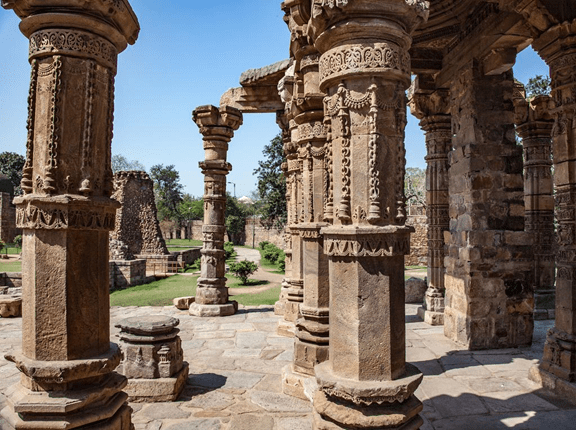
Indian architecture

Deathly blow to Indian universities

Imagine a group of horsemen riding into the campus of a world-famous university, mowing down students and professors until their bodies lie scattered everywhere. Imagine the same scene repeated at other universities, one after the other. And imagine all this in a time when there were no computers, no digital storage devices and no clouds to save the knowledge accumulated over generations. Mindless violence unleashed on the foremost universities of the time – Nalanda, Vikramshila and Odantapuri by Mohammad Bakhtyar Khilji and his men sent shock waves through Indic lands in the 13th century. The sacredness associated with institutions and persons of learning was violated in a manner never seen in India before.

The attack was chronicled by Minhaj-i-Siraj, principal historian of the Delhi Sultans in Tabaqat-i-Nasiri, who described the slaughter of thousands of “Brahmins” with shaven heads.

“There were a great number of books there; and, when all these books came under the observation of the Musalmans, they summoned a number of Hindus that they might give them information respecting the import of those books; but the whole of the Hindus had been killed.” (A.S.Altekar, 1944)

It is ironic that Bakhtyar Khilji hailed from a tribe in what is known as Afghanistan today, which practised Buddhism for centuries before being overrun by Ghaznavids and converting to Islam. In subsequent years, as Muslim rule spread and consolidated in different parts of India, many more universities were destroyed, such as Jagaddala, Somapura, Valabhi, Kashmir and others.  As the news spread, scholars abandoned their colleges even before the Muslim invaders appeared. In Banaras, one of India’s ancient centres of education, when several hundreds of temples were destroyed by Qutubuddin Aibak in the 12th century, many learned Brahmins who taught there fled to southern India along with their families (A.S.Altekar, 1944). Some of the scholars who escaped from Vikramshila and other universities, such as Sakya Sribhadra and Vibhutichandra made their way to Tibet, another hub of higher learning (Mookerjee, 1960). Records maintained by Buddhist monks at Tibet give accounts of the destruction of Indian universities. Translations of Sanskrit texts preserved in Tibet help to give some idea of the books that were found in the libraries of the great Indian universities (Sharma R. N., 2012).
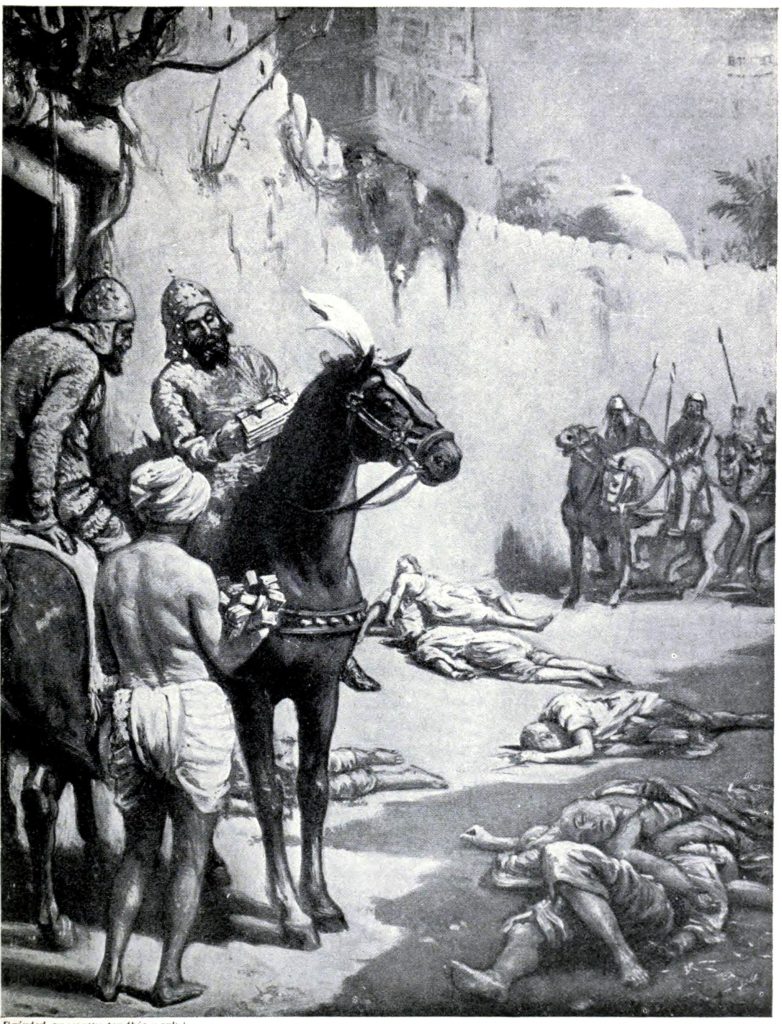
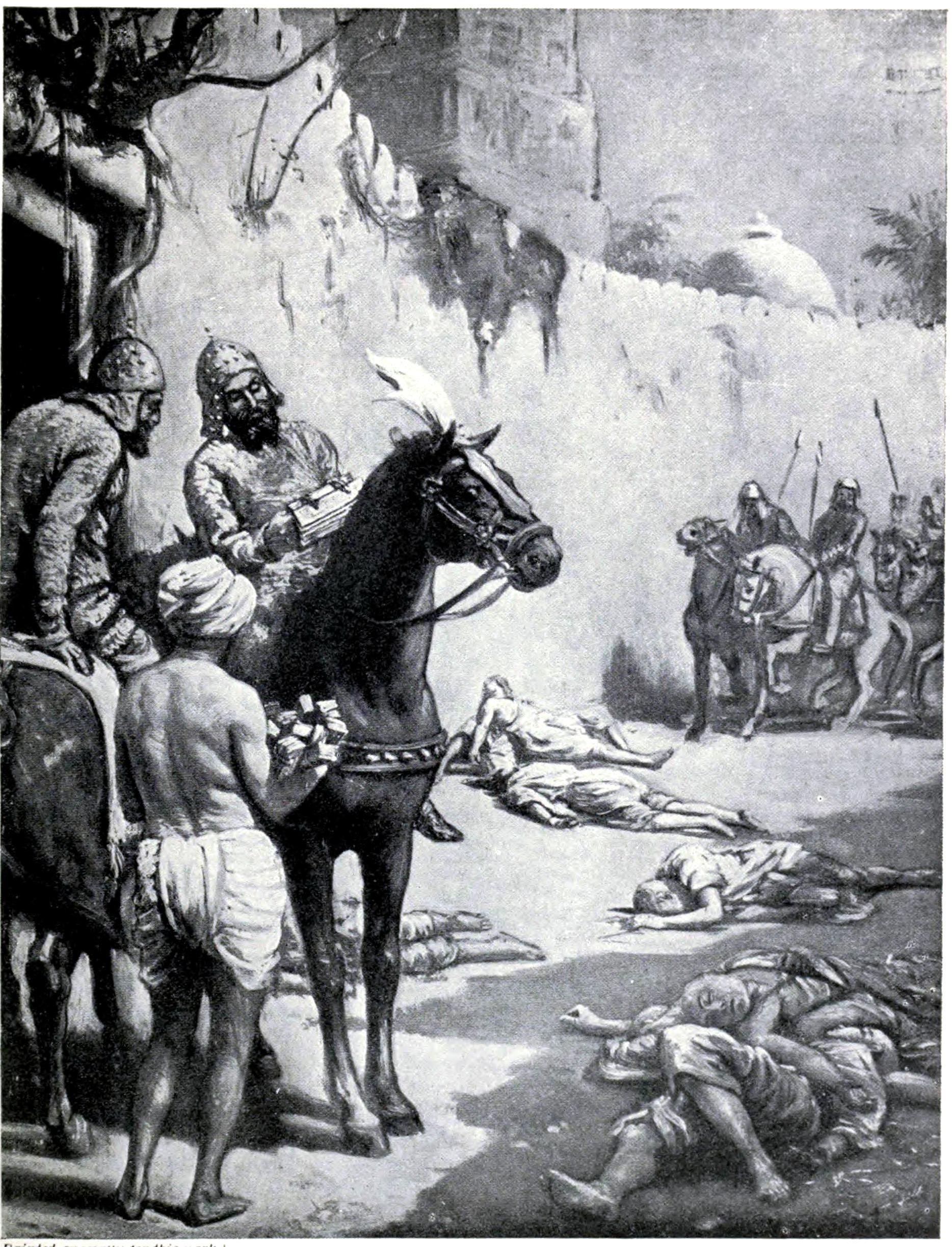
Picture captioned “The end of Buddhist Monks, A.D. 1193” in Hutchinson’s Story of the Nations (Pg 169) shows Bakhtyar Khilji trying to make sense of the manuscripts that fell into his hands, Wikimedia Commons.

Had the rulers of India learned lessons from the earlier destruction of libraries in Alexandria, Cordoba, Persia and Ghazni (many of which contained texts that originated in India itself), and put their differences aside, perhaps India would boast of the world’s longest running universities today. More importantly, India would have retained its link with ancient works in Sanskrit, especially the ones on science and medicine. The destruction of key centres of higher education in India, including temples and the persecution of Hindus, Buddhists and other followers of Dharmic faiths during the centuries of Muslim domination affected the progress of Sanskrit scholarship considerably. The writing of new smritis and their revisions suffered a setback.

Historian A.L Srivastava has described the “325 years of Turko-Afghan rule” as a period of great suffering for Hindus, which were clearly not conducive to education, especially female education.

Not only were they deprived of their position as rulers, ministers, governors and commanders of troops, but were also treated contemptuously. The Turkish Sultans and their principal followers sought their brides from well-to-do Hindu families and compelled the proud chiefs to part with their daughters. In accordance with the Muslim law, the Hindu girls were first deprived of their religion, converted to Islam, and then married. (A.L.Srivastava, 1964)

The accounts of Brahmins fleeing to different parts of India to escape Muslim persecution are too many to be missed. Despite attempts by scholars to regroup in distant locations, and even to rebuild some of the destroyed universities, the old glory of Indic educational institutions could not be restored. The absence of science education that was noted by British chroniclers in a later era can be linked to the Muslim invasions of India. Sanskrit works of scientists and mathematicians of earlier periods began to be forgotten in their land of origin, even as their Arabic and Latin translations as well as plagiarised versions became the basis of science, mathematics and technology in Europe (See Part 2 of this article series).

Emphasis on Islamic Education
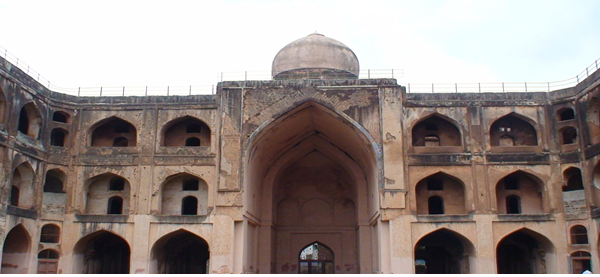
Madrasa built by Mahmud Gawan in Bidar, Karnataka. Photo: Syed Suhaib Mustafa, Wikimedia Commons

As the various Muslim dynasties got entrenched within India, education with the aim of imparting Islamic teachings became the norm. Muktabs and madrasas attached to mosques began to impart training in Islamic traditions. Says M.A. Khan in “Islamic Jihad: A Legacy of Forced Conversion, Imperialism and Slavery”:

Muslim rulers in India built only Islamic schools, namely muktabs and madrasas, often linked to mosques, solely for training Muslim students in their religion and other crafts for administrative and military duty, useful for the Muslim state. Learning Arabic and Persian language and memorizing the Quran, prophetic tradition and Islamic laws were the major subjects of study. Limited training was also given in agriculture, accountancy, astrology, astronomy, history, geography and mathematics, needed for running the state.

Muslim education was patronised by rulers from the Mamluk, Tughlaq and Lodhi dynasty as well as the Mughals and Bahmani Sultans. Delhi became one of the most important centres of Islamic learning (A.L.Srivastava, 1964). Other towns such as Jalandhar, Agra, Firozabad and provincial capitals also began to teach literature, philosophy and various humanities. The Islamic schools that used Persian as a medium of instruction were out of bounds for Hindu students. The lack of state support for education for Hindus led to a drastic decline in their higher education even though primary schools in villages continued to function wherever unjust taxation had not crippled finances completely. Many Hindus converted to Islam and learned Persian as a way of gaining respectable positions and to avoid the Jaziya tax imposed on non-Muslims. This was also a time when caste stratification became more rigid amongst Hindus in order to retain identities and preserve traditions.

Keeping Sanskrit and regional languages alive

Rich businessmen, Hindu Rajas and local communities kept the flame of learning alight for Hindus (Dwivedi, 1994). During the reign of Mughal emperor Akbar (16th century), Sanskrit received some amount of royal patronage since the ruler was interested in harmonising relationships between his Muslim and Hindu subjects. The first Sanskrit-Persian dictionary was compiled during Akbar’s reign (Mehta, 1984). Many works were produced in Sanskrit, Hindi-Urdu and regional languages such as Bengali and Marathi. It was the age of Tulsidas and Rahim. Akbar was keen for students to not solely restrict themselves to theology and classical literature. In Ain-i-Akbari, which chronicles the reign of Akbar, it is stated:

Everybody ought to read books on morals, arithmetic, the notation peculiar to arithmetic, agriculture, mensuration, geometry, astronomy, physiognomy (the art of discerning character from the features of the face), household matters, the rules of government, medicine, logic, Tabiyi (natural science), Riyazi (higher mathematics) and Ilahi (metaphysics and theology), and history; all of which may be gradually acquired.

In studying Sanskrit, students ought to learn the Vyakarana, Nyaya, Vedanta and Patanjali. No one should be allowed to neglect these things which the present time requires” (Dwivedi, 1994).

Akbar also encouraged the opening up of Madrasas for Hindu children so that Hindus and Muslims could study side by side. He introduced the study of Sanskrit in many madrasas. His imperial library in Agra housed as many as 24,000 manuscripts. The books had attractive bindings and were beautifully illustrated. The king loved to listen to readings of books on a variety of subjects. Jain monks produced a number of Sanskrit works during Akbar’s reign. (Mehta, 1984)

To some extent, the encouragement of literature in Sanskrit and regional languages continued under the reign of Jahangir and Shah Jahan. Sanskrit poets such as Panditaraja Jagannatha and Kavindra Acharya Saraswati were patronized by Shah Jahan (Sarma, 1994). A new language emerged from the amalgamation of Persian, Arabic and Hindustani, which was similar to today’s Urdu and Hindi.
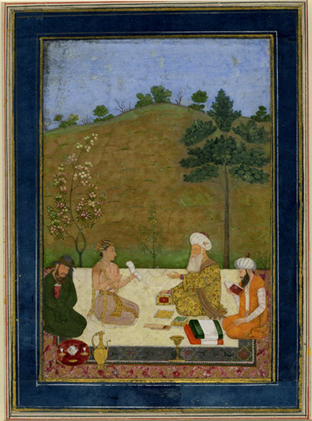
Dara Shikoh in the company of holy men. This painting is ascribed to Dal Chand. Courtesy Wikimedia Commons.

However, Aurangzeb reversed the inclusiveness that Akbar had ushered in during his reign. An Islamic fanatic, he persecuted Hindus and built new maktabs and madrasas on the ruins of demolished temples. (Riaz, 2008) On hearing that Brahmins at Thatta, Multan, Sindh and specially Varanasi were attracting Muslims to their discourses, he ordered all their temples and schools to be demolished (Mukhia, 2004). He killed his elder brother Dara Shikoh, the rightful heir to the throne, who was a Sanskrit scholar himself. With the help of pandits, Dara had translated Ramayana, Gita, Upanishads and Yogavasisthas to Persian; all of which constituted blasphemous acts in the eyes of his brother.

Dara’s Persian translation of Upanishads was translated to Latin in the beginning of the 19th century and created a renewed interest in the Upanishads among learned Europeans (Figueira, 1955). Had Dara become the emperor instead of Aurangzeb, India’s destiny could have been vastly different.

Neglect of sciences in the Mughal reign

The Mughals did not build on the leading-edge concepts presented by Hindu scholars of an earlier era to become the world leader in science and mathematics. While madrasas proliferated and students became adept in the finer details of the Quran and Hadiths in Muslim India, the western world was making advances in science and technology. Of course, these advances were considerably assisted by the Toledo school translations of Arabic works that were derived from India. (See Part 2 of this article). The Mughal kings missed the opportunity to ride the wave of technological discoveries in the west despite ruling over the richest land in the world. When Portuguese missionaries presented printed papers to Akbar, he was least interested in the potential of the printing press to transform education. His son Jahangir was similarly indifferent to a mechanical clock presented to him by the royal French delegation. (Riaz, 2008)

“The Mughal Empire has not produced a single worthwhile text on crafts or agriculture, how many volumes of poetry or histories it might have to its credit,” writes Irfan Habib (Habib, 2008). Apart from printing press and clocks, Mughal rulers were aware of nautical instruments, telescopes, pumps, various mechanical gadgets and wheelbarrows. Yet, these did not excite any desire for indigenous adaptation (Qaisar, 1982). The marvels of Mughal architecture were achieved without the aid of wheelbarrows (Kumar & Desai, 1982).

Arrival of the colonialists

Meanwhile, the Europeans who had been coming to India via the sea route from the 15th century onwards were battling amongst themselves for cornering the trade with India. The British East India Company emerged victorious after pushing the Portuguese, French and Dutch to the periphery and began spreading its tentacles within India. At first, the British did not bother themselves with education of the “natives” and focused on playing politics with different rulers and enriching themselves. Over time, they realised that “their dominion in India could not last long unless education – especially western – was diffused among the inhabitants of the land” (Basu, 1922).

A Mohammedan and a Sanskrit college were set up in Kolkata and Banaras respectively in the late 18thcentury “to provide a regular supply of qualified Hindu and Mohammedan law officers for the judicial administration” (Trevelyan, 1838). The British did not have any noble motives of education of the masses when they set up institutes of learning. These were the same people who imposed serious punishment on black slaves in America and passed laws to the effect that “assemblage of negroes for the purpose of instruction in reading or writing shall be an unlawful assembly” (Basu, 1922).

Anglicists versus Orientalists and their disdain for Indian knowledge

Many of us are familiar with Macaulay’s memorandum or “minute” on Indian Education, which was circulated by him prior to the passing of the English Education Act of 1835. That act gave effect to Governor-General William Bentinck’s decision of reallocating of funds towards a western curriculum with English as the language of instruction.

Thomas Babington Macaulay’s minute is a classic that needs to be read by every “educated” Indian:

“We must at present do our best to form a class who may be interpreters between us and the millions whom we govern – a class of persons Indian in blood and colour, but English in tastes, in opinions, in morals and in intellect. To that class we may leave it to refine the vernacular dialects of the country, to enrich those dialects with terms of science borrowed from the Western nomenclature, and to render them by degrees fit vehicles for conveying knowledge to the great mass of the population.”

Macaulay’s minute and the English Education Act came after a 15-year debate between the older faction of Orientalists and the later Anglicists. The Orientalists argued that government funds should be used to support colleges for the teaching of Arabic and Sanskrit, to pay stipends to the students at these colleges, and to translate works into Arabic and Sanskrit. The Anglicists on the other hand, advocated that these government funds should be spent on teaching English, with no stipends or translations at all. (Clive, 1971)

Most Orientalists and Anglicists had one thing in common – their belief in the “innate inferiority of the Indian culture” and the need to educate the elites (Clive, 1971). They only differed on how best to “improve” the minds of Indians, how to “correct” their beliefs and make them more useful as subjects of the British Empire.

Orientalists such as John Tytler believed in gradual reform via teaching in Arabic and Sanskrit so that the British could understand Indian culture and then prove it wrong. This method would lead to Indians themselves “correcting their countrymen”. (Clive, 1971)

Charles Trevelyan, brother-in-law of Macaulay and an avowed Anglicist, said before the Select Committee of the House of Lords on the Government of Indian Territories that both “Hindoos and Mahomedans” regarded the British as “usurping foreigners” who had “taken the country from them” and excluded them from “the avenues to wealth and distinction”. He argued that European learning “would give an entirely new turn to the native mind”. The natives would cease to “strive after independence in the native model” and would not regard the British as “enemies and usurpers”, but as “friends and patrons, and powerful beneficent persons”. (Basu, 1922)

Trevelyan’s arguments against Sanskrit and Arabic as a means of instruction sound Kautilyan in strategy. Arabic literature would keep reminding Muslims that the British were “infidel usurpers” while Sanskrit texts would inform Hindus that their foreign rulers were “unclean beasts”. He pointed out that already in the army, there was a clear distinction between the English officers and the native sepoys. Not “one native out of 500” educated in Arabic in a seminary would be interested in enlisting in the army. Therefore, it was important to educate “sepoys” in English at the elementary level (Trevelyan, 1838). For the elites, English literature would do the trick. Familiarly acquainted with literature, the Indian youth would speak of great Englishmen with the “same enthusiasm” as the British themselves. They would reject the teachings of Brahmin priests. “The natives will not rise against us because we shall stoop to raise them,” he explained.  Also, he noted that those educated in English would “cling” to the British rule because they would have everything to fear from a native government, which could mark them out for persecution. This last surmise of Trevelyan’s was clearly wrong, as the subsequent freedom movement of India proved.

Many Anglicists emphasised on the convenience attached to having English-speaking natives. Given that a large number of British officers were constantly being deputed in India, it was troublesome for them to understand the various languages and dialects of the natives. Also, it was a costly and time-consuming affair to translate various English books into native languages. In other words, the interests of the people of the land became subservient to convenience.

In addition to the Anglicists, there were the Vernacularists, who rejected Sanskrit and Persian in favour of regional languages. They championed the teaching of European knowledge in “vernacular” languages. The term “vernacular” itself has a derogatory meaning in the sense of being a language that is less cultured or refined.

Christian evangelism as a driver of education

It must be noted that spreading Christianity was a desirable goal for most Anglicists, Orientalists as well as Vernacularists. Dr Alexander Duff, an Anglicist, who opened a popular school in Calcutta was against “heathen” institutions. Macaulay himself wrote in a letter to his father, “No Hindoo who has received an English education ever remains sincerely attached to his religion.” He expressed his “firm belief” that if his plans of education were followed up, “there will not be a single idolator amongst the respectable classes in Bengal thirty years hence.” (Basu, 1922)

JC Marshman who made a sincere plea for retaining “Bengalee” as a medium of instruction gave the example of Serampore missionaries whose “labours” in “civilization and evangelization of the province of Bengal” had led to the establishing of 40 printing presses in a few decades and selling of 30,000 books in just one year. (Basu, 1922)

Many Christian missionaries learned regional languages such as Tamil and Kannada, published dictionaries in them and translated the Bible for evangelization activities. They appropriated several aspects of Hinduism into Christianity in order to make it more palatable to the locals and wean them away from traditional Sanatana Dharma.

English language struck roots in the land as the English Education Act began to take effect and the missionary schools that mushroomed across the country made English the “first language”.

Many Indians were Anglicists

An important argument made by Anglicists in favour of standardising English-medium education was that the Indian natives themselves were eager to learn English. “A taste for English has been widely disseminated,” said Trevelyan. He happily noted that a “loud call” arose from the natives themselves to be instructed in English. Schools teaching in English were extremely popular and English books were selling far more rapidly than books in Sanskrit and Arabic (Trevelyan, 1838). This is not surprising, since a good knowledge of English opened opportunities for government jobs all over the country. Besides, the vacuum in science and disconnect with Sanskrit works on science and mathematics caused by the Muslim rule made many Indians feel backward in comparison to the Europeans.
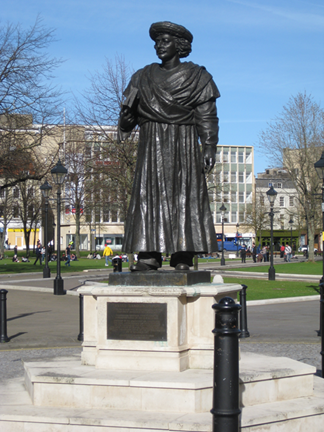
Raja Rammohan Roy's statue in Bristol

Raja Rammohan Roy is one of the most notable Indian Anglicists, who petitioned for the teaching of the “arts and sciences of modern Europe” and argued against establishing a new Sanskrit college in Calcutta in his letter to Lord Amherst. “The Sanskrit language, so difficult that almost a lifetime is necessary for its acquisition, is well known to have been for ages a lamentable check on the diffusion of knowledge; and the learning concealed under this almost impervious veil is far from sufficient to reward the labour of acquiring it,” he wrote. A new Sanskrit college, which taught the same things that were taught “two thousand years ago” would not help since ‘no improvement can be expected from inducing young men to consume a dozen of years of the most valuable period of their lives in acquiring the niceties of Byakaran or Sanskrit grammar,” he felt. Roy believed that giving allowances to the teachers engaged in teaching Sanskrit in different parts of India would be enough to keep the language alive and no new Sanskrit colleges were necessary. He was instrumental in the establishment of the Hindoo College in 1817 for imparting secular and scientific education, which later came to be known as the famous Presidency College of Kolkata. The alumni of the institute include outstanding personalities such as Bankim Chandra Chatterjee, Satyendranath Bose and Meghnad Saha.

Dharampal’s revelations of astounding data on India’s popular schooling system

When India was embroiled in the education debate, England was itself languishing in illiteracy. A minuscule fraction of the children in England went to school, and the only book most literate people had read was the Bible. In the 1960s, Dharampal, a Gandhian thinker came across archival material of extreme significance in London. He discovered documents related to a series of surveys commissioned by the British government in the 19th century to assess the level of indigenous education in India. This set him on the path of pioneering research, which brought up startling data. He discovered Thomas Munro’s statement that almost every village in India had a pathshala (school). There were 100,000 village schools reported in Bengal and Bihar alone in the 1830s. Reading, writing, arithmetic, epics and more were being taught. William Adams, one of the surveyors has written that he could not recollect studying in his village school in Scotland anything that had more “direct bearing” upon daily life than what was taught in the “humbler village schools of Bengal”. (Dharampal, 2000)

From different parts of India came reports of dedicated teachers, superior methods of teaching and high school attendance. But what simply challenged every stereotype was that in a large number of schools, “Soodras” were in majority while the Brahmins and “Vysees” were in minority. In Tamil-speaking areas, the Shudras ranged from 70% in Salem and Tinnevelly to over 84% in South Arcot. In Malayalam-speaking Malabar, Brahmin students constituted only 20% of schools, while Shudras were 54% and Muslims were 27%. The same trend was reported in Kannada-speaking Bellary and Oriya-speaking Ganjam. Only in the Telegu-speaking districts, the dwija castes formed the majority of students. Some collectors who furnished data spoke about poor Brahmins who taught children with no expectation of compensation. Girls were mostly home-schooled. However, in the Malabar district as well as “Jeypoor Zamindari of Vizagapatam district”, the percentage of girls was close to 30%, a very high number.  (Dharampal, 2000)

It must be remembered that schooling was not the only way of transmitting basic education. Artisans, craftsmen and agriculturalists taught their skills to apprentices via a separate system of education.

A.D.Campbell, the collector for Bellary applauded the “economical” teaching methods in Indian schools and the system of “more advanced scholars” teaching the “less advanced” thereby confirming their own knowledge. He mentioned that this method “well deserved the imitation it had received in England”. He was referring to the “Madras Method” of teaching, which was introduced by Reverend Andrew Bell in England. Dr Bell had been impressed by little children in Madras writing with their fingers on sand, which “after the fashion of such schools had been strewn before them for that purpose”. He saw a system of children learning from peers. After Dr Bell published his paper on Madras Method, he was in great demand to introduce this in British schools. By 1821, 300,000 children were reportedly being educated under Dr Bell’s principles and his ideas were adopted in Europe, West Indies and even Bogota, Colombia. (Tooley, 2009)

The Beautiful Ecosystem is uprooted

As the British rule progressed in India, villages got increasingly impoverished. For example, when the British with the Nawab of Arcot attacked Thanjavur in 1771 and imposed taxes as high as 59% of gross produce, they created mass poverty overnight! The entire British administrative apparatus was geared towards fleecing the citizens and even the designations of officers such as “District Collectors” indicated that the only aim of the government was to collect taxes. One collector of Bellary was so moved by the plight of the people that he wrote a letter to the authorities that the degeneration of education was attributable to the “transfer of capital of the country from the native government…to the Europeans, restricting it by law from employing it even temporarily in India and daily draining it from the land.” Further, he wrote, “The means of the manufacturing classes have been greatly diminished by the introduction of our own European manufactures.”(Dharampal, 2000)

The British educational policies also sounded the death knell for regional languages as the rush for English-medium education intensified. With every subject being taught in English and mother-tongues being relegated to “second language” the quality of literature in regional languages began sinking. Illiteracy and low self-confidence began to be associated with absence of English proficiency. M.K.Gandhi said in 1931 that the British had left India more illiterate than it was a hundred years ago. Today, India has the largest number of illiterate in the world.

Disturbingly, India’s self-gaze is still through alien eyes. The past heritage lies buried in regional and Sanskrit literature, awaiting illumination. When India became independent from the British in 1947, there was a fresh opportunity to write a new chapter of decolonization.

India is still waiting.

The author would like to acknowledge the critical inputs of the members of Indian History Awareness and Research (IHAR). She would also like to express gratitude to Rare Book Society of India and Nikhil Dureja for generously sharing books that provided key references for writing this article.

Works Cited

A.L.Srivastava. (1964). The Sultanate of Delhi 711 to 1526 AD. Shiva Lal Agarwala.

A.S.Altekar. (1944). Education in Ancient India. Nand Kishore and Bros.

Apte, D. Universities in Ancient India.

Basu, B. D. (1922). History of Education in India Under the Rule of the East India Company. The Modern Review Office.

Bose, M. (1990). A Social and Cultural History of Ancient India. Concept Publishing Company.

Clive, J. (1971). The debate on Indian education: Anglicists, Orientalists and the ideology of Empire.

Dharampal. (2000). The Beautiful Tree. Other India Press.

Dwivedi, B. L. (1994). Evolution of Educational Thought in India. Nothern Book Centre.

Figueira, D. M. (1955). Translating the Orient- The Reception of Sakuntala in Nineteenth Century Europe. State University of New York Press.

Habib, I. (2008). Technology in Medieval India. Tulika Books.

Kumar, D., & Desai, M. (1982). The Cambridge Economic History of India Vol 2. Cambridge University Press.

Mehta, J. (1984). Advanced Study in the History of Medieval India. Sterling Publishers Pvt Ltd.

Mookerjee, R. K. (1960). Ancient Indian Education – Brahminical and Buddhist. Motilal Banarsidass.

Mukhia, H. (2004). The Mughals of India. Blackwell Publishing.

Qaisar, A. (1982). Indian Responses to European Technology and Culture. Oxford Universoty Press.

Riaz, A. (2008). Faithful Education: Madrassahs in South Asia. Rutgers University Press.

Sarma, N. (1994). Panditaraja Jagannatha – The Renowned Sanskrit Poet of Medieval India. Mittal Publications.

Sharma, R. N. (2000). History of Education in India. Atlantic Publishers.

Sharma, R. N. (2012). Libraries in the early 21st century, volume 2: An international perspective. De Gruyter Saur.

Tooley, J. (2009). The Beautiful Tree – A personal journey into how the world’s poorest people are educating themselves. Cato Institute.

Trevelyan, C. E. (1838). On the Education of the People of India.

Feature Image Credit: Erik Törner

Disclaimer: The facts and opinions expressed within this article are the personal opinions of the author. IndiaFacts does not assume any responsibility or liability for the accuracy, completeness, suitability, or validity of any information in this article.

Sahana Singh writes on Indian history. She is a member of Indian History Awareness and Research (IHAR), and has recently authored “The Educational Heritage of Ancient India – How An Ecosystem of Learning Was Laid to Waste”.


How India Went From World’s Education Capital to Depths of Illiteracy – Part II

Link to original post by Suhana Singh

student who completed basic education in ancient India and wished to learn more, had a plethora of institutions to choose from, depending on whether he wanted to specialise in the Vedas, logic, medicine, sciences, classical music or any other subject. Thus, a student who wanted to learn classical music could, for instance, move to Varanasi and learn from the maestros in the city’s ancient college of music. If he found a friend keen on studying in Varanasi’s college of astronomy, then perhaps the two could travel together. Travelling was a risky proposition in those days when the land was covered with forests abounding in predators, and parents would celebrate when their children returned home after four to 12 years of higher education.

In the Kathasaritsagara, there is a reference to a Brahmin, who decided not to send his son for further studies to Nalanda or Varanasi, which were closer to his place of residence in the Ganga plains and instead took the risk of choosing a far-off Valabhi university located in today’s Gujarat (Bose, 1990). Valabhi’s graduates were known to secure employment in government services. Its courses in political science (niti) and business (varta) were well known alongside religious studies of Hinayana Buddhism (Apte).

An interesting reference to co-education is found in the Sanskrit play Malatimadhava written by Bhavabhuti (in the eighth century) where a female student Kamandaki is indicated to be a classmate and close friend of male students Bhurivasu and Devarata at a famous university in Padmavati. All three characters hail from different regions. (Mirashi, 1996)

There seems to have been a remarkable mobility of students and teachers across the universities of ancient India. Thus, we find professors in Nalanda, such as Sthiramati and Gunamati who had earlier established Valabhi University in the west. Dinnaga and Dharmapala, two famous scholars of Nalanda were both natives of Kanchipuram in the south. Ratnavajra, a noted professor at Vikramshila hailed from Kasmira (Kashmir). Xuanzang himself, after finishing his studies in Nalanda went to teach in Orissa upon receiving a directive from King Harsha (Mookerjee, 1960). The famous Bhaskara II, hailed by some as the greatest mathematician ever, taught at Ujjaini, but hailed from Bijapur in the south (Puttaswamy, 2012). Clearly, many of the learned people of yore travelled to centres of excellence in their areas of interest.

Bhaskara II, head of the astronomical observatory at the famous Ujjaini University in central India was a native of Bijapur in southern India.

Funding of higher education

An interesting aspect about the education system was that it was subsidised for pupils and teachers by the ruling kings as well as communities that lived around universities. The Nalanda University was described by Xuanzang as having been endowed with buildings and lands by ruling kings of the time. He also mentions that the revenues of 100 villages were allocated for meeting the expenses of the university. The students and teachers received clothes, food, bedding and medicine free of cost. (Mookerjee, 1960)

However, according to the Jatakas, students who wished to study at Takshshila were required to either pay their tuition fees at the beginning or if they lacked cash, to pay in the form of services to the teacher, such as bringing firewood. Most Brahmin students were too poor to pay upfront and would opt to carry out menial tasks. Some would get permission to pay at the end of their studies, and there were instances of Brahmin students soliciting financial assistance from households. We also hear of some winning state scholarships and not being required to pay any fees. Often, families living around the universities would generously host meals at their residences for the students. (Mookerjee, 1960)

There was a well-established ecosystem to support learning. Since the ethos of the times demanded that Brahmin scholars lead a simple life engaged in the pursuit of knowledge without amassing riches, it fell upon the shoulders of wealthy non-Brahmin families as well as humble farmers to support those who were devoting their entire lives to learning and teaching (Hazra, 1987).

Graduating the Indian way: Samavartana

Given that ancient Indians set so much store by learning, it should not come as a surprise that they had a meaningful rite of passage to mark the graduation of students, called Samavartana or Snana. In the presence of students, teachers and invited guests, the graduating student would offer his guru-dakshina (gift to guru), after which the guru would recite the snataka-dharma from the Taittiriya Upanishad. This would be followed by a homa (fire ritual) and snana (ceremonial bath). (Kane, 1941)

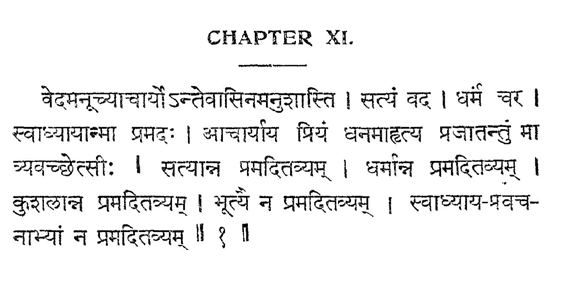
The Snataka Dharma recitation from Shiksha Valli in the Taittiriya Upanishad was an important ritual in the graduation ceremony.

A partial translation of the Snataka Dharma recitation is as follows:

Never deviate from Truth,

Never deviate from Dharma,

Never neglect your well-being,

Never neglect worldly activities (for gain and welfare),

Never neglect Svādhyāya (self study) and Pravachana (teaching of Vedas).


We all know the famous shloka

Maatru devo bhava,

Pitru devo bhava

Acharya devo bhava

Atithi devo bhava

This verse stating that one’s mother, father, teacher and a visiting guest are all equivalent to Devata comes from the Taittiriya Upanishad, which also was recited during the Samavartana. Equipped with holistic knowledge and blessings from the guru, a graduate or vidya-snataka (one who is bathed in learning) would be ready for the next stage of life – usually teaching and of course, marriage.

The temple universities of India

Photo courtesy Kanniks Kannikeswaran

An interesting aspect about ancient Indian temples is that often, they became centres of knowledge dissemination and debating. There was a continuity of learning with conferences and assemblies of learned scholars that have been mentioned in the Rig Veda itself, for disseminating the philosophies that form the core of Vedic literature.  Well-endowed temples became magnets attracting students and teachers, which led to annexes being built for the temples and even entire colonies housing intellectuals from a variety of disciplines.

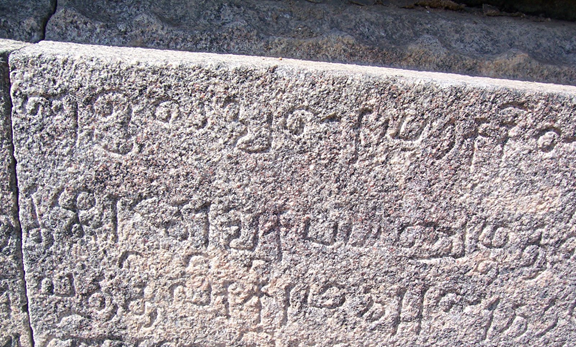
Multiple inscriptions on several temples of southern India reveal the extent to which higher education had got institutionalised. Ennayiram is one such location in Tamil Nadu, which abounds in inscriptions giving minute details related to the subjects taught, number of students, endowments and so on. For example, an inscription from the time of Rajendra Chola I (11th century) lays out the endowments given for the boarding and tuition of 340 students studying at a Vedic college. The college received 45 velis (300 acres) of land. Each student of Veda was noted to cost 6 Nalis of paddy per day and ½ Kalanju of gold per year. A student studying the more advanced Vedanta, Mimamsa or Vyakarana got 66% more. Meanwhile, a teacher was noted to receive a meal allowance equivalent to that of 16 students per day. The inscription notes that 75 students were studying the Rig Veda, 75 Yajur Veda, 10 Atharva Veda, 20 Chandoga Saman, 20 Talavakara Saman, 20 Vajasaneya, 25 Vyakarana, 35 Prabhakara Mimamsa, 10 Baudhayaneya Grihya, Kalpa and Gana, 40 Rupavatara and 10 Vedanta (Mookerjee, 1960). In 2013, archaeologists found more lines of inscriptions in the basement of a temple in Ennayiram (Subramanian, 2003). Clearly, there is a lot more waiting to be unearthed.

A temple inscription in Ennayiram, Tamil Nadu describing a college attached to a temple along with a hostel and hospital. Photo courtesy: Tamil Nadu Tourism (http://tamilnadu-favtourism.blogspot.sg)

Even the medical care of students was accounted for. Some inscriptions describe colleges with attached hospitals and hostels. One hospital is described to have 15 beds, a physician, a surgeon, two errand boys and two nurses. It was even equipped with a pharmacy with medicines such as Haritaki, Bilvadighrita, Vajra-kalpa and Kalyanalavana. (Mookerjee, 1960)

Ancient academies of excellence

Apart from temples, there was the ghatika, the agrahara and the mathha. Ghatikas were groups of learned acharyas, which carried out deep discussions on Vedic matters. Ghatikas are said to have played a key part in making Kanchipuram (also called Kanchi) a hub of Vedic studies. They even played a pivotal role in the selection of kings. Numerous poet-scholars and saint-philosophers who produced the finest of Tamil literary works are associated with Kanchi (Rao, 2008). As we have seen earlier, some of the brightest went on to teach in famed universities in other parts of India.

Agraharas were entire settlements of learned Brahmins with their own rules of governance and were funded by generous donors (usually non-Brahmins).  Mathhas were also educational institutions and along with Agraharas served like modern academies of excellence (Mookerjee, 1960).

Agraharas were entire settlements of learned Brahmins. Photo courtesy incredibleindiaphotogallery.com

Inscription after inscription in southern India talks of the revenues of villages being entirely allocated for supporting agraharas with Brahmin scholars sometimes numbering 108, sometimes 308. The revenues were to be used in supporting the sacred task of learning and teaching, which included building libraries called “Sarasvati Bhandara” (Mookerjee, 1960). The learned Brahmins, who often held titles such as Chaturvedin,

Trivedin, Somayajin, Shadangavid, Bhatta, Kramavid, Sarvakratuyajin and Vajapeyin, which denoted their specialisation in different texts. Mookerjee puts it eloquently when he says:

“These learned settlements were centres of light and life, showing how theory and practice should go together, how precept should be supported by example, ethics by conduct, learning was to be lived and truth or religion was to be realised in the activities of daily life.”

 It is important to highlight the contribution of the Kerala school of mathematics and astronomy (14th to 15th century) in the context of Indian systems of advanced learning. Concentrated in a geographical area around Thrissur in Kerala, a rich tradition of mathematics developed and flourished amongst the Namboodri Brahmins. They discovered the infinite series, which laid the foundation for calculus centuries before Newton. There is strong circumstantial evidence that Jesuit missionaries who visited India in the 15thcentury carried back mathematical concepts from Kerala to Europe (Joseph, 2000).

The brilliant scholars of Kerala were believed to be mainly motivated by the mysteries of astronomy. However, George Gheverghese Joseph, in his famous book The Crest of the Peacock – The non-European Roots of Mathematics argues that these mathematicians seem to have revelled in their love for pure mathematics. Why else would Madhava (the founder of the Kerala School) indulge in long and tedious calculations of sine tables to 12 decimal places?

Famous names associated with the Kerala School are Parameshvara, Neelakanta Somayaji, Jyeshtadeva, Achyuta Pisharati, Melpathur Narayana Bhattathiri and Achyuta Panikkar. GG Joseph points out that some non-Brahmins such as Sankara Variyar and Acyuta Pisarati were also part of the Kerala School and many from “lower” castes, such as carpenters, construction workers and artisans were conversant with precise calculations, indicating that the symbiotic society did not fit into the neat framework of the caste system envisaged by modern researchers.

How Indian scholars transferred knowledge to China

In the first century CE, Chinese emperor Ming-Ti sent 18 persons to study Buddhist doctrines in India. When they returned, they took back many books and also two Buddhist scholars Kasyapa Matanga and Dharmaratna. Kasyapa was in Gandhara, when he was invited by the Chinese envoy. His journey from Gandhara to China was fraught with hardship as he passed through the steep mountains of Chinese Turkestan and the harsh Gobi desert. There was also a language problem. However, the two pioneering scholars persevered and opened up opportunities for hundreds of professors from Indian universities to work in China. A large number of Sanskrit manuscripts were carried to China. Among the well-known Indians who migrated in the first three centuries were Samghavarma, Dharmasatya, Dharmakala, Mahabala, Vighna, Dharmaphala, Kalasivi, Kalaruchi and Lokaraksha (Mookerjee, 1960).

Kashmir, which was a prominent centre of Buddhist learning supplied a steady stream of erudite scholars to China. One such scholar Gunavarman from Kashmir’s royal family first went to Ceylon and Java where he made a name for himself. The Chinese emperor invited him to China, personally received him in Nanking, became his disciple and built a temple for him. A few scholars from southern India also got pulled to China, such as Dharmaruchi who lived in China for 20 years between 693 to 713 CE and translated 53 works into Chinese (Mookerjee, 1960).

Hundreds of Sanskrit works were painstakingly translated into Chinese by the Indian scholars with the help of Chinese intellectuals. It was a mammoth task considering the totally different syntax and structure of the two languages and many scholars even recorded their struggle and discomfort.

The first printed book in China was the Indian treatise Vajjra-Chhedika-Prajna-Paramita Sutra (or the famous Diamond Sutra), which was translated into Chinese by Kumarajiva in 402CE. Kumarajiva was prodigiously talented.  He studied in Kashmir, Kashgar and Koutcha, and it is said there was a battle for his services between the King of Koutcha and the Chinese Emperor, whose general imprisoned him. For 12 years, Kumarajiva translated more than 100 Sanskrit works, which are considered masterpieces of Chinese literature! He is also known as the teacher of the famous Chinese traveller Fa-Hien (Mookerjee, 1960).

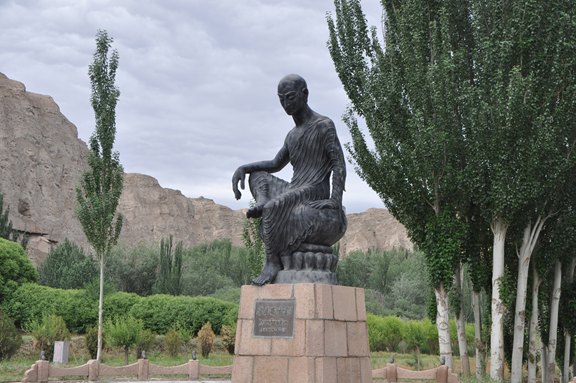
Statue of Kumarajiva in front of Kizil Caves, Kuqa, Xinjiang, China. Photo Courtesy Yoshi Canopus

Unlike Kumarajiva, another scholar, Dharmakshema’s life was cut short by an assassin, when two Chinese rulers competed for his services. Reference is also found to a well-travelled and much-in-demand scholar Amoghavajra who earned titles such as Prajna-moksha and Tripitika Bhadanta from a Chinese emperor. The poor man was made to return from the shores of India the very moment he landed back in the year 749 because the Chinese emperor decided there was little time to be lost. It is not just in modern timelines that employees get called back from vacations by hard-hearted bosses. Amoghavajra collected more than 500 texts from different parts of India to take back to China and translated at least 77 works, including Dharanis and Tantras. In China, he is known as the founder of Tantrik Buddhism (Mookerjee, 1960).

Several Indian mathematicians and astronomers from the best universities held high positions in China’s scientific establishments. One Indian scientist called Gautama Siddha (Qutan Xida in Chinese) became the president of China’s official board of astronomy in the 8th century. He translated the Indian navagraha calendar into Chinese. He also introduced Indian numerals into China. The invention of printing is also attributed to Buddhist scholars who went from India to China and printing was used as a means to spread Buddhist thought. (Sen, 2009)

Knowledge transfers from India to Greece, Islamic world and Europe

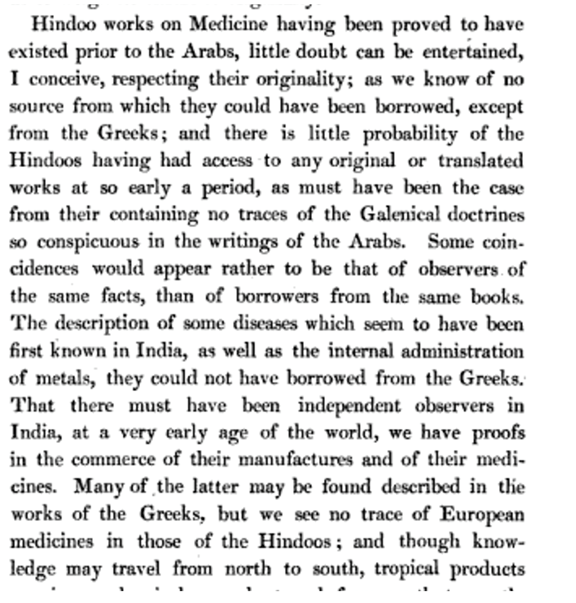
The antiquity of civilisation and the ecosystems set up for the propagation of knowledge turned India into a veritable garden with exquisite flowers that attracted honeybees. Royle, in an essay on the antiquity of “Hindoo medicine” mentions Barzouyeh, a royal physician in the court of Persian King Khosrau (531-579 CE), who returned from India with medical texts as well as a variety of herbs and who was proficient in Sanskrit (Royle, 1837). There was a thriving trade between India and western Asia in ancient times, which involved not just spices and textiles, but also medicines.

In his talks on the antiquity of Indian medical systems, Raj Vedam, co-founder of Indian History Awareness and Research has laid out the trajectory by which the knowledge of Ayurveda was transmitted from India to Greeks/Romans, the Islamic world and then Europe. He points out how the scientific concepts articulated by the Indian Rishi Kanada (6th Century BCE), for example, were taken up by the Greek philosopher Democritus (4th Century BCE). According to Bertrand Russell, Democritus travelled widely and had visited Egypt and Persia “in search of knowledge”. Hippocrates, considered the father of western medicine was a student of Democritus.

Excerpt from page 62 of JF Royle’s “An Essay on the Antiquity of Hindoo Medicine Including an Introductory lecture to the Course of Materia Medica and Therapeutics delivered at the King’s College”

Dr Vedam also states that the library of Alexandria played a major role in transmitting texts from the East to the West.  It has been well chronicled that the library administrators went to any extent (“buy, borrow or steal”) to get the “most original, most authoritative copies” (Philips, 2010). The Materia Medica compiled by Greek physician Dioscorides during 50 to 70CE, which was used for 16 centuries in Europe, contains a large number of Indian herbs (Vedam, 2016). Another data point offered by Dr Vedam is the fleeing of Nestorians to Persia to escape the persecution of the Christian Church and from there to Kerala in the fifth century that served to transmit Indian medical knowledge back to Syria.

The fifth Abbasid Caliph Haroun Al Rashid had an Indian physician Manka in his court, who translated ancient India’s indispensable medical text – the Sushruta Samhita into Persian. The imprint of Indian scholars on Islamic sciences, not just medicine has been well-acknowledged by the Islamic scholars such as Alberuni themselves. Indian scholars were often invited to Baghdad. The works of Muslim intellectuals such as Al Kindi, Al Farabi, Al Farghani, Al Tabari and Al Khwarizmi played a paramount role in transferring Indic knowledge of mathematics, medicine, astronomy, philosophy, chemistry and even music to the Islamic world (Khan, 2009). While the Islamic scholars often credited their knowledge to Indic sources, the European scholars often plagiarised from Arabic texts without references. The Renaissance was propelled by the works of Arabic scholars, which were passed off as original works by Europeans (Hasse, 2016).

In the 12th and 13th centuries, the Toledo School of Translators in Spain employed many scholars to translate major Arabic works into Latin (Bronowski, 2011). These translators produced a prolific output and helped to transfer a substantial amount of ancient Indian knowledge to Europe. The transfers continued with even greater intensity during the colonial period from the 14th century onwards when the contents of hundreds and hundreds of Indian books made their way into monographs and books in Europe. A catalogue of the Indian books and manuscripts that were translated into European languages during this period would itself form a bulky book! A case in point is the Bibliotheca Malabarica, a catalogue of over 100 Tamil manuscripts collected by the missionary Bartholomäus Ziegenbalg during his first two years in India (1706–1708).

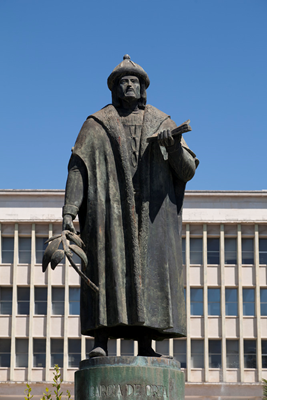
Garcia D’Orta, Portuguese traveller to India wrote a detailed treatise “Colóquios dos simples e drogas da India” on the medicinal plants of India in 1563. Photo Courtesy Martins Correia.

We have seen how India’s ancient systems of education helped to fuel a knowledge revolution around the world. However, in the 11th century, marauding incursions by Muslim invaders disrupted the idyllic world of university learning in India. This was followed by European colonisation, which led to further erosion and degeneration of India’s traditional learning systems. All this and more will be discussed in the next article, which will conclude this series.

The author would like to acknowledge the valuable inputs of the members of Indian History Awareness and Research (IHAR) and specially thank Kanniks Kannikeswaran for supplying pictures from his personal collection.

Bibliography

Apte, D. Universities in Ancient India.

Bose, M. (1990). A Social and Cultural History of Ancient India. Concept Publishing Company.

Bronowski, J. (2011). The Ascent of Man. BBC Books.

Hasse, D. N. (2016). Success and Suppression: Arabic Sciences and Philiosophy in the Renaissance. Harvard University Press.

Hazra, R. C. (1987). Studies in the Puranic Records on Hindu Rites and Customs. Motilal Banarsidass.

Joseph, G. G. (2000). Crest of the Peacock, Non-European Roots of Mathematics. Princeton University Press.

Kane, P. (1941). History of Dharmashastras Vol II, Part I. Bhandarkar Oriental Research Institute.

Khan, M. (2009). Islamic Jihad – A Legacy of Forced Conversion, Imperialism and Slavery. iUniverse.

Mirashi, V. V. (1996). Bhavabuti. Motilal Banarsidass.

Mookerjee, R. K. (1960). Ancient Indian Education – Brahminical and Buddhist. Motilal Banarsidass.

Muller, M. Lectures on the Science of Knowledge delivered at the Royal Institution of Great Britain in April, May and June 1861, 1868.

Philips, H. (2010). The Great Library of Alexandria?

Puttaswamy, T. (2012). Mathematical Achievements of Pre-Modern Indian Mathematicians. Elsevier.

Rao, P. N. (2008). Kanchipuram: Land of Legends, Saints and Temples. Readworthy Publications.

Royle, J. F. (1837). An Essay on the Antiquity of Hindoo Medicine Including an Introductory lecture to the Course of Materia Medica and Therapeutics delivered at the King’s College. Allen.

Russell, B. (1972). History of Western Philosophy. Simon & Schuster.

Saraswati, S. D. (2016). Taittiriya Upanishad. Arsha Vidya Research and Publication Trust.

Sen, A. (2009). The Argumentative Indian: Writings on Indian History, Culture and Identity. Allen Lane.

Subramanian, P. (2003). 100 year old, long Tamil inscription found.

Vedam, R. https://www.youtube.com/watch?v=TtoXaR7wgiI. (2016). Lecture on Antiquity of Indian Medical Systems [Youtube Video].

Disclaimer: The facts and opinions expressed within this article are the personal opinions of the author. IndiaFacts does not assume any responsibility or liability for the accuracy, completeness,suitability,or validity of any information in this article.

Sahana Singh writes on environmental (water) issues, current affairs and Indian history. She is a member of Indian History Awareness and Research (IHAR), and has recently authored “The Educational Heritage of Ancient India – How An Ecosystem of Learning Was Laid to Waste”.
How India went from World’s Education Capital to Depths of Illiteracy –I

linkHow India become Center of education to illiteracy

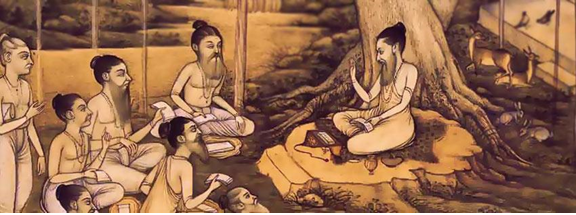
ndia’s earliest teachers were the gurus, who taught in gurukulams and ashrams located far away from the hustle and bustle of towns in what could be called forest universities. It is no surprise that the Vedas, which are the earliest known oral books containing the thoughts of a highly civilised society are replete with exquisite references to nature and the concept of inter-dependence of living organisms. To these gurus, it was important for humans to realise their humble status in the infinite universe before embarking on the long journey of learning.

Over time, the systems of transmission of learning to newer generations got institutionalised and gave birth to famous universities such as Takshshila, Nalanda and many famous temple universities of which the remains are still found in southern India. A sizeable number of foreign students came to study in India from China, Korea, Japan, Indonesia and West Asia. While the most famous names are Fa-Hien and Xuanzang, who left behind detailed accounts, there are scores of others, who made difficult journeys by foot and on board the ships just to imbibe knowledge from Indian professors. Many of the foreign students copied texts and commentaries to carry back to their countries. The rush for gaining an education from the Brahmins and Buddhist scholars of India was similar to today’s rush to study in or be certified by American and European universities.

There is a curious hesitation among modern historians to refer to India’s multi-disciplinary centres of traditional learning as universities. This comes from the excessive importance given to the written word, to solid buildings with established pedagogy and rigid systems of certification. Thus, the talented, but bare-chested and dhoti-clad engineers and architects of ancient India, who built incredible irrigation canals, rainwater harvesting structures, palaces, forts, roads, dams and aqueducts are barely acknowledged as professionals, who learned from professors in universities. Similarly, the medical practitioners of yore, who knew which combination of herbs could help in healing diseases, where to procure them in forests, how to conduct complex surgeries and who additionally possessed spiritual insights are often regarded as quacks or witch doctors.

Learning was a sacred, important duty

Ancient Indians were obsessed with gaining perspectives about “the material and the moral, the physical and the spiritual, the perishable and the permanent” (Mookerjee, 1960). During the process of gaining these perspectives, they made important discoveries in the sciences, mathematics and applied medicine. The sacredness of learning is evident from the large number of Sanskrit shlokas that deify the guru such as “Acharya devobhava” (Taittiriya Upanishad). Initiation of children (both male and female) into the alphabets for the first time was done ceremonially in most parts of India.

Even today, the ceremony survives in the Haathekhori in Bengal (performed during Saraswati Puja) and the Vidyarambham in Southern India (when children are asked to trace alphabets on rice). The sacred thread ceremony or the Upanayanam ceremony performed for Dwija children between the ages of eight and 12 customarily marked the beginning of education. It was considered terrible to barter knowledge for money. Gurus usually took a token gift (Guru Dakshina) in return for the long years of knowledge they imparted.

The forest universities of Ancient India

The Mahabharata gives examples of famous ashramas such as Naimisha, which was a forest university headed by Saunaka. Other hermitages mentioned in the epic are those of Vyasa, Vasishtha and Visvamitra. One hermitage near Kurukshetra even mentions two female rishis. Among Vyasa’s famous disciples were Sumantra, Vaisampayana, Jamini, Paila and Suka (Mookerjee, 1960).

Forest Universities

Rishi Kanva’s hermitage is not mentioned as a solitary unit, but as an assemblage of numerous hermitages around the central one presided by Rishi Kanva. There were specialists in every branch of learning cultivated in that age; in each of the four Vedas; in Yagna-related literature and art; Kalpa-Sutras; in the Chhanda (Metrics), Sabda (or Vyakarana), and Nirukta. There were also Logicians, knowing the principles of Nyaya, and of Dialectics. Specialists in physical sciences and art also taught their skills. The art of constructing altars of various dimensions and shapes for conducting yagna was regarded as significant and this required the teaching of Solid Geometry. There were no artificial demarcations between religion and science and often, one led to the other. Other topics that were taught included properties of matter (dravyaguna) and physical processes. Zoology was also a subject (Mookerjee, 1960). Thus, the forest universities laid out an entire spread of subjects that imparted a holistic view of the world as it was then known.

The citadels of learning distributed across India

There were a staggering number of universities spread across the length and breadth of India. The oldest excavated so far is Takshashila, which is dated to the 6th century BCE, but could be much older. It is located in today’s Pakistan in the Rawalpindi District of Punjab. Others were Nalanda, Valabhi, Vikramshila, Pushpagiri, Jagaddala, Odantapuri, Somapura, Bikrampur, Ratnagiri, Mithila, Ujjaini and Kanchipuram, though this is only a partial list. Even today, archaeologists are coming across the remains of ancient universities close to the already excavated ones.

It is possible that both the forest universities and the brick and mortar universities existed side by side. There is an instance of Svetaketu, who is a graduate in the “arts” from Takshashila. He set out to gather practical arts by wandering all over the country, when he came across 500 rishis in a cluster of hermitages, who taught him their arts, texts and practices (Mookerjee, 1960).

Traditionally, it is believed that the Mahabharata was first recited at Takshashila by Vaishampayana, student of Vyasa. Takshshila is described as a centre of great learning in the Buddhist Jātaka tales, written around the 5th century CE. The Chinese traveller Fa-Hien mentioned it in his account of his visit to Takshshila in 405 CE. Xuanzang (Hieun Tsang), another Chinese monk, visited Takshshila in 630 and 643CE. The city was overrun by the Huns in 455 CE so it was in ruins by the time Xuanzang visited.

Takshashila made great contributions to world culture and Sanskrit language. It is associated with Acharya Chanakya, also known as Kautilya. His famous Arthashastra is said to have been composed in Takshashila itself. The renowned physician Charaka to whom Ayurveda owes a huge debt, also studied at Takshshila. He later became a professor in the same institute. Jivaka, another famous physician and surgeon studied here, according to Pali texts (Mookerjee, 1960). The ancient grammarian Pāṇini, who codified the rules that would define Classical Sanskrit, was also a part of the Takshshila alumni. Clearly, Takshshila produced some formidable scholars.

According to the Jatakas, the students went to Takshshila for higher education, and they were trained in the Vedas. Apart from this, there were 18 Sippas or Arts that were taught. The Sippas include scientific and technical education. Takshshila also had special schools teaching Medicine, Law and Military Sciences. There was a demand for its archery courses, and there is a mention of 104 princes studying there at the same time. Not everyone came from affluent families (Mookerjee, 1960).

It is said that Jivaka, a Takshashila alumnus cured Emperor Bimbisara of fistula and, as a result, was appointed as the physician to the King and to the Buddhist sangha. He is also credited with curing King Pradyota of Ujjaini of jaundice. Jivaka was noted to be a skilled surgeon. A case has been described where a merchant, who was suffering from a head disease, was treated by Jivaka by tying the patient to his bed, cutting through the skin of his head, drawing apart the flesh on each side of the incision, pulling two worms out of the wound, then closing up the sides of the wound, stitching up the skin on the head and anointing it with salve. He is also said to have successfully cured cases of twisted intestines (Mookerjee, 1960).

Practical training was an important component of university learning

Great store was set by practical training. For example, in medicine, the practical course included a thorough knowledge of medicinal plants. Nature study was considered the best means of awakening a healthy curiosity. Students were required to give a practical demonstration of what they had learned in their colleges. So, Jivika, for example, was cited as having demonstrated his ability to conduct successful surgeries on patients. There is also a mention of a student, who gave a practical demonstration of the technical education he got, in front of his parents, after he returned from Takshshila. Extensive foreign travel was required at the end of the theoretical education in universities. This was specially insisted upon in the case of students from rich families, brought up in luxury, in order to make them experience the hardships of travelling, and to endure heat and cold (Mookerjee, 1960).

Nalanda – a beacon of learning for students far and near

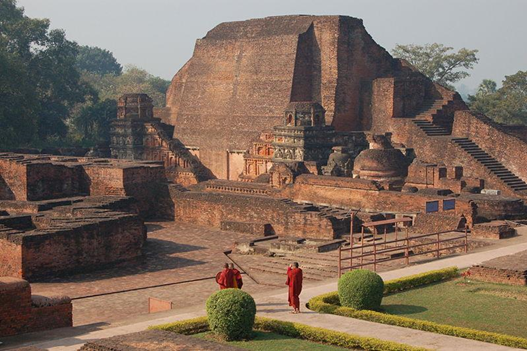
By far the most detailed description we have is of the Nalanda University in the ancient kingdom of Magadha thanks to the writings (seventh century CE) of Chinese travellers Xuanzang and Yijing. Students flocked from near and far to learn from the acclaimed teachers at the university and some came all the way from Tibet, China, Korea and Central Asia.

untitled

It was not easy to gain admission into Nalanda University (just as in an earlier era, it was not easy to be accepted as pupils by renowned gurus). From the accounts of Xuanzang, it appears that Nalanda had a very tough entrance examination. Only about 20% of the students, who applied, seem to have got through it. And yet, the university had as many as 8,500 students and 1,500 teachers (Mookerjee, 1960). There was even a network of schools that helped students prepare for getting into Nalanda, which sounds uncannily similar to today’s coaching centres for IIT-JEE and other competitive examinations.

The students of Nalanda were looked up to as models all over India and were highly respected, according to Xuanzang. Taking advantage of this, some people even faked their Nalanda degrees! By the seventh century, there were four other universities in Bihar, all largely inspired by Nalanda. They worked in collaboration, and by the tenth century, one of them—Vikramshila—emerged as a serious competitor to Nalanda in higher education.

A wide range of subjects were taught in Nalanda; sacred and secular, philosophical and practical, sciences and arts; it was the most complete education available at that time, says Xuanzang, who studied there for five years. He studied Yoga shastra under the highest authority of the time – Silabhadra. He also studied Nyaya, Hetuvidya, Shabdavidya and the Sanskrit grammar of Panini. There is an interesting side story to this. Xuanzang has written that, when he visited Kanchi, he met a number of monks from Ceylon. When he told them about his impending visit to Ceylon, they said it was futile because he would not meet anyone superior to them in knowledge. Intrigued, Xuanzang began to discuss yoga texts with them. To his disappointment, he found their explanations not as good as the one he got from Professor Silabhadra in Nalanda University (Mookerjee, 1960).

Nalanda mainly flourished under the patronage of the Gupta Empire as well as emperors such as Harsha and later, the rulers of the Pala Empire. Various endowments were made by the kings, which led to the construction of impressive buildings, majestic in their size with richly adorned towers and turrets that gave the look of hill-tops, and observatories that were covered by mist in the mornings. According to Xuanzang, there was a lofty wall all around the grounds and a big gate, which opened into the university with a big main hall from which was separated eight other halls. He describes that the upper rooms towered above the clouds and from their windows, one could see the wind and clouds producing new forms, and from the soaring eaves (overhang from the roof), splendid sunsets and moonlit glories could be seen. A similar description is given in the Nalanda Stone Inscription of Yasovarman of the 8th century stating that the rows of monasteries had their series of summits (shikhara-shreni) licking the clouds (ambudhara). The grounds had deep, translucent ponds bearing blue lotuses interspersed with the deep red Kanaka flower, while Amra groves spread their shade all around. The massive external grandeur of the buildings is said to have contrasted with the delicate artistic beauty of the interior (Mookerjee, 1960).

Debating – An intrinsic part of education in ancient India

Logic and debate were extremely significant for India’s philosophical traditions. This love for debate and presentation of arguments from ancient times formed the root of democracy, which has endured even today right down to the village level. The debates we see on TV channels and legislative bodies are a part of a continuum, albeit in a degraded form going back to a hoary past.  References to Tarka-Vidya, the science and art of logic and debate and Vaada-Vidya, the art of discussion can be found in innumerable ancient texts such as Ramayana, Manusamhita, Mahabharata, Skandapurana, Yajnavalkya Samhita, and Chandogya Upanishad, to name just a few.

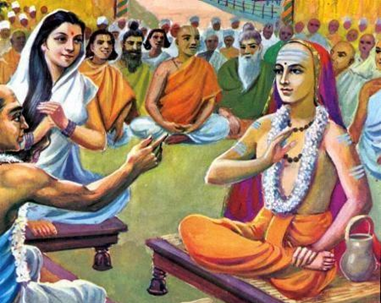
The famous Debate between Adi Shankaracharya and Mandana Mishra. Photo Credit: http://vipasana-vidushika.blogspot.in

The terminology of debate was well-developed. To give a flavour of the terms, consider saadhya (thesis which is to be established), siddhanta (proposition, tenet or conclusion), hetu (reason), udhaarana (example), saadharmya (affirmative example), vaidharmya (negative example), pratyaksha (perception), anumaana (inference) and pramaanaa (proof). In his book on Indian logic, Satish Chandra Vidyabhusana refers to Maitreya, an eminent teacher, also called Mirok in Chinese, who lived 900 years after the nirvana of Buddha. He wrote a treatise on debate in which, he postulated that the subject of debate should be a useful, not an irrelevant one. Further, he said debate should not be entered into in any place but in the presence of scholars or in a parishad (council). Maitreya laid out the rules by which a candidate’s victory or loss could be decided in a debate. He stressed that debaters should be well-versed in each other’s scriptures, must never discard dignity and use disrespectful language, must be fearless, must speak continuously and intelligibly, and with voice-variation, that is sometimes slowly and sometimes loudly. Is it not amazing that even today, these are the skills taught to public speakers and debaters?

According to Xuanzang the monks at Nalanda frequently assembled for discussions to test intellectual capacity. Those who were able to put forward finer points in philosophy, who could give subtle principles their proper place and who were ornate in diction, were rewarded. These universities played a big role in nourishing the spirit of open debate in ancient India. Yijing, another Chinese traveller to India, who came after Xuanzang mentions that kings were fond of organising intellectual tournaments in which people with superior knowledge and debating skills were richly rewarded (Mookerjee, 1960).

Nalanda had a famous, well-equipped library with many rare manuscripts. According to Yijing, the library had three huge buildings called Ratnasagara, Ratnadadhi and Ratnaranjaka of which Ratnasagara was a nine-storeyed building that stored rare sacred works such as Prajna Paramita Sutra.  Today, we marvel at the imposing libraries housed in Ivy League universities. Throw back your imagination to a time when such libraries were a part of Indian tradition.

Competition and collaboration between universities

Among the competitors of Nalanda was Valabhi University in Gujarat, which was famous for its teaching of secular subjects. Students went to study there from all over the country. Some of them got high government positions on graduating.

Vikramshila University was built by King Dharmapala in the 8th century, again a rival of Nalanda, but it also collaborated with it. The alumni of this university is said to have practically built the culture and civilization of Tibet. The most important of them is Dipankara Sri Jnana. Then there was Mithila, which specialised in logic and scientific subjects. According to historian Keay, it was so strict in guarding its knowledge that students were not allowed to take any books outside or even copies of lectures. They could only leave with their diplomas or degrees (Vidyabhusana, 1920).

Vikramashila University. Photo Credit: http://madhurima-bharati.blogspot.in

The monopoly of Mithila University was broken by the Nadia University, which also specialised in logic. The story goes that Vasudeva Sarvabhauma in the 15th century, studied in Mithila University, but when he was prevented from copying the texts, he committed to memory, the whole of Tattva Chintamani and the metrical part of Kusumanjali. Then, in Nadia, he wrote down the texts he had memorised and founded a new academy of logic. Nadia soon outrivaled Mithila by producing better scholars (Mookerjee, 1960).

When scientists, astronomers and mathematicians made a beeline for Ujjaini University

One university that simply stands out for its academic output in astronomy and mathematics is Ujjaini (also called Ujjain), which was equipped with an elaborate observatory and stood on the zero meridian of longitude of those times (Raju, 2007). Had imperialistic Europe not assumed control of the scientific discourse of the world, perhaps Ujjain, not Greenwich would have been today’s prime meridian.

Brahmagupta was among the most celebrated astronomers of Ujjaini University, who continued the tradition of Varahamihira and made significant contributions to mathematics. He worked on trigonometrical formulae, quadratic equations, area of cyclic quadrilateral, arithmetic progression and improved Aryabhata’s sine tables. In his treatise Brahmasphutasiddhanta, he was the first to treat zero as a number in its own right, rather than as simply a placeholder digit. He established basic mathematical rules for dealing with zero such as 1 + 0 = 1; 1 – 0 = 1; and 1 x 0 = 0 (B.S.Yadav, 2011). Brahmagupta’s works reached the court of Khalifa al-Mansur in Baghdad and played a path breaking role in making the Arabs conversant with Indian astronomy and mathematics. Later, this knowledge was transmitted to Europe.

The tradition of Brahmagupta was continued by Bhaskara II, also called Bhaskaracharya, who became the head of the astronomical observatory at Ujjaini. He wrote the famous Siddhantasiromani and Lilavati.  In the New World Encyclopedia, J. J. O’Connor and E. F. Robertson are quoted to have said in their paper for the School of Mathematics and Statistics that Bhaskaracharya “reached an understanding of the number systems and solving equations, which was not to be achieved in Europe for several centuries.” He was said to be the first mathematician to write a work with full and systematic use of the decimal number system.  Bhaskaracharya is also considered as the founder of differential calculus, who applied it centuries before Newton and Leibniz. He too had a profound impact on Islamic mathematicians just like the earlier acharyas of Ujjaini.

In the next part, we will examine the role of temple universities in southern India, the role of Indian scholars in influencing global streams of knowledge and the weakening of India’s education fabric during colonial rule.

original article LinkBy Suhana Sngh

Sikh guru were descendants of King Dasrath

Sanatan Dharm and Hinduism's avatarHINDUISM AND SANATAN DHARMA

1. Dasam Granth manuscript describing Chobis Avatar.

2. An stone lithographed copy of Adhyatam Ramayan printed in Lahore 1903.2. An stone lithographed copy of Adhyatam Ramayan printed in Lahore 1903.

All the Ten Sikh Gurus were the descendents of Raja Dasrath.

The ancestors of Guru Nanak and the succeeding Nine Gurus were the Kashtriyas of the Solar Dynasty, Kings Raghu, Aj, Dashrat, and Sri Ram Chander and their descendants, who were the rulers of North western part of India. A section of the descendents of this dynasty became the great scholars of religion and became the exponents of the Vedas. From these scholarly traditions , which were maintained in this clan, they came to be known as Baidis, Trehans, Bhallas and Sodhis It was in Baidi clan, Guru Nanak was born in 1469 C.E. , Guru Angad Dev in Trehan clan, Guru Amar Das in Bhalla clan, and Guru Ram Das in Sodhi clan; the six remaining Gurus, from 5th to…

View original post 1,414 more words

Battle of Kangra- Rajput defeated Tuglaq- truth retold

Sanatan Dharm and Hinduism's avatarHINDUISM AND SANATAN DHARMA

BATTLE OF KANGRA (1333)

HOW KATOCH RAJPUTS BADLY DEFEATED MUHAMMAD -BIN- TUGHLAQ ?

The Kangra Fort is located 20 kilometers from the town of Dharamsala on the outskirts of the town of Kangra, India.The Kangra Fort was built by the royal Rajput family of Kangra State (the Katoch dynasty), which traces its origins to the ancient Trigarta Kingdom, mentioned in the Mahabharata epic. It is the largest fort in the Himalayas and probably the oldest dated fort in India. Many rulers sought to conquer the fort and plundered the treasures of its temples.

. The Katoch Rajputs of Kangra Annihilate Muhammad bin Tughlaq’s China Army (1333 AD)

Muhammad bin Tughlaq has been described as the Caligula of India – a man possessed by megalomania, ambition and ineptitude in equal measure. Tughlaq dreamed of being a world conqueror like Alexander, but sadly possessed neither the skill nor the temperament of an…

View original post 612 more words