Krishna – The Historical Perspective
This day, Narsimha defeated the demon,To uphold virtuous Prahlad’s dominion,
View original post 4,147 more words
Krishna – The Historical Perspective
View original post 4,147 more words
These are some open evidence which west cant refuse !!! Time and again they tried their level best to keep aside hindu history of human civilisation .Already in my many post, I have provided ground breaking evidences yet for many Indians, Americans. Native americans to Myans , Sumer , Incas , Meso all are Indian migrants .
The ancient Mexican game of Patolli is similar in details to the game of Panchisi played in India. The mathematical probability of two games invented separately agreeing by chance in so many specific intricate features, is zilch. Mexican call a potter “Kumbhar”, as Sanskrit word. There are several other similarities.After Vedic people the Mayas of Yucatan were the first people to use a zero sign in Mathematics. This knowledge came from India, as we had this knowledge thousand of years before them. All over Mayan civilization you find stone sculptures of Indian Vimanas and…
View original post 6,731 more words
Ancient India and Mayan similarities

By Anand Sharma
The archaeological remains of ancient Maya civilization of Mexico are lying scattered in the parts of Yucatan, Campeche, Tabasco and eastern half of Chiapas as well as in the territory of Quintana Roo of the republic of Mexico. Covering an area of about 125,000 square miles, its traces are to be found in the western section of Honduras Republic, Peten and adjacent highlands of Guatemala and practically in the whole of Honduras.
Admiral Christopher Columbus mistakenly called the New World
inhabitants as Indians. Although he corrected himself subsequently, the natives of Americas continued to be called ‘Indians’. During the course of his third journey, Columbus came into contact with ‘Maya’ people.
Many theories have been advanced by scholars to explain the origins of these American Indians and if there were any links…
View original post 1,256 more words

‘बृहत’ (बड़ा) और ‘आरण्यक’ (वन) दो शब्दों के मेल से इसका यह ‘बृहदारण्यक’ नाम पड़ा है। इसमें छह अध्याय हैं बृहदारण्यक उपनिषदों पर भर्तु प्रपंच ने भाष्य रचना की थी।
प्रथम ब्राह्मण में, सृष्टि-रूप यज्ञ’ को अश्वमेध यज्ञ के विराट अश्व के समान प्रस्तुत किया गया है। यह अत्यन्त प्रतीकात्मक और रहस्यात्मक है। इसमें प्रमुख रूप से विराट प्रकृति की उपासना द्वारा ‘ब्रह्म’ की उपासना की गयी है।
दूसरे ब्राह्मण में, प्रलय के बाद ‘सृष्टि की उत्पत्ति’ का वर्णन है।
तीसरे ब्राह्मण में, देवताओं और असुरों के ‘प्राण की महिमा’ और उसके भेद स्पष्ट किये गये हैं।
चौथे ब्राह्मण में, ‘ब्रह्म को सर्वरूप’ स्वीकार किया गया है और चारों वर्णों (ब्राह्मण, क्षत्रिय, वैश्य और शूद्र) के विकास क्रम को प्रस्तुत किया गया है।
पांचवें ब्राह्मण में, सात प्रकार के अन्नों की उत्पत्ति का उल्लेख है और सम्पूर्ण सृष्टि को ‘मन, वाणी और प्राण’…
View original post 7,936 more words

Srimad Bhagavatam Canto 5 Chapter 21 text 1 to text 19 : The Movements of the Sun by His Divine Grace A.C Bhaktivedanta Swami Prabhupada
This chapter informs us of the movements of the sun. The sun is not stationary; it is also moving like the other planets. The sun’s movements determine the duration of night and day.
When the sun travels north of the equator, it moves slowly during the day and very quickly at night, thus increasing the duration of the daytime and decreasing the duration of night. Similarly, when the sun travels south of the equator, the exact opposite is true — the duration of the day decreases, and the duration of night increases.
When the sun enters Karkaṭa-rāśi (Cancer) and then travels to Siṁha-rāśi (Leo) and so on through Dhanuḥ-rāśi (Sagittarius), its course is called Dakṣiṇāyana, the southern way, and when the sun enters Makara-rāśi (Capricorn)…
View original post 2,015 more words
The inquisitive human mind naturally yearns to understand the universe and man’s place within it. Today scientists rely on powerful telescopes and sophisticated computers to formulate cosmological theories. In former times, people got their information from traditional books of wisdom. Followers of India’s ancient culture, for example, learned about the cosmos from scriptures like the Srimad-Bhagavatam, or Bhagavata Purana. But the Bhagavatam’s descriptions of the universe often baffle modern students of Vedic literature. Here Bhaktivedanta Institute scientist Dr. Richard Thompson suggests a framework for understanding the Bhagavatam’s descriptions that squares with our experience and modern discoveries.
Jambudvipa: The Srimad-Bhagavatam describes that the universe lies within a series of spherical shells which is divided in two by an earth plane called Bhu-mandala. A series of dvipas, or ‘islands,’ and oceans make up Bhu-mandala. In the center of Bhu-mandala is the circular ‘island’ of Jambudvipa (inset), whose most prominent feature is…
View original post 2,557 more words

Sri Narayana Panditacharya’s ‘Mani Manjari’ is a work of 301 slokas divided into eight chapters. Traditionally, it is the first text taught to Madhvas. It is among the three works on Sri Madhvacharya – Sri Hari Vayustuti and Sri Sumadhva Vijaya, being the other two – that has had a long tradition of being recited with devotion among orthodox Madhva circles. According to Dr. BNK Sharma, it is an essential prologue to Sri Sumadhva Vijaya. In the collection of essays on Sri Sumadhva Vijaya by Sixteen Eminent Scholars, released in Srirangam in late sixties, Sri Narayana Panditacharya is mentioned as amsha of Sri Subramanya, though no pramanas are given.
The first two chapters deal with Creation and Ramayana. The third and fourth chapter deal with Krishnavatara. The fifth chapter deals with ascent of Buddhism and early days of Advaita. The sixth chapter deals with the birth of Adi Sankara…
View original post 9,679 more words
Maharshi Bharadwaaja:
I make obeisance to the Divine Being, who is visible on the crest of the Vedas, who is the fountain of eternal bliss, and whose abode is reached by Vimaanas or Aeroplanes. Having studied the Shaastraas or sciences propounded by previous men of science to the best of my ability, for the benefit of mankind, I shall deal with the science of Aeronautics, which is the essence of the Vedas, which will be a source of joy and benefit to humanity, which will facilitate comfortable travel in the sky from world to world, in eight chapters, consisting of 100 topics…
View original post 44,004 more words
Vanaras and Hanuman were not monkeys but advanced civilized race that was going down as new humans evolving. Western confused Hindus.

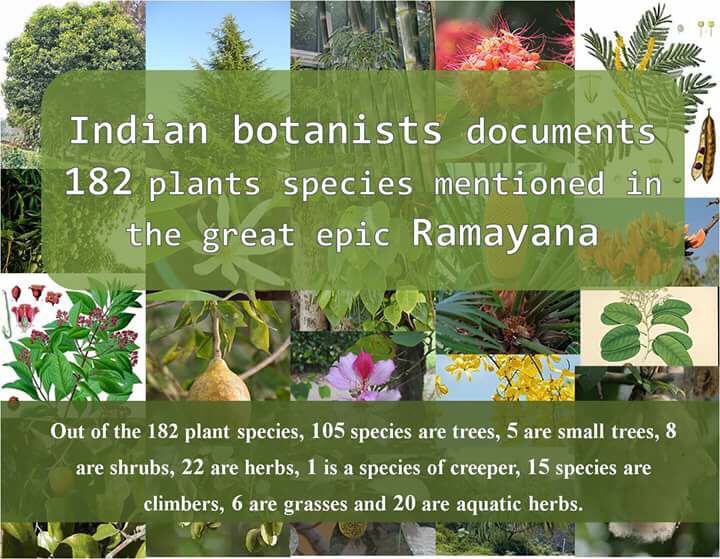
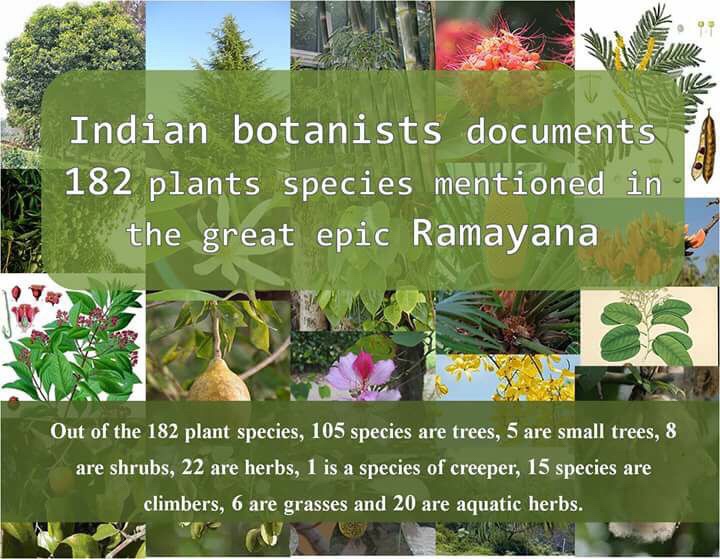
The world of plants is central to the Ramayana, and this Indian pre-historical book written in long poem describes several trees and plants that are geographically accurate, and even today, the plants that are described are found growing in the exact locations all over India where Valmiki, author of the Ramayana, has placed them. It is both geographically and botanically correct.
Mr. M. Amerthalingam, botanist with the C.P.R. Environmental Education Centre, Chennai, presented the paper, “Plant Diversity in the Valmiki Ramayana” at the February 2013 Conference on The Ramayana in Literature, Society, and the Arts. The proceedings have recently been published. Dr. P. Sudhakar, the co-author*, was invaluable in tracing the botanical and modern names for several of the plant species, which are named in Sanskrit. Valmiki Ramayana is replete with superb descriptions of nature’s glory. It hinges on two major events, namely Rama’s fourteen year exile in the forests…
View original post 340 more words