Buddha did not convert 


There was no “Hinduism” at that time. There was a nation of many religions united under Aryan (Brahmin) law, the Constitutional Mantra of which is represented by the Yantra of the Swastika. This nationality came to be called Hinduism much later after it was defunct.. The Budha was an Arya of the Gautama Gothra who practiced Brahmanism. He was a Brahmin by religion and a Kshatriya by Varna who opted for Shivacharya Tantra and Sankhya Pramana.
Original Budhism is a peculiar mythology developed from local tribal lore in different places around a core of Brahmanism. Ashokan Budhism was Imperial like the Christianity of Paul, Charlemagne and Constantine or the Islam of Mahomet and Budhist Mendicants were often Imperial spies intended to smell out dissent and Brahmanism which would then be eradicated by ruthless “Budhist” soldiers.. 
Pre-Ashokan Budhism which was spread through debate and preaching is nothing but Brahmanism translated to Pali and other languages and then back again to eternal fissiparious confusion. 
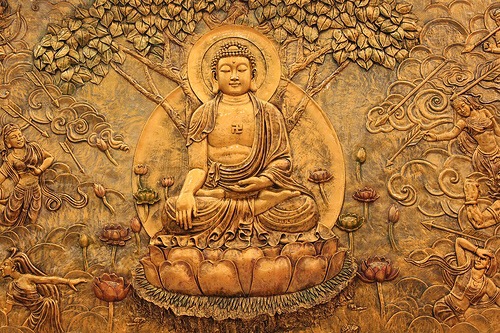
Budha himself was an agnostic with a handful of faithful disciples whose answer to the question, “Is there Brahma”? was a half smile as he passed away. Budha was used to reform and spread Brahmanism by Brahmins. Kashyapa created Zen (good) , Koushika (Padma Sambhava) took it to Tibet. Bharadwaja took it to Japan. His statue still sits outside the great temple at Nara. 
Budhism adopts the notions of Karma and Dharma that originated in the Prathamo Upanishad that was received by the Saptha Rishis (Athri, Bhrigu, Kuthsa, Vasishta, Gautama, Kashyapa and Angirasa) who are the patrilineal ancestors of the Shroutha Smartha Brahmins (I am a Kashyapa) . 
While Ashoka destroyed and plundered all the Brahmin temples and guru kulas (Sarnath and theSanchi Stupa are now the oldest buildings in his erstwhile empire), the Budhist temples of Japan, which predate Ashokan Budhism, sport the Saffron Swastika of Aryavarta Dharma rather than the Chakra of Ashoka’s tyranny, (So do India’s Jain temples). 
Japan is a classic case which has been immune to political mythology masquerading as History thanks to their Shinto-Kojiki culture which passes mouth to ear from guru to shishya as does the Shroutha Smartha tradition. The ancient Shinto-Budhist Sanju Sanjusangendo Hall of Warriors at Kyoto has 12 foot high bronze statues of the Dasha Dikpalaka of Aryan Brahmanism. The not so ancient Asakusa Budhist Temple (near Tokyo) has enormous stone statues of Virinchi (Mahasthana Praptha), and Narayana (Amithabha) installed in the garden outside the Shinto Shrine to those who built the temple and Shankara (Avalokiteshwara or Kannon) is the principal deity. These are the trinity of Gunas that come from Savitur,the Light of Surya (the Sun) which is itself formed from the light of Brahma (Mitra common to Zorastrianism and the now exterminated Gnostic Christianity-though the Mitre head dress derives its name from the original Mitra) in Brahmanism. Indra, Varuna, Rahu and Kethu guard the gates at Asakusa Temple and the temple main shrine is emblazoned with an enormous Saffron Swastika at its rear which all traditional worshipers pay obeisance to during perambulations. There is a separate shrine for Lalitha which indicates that this temple was constructed post Dravido-Aryan integration (Atharva Veda period) and pre Ashokan 
Thailand is also an interesting point here. While the majority of the population follow pre-Ashokan Budhism (distinguished by the Swasthika of Aryavartha Dharma), the State Religion is Brahmanism, and the King, Bhoomipala Athulyatheja, is an Arya Kshatriya who follows Brahmanism. So was the late Nara Utham Sihanouk of Cambodia. Budhism in India was destroyed in the backlash to Ashoka but prospered elsewhere. .
Footnote:
Gandhi, like any post 1857 “God Man,” is the “Hindoo” that the British helped create to emasculate the People of Dharma. 
Outside of the “Church”, we, the Illuminati, have always known that Titus Flavius brought about the first schism between the Gnostics and the literati to pacify the Jews and create a Christianity, via the Literati, that would be an instrument of the Roman Empire. Paul embraced the temptations of Satan repudiated by Jesus and turned Christianity into an Empire. Constantine Charlemagne James and others formed Councils that cherry picked gospels suitable for the purpose and discarded the rest. This is why present day Christians cannot perform the miracles that Jesus’ original disciples could despite claiming to be following in Jesus’ footsteps. We also know that Christianity not only failed Jesus, but also failed Satan as it got corrupted by various human virtues such as mercy, compassion, and love. This is why Satan set Christianity aside, possessed Mahomet and founded Islam: 
Ashoka did the same thing and twisted Budhism (which was a proselytizing and modified Brahmanism) to his Imperial advantage, tyranny and self glorification. The backlash all but wiped out Budhism and the Black Chakra of Ashoka’s writ in India while Budhism prospered elsewhere in China, Japan, Tibet and so on under the benign Saffron Swasthika of the Aryan Constitution. 
Uthman (3rd Khalifa) had ordered burning of all copies of Quran except his version. Abdullah Ibn Masud (person Mohammad recommended to learn Quran from) Rejected Uthman’s version and asked the people of Iraq to hide the real Quran from Uthman. The Original Quran was hidden somewhere in Iraq or Syria, destroying which is the target of descendants of Uthman and Abu Bakr, this is the reason why they are attacking the museums in Iraq & Syria. Todays muslims have a choice – to continue following Uthman’s Quran; OR to find the original Quran, follow it, and become the protected “one sect” Mohammad talked about. 
This is rather like William Hunter of the William Hunter Commission created by the British that picked up fragments of the Manu Smrithi, Vedas and so on from Max Mueller and others and twisted them and published their own perverted versions as a central pillar of their effort to create a “Hinduism” to replace the People of Dharma by eradicating Brahmanism, and the talking, walking Libraries of Aryan History, Law, Traditions and so on, The Brahmins. 
Post 1857, the British took a page from Titus Flavius to create a “Hindu” lumpen in the vacuum comprising all who were not the Deen e Kitabi with Sgt Khilafart Gandhi, MBE, leading the charge to emasculate the natives and lobotomize the People of Dharma. 
Sufism is a similar confection that attempted to disarm pockets of resistance that could not be overcome with violence through a form of “bribery”. It began with the need to motivate the enslaved architects, masons, artists, musicians and others to remain creative and productive though enslaved under the iron heel of Moslem tyranny.
The British began the eradication of Brahmins and Brahmanism post 1857. Part of the project was to create a tame Hinduism that went by the Book as trans created and approved by the British. The William Hunter Commission was entrusted with this project of creating a :”Hinduism” that would include all those who were not Deen e Kitabi as the “Hindu” lumpen independent of Brahmins and dependent on British made books. From this distortion sprang the pratings of Ambedkar, Periyar, Narayana Guru, Khilafart Gandhi and the great veneration of the Gita which is but an excerpt from a literary masterpiece that contains far more sagacious passages and has no canonical significance whatsoever other than in India’s grotesque British made courts and the lectures of latter day God Men.

Did Buddha leave hinduism
By suchindranath Aiyer

http://pparihar.com/2015/01/15/love-story-of-man-singh-tomar-and-gurjar-mrignayani-mansinghtomar-rajput/

SUMERIAN KINGS IN PRESENT DAY IRAQ.

Sanatan Dharm and Hinduism's avatarHINDUISM AND SANATAN DHARMA


Out of the many incredible artefacts that have been recovered from sites in Iraq where flourishing Sumerian cities once stood, few have been more intriguing that the Sumerian King List, an ancient manuscript originally recorded in the Sumerian language, listing kings of Sumer (ancient southern Iraq) from Sumerian and neighbouring dynasties, their supposed reign lengths, and the locations of “official” kingship. What makes this artefact so unique is the fact that the list blends apparently mythical pre-dynastic rulers with historical rulers who are known to have existed.

The first fragment of this rare and unique text, a 4,000-year-old cuneiform tablet, was found in the early 1900s by German-American scholar Hermann Hilprecht at the site of ancient Nippur and published in 1906. Since Hilprecht’s discovery, at least 18 other exemplars of the king’s list have been found, most of them dating from the second half of the Isin dynasty (c…

View original post 1,051 more words

An Atomic Bomb went off on Earth more than 12000 years ago?


Ancient civilizations and pagan religions have left many mark in history with scripts, monuments and numerous objects that make us reevaluate what we know so far regarding our past and where we are going as a civilization.

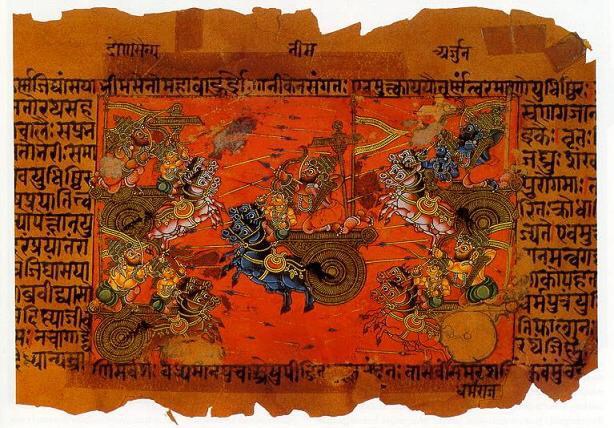
The Mahabharata and the Ramayana offer many answers to numerous questions regarding our past, present and future.
The Mahabharata is one of the two major Sanskrit epics of ancient India, the other being the Ramayana. It consists of 100,000 verses divided into 18 parts or books that are equivalent to eight times the Iliad and Odyssey combined. these ancient texts are more than a historical narration. It is a combination of facts, legends stories and myths. A vast collection of didactic discourses written that were written in a beautiful language, nurturing all Hindu mythology and creating one of the major world religions: Hinduism.
Among those historical texts, we see a story of a devastation that occurred in the past, one that cannot be compared to anything else in the past, a devastation much similar to what we know today is destruction caused by nuclear weapons. Historian Kisari Mohan Ganguli, argues that the Mahabharata and the Ramayana are full of descriptions of large nuclear holocausts that are apparently of incredibly higher proportions than those at Hiroshima and Nagasaki.
When a student asked Dr. Oppenheimer if the first nuclear device that went off was the one at Alamogordo. during the Manhattan Project, he responded… Well … yes. In modern times, yes, of course.
The ancient Hindu text the Mahabharata:
“Gurkha, flying a swift and powerful vimana,

hurled a single projectile

charged with the power of the Universe.
An incandescent column of smoke and flame,

as bright as ten thousand suns,

rose with all its splendor.
It was an unknown weapon,

an iron thunderbolt,

a gigantic messenger of death,

which reduced to ashes

the entire race of the Vrishnis and the Andhakas.
The corpses were so burned

as to be unrecognizable.
Hair and nails fell out;

Pottery broke without apparent cause,

and the birds turned white.
…After a few hours

all foodstuffs were infected…

…to escape from this fire

the soldiers threw themselves in streams

to wash themselves and their equipment.”

 A second passage.
“Dense arrows of flame,

like a great shower,

issued forth upon creation,

encompassing the enemy.

A thick gloom swiftly settled upon the Pandava hosts.

All points of the compass were lost in darkness.

Fierce wind began to blow

Clouds roared upward,

showering dust and gravel.
Birds croaked madly…

the very elements seemed disturbed.

The sun seemed to waver in the heavens

The earth shook,

scorched by the terrible violent heat of this weapon.
Elephants burst into flame

and ran to and fro in a frenzy…

over a vast area,

other animals crumpled to the ground and died.

From all points of the compass

the arrows of flame rained continuously and fiercely.” — The Mahabharata
 
There are many other references in the Ramayana which seem to be very similar to those described in the above texts. It is very clear that these texts allude to a great holocaust that killed thousands of lives. One that can be easily traced to nuclear weapons we use today.
But is there evidence, other than the texts supporting the theory that a nuclear device went off on Earth thousands of years ago? In 1992 researchers discovered in Rajasthan a layer of radioactive ash, covering an area of ​​about eight square kilometers, 16 kilometers west of Jodhpur. The radiation is so intense that it still contaminates the area today. Researchers excavated at Harappa and Mohenjo-Daro, discovering skeletons scattered throughout the area as if a sudden event occurred that devastated entire cities.
 “(It was a weapon) so powerful

that it could destroy the earth in an instant–

A great soaring sound in smoke and flames–

And on it sits death…” . — The Ramayana
The site where researchers have found skeletons and remains of radioactivity is very similar to Hiroshima and Nagasaki, but with one striking difference: the radiation levels found at Harappa and Mohenjo-Daro were 50 times higher than the remains of the nuclear holocaust of Hiroshima and Nagasaki.
What really happened? Are the Mahabharata and the Ramayana really describing a nuclear device exploding on Earth tens of thousands of years ago? If so where id it come from? Ancient astronaut theorists are talking about a nuclear holocaust which happened around 12,000 years ago. An explosion that according to theories, created a crater with 2154 meters in diameter, located 400 kilometers from Mumbai.

The dating ranges from 12,000 to 50,000 years ago so researchers have a gigantic time frame to work with.

From ancient-code.com

Ancient Indian and Electricity

Sanatan Dharm and Hinduism's avatarHINDUISM AND SANATAN DHARMA

Did Ancient India know the use of Electricity :

ai

First mentioned about 1,200 BCE, in ancient writings: Atharvana अथर्ववेद. or the Book of White and Black Magick, a collection of 730 hymns with about 6,000 mantras, divided into 20 books.

The west mentions the Greeks, about 600 BC to be the first to discover it. The Hindu Holy Scriptures, Atharvana Veda, proves otherwise. In India electricity was well known and even used for warfare. Long before the Greeks. Here is proof.

Chapter 1: Hymn VII
Verse 2: Nav Yo Navati Puro bibhed bahvotjasaa
Ahi Cha vritrahaavadheetai1

Translation : Electricity , which breaks, by the energy of its arms the 99 cities, destroys the cloud, which covers the rays of the sun, the source of all energy and power.

Verse 3: Sa na Indrah Shivah sakhashwavad gomadvavama
Urudhaarev dohate

Translation : That very electric power may be our peaceful friend, providing…

View original post 1,159 more words

More than 100,000 years proof of man-Bhimbetka Caves in Madhya Pradesh | HINDUISM AND SANATAN DHARMA

https://pparihar.com/2016/10/29/more-than-100000-year-proof-of-man-bhimbetka-caves-in-madhya-pradesh/

Athatvsvedas-Ancient Indian theory of science, cosmos  | HINDUISM AND SANATAN DHARMA

https://pparihar.com/2016/10/26/athatvsvedas-ancient-indian-theory-of-science-cosmos/

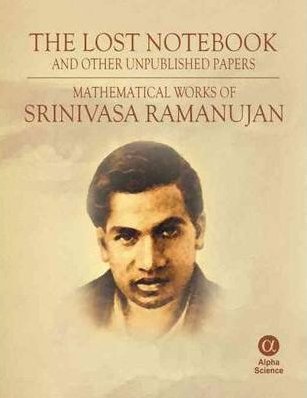
Lost notebook of Ramanujan Math

Sanatan Dharm and Hinduism's avatarHINDUISM AND SANATAN DHARMA

ramanujan-lost-notebookramanujan

Ramanujan’s second construction for the approximate squaring of a circle

To experience the greatness of great men one has to relive or redo some acts of theirs to the best of ones ability. In ones youth such enactments might inspire one to make a bid for greatness. Whether this happens or not is mostly up to your genetics. Nevertheless, through the enactments one can at least savor the experience of what it takes to get there. If there was one man in our midst who could have lived up to be a Gauss or an Euler it was Srinivasa Ramanujan.

manasataramgini

By redoing some of his acts that are within the grasp of our limited intellect we experienced the monument that he was. He gave two constructions for the approximate squaring of a circle using a compass and a straight-edge. We had earlier described the first and more widely known of…

View original post 406 more words

Ramayan is > 2 million years old | HINDUISM AND SANATAN DHARMA

More than 2 million year old God ram story of Hindu
https://pparihar.com/2015/03/30/ramayan-is-2-million-years-old/

Krishna, Vishnu and Mahabharat influence on Ancient China

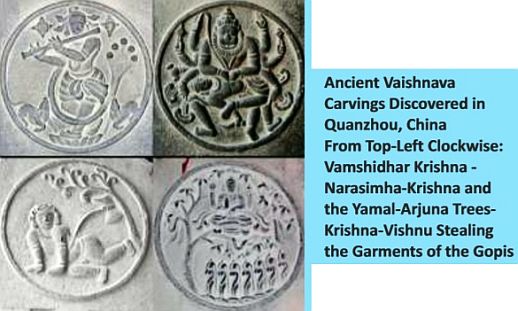
vaishnava_carvings_quanzhou_china

Apart from Saivism, Vaishnavism was also followed by people on ancient China.
Mahabharata (composed around 3100 BCE) makes a reference to presents brought by the Chinese to the Rajasuya Yajna performed by the Pandavas.
In the Vana Parva of the Mahabharata it is stated that the Pandava brothers crossed the country of the Cinas (China) during their trek through the Himalayan territory north of Badrinath.
They are said to have reached the realm of the Kirata King Subahu. Also in the Mahabharata the Cinas (Chinese), with the Kiratas, are found among the armies of King Bhagadatta of Pragjyotisa, India’s modern Assam region.
In the Sabha Parva this king is described as surrounded by the Kiratas and the Cinas.
The name China and the Chinese were after the Chins of India and proves the Indian origin of the name of China.

In the Bhisma Parva of the Mahabharata, the corps of Bhagadatta, consisting of the Kiratas and the Cinas of yellow color, are said to ‘look like a forest of Karnikaras‘.
In the Artha Sastra(Book on Economics written in 3rd century BCE) of Chanakya, China is mentioned as well. It is theorized that the name China is based upon the name of the kingdom, Ch’in, which was established by Shih Huang Ti in the year 221 BCE, but the word and race of Chin was mentioned in Mahabharata much earlier.

The name China comes from “an ancient Sanskrit name for the regions to the East”. The Chinese word for lion, ‘Shih’, used long before the Chin dynasty, was derived from the Sanskrit word, ‘Simha’.
African Swahili word for lion ‘Simba’ is virtually the same as the Sanskrit ‘Simha’ as well.
The Greek word for China, ‘Tzinista’, appears to be derived from the Sanskrit ‘Chinasthana’.

Magadha was known to the Chinese by the name Mo-kiato, and its capital was recognized by both its Hindu name Kusumpura, for which the Chinese wrote Kia-so-mo-pon-lo and Pataliputra, out of which they made Patoli-tse by translating putra, which means son in Sanskrit, into their own corresponding word, tse.
Such translation of names has thrown a veil of obscurity over many a name of Hindu origin.
Hindu geography has suffered a great loss.
Another clear example of the impact of dialect upon a language in the Sanskrit word ‘Maṇḍala’. In Japan it becomes ‘Mandara’ but in China it is ‘Màntúluó’.

Both Buddhism and Hinduism were patronized by the Chinese rulers. In the 6th century AD, the Chinese royal family was Hindu for two generations. The following Tang dynasty (7th to the 9th century A.D.) also patronized both Hinduism and Buddhism because the latter was but a branch of Hinduism.

Chinese Creation ‘Myth’ involves a ‘Boy of the White Crane‘. He is said to live in the palace of ‘jade emptiness’.
This is believed to represent the ‘Primeval Ocean’ and Lord Brahma who rides a white swan and is born from the navel of Lord Vishnu as he rest in the Primeval Ocean.
Also the “Supreme God in Chinese popular religion” is called ‘Yù-huáng[-dà]-dì’, which translates as “JadeEmperor-Big-Supreme Being“.
Thus we find that, like Quetza-lcoatl, the Supreme Being of the Mayans and
Aztecs, Lord Vishnu, the Supreme Being within the Vedic tradition, the Chinese Supreme Being Yu-Huang di is green as well.
Since this ‘Jade-Green’ is considered to be seacolored green we see yet another Supreme Being connected with the color of water which iconically means the color blue.

The presence of carvings depicting Krishna’s activities as a child in Vrindavan is quite remarkable. Despite theories that present the evidence of Chinese Vedic
culture as a mere offshoot of the Tamil merchant community, the presence of carvings based on Krishna’s Vrindavan pastimes suggest much more.
The fact is just as Buddhism was adopted and practiced by billions of non-Indians it is highly probable that Vedic culture was just as prevalent.

Taoism similar to Saktism (Śāktaṃ in Vedic tradition)

Chinese Taoism has something in common with Saktism in Vedic tradition.
One text in which the Tung Hsuan Section of the Tao Tsung (Taoist Canon) originated goes by the name Lin PaoChing (Book of the Marvelous Jewel).
Here we can find the influence of Brahmanism and Upanishad (Vedanta) in particular. It has a portrait of Yuan Shih TienTsun (the Highest God of Taoism) based on the portrait of the Maha Brahma of Brahmanism at the numerous kalpas in the unlimited darkness of Chaos.
Thus, He transforms himself into thirty-three devas, asuras, Ten directions of the Universe etc.
Among many other rare insights into Chinese Hinduism, the Monkey King, Sun Wukong, is indeed Hanuman.

Today’s India is still called Bharat but it only represents an extremely truncated Bharat.
True Bharat is the entire world and this Vedic culture is the entire humanity’s heritage.

Read more