


Sanskrit has invented some 1.7 millions of years ago as a scientific
language expressly for passing on Vedic knowledge, since the inventors of
Sanskrit was well aware that Earth would pass through an Ice Age and pole
shift, where their Siberian homeland would freeze over. For this reason, the
authors of Sanskrit developed the language in order to encode their highly –
advanced scientific knowledge.
To achieve this goal, the builders of Sanskrit attached a numerical value to each
Sanskrit letter. Thus, a passage in Sanskrit which appears to describe a religious
theme (as humans have generally interpreted the Vedas for millennia) in fact
describes nuclear physics.
In Sankhya the Triguna theory of simultaneous and self-similar interactions
derives the standard oscillatory cycle of components in space through axiomatic
theorems and equals 2.965759669e+8 interactions per cycle, which is
approximately equal to the frequency of the modern velocity of light at a
View original post 857 more words

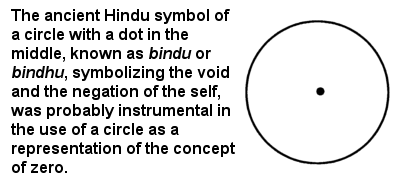





 Jambudvipa: The Srimad-Bhagavatam describes that the universe lies within a series of spherical shells which is divided in two by an earth plane called Bhu-mandala. A series of dvipas, or ‘islands,’ and oceans make up Bhu-mandala. In the center of Bhu-mandala is the circular ‘island’ of Jambudvipa (inset), whose most prominent feature is…

 GLOBAL HINDUISM