History of Hindus murdered by Muslims from 635 AD-Authentic History

Sanatan Dharm and Hinduism's avatarHINDUISM AND SANATAN DHARMA

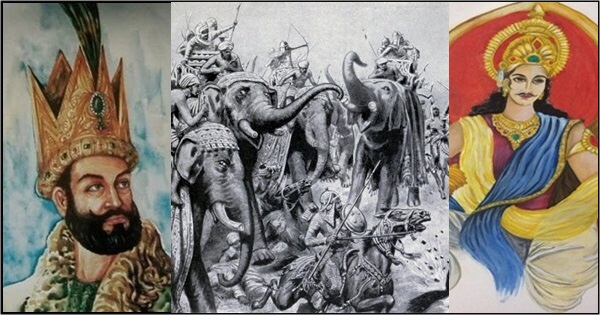
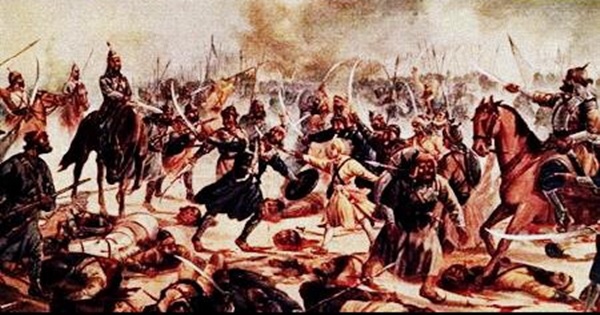
Wounds of the past continue to haunt the people. Without understanding the past, one can never fully understand the present. Therefore, we make an attempt to see a brief history of attacks on India- all done by foreigners. The aggressive design against India initiated in 636-37 AD by the Arabs and later on carried further by the groups from the Middle East, has been continuing intermittently for centuries. These attacks started within 14 years of the birth of Islam in AD 622, and within 4 years of the death of the Prophet of Islam in AD 632.

The Godhra carnage of 27thFebruary, 2002 is not a product of the Ayodhya movement, or the Babri mosque demolition on 6thDecember, 1992. There may be more Godhras in store. India has been bleeding from a thousand wounds. Belgium based world famous scholar, Dr. Koenraad Elst (b. 1959) has written:…

View original post 2,683 more words

How Samgramaraja of Kashmir Repulsed Attacks of Mahmud of Ghazni

Sanatan Dharm and Hinduism's avatarHINDUISM AND SANATAN DHARMA

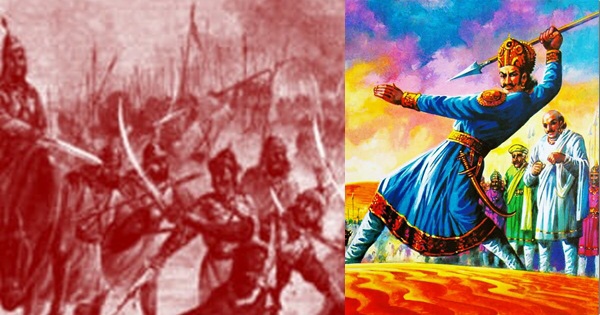
Raja Samgramaraja! Not everyone are familiar with this king from Kashmir, who ruled from 1003 to 1028 CE. He was the founder of the Lohara dynasty. Mahmud of Ghazni plundered and looted many kingdoms in India besides razing hundreds of temples to the ground, beheading lakhs of Hindus, taking women as sex slaves, and converting many to Islam. Do you know Raja Samgramaraja repulsed several attacks of Mahmud of Ghazni in Kashmir? Plunderer Mahmud could never defeat the Kashmiri king! Besides, Raja Samgramaraja also helped Trilochanpala, the Hindu Sahi ruler of Kabul, with an army against Mahmud of Ghazni. The combined army defeated Sultan Mahmud. It is unfortunate that History books did not teach us this!

Samgramaraja ascended the throne of Kashmir in 1003 CE after the death of Didda, the queen of Kashmir. Didda belonged to Lohara, a region located in the Pir Panjal range of mountains between western…

View original post 1,430 more words

Lalitaditya Muktapida: Kashmir King who Defeated Arabs and Subjugated Turks

Sanatan Dharm and Hinduism's avatarHINDUISM AND SANATAN DHARMA

Lalitaditya Muktapida! Not many except few have heard about this great king of Kashmir from the 8th century. He was one of the bravest kings of India who resisted attacks by Arabs. Junaid, the Arab governor of Sindh, attacked Kashmir following the orders of Caliph Hisham. Lalitaditya defeated Junaid and thus the Arab attempt of plundering Kashmir failed. He subjugated the Turks by attacking their territories. He also defeated the Tibetans, who were then very strong. He built the famous Martand Sun temple. This temple is the only surviving structure that speaks volume about this great emperor from Kashmir.

Do you know Lalitaditya Muktapida had one of the biggest empires in world history? But it was short lived. It was more of a military expedition. He was able to subjugate kings of regions ranging from Afghanistan and Punjab, major parts of Haryana and Uttar Pradesh to Bengal, Bihar, and Orissa…

View original post 1,815 more words

How Avanijanashraya Pulakeshin of Gujarat Defeated Arabs in 737 CE

Sanatan Dharm and Hinduism's avatarHINDUISM AND SANATAN DHARMA

Avanijanashraya Pulakeshin! Except in Gujarat and few parts of South India, the name of this brave son of Bharat Mata is in oblivion. Like hundreds and thousands of our valorous ancestors from the east to west, north to south, who don’t find a place in History books, his name is unsung. He is one of the earliest feudatory chiefs from Gujarat, who bravely repulsed attacks by Arabs. He defeated the Arabs in a fierce battle near Navsari in around 737 CE.

Think about Gujarat. The region’s ancient settlements are corroborated by archaeological evidences confirming existence of a prosperous city dating back to 4000-6000 years. This was Krishna’s Dwarka. Besides, there are numerous archaeological substantiations of Stone Age settlements in this region. And who isn’t familiar with the Indus Valley excavations in this area. Ancient ports here served as national and international trading centres. Nandas, Mauryas, Satavahanas, Guptas followed by Maitrakas…

View original post 844 more words

How Marthanda Varma Defeated Dutch in Battle and Crushed their Indian Expansion

Sanatan Dharm and Hinduism's avatarHINDUISM AND SANATAN DHARMA

How Marthanda Varma Defeated Dutch in Battle and Crushed their Indian Expansion

Who was Raja Marthanda Varma? Except few from Kerala and Tami Nadu, the rest of India hardly knows about this brave son of Bharat Mata from Travancore. He was one of the first Asian kings to badly defeat a robust Dutch army in a naval battle at Colachel. As per the bookBattle of Colachelby Frederic P. Miller, Agnes F. Vandome, and John McBrewster,it was the earliest example of defeat of an European power in Asia. It was 1741. Marthanda Varma captured all the Dutch forts and crushed their expansion in India. Had Marthanda not checked or destroyed their expansion, there would have been an extended Dutch rule in India like the British! Marthanda Varma is also known as the ‘maker of modern Travancore’. Sadly, his name is in oblivion in our national History textbooks.

It was…

View original post 1,880 more words

How Pazhassi Raja of Kerala Resisted Troops of Hyder Ali, Tipu Sultan, and British

Sanatan Dharm and Hinduism's avatarHINDUISM AND SANATAN DHARMA

Pazhassi Raja! He was a brave warrior known to many from Kerala but almost unknown to the rest of India. At a young age of 21 he became the prince regent of the princely state of Kottayam of Malabar. He ruled as king from 1774 to 1805. He bravely resisted Hyder Ali’s troops using guerrilla warfare techniques. In later years, he also resisted Tipu Sultan’s troops. He was one of the earliest freedom fighters of India. Even Arthur Wellesley, who later defeated Napoleon Bonaparte and became first Duke of Wellington and twice the British Prime Minister could not defeat Pazhassi Raja! He was called the Lion of Kerala – the lion who never bowed in front of foreigners, the lion who defended Kerala from foreign clutches. It is a pity that we hardly know about this brave son of Bharat Mata from Kerala!

Kerala Varma, Cotiote Rajah,Pychy Rajah – these…

View original post 2,613 more words

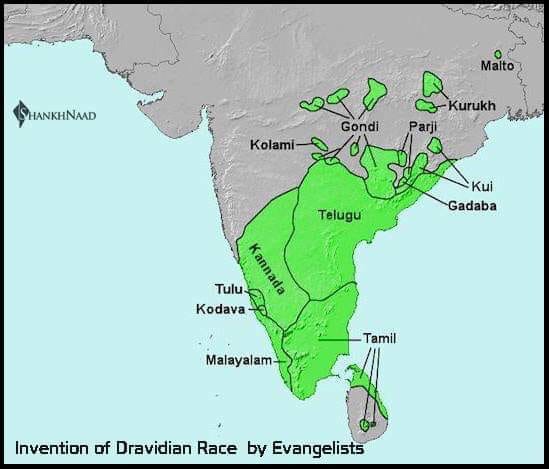
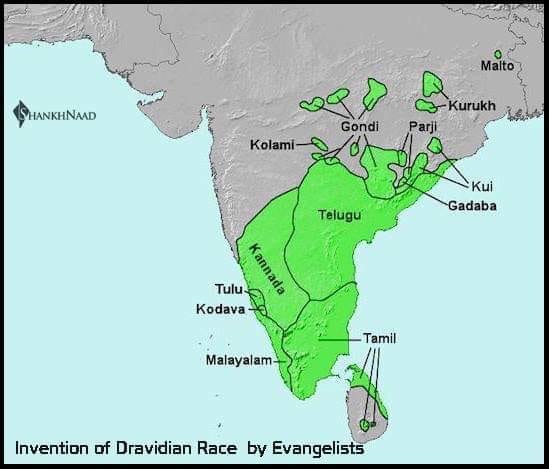
British evangelicals divided India in Aryans and Dravidian

Sanatan Dharm and Hinduism's avatarHINDUISM AND SANATAN DHARMA

Colonial administrators and evangelists were able to divide and rule the peoples of the Indian subcontinent, based on imaginary histories and racial myths – to the extent of inventing an entire race called ‘Dravidians’.

British Colonial administrators, such as Francis Whyte Ellis and Alexander D. Campbell, studied the grammar of Tamil and Telugu and proposed that these languages might belong to a different languagefamily from other Indian languages. Another British administrator, Brian Houghton Hodgson, invented the term ‘Tamulian’ to refer to what he considered to be the non-Aryan indigenous population of India. While Ellis and Campbell proposed a linguistic theory, Hodgson had a race-based perspective.

But the catalyst who is credited with the construction of the ‘Dravidian race’ was a missionary-scholar from the Anglican Church. His name was Bishop Robert Caldwell (1814–91), an evangelist for the Society for the Propagation of the Gospel, who combined the linguistic theory of Ellis…

View original post 115 more words

No animal sacrifice in vedas- Europeans filled filth in vedas when translated.

Sanatan Dharm and Hinduism's avatarHINDUISM AND SANATAN DHARMA

<p>Anumantaa vishasitaa nihantaa krayavikrayee</p><p>Samskartaa chopahartaa cha khadakashcheti ghaatakaah</p><p>Manusmrithi 5.51</p>Those who permit slaying of animals; those who bring animals for slaughter; those who slaughter; those who sell meat; those who purchase meat; those who prepare dish out of it; those who serve that

meat and those who eat are all murderers.

———————————————<p>Breehimattam yavamattamatho maashamatho tilam</p><p>Esha vaam bhaago nihito ratnadheyaaya dantau maa hinsishtam pitaram maataram cha</p>Atharvaveda 6.140.2

O teeth! You eat rice, you eat barley, you gram and you eat sesame. These cereals are specifically meant for you. Do not kill those who are capable of being fathers and mothers.

——————————————–

<p>Ya aamam maansamadanti paurusheyam cha ye kravih</p><p>Garbhaan khaadanti keshavaastaanito naashayaamasi</p><p>Atharvaveda 8.6.23</p>

We ought to destroy those who eat cooked as well as uncooked meat, meat involving destruction of males and females, foetus and eggs.

——————————————-

<p>Anago hatya vai bheema kritye</p><p>Maa no gaamashvam purusham vadheeh</p><p>Atharvaveda 10.1.29</p>

It is definitely a…

View original post 1,313 more words

Speed of Light and Puranic cosmology

Sanatan Dharm and Hinduism's avatarHINDUISM AND SANATAN DHARMA

puranic

Ancient Indian wisdom is a treasure trove of science. In fact, most of the claims made by ancient India (related to astrology, yoga, ayurveda) have been validated by Modern Science today. For example, this physics journal from USA in 1998 was astonished to find that ancient India knew the speed of light, down to the last digit of accuracy!!

Click to access 9804020.pdf

Ancient Indian wisdom is a treasure trove of science. In fact, most of the claims made by ancient India (related to astrology, yoga, ayurveda) have been validated by Modern Science today. For example, this physics journal from USA in 1998 was astonished to find that ancient India knew the speed of light, down to the last digit of accuracy!!

Link to the webpage:
http://www.math.nus.edu.sg/aslaksen/gem-projects/hm/0203-1-02-sunspots/human.html

View original post

Non-Violence In Sanatan Dharma

Sanatan Dharm and Hinduism's avatarHINDUISM AND SANATAN DHARMA

Non-Violence In Sanatan Dharma :

“Ahimsa Paramo Dharma” is a Sanskrit phrase that is often repeated today to demonstrate the universality of Ahimsa.

Loosely translated, Ahimsa means Non-violence, Paramo means topmost, ultimate, or supreme, and Dharma means duty. Thus, the entire phrase means that non-violence is the topmost duty to the extent that it supersedes all other duties.
.
For someone who holds this true, it means that there is no selective application of Ahimsa…it must be applied in every case and in all matters. This universal sense leads to an unconditional and unilateral abandonment of violent resistance, under any and all circumstances (as in the philosophy of Buddha and Jains).

But Sanatan Vedic Dharma does not impose total non-violence on its followers except in the case of ascetics. Ahimsa is a general Dharma that is superseded with Himsa (violence) in order to protect Dharma.
.
Ahimsa is only loosely…

View original post 1,967 more words