NEWTON STOLE CALCULUS FROM ARYABHATTA,ANCIENT INDIAN SCIENTIST

Sanatan Dharm and Hinduism's avatarHINDUISM AND SANATAN DHARMA

Now,people are blinded by falsehood of Newton as father of calculus.Infact he stole it from Indian,who practiced calculus in a school of Astronomy in Malabar,Kerla 2000 years before Jesus came. It is same port where Vasco De Gama landed in 1498 for christian conversion of Hindus. Stupid King at that time let Vasco de Gama come but did not realize that it will be like East India Company which came to dupe Indians and Hindus like what Germans did ,stole Swastika and turned this pious sign to wrong end. Now with internet, people are understanding and started researching.

Astronomy school of Kerla and also Ujjain in Madhya Pradesh produced a student,namedAryabhatta who calculated value of Pi of 3.1416 and the solar year of 365.358 days . He is the one who produced heliocentric universe 4200 years before Copernicus, with elliptically orbiting planets and a spherical earth spinning on its axis…

View original post 2,381 more words

Vedas and metaphysics,mantra,music-science beyond imagination

Sanatan Dharm and Hinduism's avatarHINDUISM AND SANATAN DHARMA

vedas2

Sanskrit has invented some 1.7 millions of years ago as a scientific
language expressly for passing on Vedic knowledge, since the inventors of
Sanskrit was well aware that Earth would pass through an Ice Age and pole
shift, where their Siberian homeland would freeze over. For this reason, the
authors of Sanskrit developed the language in order to encode their highly –
advanced scientific knowledge.
To achieve this goal, the builders of Sanskrit attached a numerical value to each
Sanskrit letter. Thus, a passage in Sanskrit which appears to describe a religious
theme (as humans have generally interpreted the Vedas for millennia) in fact
describes nuclear physics.

In Sankhya the Triguna theory of simultaneous and self-similar interactions
derives the standard oscillatory cycle of components in space through axiomatic
theorems and equals 2.965759669e+8 interactions per cycle, which is
approximately equal to the frequency of the modern velocity of light at a

View original post 857 more words

CONCEPT OF ZERO

Sanatan Dharm and Hinduism's avatarHINDUISM AND SANATAN DHARMA


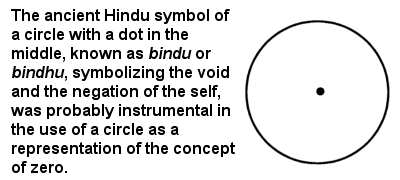
The concept of zero is referred to as shunya in the early Sanskrit texts and it is also explained in the Pingala’s Chandah Sutra (200 AD). In the Brahma Phuta Siddhanta of Brahmagupta (400-500 AD), the zero is lucidly explained. The Hindu genius Bhaskaracharya proved that x divided by 0 = 4 (infinity) and that infinity however divided remains infinity. This concept was recognized in Hindu theology millennia earlier. The earliest recorded date for an inscription of zero (inscribed on a copper plate) was found in Gujarat (585 – 586 AD). Later, zero appeared in Arabic books in 770 AD and from there it was carried to Europe in 800 AD.
 
The reason why the term Pujya – meaning blank – came to be sanctified can only be guessed. Indian philosophy has glorified concepts like the material world being an illusion Maya), the act…

View original post 1,357 more words

Hindu SCRIPTURES About invisible rays

Sanatan Dharm and Hinduism's avatarHINDUISM AND SANATAN DHARMA

UV RAYSMundakopanishad-6000BC abt particles that travel faster than light and other invisible Rays for naked eyes and its effect on human Body. BEFORE 12000-6000 BCE. Amazing ? Read More …

Tachyons, Ultra-voilet, Infra-red bands, Nuclear Energy and Blacks Holes in Mundakopanishad

Mundakopanishad written around 6000 BCE in ancient india, is associated with the Atharvaveda.
It describes about Tachyons (particles that travel faster than light), Ultra-Violet band, Infra-Red band, Nuclear Energy and Black Holes in the space.

Mundakopanishad might have derived its name from ‘munda‘ (shaven head of a monk).
It has three chapters and each chapter is divided into sub chapters which are called “Khanda“. In total this Upanishad has 64 Mantras.
This Upanishad divides all knowledge into two categories. The knowledge that leads to Self Realization is called Para Vidya (Great or Divine Knowledge) and everything else is called Apara Vidya or Knowledge of Material world (wordly knowledge).
Another important…

View original post 210 more words

KRISHNA

Sanatan Dharm and Hinduism's avatarHINDUISM AND SANATAN DHARMA

Krishna – The Historical Perspective

 
Trees blossom with crimson flowers,
Tender sprouts bursting from barks,Nature begins to shed its qualms,To welcome Spring with open arms,
This day, Narsimha defeated the demon,To uphold virtuous Prahlad’s dominion,
Holika burns amidst the commotion,
Evil defeated by Love and Devotion,
Wind blows pretty rainbows around, Black nor White, just colors abound,
Festival of Spring, is the festival of Mirth,
Of Radha and Krishna’s Eternal Love!
 
 
As the first buds of spring appear on trees and a riot of colors magically appears in the markets, the time seems perfect for a post about Krishna, the role-model for a motley of Bollywood numbers on Holi :o)


Krishna and Radha playing Holi


Krishna, the all-attractive-one; Megh-varna, the one with the color-of-clouds; Go-pal, the protector of cows; Murli-manohar

View original post 4,147 more words

Ram and Hinduism in world

Sanatan Dharm and Hinduism's avatarHINDUISM AND SANATAN DHARMA

These are some open evidence which west cant refuse !!! Time and again they tried their level best to keep aside hindu history of human civilisation .Already in my many post, I have provided ground breaking evidences yet for many Indians, Americans.  Native americans to Myans , Sumer , Incas , Meso all are Indian migrants .

The ancient Mexican game of Patolli is similar in details to the game of Panchisi played in India. The mathematical probability of two games invented separately agreeing by chance in so many specific intricate features, is zilch. Mexican call a potter “Kumbhar”, as Sanskrit word. There are several other similarities.After Vedic people the Mayas of Yucatan were the first people to use a zero sign in Mathematics. This knowledge came from India, as we had this knowledge thousand of years before them. All over Mayan civilization you find stone sculptures of Indian Vimanas and…

View original post 6,731 more words

Ancient India and Mayan civilization

Ancient India and Mayan similarities

Sanatan Dharm and Hinduism's avatarHINDUISM AND SANATAN DHARMA

Ancient India and Mayan architecture similarityLatin American Pyramids

Maya Civilization of Mexico. Baffling Links with Ancient India

 By Anand Sharma

The archaeological remains of ancient Maya civilization of Mexico are lying scattered in the parts of Yucatan, Campeche, Tabasco and eastern half of Chiapas as well as in the territory of Quintana Roo of the republic of Mexico. Covering an area of about 125,000 square miles, its traces are to be found in the western section of Honduras Republic, Peten and adjacent highlands of Guatemala and practically in the whole of Honduras.

Admiral Christopher Columbus mistakenly called the New World
inhabitants as Indians. Although he corrected himself subsequently, the natives of Americas continued to be called ‘Indians’. During the course of his third journey, Columbus came into contact with ‘Maya’ people.

Many theories have been advanced by scholars to explain the origins of these American Indians and if there were any links…

View original post 1,256 more words

बृहदारण्यकोपनिषद – प्रलय के बाद ‘सृष्टि की उत्पत्ति

Sanatan Dharm and Hinduism's avatarHINDUISM AND SANATAN DHARMA

img_4902

‘बृहत’ (बड़ा) और ‘आरण्यक’ (वन) दो शब्दों के मेल से इसका यह ‘बृहदारण्यक’ नाम पड़ा है। इसमें छह अध्याय हैं बृहदारण्यक उपनिषदों पर भर्तु प्रपंच ने भाष्य रचना की थी।

इसमें छह ब्राह्मण हैं।

प्रथम ब्राह्मण में, सृष्टि-रूप यज्ञ’ को अश्वमेध यज्ञ के विराट अश्व के समान प्रस्तुत किया गया है। यह अत्यन्त प्रतीकात्मक और रहस्यात्मक है। इसमें प्रमुख रूप से विराट प्रकृति की उपासना द्वारा ‘ब्रह्म’ की उपासना की गयी है।

दूसरे ब्राह्मण में, प्रलय के बाद ‘सृष्टि की उत्पत्ति’ का वर्णन है।

तीसरे ब्राह्मण में, देवताओं और असुरों के ‘प्राण की महिमा’ और उसके भेद स्पष्ट किये गये हैं।

चौथे ब्राह्मण में, ‘ब्रह्म को सर्वरूप’ स्वीकार किया गया है और चारों वर्णों (ब्राह्मण, क्षत्रिय, वैश्य और शूद्र) के विकास क्रम को प्रस्तुत किया गया है।

पांचवें ब्राह्मण में, सात प्रकार के अन्नों की उत्पत्ति का उल्लेख है और सम्पूर्ण सृष्टि को ‘मन, वाणी और प्राण’…

View original post 7,936 more words

The Movements of the Sun per Śrīmad-Bhāgavatam

Sanatan Dharm and Hinduism's avatarHINDUISM AND SANATAN DHARMA

Srimad Bhagavatam Canto 5 Chapter 21 text 1 to text 19 : The Movements of the Sun by His Divine Grace A.C Bhaktivedanta Swami Prabhupada

This chapter informs us of the movements of the sun. The sun is not stationary; it is also moving like the other planets. The sun’s movements determine the duration of night and day.

When the sun travels north of the equator, it moves slowly during the day and very quickly at night, thus increasing the duration of the daytime and decreasing the duration of night. Similarly, when the sun travels south of the equator, the exact opposite is true — the duration of the day decreases, and the duration of night increases.

When the sun enters Karkaṭa-rāśi (Cancer) and then travels to Siṁha-rāśi (Leo) and so on through Dhanuḥ-rāśi (Sagittarius), its course is called Dakṣiṇāyana, the southern way, and when the sun enters Makara-rāśi (Capricorn)…

View original post 2,015 more words

The Cosmology of the Bhagavata Purana

Sanatan Dharm and Hinduism's avatarHINDUISM AND SANATAN DHARMA

The inquisitive human mind naturally yearns to understand the universe and man’s place within it. Today scientists rely on powerful telescopes and sophisticated computers to formulate cosmological theories. In former times, people got their information from traditional books of wisdom. Followers of India’s ancient culture, for example, learned about the cosmos from scriptures like the Srimad-Bhagavatam, or Bhagavata Purana. But the Bhagavatam’s descriptions of the universe often baffle modern students of Vedic literature. Here Bhaktivedanta Institute scientist Dr. Richard Thompson suggests a framework for understanding the Bhagavatam’s descriptions that squares with our experience and modern discoveries.

Jambudvipa: The Srimad-Bhagavatam describes that the universe lies within a series of spherical shells which is divided in two by an earth plane called Bhu-mandala. A series of dvipas, or ‘islands,’ and oceans make up Bhu-mandala. In the center of Bhu-mandala is the circular ‘island’ of Jambudvipa (inset), whose most prominent feature is…

View original post 2,557 more words