BHȂRATA VARSHA, The Ancient Expansive India that was > 2500 years ago
Brahmāṇḍa Purāṇa was composed before 400 BCE. That is, >2500 years ago. In this great and enormous Purana, there are some details that may interest you. In the chapter on Bhārata, there are some interesting observations.
This is an exhaustive description of the land called Bhārata Varsha in those days. [Varsha could mean a continent].
1. Nine divisions by Sea:
भारतस्यास्य वर्षस्य नव भेदान्निबोधत
समुद्रान्तरिता ज्ञेयाः ते त्वगम्याः परस्परम् । १.१५.८। ।
Know that the Varsha called Bhārata is divided into nine parts. They are all surrounded by the ocean and difficult to go from one to another.
These nine “islands” of the Varsha or continent called Bhārata are: Sri Lanka, Singapore, Indonesia, Philippines, Maldives, Japan, Brunei Darussalem, East Timor and Taiwan.
2. DIFFERENT RACES IN THE NORTH-WEST BHȂRATA The different races of the north western parts of…
Skandagupta (स्कंदगुप्त)(455 – 467 AD) was successor of Kumargupta I as ruler of the Gupta Empire. Skandagupta is generally considered to be the last of the great Gupta Emperors. He crushed the Pushyamitras who had threatened the imperial authority.
But shortly thereafter he was faced with the problem of invading Hephthalites or “White Huns”, known in India as Indo-Hephthalites or Hunas, from the northwest. He repulsed the first Huna attack c. 455. But it proved a very expensive affair as the war drained the empire’s financial and military resources and that led to its decline.
Skandagupta passed away in 467 and was succeeded by his son Narasimhagupta Baladitya.
Skandagupta succeeded his father Kumaragupta I as the ruler of Gupta empire. He ruled from 455 A.D. to 467 A.D. His rule was marked by wars against the Pushyamitras and the Hunas. He had defeated the Hunas once as the crown-prince but the penetration of…
When islamist were doing atrocities, murder,for religious conversion,one elder son of Hindus started making an army , that was called Sikh and these in long run formed Sikh religion, which is basically Hindu religion. They should not distract and forget about Guru Teg Bahadur who fought against Muslim atrocities and terrorism but not gave up. Some Sikhs are not happy for ban on BEEF, as they forgot their origina and started following ISLAMIC teaching of eating BEEF ,although their many ancestors were murdered by same islamist. Beware Sikhs–sikkh dharma rajput history
Following is by डॉ विवेक आर्य-अलगाववादी सिखों को गुरु ग्रन्थ साहिब की सीख
हमारे कुछ सिख भाई पाकिस्तानी मुसलमानों के बहकावें में आकर अपने आपको हिन्दू धर्म से अलग दिखाने की होड़ में “हम हिन्दू नहीं हैं” , “सिख गौ को माता नहीं समझते”, “सिख मुसलमानों के अधिक…
Apart from the carbon dating, studies of signs showed similarities of Indus Valley civilization comprised of Mohanjodaro and Harappan.
A new hypothesis that links the Vaigai civilization, represented by the ongoing archaeological excavation at Keezhadi near here, with Indus civilization on the basis of exact names of places was put forth by R. Balakrishnan, Additional Chief Secretary, Odisha, India.
Mr. Balakrishnan said that there were still about 500 names in the Indus Valley which were alien to north Indian languages.
But their replicas were found in south Tamil Nadu, especially on both banks of the Vaigai.
He pointed out that names like Korkai, Madurai, Vanji, and Thondi existed now in the Indus Valley and this could not be deemed accidental.
Added to this were the symbols of the Indus Valley unearthed in Keezhadi. Mr. Balakrishnan said that the proven or potential archaeological sites along the Vaigai had exact counterparts in…
17 बड़े आक्रमण जो पुरी के जगन्नाथ मंदिर पर हुए हैं, क्या आपको है जानकारी? पुरी के विश्वप्रसिद्ध जगन्नाथ मंदिर के चमत्कारों से सभी सुपरिचित हैं। लेकिन बहुत कम लोग जानते हैं कि इस मंदिर पर कई बड़े हमले हुए हैं। हर हमले के बाद मंदिर और मंदिर के चमत्कारों पर कोई असर नहीं हुआ […]
नौंवा हमला
मंदिर पर नौवां हमला वर्ष 1611 में मुगल बादशाह अकबर के नवरत्नों में शामिल राजा टोडरमल के बेटे राजा कल्याणमल ने किया था। इस बार भी पुजारियों ने मूर्तियों को बंगाल की खाड़ी में मौजूद एक द्वीप में छुपा दिया था।
दसवां हमला
10वां हमला भी कल्याणमल ने किया था, इस हमले में मंदिर को बुरी तरह लूटा गया था।
One of the main reasons for the Europeans to sail the oceans was to find new trade routes to Asia, especially, to India. The adventure was inevitable as the land route to Asia was now held by the Ottoman Empire since 1453 CE (In 1453 CE, Constantinople was captured by the Ottomans, which led to the fall of the Byzantine Empire) and an alternative trade route had to be discovered, for the sake of trade and profits.
But, besides monetary prospects, another significant reason/motivation for all European colonisations in different parts of the world is almost always ignored. It was an inherent ideology of “western supremacy”. This idea is often referred to as “the white man’s burden”: a self-proclaimed responsibility of the west to subjugate and civilize any other person, who does not fall under the category of the “west”.
Accordingly, the Europeans, who “discovered” India had both intentions in mind. But, it was the British, who were the most successful among them. They not only succeeded in controlling most of the Indian Territory, but also successfully colonized various aspects of the Indian society like culture, politics, economy and education. They have since become an inseparable part of our history.
Hence, in their conquest of India, two important objectives of the British emerge: Profit and spreading civilization among Indians. This article briefly examines how the hostile and atrocious policies of the British, intended to achieve the above mentioned objectives, systematically impoverished the Indians, both physically and mentally.
Financial Atrocities
Before proceeding to look at how the British rule shattered the Indian economy, it will be useful to consider the respective macro-economic situations that prevailed in Britain and India before the Indian subjugation.
It should be noted that the British, during the 16th and 17th centuries, were in a bad shape. In the sixteenth century, “England was a backward country”, says Robertson. In the early 17th century, says Mill, Britain was, “oppressed by misgovernment or scourged by civil war, (with) affordable little capital to extend trade, or protect it”. [Lajpat Rai]
Specifically, from the available data, the GDP of Britain was only $2,815 million (in 1990 international $, same unit until otherwise specified) in 1500 CE and $10,709 million during 1700 CE. [Angus Maddison]
On the other hand, India was the richest country on earth until early periods of the 2nd millennia. Accordingly, India’s GDP in the year 1000 CE was approx. $33,750 million. Later, in 1500 CE, it was $60,500 million. During 1700 CE, it was $90,750 million. [ibid]
India was also one of the major trading nations in the 18th century. In fact, India had a monopoly in the supply of high quality finished textiles and spices. In 1750, her trade amounted to about 24.5% of the total world trade. India and China (whose contribution was a little over 32%) together contributed to more than half to the total world trade. [David Clingingsmith &Jeffrey G. Williamson]
Later, India’s GDP in 1870 CE was $134,882 million and it was $222,222 million in 1950 CE. However, the GDP of Britain rose to $100,179 million (at 5% average growth) in 1870 CE and then sharply rose to $347,850 million in 1950 CE. [Maddison]
The growth rates of both the countries show the vast gap between their economic growths. Through the 250 years from 1700-1950, the average growth rate of India was only 0.6%, whereas Britain grew at an average rate of 12.6%. In other words, the UK economy was only 4.6% of the Indian economy in 1500 CE; it was around 12% in 1700 CE. It then rose to be around 74% of the Indian economy in 1870 CE. (It should be noted that the British economy was already on an up during the early 19th century to be around 32.5% of the Indian economy in 1820 CE. This period from mid-18th century to mid-19th century was when the East India Company had directly controlled many Indian territories and ports). Then, finally in 1950 CE, the process had reversed and the Indian economy had become around 64% of the British economy. This clearly shows the rise of the Britain and a simultaneous fall of the Indian economy during the period of the British engagement in India.
In the early second half of the 18th century, England witnessed a tremendous change in its economy and society. The phenomenon was called the Industrial revolution, which brought in dramatic improvements in working culture, people’s Income and their health and lifestyles. This in fact spread all over continental Europe within the next few decades. While, it is true that the industrial revolution gave a big push to Britain’s economy, a major portion of the huge capital investments that was required for the success of the revolution was itself supplied by India.
Moreover, the hostile financial policies of the British like ruthless taxation, discouraging Indian industries like textile and ship building, trade restrictions, etc. significantly contributed to the downfall of the Indian economy. The British (both under the East India Company and the British crown) simply shipped away huge amounts of wealth with practically no returns to India. In the words of Macaulay,
“……Treasure flowed to England in oceans; and what was lacking in England to make the fullest possible use of the mechanical inventions made by Watt and others was supplied by India. The influx of Indian treasure added considered to England’s cash capital………” [Lajpat Rai]
In fact, trade with India opened the doors of fortune to the East India Company. According to Macaulay, the company’s shares, which was priced 245 in 1677 almost reached 500 in the later years [ibid].
Though, an in depth analysis of specific policies is not in the purview of the present article, a brief analysis of one such policy i.e. taxation would assist us in understanding the general scenario at that time. Such an analysis was conducted by Hyndman, a British author, who as a responsible English man was the biggest critic of the British conduct in India.
Accordingly, the total tax levied on the Indian people during 1857 CE was 24,110,000 pounds, that is, around 2 shillings, 6 pence per head. However, in 1876, it had drastically risen (in 20 years) to become 36,000,000 pounds (round figured), which gives us the per capita tax to be 3 shillings, 9.5 pence. [Hyndman] Further, the per capita produce (can be considered as an income) was 31 shillings, 6 pence [from mid-18th to mid-19th centuries]. [ibid]
To see how much of this was needed to provide for the actual necessities of life, Hyndman looked at the per prisoner maintenance charge in the then Indian prisons. There, it costed around 46 shillings or 2.3 pounds to maintain a prisoner per year. This, however, does not include enough clothing, house allowances, repairs, costs of household equipment, etc.
Now, we have a situation where a person needed more than 46 shillings for subsistence plus 3 shillings 9.5 pence to pay off his/her taxes but earned an Income of only 31 shillings and 6 pence. That is, all his expenses, including the taxes may have required more than 50 shillings (at least around 55 to 60 shillings), but his income was only around 31 shillings. This huge deficit in a person’s balance sheet was not an aberration, but continued year after year for decades together, which made the financial situation of the people deteriorate. This, in-turn, forced the people to borrow money from moneylenders, which inevitably may have placed them insurmountable debts.
Hyndman, thus, observes, rather with pain,
“……Even as we look on, India is becoming feebler and feebler. The very life blood of the great multitude under our rule is slowly, yet ever faster, ebbing away…..” [Hyndman]
But, this deterioration in people’s welfare did not curtail the loot carried on by the British. This loot: the outflows of huge amounts of cash and kinds of monetary value from India to Britain during the colonial periods, are often referred to as a “drain”. Though, the exact amount of “drain” may never be known, many economists have given varying, but reliable estimates of this loot after examining the issue in depth.
In all, the total outflow of wealth (in the form of taxes, tributes, profits, etc.) from India to Britain was estimated to be approx. £6,080 million (for the period till the end of 19th century only) by Mr. Digby. However, Hyndman, writing in 1906, puts the figure at £40 million per annum, while Mr. A.J. Wilson fixed it at £35 million per annum. [Lajpat Rai] On the other hand, Mr Shashi Tharoor, MP in Rajya Sabha, in a recent debate at the Oxford University, vehemently argued that the British loot of the Indian treasure escapes the imagination and amounts to a total of approx. 3.4 trillion pounds sterling.
As enormous as it may seem, the above figures captures only one side of the story. The public debt of India (payments from India for British expenses on wars and expeditions, etc., which was often not adequately paid back) was around $35,000,000 in 1792. Gradually, it rose to be $215,000,000 in 1845, $1,535,000,000 in 1913 and $3,500,000,000 in 1929. [Will Durrant]. However, the total contribution from India, in cash and kinds, to British wars alone, amounts to approx. 9.25 billion pounds (in today’s value) according to Mr Tharoor.
Adding to this loot was the immense pain inflicted upon India, by the British, directly or indirectly, by caring little for the lives of millions of Indians. While violent crushing of hundreds of freedom fighters was almost a routine, an estimated number of deaths due to famine in India, since 1770 till independence, stood at over 25 million people.
However, these deaths were not due to the lack of production of food. The available food was either shipped away or was sold at outrageous prices, which almost always forced the already poverty stricken population to starve and die.
Seeing the then situation of the people, Sir Wilfred Scawen Blunt says,
“Though myself a good conservative….. I own to being shocked at the bondage in which the Indian people are held….; And I have come to the conclusion that if we go on developing the country at the present rate, the inhabitants, sooner or later, will have to resort to cannibalism, for there will be nothing left for them to eat ” [ibid]
It should also be noted that the Indian economy, which contributed 23% of the world economy during the 17th-18th centuries was down to around 4% in 1947. Such was the loot conducted by the British for most of their period in India. This, however, does not capture the exact picture of the sufferings of the then people. We can only imagine the poor conditions of the people for generations after generations. Moreover, this was not the only tool used by the British to break the Indian people. The financial atrocities caused physical damage, but the British wanted to influence the minds of the Indians too.
English education: A tool of mental subjugation
The British found out that the best possible way to enslave the minds of the Indians was through the introduction of the English education. The indigenous education system, which was referred to as “A beautiful tree” by Mahatma Gandhi was dismantled and destroyed. A strong emphasis was given to teaching the Indians about European literature, western art and languages, so as to make the English speaking Indians alien to their own culture and traditions.
Thomas Babington Macaulay famously (or infamously rather) argued in his “Minute on Indian Education” (2/2/1835) delivered in the British parliament that the British had to do their best to create a class of individuals in India, who would be Indian in blood and colour, but English in tastes, opinions, morals and intellect. He, after discounting Indian culture, arts, languages, etc. as primitive and useless, declared that an entire library of eastern literature is equivalent to just one shelf of English literature.
It was vastly argued by many like Carey and Wilberforce that the barbarity in which the Indians lived was bitter and the only cure for this was to cut them off from their Indian-ness. The British also believed that the presence of westernized Indians would facilitate in the smooth function of the Raj.
In a paper presented to the parliamentary committee on education in India in 1853, Sir Charles E. Trevelyan, an officer of the Bengal civil service observes, thus:
“………. The natives will not rise against us because we shall stoop to raise them; there will be no reaction because there will be no pressure; the national activity will be fully and harmlessly employed in acquiring and diffusing European knowledge, and naturalizing European institutions.”
To forward this cause, various seminaries were started to educate the Indian youth in English and western literature. No doubt, these institutions provided the much needed knowledge of modern sciences to young Indians, but at the same time, they not only alienated these young Indians from their culture, but also from indigenous knowledge systems (both science and arts). Thus, in a highly systematic manner, English and everything associated with it was promoted and made to replace India’s indigenous education system.
It was decided in 1835 by the then Governor General of India that no new support or assistance would be provided to teachers and students pursuing native subjects and languages. It was also decided that all the funds of education would be spent on promoting English education alone. In 1838 (within only 3 years), the seminaries established under these objectives were 40 in number.
Following this, Trevelyan provides the statistics for the sale of books by the School Books Society for the years 1834 and 1835; out of a total of 51,823 books sold; 31,649 were English books; 4,525 books were partly in English; only 16 books were of Sanskrit and all the remaining books were either in Arabic, Persian, Urdu, Bengali or Hindi.
The result of these efforts was visible on the ground as early as 1838. While noting the success of the new education policy, Trevelyan says that there has been a wide taste for English among the youth trained in the Hindu college at Calcutta and notes that the moral effect of the English education was so deep that some of the Hindu youth born in noble families had developed an impatience for the restrictions of Hinduism and also a disregard for its ceremonies and rituals. He then notoriously predicts that another generation of such people would alter the very fundamental notions and feelings of the Hindu community. This perhaps was the first sign of self-alienation; our own people developing a sense of animosity towards their own identities.
Swami Vivekananda rightly observes on the issue of English education that,
“The child is taken to school and the first thing he learns is that his father is a fool, the second thing that his grandfather was a lunatic, the third thing that all his teachers are hypocrites, the fourth that all his sacred books are a mass of lies. By the time he reaches sixteen, he is a mass of negation, lifeless and boneless.”
Christianity and Conversions
Another method used by the British to civilize Indians was to Christianize them. They believed that the religion of the Indians, i.e. Hinduism was the root cause of all the evils that was prevalent in India.
Alexander Duff, a Scottish missionary and leading educator had opined that the Indian philosophy, in essence, conveyed vain, wicked and foolish conceptions only. For him, Hinduism was utter darkness and the Christian task was to somehow do everything possible to demolish this gigantic fabric of idolatry and superstitions.
When the East India Company was at the helm of affairs in India, many thinkers such as Edmund and Burke had started to argue that the company has to consider and take care of its moral responsibilities. In his personal capacity, Charles Grant, a junior officer in East India Company even drafted a proposal for the mission in 1786-87 and conducted a vast campaign for years for its implementation with no real gains however. In 1793, William Wilberforce, influenced by the work of Charles Grant moved his famous resolution known as the “Resolution on Missions”.
But, the East India Company did not consider any of the above as it was wary of openly supporting the Christian missions fearing that any religious interference would lead to the awakening of the Indian, especially the Hindu consciousness.
This stance of religious neutrality of the company was substantially challenged in 1813, when its charter was considered for renewal. It was argued that the Christianization of the Indian people would bring them at par with other subjects and also increase their loyalty to the masters in England.
Claudius Buchanan, a loyal and devout Christian missionary voiced the opinion that God has laid upon the Britain the solemn duty of evangelizing India and the government, instead of hesitating, must fully support the cause of Christian education and the war on Hindu superstitions.
Overall, the need for Christian missions in India was widely supported and this led to the attachment of a missionary clause into the company’s charter of 1813, granting permission to those, who wished to come to India for promoting moral and religious “developments”, to propagate English and preach Christianity. A sum of 100,000 Rupees was also allocated for the cause.
Later, in the charter act of 1833, a regulation was laid out for the permanent presence of missionaries in India. Provisions for the Anglican hierarchy in Calcutta and for the establishment of the Dioceses in Madras and Bombay were also introduced.
After, the changes made in 1813, the missionaries started coming to India in large numbers declaring that the solution for the Darkness of the Indians was the introduction of “light”. In 1853, the Queen proclaimed that the equality, which the Indians would receive with their other counterpart subjects of the crown would breathe a sense of religiousness, generosity and benevolence.
These developments made the missionaries an important hand of the British administration in India. It also led to an unholy nexus wherein the missionaries and the colonial masters implicitly (sometimes explicitly) supported each other. The missionary writers through their over-exaggerated, one-sided atrocity literatures propagated around the world that, if not for the British, India was on the brink of falling into the grasp of barbarity and backwardness. They were, as Mahatma Gandhi called Catherine Mayo, professional drain inspectors. The poverty, diseases, etc., many of which were the direct results of British policies were projected to be the effects of “Hindu Superstition”.
Moreover, the missionaries were allowed to open mission schools where thousands of young Indian minds were educated. Trevelyan makes it clear to us that the Christian priests coming to India took full advantage of these schools to influence the young minds.
Monier Williams, a Sanskrit professor in the University of Oxford acknowledges the role of missionaries and says,
“With regard to the progress of Christianity in India, I will only at present record my opinion that the best work done by the missionaries is in their schools…………… the ancient fortress of Hinduism is in this way being gradually undermined. The educated classes look with contempt on idolatry.”
It can also be seen that the missionaries used crooked and deceptive means to achieve their goals. One of the special target groups for them was the tribals. In a speech delivered at the Baptist Missionary Society in London, Sir Richard Temple said that it is a duty of every Christian to spread their religion, and that Hinduism and Buddhism is dying and the special focus of missionaries must be on tribals.
In conformity with this, in the census of 1911, it was very clear that 9/10th of all converts in Bengal, Bihar, Orissa and Sikkim regions belonged to the 4 major tribal communities viz. Oraons, Mundas, Kharis, and Santhals.
Moreover, Monier Williams advises the missionaries and also the people of England that it should not be a surprise, if the missionaries in India have to become all things to all people, following, St. Paul, in order to win over Indians to Christ. Furthermore, it is a well-established fact that the missionaries took great advantage in situations like famines and disease to lure innocent people to convert. In 1923, a publication from America named “India and its Missions” discussed the advantages of famines and diseases to Christianity. It says,
“The famine has wrought miracles. The catechumenates are filling, baptismal water flows in streams and starving little tots fly in masses to heaven.” [Ram Swarup]
Various tactics like coercion and deception that were used for converting Indians were discussed in great detail in a report presented to the government of Madhya Pradesh, popularly known as Niyogi Committee Report of 1957. It can be considerably assumed that these very means were practiced by missionaries in British India as well.
Due to all these efforts, the Indian Christian population, which was in meagre numbers (perhaps around 2 lakhs) during the 18th century had risen to 18,62,634 by 1871 at almost 8% average growth rate over a span of 100 years. In 1951, Christians were 83,05,026 at over 4% average growth rate over a span of 80 years (not adjusted for partition). However, the growth rate of the Hindus for the same period (1871-1951; adjusted for partition) was around 1.5% average.
The British had a clear goal: to westernize and Christianize India, using all possible means. Though, the British were not the first foreigners to rule over us, they had an important distinction over their Islamic predecessors. While the Islamic invaders caused much violence and immense physical damage and reduced Hindus to second class citizens at many places, the distinction of enslaving the Indian mind goes to the British. The British, in many ways, are solely responsible for the mental self-alienation and physical deprivation of the Indian population, whose deep effects are visible even today. India is free today, but the Indian mind is still colonized.
Angus Maddison, “The world economy: A millennial perspective”, OECD, 2001.
David Clingingsmith and Jeffrey G. Williamson, “India’s de-industrialization under British rule: new ideas, new evidence”, Working Paper 10586, National Bureau of Economic Research, Cambridge, MA, June 2004, (pdf file), http://www.nber.org/papers/w10586
Ram Swarup, “The issue of ethical conversion”, Hinduism and Monotheistic Religions, Voice of India, New Delhi, 2009.
Disclaimer: The facts and opinions expressed within this article are the personal opinions of the author. IndiaFacts does not assume any responsibility or liability for the accuracy, completeness, suitability, or validity of any information in this article.
सामान्यतः कुछ पढ़े लिखे लोग यह मान्यता वाले होते है कि, मुघलो और अंग्रेजो ने ही हमे शिक्षित किया और हमे सभ्यता सिखाई। यह लोग ये भी तर्क देते है कि, भारत में सिर्फ कहानियाँ और मंदिरो के सिवा कुछ भी नहीं था। हमारा देश आज ज्ञान-विज्ञान में जो भी है वो अंग्रेजो की कृपा की बजह से है।
लेकिन हमारे देश में कई सालो से सुसंस्कृत सभ्यता थी। और ज्ञान-विज्ञान का भरपूर स्त्रोत हमारे पास था। कुछ ज्ञान सालो से लुप्त होता गया अन्यथा उसके ग्रंथो को कही न कही आक्रांताओ द्वारा नष्ट किया गया। इस लेख में ऐसे ही विज्ञान की एक मुख्य शाखा- रसायन विज्ञान के कुछ तथ्यों को सामने रखने का प्रयास करूँगा।
आधुनिकरसायनशास्त्रकाउद्भव
पंद्रहवीं-सोलहवीं शती तक यूरोप और भारत दोनों में एक ही पद्धति पर रसायन शास्त्र का विकास हुआ। सभी देशों में अलकीमिया का युग था। अलकीमिया माने तो किसी भी धातु में से सोना बनाना। पर इस समय के बाद ये यूरोप में (विशेषतया इंग्लैंड, जर्मनी, फ्रांस और इटली में) रसायन शास्त्र का अध्ययन प्रायोगिक तौर पर हुआ। प्रयोग में उत्पन्न सभी पदार्थों को तोलने की परंपरा प्रारंभ हुई। और उसके बाद १७८१ में यूरोपीय वैज्ञानिक हेन्री केवेंडिश ने पानी का विद्युत-अपघटन किया। वहां से उन्हें हाइड्रोजन और ऑक्सीजन वायु की प्राप्ति हुई। वही से आधुनिक रसायनशास्त्र का उद्धव और विकास हुआ।
मेंडेलीफ़ ने उसके बाद आवर्त कोष्टक (Periodic Table) की रचना की। बाद में उसमे आज तक ११४ तत्वों की प्राप्ति हुई है। जबकि भारत का प्राचीन रसायन शास्त्र सिर्फ ७ धातु के अभ्यास और संशोधन के आसपास केंद्रित होने का जानने को मिलता है।
भारतमें ईसा पूर्वका रसायनशास्त्र
वेदवउपनिषद मेंरसायनशास्त्र
जैसा की मैंने आगे विवरण किया है कि, प्राचीन समय में रसायन शास्त्र ७ धातु के अभ्यास और संशोधन के आसपास केंद्रित था। और वह ७ धातु है- सुवर्ण(सोना), रजत(चांदी), ताम्र(तांबा), लोह(लोहा), पारद, सीसा(लेड) और रांगा (टीन). इन सभी धातुओं का उल्लेख प्राचीनतम संस्कृत साहित्य में उपलब्ध है। ऋग्वेद की कई ऋचाओं में भी स्वर्ण और रजत का मूल्यवान धातु के रूप में स्पष्ट उल्लेख होता है। अर्थर्ववेद के श्लोक में भी धातु का उल्लेख मिलता है।
वेदों की प्राचीनता ईसा से हजारों वर्ष पूर्व निर्धारित की गई है। इससे हम कह सकते है की वैदिक काल यानि कि इसा पूर्व से रसायन शास्त्र का संशोधन और अभ्यास हो रहा है। यजुर्वेद की रचना उपनिषद के काल में हुई थी, ऐसा माना जाता है। छांदोग्य उपनिषद में भी धात्विक मिश्रण का स्पष्ट वर्णन देख सकते है। छांदोग्य उपनिषद में वर्णन है की किस तरह से धातु को मिश्रित करके मिश्र धातु(Alloy) प्राप्त कर सकते है।
कौटिल्यकेअर्थशास्त्रमेंरसायनशास्त्र
यह तो पूर्ण रूप से स्पष्ट है की कौटिल्य का समय ईसा पूर्व २५० वर्ष है। उनके २ ग्रन्थ ‘नीतिशास्त्र’ और ‘अर्थशास्त्र’ प्रमाणित है। अर्थशास्त्र के दूसरे अधिकरण अध्यक्षप्रचार के छठे अध्याय में महसूल का विवरण देखने को मिलता है। उसमे लिखित है कि, “सुवर्ण और रजत के अयस्क पदार्थो पर राजा कर लगा सकता है।” इसी ग्रंथ के अन्य कुछ हिस्सों में धातु के अयस्क का खनन, विचरन और खानों के प्रबंधन की व्याख्या भी प्रच्छन रूप से देखने को मिलती है।
ईसापूर्वकेभारतीयजीवनमेंरसायनशास्त्रकाप्रभाव
यदि हम सिंधु घाटी के मिले अवशेषों और ईसा पूर्व में लिखे ग्रंथो का अध्ययन करे तो हम उस समय में धातुओं का उनके जीवन पर क्या प्रभाव था? उसके लिए अभ्यास और संशोधन कैसे हुआ? इन प्रश्नो का उत्तर पा सकते है। मैंने इन धातुओं का भारतीय जीवन पर प्रभाव के बारे में संक्षिप्त में लिखा है।
स्वर्ण: ईसा से 2500 वर्ष पूर्व सिंधु घाटी की सभ्यताकाल में (जिसके भग्नावशेष मोहनजोदड़ो और हड़प्पा में मिले हैं) स्वर्ण का उपयोग आभूषणों के लिए हुआ करता था। उस समय दक्षिण भारत के मैसूर प्रदेश से यह धातु प्राप्त होती थी। चरकसंहिता में (ईसा से 300 वर्ष पूर्व) स्वर्ण तथा उसके भस्म का औषधि के रूप में वर्णन आया है। कौटिल्य के अर्थशास्त्र में स्वर्ण की खान की पहचान करने के उपाय धातुकर्म, विविध स्थानों से प्राप्त धातु और उसके शोधन के उपाय, स्वर्ण की कसौटी पर परीक्षा तथा स्वर्णशाला में उसके तीन प्रकार के उपयोगों (क्षेपण, गुण और क्षुद्रक) का वर्णन आया है। इन सब वर्णनों से यह ज्ञात होता है कि उस समय भारत में सुवर्णकला का स्तर उच्च था।
रजत: रजत का मूल्य स्वर्ण से कम माना जाता था। कौटिल्य के अर्थशास्त्र में भी रजत के धातुकर्म और उसके उपयोगो का वर्णन मिलता है। अन्य ग्रंथो में भी रजत के बारे में बहुत कुछ लिखा हुआ है।
तांबा: प्राचीन समय में इसका उपयोग शस्त्रक्रिया के साधन बनाने में होता था, यह बात आयुर्वेद के ग्रंथ में लिखी हुई है।
लोहा: भारत के लोगों को ईसा से 300-400 वर्ष पूर्व लोह के उपयोग ज्ञात थे। तमिलनाडु राज्य के तिन्नवेली जनपद में, कर्णाटक के ब्रह्मगिरी तथा तक्षशिला में पुरातत्व काल के लोहे के हथियार आदि प्राप्त हुए हैं, जो लगभग 400 वर्ष ईस्वी के पूर्व के ज्ञात होते हैं।
टीन (वंग): भारत में सिंधु घाटी की सभ्यता के काल के प्राप्त धातु पदार्थों में वंग पाया गया है। ऐसा अनुमान है कि उस समय वंग ईरान से आता था। ईसा से पाँच शताब्दी पूर्व आयुर्वेद काल में सुश्रुत में त्रपु (वंग) तथा वाग्भट्ट के अष्टांगहृदय में भी वंग के यौगिक का वर्णन आया है।
सीसा: सीसा बहुत प्राचीन काल से ज्ञात है। इसका उल्लेख अनेक प्राचीन ग्रंथों में मिलता है। इसका उपयोग भी ईसा के पूर्व से होता आ रहा है।आयुर्वेद में सीसा सप्त धातुओं में है और अन्य धातुओं के समान यह भी रसौषध के रूप में व्यवहृत होता है। इसका भस्म कई रोगों में दिया जाता है। वैद्यक में सीसा आयु, वीर्य और कांति को बढ़ानेवाला, मेहनाशक, उष्ण तथा कफ को दूर करनेवाला माना जाता है।
पारद: भारत में इस तत्व का प्राचीन काल से वर्णन हुआ है। चरक संहिता में दो स्थानों पर इसे ‘रस’ और ‘रसोत्तम’ नाम से संबोधित किया गया है। वाग्भट ने औषध बनाने में पारद का वर्णन किया है। वृन्द ने सिद्धयोग में कीटमारक औषधियों में पारद का उपयोग बताया है।
ईसा के पूर्व में रसायनशास्त्र का स्वतंत्र विकास नहीं हुआ था। परन्तु ईसा के बाद में रसायन शास्त्र का स्वतंत्र विकास भारत में होता रहा। जिसके बारे में संशोधनीय जानकारी में अपने अगले लेख में दूंगा।
References
History of Chemistry in ancient and Medieval India: Incorporating the History of Hindu Chemistry by P. Ray
Disclaimer: The opinions expressed within this article are the personal opinions of the author. IndiaFacts does not assume any responsibility or liability for the accuracy, completeness, suitability, or validity of any information in this article.
Harshil Mehta has pursued graduation in stream of an electrical engineering at L.D. College of engineering. Associated with RSS, he is core team member of the think tank Bhartiya Vichar Manch. He frequently writes commentary and opinions on History, Indology and Politics.
भारतीय संस्कृति में मनुष्य जीवन को चार पुरुषार्थों में विभाजित किया गया है – धर्म, अर्थ, काम और मोक्ष l काम का स्थान चार पुरुषार्थों में तीसरा है और अन्तिम पुरुषार्थ मोक्ष है जिसको जीवन का अन्तिम लक्ष्य कहा गया है l यथा धर्म के लिए धर्मशास्त्रों का, अर्थ के लिए अर्थशास्त्र का और मोक्षप्राप्ति के लिए मोक्ष के ग्रन्थों का अध्ययन आवश्यक है तथैव काम के ज्ञान और यथायोग्य विवेकजन्य प्रयोग के लिए कामशास्त्र का अध्ययन आवश्यक है l इस लेख में काम और कामशास्त्र को ध्यान में रखकर निम्नलिखित मुद्दों पे विवेचन प्रस्तुत है –
काम की व्युत्पत्ति और शास्त्रों में स्थान l
कामशास्त्र का उद्गम और प्रयोजन l
वात्स्यायन और कामसूत्र की रचना l
कामशास्त्र की ग्रन्थ परम्परा l
कामसुत्र का संदेश l
उपसंहार l
इस ग्रन्थ के पठन पर्यन्त यह अपेक्षा है कि पाठक काम और कामशास्त्र के उन बिन्दुओं से अवगत होगा जो सामान्यतया प्रकाश में नहीं आये हैं या उनको दबा दिया गया है और फलतः आज कामसूत्र को शास्त्र होते हुए भी घृणा या जुगुप्सा की दृष्टि से देखा जाता है l
काम की व्युत्पत्ति और शास्त्रों में स्थान
“कम् – कान्तौ” धातु से जन्य शब्द है काम l काम अर्थात् इच्छा[1] l जहाँ इच्छा वहाँ आकर्षण और यह आकर्षण ही समस्त संसार के अस्तित्व का मूल है l विज्ञान से यह सिद्ध है कि विश्व का प्रत्येक पदार्थ अन्य पदार्थ को आकर्षित करता है अतः आकर्षण जिसके मूल में है वह काम प्रत्येक पदार्थ में स्थित है l अमरकोश में काम को ‘मानसिक भाव’ की श्रेणी में रखा गया है l ऋग्वेद में काम को मन का वीर्य (रेतस् ) कहा गया है जो मानसिक भाव को प्रतिपादित करता है l[2]
वात्स्यायन प्रणीत कामसूत्र के अनुसार ज्ञानेन्द्रियों का(कर्ण, त्वचा, नेत्र, जिह्वा, नासिका), अपने अपने विषय में (क्रमशः शब्द, स्पर्श, रूप,रस, गन्ध), अनुकूल रूप में, प्रवृत्त होना अर्थात् काम l[3] यहाँ काम की व्याख्या में वात्स्यायन स्पष्ट है l वह काम को केवल शारीरिक सुख या वासना नहीं बताते l
काम के मुख्य दो प्रकार मिलते हैं – लौकिक और अलौकिक l लौकिक काम में मुख्य रूप से शारीरिक सुख और गौणरूप से अन्य इच्छा का समावेश होता है l अलौकिक काम की श्रेणी में दिव्यकर्म की इच्छा और कभी देवों की इच्छाओं को भी रखा जा सकता हैं l
ऋग्वेद में पृथ्वी की उत्पत्ति का कारण काम ही माना गया है और उसे परब्रह्म के हृदय से जनित बताया है[4] अतः काम की उत्पत्ति अलौकिक है न कि लौकिक l लौकिक हेतुओं की सिद्धि हेतु काम से ही अन्य प्रजा जन्म लेती हैं l उपनिषद में भी इसका प्रतिपादन हुआ है l
सोऽकामयत बहुस्यां प्रजायेत l
काममय एवायं पुरुषः ll – तैत्तिरीयोपनिषद्
श्रीमद्भगवद्गीता में भी भगवान् श्रीकृष्ण ने कहा है कि “समस्त प्राणिजगत् में धर्म के अनुरूप जो भी काम है वह मैं ही हूँ” l[5] “अहं सर्वस्य प्रभवः” बोल कर गीता में, कृष्ण, स्वयं को जगत् की उत्पत्ति का मूल कारण बताते है अतः कामरूप बीज स्वयं को ही बताते है l
पौराणिक साहित्य (पुराण आदि) एवं लौकिक साहित्य (कालिदास, माघ आदि का साहित्य) में काम को देव की उपाधि प्राप्त होती है और उसे नाट्यशास्त्र में भी स्थान प्राप्त होता है l समय का चक्र काम को शिल्प-स्थापत्य में भी स्थानप्राप्ति देता है और साथ साथ शास्त्रपरम्परा में भी l पुरुषार्थचतुष्ट्यम् में धर्म और अर्थ के बाद काम को स्थान मिलता है और बाद में मोक्ष को l व्याकरण के अनुसार सर्वप्रथम धर्म, तत्पश्चात् अर्थ, काम और मोक्ष शब्द होने चाहिए ऐसा कोइ नियम नहीं है, किन्तु सर्वप्रथम अर्थ शब्द होना चाहिए, यद्यपि यह क्रम निश्चित हुआ है जो मुक्ति (मोक्ष) से पूर्व काम की उपयोगिता दर्शित करता है l मुक्ति मानवजीवन का सर्वोच्च ध्येय है किन्तु काम की उपेक्षा कर के नहीं क्योंकि काम (धर्मानुरूप) मानवी के लिए मोक्ष में बाधक नहीं अपितु सहायक है l
शास्त्रोक्त और आज रूढिगत हो चुके षोडश संस्कारों में वर्णित गर्भाधान, पुंसवन और विवाह जैसे संस्कारों से काम का महत्त्व देखने को मिलता है l
गर्भाधान संस्कार – गर्भाधान का सामान्य अर्थ है “धर्मपत्नी के गर्भ में बीज का आरोपण करना” और उस से उत्पन्न संतान ही औरस संतान होती है l इसी संतान से माता-पिता के धर्म एवं अन्य जीवनकार्य (अर्थ आदि) जुडे होते हैं अतः कामप्रेरित व धर्मानुकूल गर्भाधान से जन्य संतति माता-पिता के पुरुषार्थों की वाहक होती है l गृहस्थाश्रम का यह कार्य ही आगे सन्यासाश्रम में मोक्षप्राप्ति तक ले जाता है l
पुंसवन संस्कार– सामान्यतया, गर्भ रहने के तीन या चार माह बाद, संतति के दोषरहित जन्म हेतु किए जाते है l यहाँ भी संतति के जन्म हेतु ‘कामना’ की जाती है जिसे शास्त्रोक्त विधि से अभिषिक्त किया जाता है l
विवाह संस्कार – चारों आश्रमों में गृहस्थाश्रम का महत्त्व सर्वाधिक है और मनु ने उसे अन्य सभी आश्रमों का आधार बताया है[6] तथैव विवाह गृहस्थाश्रम का प्रमुख संस्कार माना गया है l विवाह को वैदिक साहित्य में ‘यज्ञ’ की श्रेणी में रखा गया है[7] और उसका मुख्य उद्देश्य संतानप्राप्ति (वंशप्राप्ति) है जिस की पूर्ति हेतु धर्माधारित काम का आचरण अनिवार्य है l यहाँ दो शब्दों का भेद जानना अत्यावश्यक होगा – काम और यौन.
संतति की प्राप्ति हेतु शारीरिक सम्बन्ध स्थापित होता है तो उसे कामसम्बन्ध कहा जाता है l
शारीरिक सम्बन्ध का हेतु संततिप्राप्ति न हो कर केवल आनन्दप्राप्ति हो तो वह यौनसम्बन्ध है l
निष्कर्ष – वैदिक शास्त्रों में वर्णित दैवी काम, जो जगत् और प्रजा की उत्पत्ति का कारण है, पौराणिक शास्त्रों में देवत्व को प्राप्त होता है और आगे चल कर साहित्य में और कलाओं में भी यथायोग्य स्थान को प्राप्त होता है l श्रुति और स्मृति दोनों प्रकार के ग्रन्थों में काम को अन्य तीन पुरुषार्थों का पूरक माना है और मुख्य सोलह संस्कारों में भी काम का प्रमुख स्थान है अतः धर्मानुकूल काम सदैव ही समाज का एक महत्व का अङ्ग रहा है l
कामशास्त्र का उद्गम
अथर्ववेद के विवाह प्रकरण सूक्त में कामशास्त्र की संकल्पना के बीज मिलते हैं[8] जहाँ अग्निदेव से प्रार्थना की जाती है कि वह नवविवाहिता स्त्री को सुसंतति प्रदान करे l अथर्ववेद के इसी सूक्त की एक ऋचा में सूर्यपुत्री को उत्तम संतति को जन्म देने हेतु प्रसन्नचित्त हो कर पति के साथ समागम के लिए शैया पे आने को कहा जाता है l[9]
छान्दोग्य उपनिषद में यही संकल्पना विकसित हुई है l वहाँ स्त्री-संभोग को ‘सामवेद का गान’, स्त्री को प्रसन्न करने की क्रिया को ‘प्रस्ताव’, स्त्री के साथ शयन को ‘उद्गीथ’, संभोग को ‘प्रतिहार’ और मैथुनक्रिया के अन्त में होते वीर्यस्खलन को ‘निधन’, प्रायः अन्त में समूह में होता सामवेद का गान, कहा गया है l[10]
अतः कामशास्त्र का मूल वैदिक साहित्य में प्राप्त होता है जो आगे जाकर शास्त्र के रूप में विकसित होता है l
कामशास्त्र का प्रयोजन
काम का धर्माधारित होना अत्यावश्यक है यह हमने देखा l अभी यक्ष प्रश्न यह है कि धर्म-आधारित काम क्या है ? उससे हम अवगत कैसे हो ? विभिन्न सामाजिक परिस्थितियों में धर्माधारित काम क्या होगा ? क्योंकि काम धर्माधारित है अतः वह प्रत्येक व्यक्ति के लिए प्रत्येक परिस्थिति में समान न रहकर भिन्न रूपों में होगा l ऐसे अनेक प्रश्न एवं संशयों के निवारण हेतु शास्त्र का होना अनिवार्य है और यही है काम आधारित शास्त्र अर्थात् कामशास्त्र का प्रयोजन l
शास्त्र की एक सर्वमान्य व्याख्या है – शास्ति च त्रायते च इति शास्त्रम् – जो अनुशासन और रक्षा प्रदान करे वह है शास्त्र l काम यदि मर्याद व अनुशासित न रहे तो वह प्रथम व्यक्ति के और तत्पश्चात् समग्र समाज के पतन का कारण बनता है l इतिहास में अमर्याद काम से नष्ट होते व्यक्ति के अनेक उदाहरण प्राप्त होते हैं जिनसे संदेश यही मिलता है कि काम अनुशासित और मर्यादा में ही होना उचित है l धर्माधारित और मर्यादारत काम घर में, कुल में और समाज में अनुशासन बनाए रखता है जिस से व्यभिचार, भ्रष्टाचार आदि पे नियन्त्रण रहता है, शान्ति बनी रहती है और समाज रक्षित रहता है l श्रीमद्भगवद्गीता में अर्जुन ने कहा है – अधर्म आधारित काम से वर्णसङ्कर प्रजा का जन्म होता है जो प्रथम कुल को, तत्पश्चात् जाति को, तत्पश्चात् समाज को नष्ट करती हैं l[11]
काम को शास्त्र के रूप में वर्णित करनेवाला प्राचीनतम ग्रन्थ जो आज प्राप्य है वह है मुनि वात्स्यायन प्रणीत कामसूत्र l कौन थे वात्स्यायन और क्यों उन्होंने कामसूत्र की रचना की ?
वात्स्यायन और कामसूत्र की रचना
वात्स्यायन
विद्वानों के मतानुसार वात्स्यायन वत्स गोत्र में उत्पन्न संतान का निर्देशक है – वत्सस्य गोत्रापत्यम् वात्स्यायनम् l गौड ब्राह्मणों के एक गोत्र का नाम वत्स है अतः वात्स्यायन वास्तविक नाम न होने की विशेष संभावना है l संस्कृत गद्यकार सुबन्धु रचित “वासवदत्ता” में कामसूत्र के रचयिता का नाम ‘मल्लनाग’ दिया है और यही नाम कामसूत्र के प्रसिद्ध टीकाकार यशोधर ने भी अपनी टीका में दिया है l अतः वात्स्यायन का वास्तविक नाम मल्लनाग होने के प्रमाण भी प्राप्त है l एक और वात्स्यायन भी है जिसने न्याय पे भाष्य लिखा है l विद्वानों के मतानुसार कामसूत्र और न्यायभाष्य – दोनों का कर्ता एक ही व्यक्ति हो सकता है l कामसूत्र में यथोचित स्थान पे रचनाकार “इति वात्स्यायनः” कह कर अपना मत प्रकट करता है अतएव कामसूत्र के रचयिता के रूप में वात्स्यायन नाम ही प्रचलित हुआ है l
कामसूत्र का उल्लेख सुबन्धु के ‘वासवदत्ता’ में और भरतमुनि के ‘नाट्यशास्त्र’ में प्राप्त होता है l कालिदास की कृतिओं में और अन्य सभी परवर्ती साहित्य में भी कामसूत्र का प्रभाव स्पष्ट देखने को मिलता है अतः कामसूत्र न केवल एक प्राचीन शास्त्र है अपितु साहित्य में भी उसको यथोचित स्थान प्राप्त है l
कामसूत्र की रचना
कामसूत्र के प्रारम्भिक सूत्रों में ही कामसूत्र की रचना कैसे हुइ उसका विवरण प्राप्त होता है जिसका संक्षिप्त रूप है – प्रजापति ब्रह्मा द्वारा एक लक्ष (लाख) अध्यायों से युक्त शास्त्र का सर्जन होता है जिसमें से धर्मशास्त्रविषयक अंश को मनु, अर्थशास्त्रविषयक अंश को बृहस्पति और महादेव के अनुचर नन्दी द्वारा सहस्र (1000) अध्यायों से युक्त कामशास्त्रविषयक अंश को पृथक् किया गया l शिव-पार्वती के विवाह पश्चात् उनके रतिसुख के समय पे नन्दी द्वारा इस ग्रन्थ की रचना बताई गई है l
आरुणि उद्दालक का पुत्र श्वेतकेतु सहस्र अध्यायों को पाँच सौ (500) अध्यायों में संक्षिप्त करता है l प्रायः यह वही श्वेतकेतु है जिसने विवाह परम्परा को स्थापित किया था l बभ्रु का पुत्र बाभ्रव्य इसे एक सौ पचास (150) अध्यायों में संक्षिप्त करता है और साथ में सात अधिकरणों में विभक्त भी करता है l बाभ्रव्य के परवर्ती साहित्यकारों द्वारा एक एक अधिकरण पे स्वतन्त्र कामाधारित शास्त्रों की रचना होती है अतः अन्त में शास्त्र एक न रह कर विभक्त रूपों में विस्तारित हो जाता है l बाभ्रव्य से पूर्ववर्ती आचार्यों के शास्त्र भी लुप्त हो जाते हैं अतः संपूर्ण कामशास्त्र का अध्ययन होना अशक्य हो जाता है और अन्त में वात्स्यायन द्वारा बाभ्रव्य के प्रायः लुप्त सातों अधिकरणों को ही आधार बनाकर कामसूत्र की रचना होती है जिसमें संक्षिप्तता भी हो और पूर्णता भी l नन्दी से वात्स्यायन पर्यन्त इस शास्त्र का नाम ‘कामसूत्र’ ही होता है जो ध्यानपात्र मुद्दा है l
कामशास्त्र की ग्रन्थपरम्परा
कामसूत्र की रचना के पश्चात् कामशास्त्र की ग्रन्थपरम्परा का उद्भव हुआ जिसका आधार नित्य कामसूत्र ही रहा l प्राप्त-अप्राप्त अनेक ग्रन्थ इस ग्रन्थपरम्परा में प्राप्त होते हैं जिसमें से कुछ निम्नलिखित हैं –
कामसूत्र की रचना को ले कर संदेश वात्स्यायन ने इस ग्रन्थ में अन्तिम चरण में निर्दिष्ट किया है जो निम्नलिखित है और प्रायः लोग उस पर ध्यान नहीं देते –
1] पूर्ववर्ती कामसूत्र के ग्रन्थ एवं उनके रचयिताओं के विभिन्न मतों का अध्ययन करके एवं स्वबुद्धि से चिन्तन करके ही वात्स्यायन ने कामसूत्र की रचना कि है l[12]
2] इस कामशास्त्र को जाननेवाला व्यक्ति निश्चय ही धर्म, अर्थ, काम, विश्वास और लोकाचार को ध्यान में रख कर ही प्रवृत्त होगा, राग या कामुकतावश नहीं l[13]
3] कामसूत्र में धर्मविरुद्ध कामक्रियाओं का उल्लेख अवश्य है किन्तु वह कुछ क्षेत्रों की लोकप्रचलित रूढियों से विशेष नहीं हैं और उसे विवेचन के पश्चात् निषिद्ध घोषित भी कर दिया गया है l[14]
4] कामसूत्र की रचना ब्रह्मचर्य व समाधि द्वारा लोकव्यवहार को सुचारु रूप से चलाने के लिए हुइ है अतः इस ग्रन्थ के विधान रागमूलक नहीं समझना चाहिए l[15]
5] कामशास्त्र के तत्वों को समझनेवाला व्यक्ति काम की यथायोग्यता को लेकर जितेन्द्रिय हो जाता है l[16]
कामसूत्र के अन्तिम सूत्र में वात्स्यायन कामसूत्र का मुख्य उद्देश्य भी स्पष्ट करते है कि – जो भी व्यक्ति रागात्मक भाव से इस शास्त्र का अध्ययन व प्रयोग करेगा उसे सिद्धि कदापि प्राप्त नहीं होगी किन्तु विवेक से किए गए अध्ययन व प्रयोग से पूर्णसिद्धि प्राप्त होगी l[17]
उपसंहार
उपरोक्त बिन्दुओं से यह प्रमाणित होता है कि कामशास्त्र का आधार धर्म है और उसकी रचना का उद्देश्य सामाजिक व्यवस्था है न कि व्यभिचार की वृद्धि l
वात्स्यायन ने धर्म को सर्वाधिक महत्ता दी है अतः काम धर्म का विरोधी नहीं है अपितु धर्म पे ही आधारित है l
कामसूत्र में वात्स्यायन ने मत दिया है कि – धर्म संसार का नियामक है अतः वह पुरुषार्थों का मूल है और अर्थवृत्ति भी धर्माधारित ही होनी चाहिए तत्पश्चात् धर्माविरुद्ध काम का सेवन इच्छनीय है अतः कामशास्त्र अमर्याद या उच्छृंङ्खल काम की अनुमति नहीं देता l
कामसूत्र का अध्ययन व प्रयोग विवेक आधारित होगा तभी समाज में अनुशासन रहेगा अन्यथा अराजकता और व्यभिचार की वृद्धि होगी l
कामसूत्र और काम के अन्य ग्रन्थ, शास्त्र की एक विशाल श्रेणी के अन्तर्गत आते हैं अतः उनका अध्ययन शास्त्रोक्त विधि से होना चाहिए न कि सामान्य भाषान्तर के पठन द्वारा l यदि ऐसा न हुआ तो अर्थ का अनर्थ होना निश्चित है और शास्त्र का प्रयोजन ही विफल हो जाएगा l
वात्स्यायन के एक सूत्र से इस लेख को पूर्ण कर रहा हूँ –
एक आम भारतीय तंत्र शब्द सुनकर शायद गांजा फूंकते हुए, हाथ में एक खोपड़ी पकडे, शमशान घाट में बैठे हुए कुछ अरुचिकर अनुष्ठान करते हुए खून से लथपथ आंखों वाला एक अव्यवस्थित व्यक्ति की कल्पना करेगा। विदेशी और अंग्रेजी शिक्षित अधिक कुलीन पश्चिमीकृत शहर के लोग तुरंत सेक्स और अवसाद के बारे में सोचेंगे। यदि आप इंटरनेट पर ‘तंत्र’ शब्द गूगल करेंगे, तो आप विभिन्न यौन स्थितियों में “पूर्वी दुनिया” के लोगों की बहुत सारी छवियों को देखेंगे। तंत्र का सभी प्रकार के अनैतिक, दुष्ट और अजीब प्रकार के नाकारात्मक जुडाव हिंदूओं के साथ-साथ गैर-हिंदूओं के मन-मस्तिष्क में घर कर गया और तंत्र को लोग काला-जादू, पशु बलि और अन्य आपत्तिजनक प्रथाओं से जोड़कर देखने लगे हैं।
इसके अलावा, “तंत्र सेक्स” और “तंत्र मसाज़” का एक कुटीर उद्योग पश्चिमी देशों, विशेष रूप से संयुक्त राज्य अमेरिका में में विकसित हुआ है जो तंत्र को सॉफ्ट पोर्नोग्राफी की तरह प्रस्तुत करने की कोशिश करता है और इस बारे में जानबूझकर गलत प्रचार के द्वारा अपने आसपास उत्पादों और सेवाओं को बेचता है। तंत्र की विकृत परिभाषा विश्व स्तर पर फैली हुई है| उदहारण के लिए हमारे पास एक ऑस्ट्रेलियाई ‘स्कूल ऑफ़ तंत्र (लव वर्क्स) भी है, जिसके पास सर्वाधिक मांग वाला कार्यक्रम “मेलबोर्न कपल्स कोचिंग” है, जो पुरुषों के लिए मैथुन में लम्बी अवधि तक टिकने और महिलाओं के लिए अधिक यौन सुख पाने का “तांत्रिक कौशल” सिखाने का दावा करता है!
यह बहुत गंभीर एवं विचारनीय विषय है। तंत्र के बारे में इन धारणाओं में से प्रायः निश्चित रूप से गलत हैं और हिंदू धर्म को हीन दिखाते हैं। निबंधों की इस श्रृंखला में मैं तंत्र के बारे में चर्चा करूँगा कि यह क्या है? किसको तंत्र नहीं कह सकते? वैदिक धर्मशास्त्र और तत्वमीमांसा से इसका संबंध, तंत्र के बारे में विभिन्न मिथक और गलत धारणाएं और आखिरकार आधुनिक हिंदू धर्म में इसकी प्रासंगिकता पर चर्चा करूँगा। मैं दिखाऊंगा कि कैसे तंत्र एक आम हिंदू के जीवन के लगभग सभी पहलुओं में जाने-अनजाने इस प्रकार सम्मिलित है जिसकी वह कल्पना भी नहीं कर सकता।
गूढ़ तांत्रिक अभ्यास
कुछ गूढ़ तांत्रिक साधनाएं जैसे पञ्च-मकार (मत्स्य,मांस,मदिरा(शराब),मुद्रा,मैथुन(समागम)) या षड-कर्म (छह “जादुई” अनुष्ठान) मुख्यधारा के हिंदू धर्म के अनुसार रहस्यमय या इससे विलग दिखाई देते हैं। इन्हें कुछ यहूदी-ईसाई पृष्ठभूमि वाले पश्चिमी इंडोलॉजिस्टों ने बाधा-चढ़ा कर और अजीब ढंग से पेश किया है क्योंकि वे धर्म को प्रामाणिकता के चश्मे से देखते हैं।
हालांकि तंत्र मांस और मैथुन से कहीं अधिक बढ़कर है – ये वास्तव में विशेष परिस्थितियों में कुछ चिकित्सकों द्वारा अभ्यास किया जाने वाला दुर्लभ और असाधारण रूप हैं। प्रख्यात तंत्रज्ञ श्री प्रबोध चन्द्र बागची [1] के अनुसार, ” इस बात से इनकार नहीं किया जा सकता है कि कुछ ग्रंथों में क्रियाएं हैं जिसे काला जादू कहा जा सकता है, और कुछ पाठ अश्लीलता से भरे भी हैं; लेकिन ये तांत्रिक साहित्य का मुख्य हिस्सा नहीं हैं ”।
अक्सर इन गूढ़ क्रियाओं पर अधिक ध्यान देने से मूल-तत्त्व पीछे छूट जाता है। आत्म-शुद्धि और आध्यात्मिक विकास पर पूर्ण ध्यान केन्द्रित करना तंत्र शास्त्र का अभिन्न अंग है, जिसमें सूक्ष्म तत्वमीमांसा और उन्नत योगाभ्यास शामिल हैं। इस संबंध में, प्रख्यात जर्मन इंडोलॉजिस्ट जॉर्ज फ्यूरस्टीन का कहना है: “हिंदू धर्म की तांत्रिक विरासत पर शोध और प्रकाशनों की कमी के कारण हाल के वर्षों में भ्रामक किन्तु चर्चित पुस्तकों ने इसका स्थान ले लिया है जिसे मैं नव-तांत्रिकता(Neo-Tantrism) कहता हूँ। उनका न्यून्तावादी दृष्टिकोण इतने चरम है कि इस विषय के एक नवसिखिये को उनके ग्रंथों में तांत्रिक विरासत के बारे में बमुश्किल ही कुछ मिल पायेगा। सबसे आम विकृति तांत्रिक योग को एक अनुष्ठान या पवित्र सेक्स के विषयमात्र के रूप में प्रस्तुत करना है। आज लोगों के विचार में, तंत्र सेक्स के सामान हो गया है। पर यह सच्चाई से कोसों दूर है!”[2]
यह बेहद दुर्भाग्यपूर्ण है, और बहुत हद तक हम हिंदू खुद इसके लीयते जिम्मेदार हैं, क्योंकि हमने इस विकृति को हमारी अज्ञानता और अरुचि के कारण जारी रखने की अनुमति दे रखी है। फिर कई स्वघोषित हिंदू गुरु भी हैं जो तंत्र के इस विकृत संस्करण को फैला रहे हैं। रही-सही कसर बॉलीवुड ने पूरी कर दी है जिसमे तांत्रिक गुरुओं को भ्रष्टाचारी या एक गुफा में रहने वाले तांत्रिक गुरु जैसा रूढ़िवादी चित्रण करता है, जो सम्मोहन और जादुई कौशल से भविष्यवाणी कर सकता है; दुख की बात है कि बॉलीवुड ने फिल्मों से प्यार करने वाले भारतीयों की तीन पीढ़ियों के दिमाग में जहर भर दिया है।
हिंदू धर्म का एक अभिन्न अंग
संरचनात्मक स्तर पर तंत्र हिंदू धर्म का एक अभिन्न अंग है जैसे हाइड्रोजन परमाणु पानी के अणु (H2O) का एक अभिन्न अंग है। तंत्र “वर्तमान समय में भारत में पूजा की हर प्रणाली में व्याप्त है, जिसमें वैष्णव भी शामिल हैं” [3]; इसे कोई हिंदू धर्म से अलग नहीं कर सकता, वैसे ही जैसे कोई भोजन से स्वाद को अलग नहीं किया जा सकता।
तंत्र का मूल दर्शन वैदिक विश्वदृष्टि के अनुरूप है और जो भी अंतर मौजूद है वह बहुत सूक्ष्म और अति विशिष्ट दार्शनिक बिंदुओं को लेकर है। स्वामी समर्पणानंद के शब्दों में [४]:
तंत्र वेदों या किसी हिंदू दर्शन की तरह एकात्मक प्रणाली नहीं है। यह प्रागैतिहासिक काल से ही हिंदुओं की व्यवहार और विचारों का एक संचय रहा है। इसका जन्म वेदों में निहित है; इसका विकास उपनिषदों, इतिहास, पुराणों, और स्मृतियों के माध्यम से हुआ; और बौद्ध धर्म, विभिन्न लघु हिंदू संप्रदायों और विदेशी प्रभावों द्वारा भी इसका सतत उत्थान ही होता रहा है। तंत्र द्वारा इस प्रकार अर्जित सामर्थ्य और लचीलेपन के कारण इसे भारत के हर घर और मंदिर में प्रवेश मिला है और इसने हर उस प्रदेश में, जहां भारतीय विचार पहुंचे, वैभवशाली स्थान प्राप्त किया । भारत और पश्चिम में हिंदू धर्म के रूप में जो भी आप पाते हैं, वह अनिवार्य रूप से तंत्र ही है जो एक विशेष समुदाय या व्यक्ति की आवश्यकता के अनुरूप ढाला गया है।
यहाँ ध्यान देने योग्य एक महत्वपूर्ण बात यह है कि पूजा, जो आम घरों और मंदिरों में होने वाली उपासना की विधि है, के मूल और विकास में तंत्र ही है। दूसरी ओर यज्ञ वैदिक तत्वमीमांसा में निहित एक शुद्ध वैदिक निर्माण है। पुराण-पूजा नाम की भी एक पूजा है और पुराणों में स्वयं तंत्र शास्त्रों का बड़ा अंश उधार लिया गया है।
यह स्पष्ट है कि तंत्र को एक अलग श्रेणी में 19 वीं शताब्दी के इंडोलॉजिस्टों द्वारा पेश किया गया था। क्योंकि वे वेदों से अलग किन्तु तत्त्वमीमांसा का ही एक भाग रहे तंत्र, आगम और यमला जैसे हिंदू (और बौद्ध) साहित्य के विशाल ज्ञान को समझने में असमर्थ थे। 19 वीं शताब्दी तक, हिंदुओं ने कुछ विशेष संप्रदायों की बेहद आपत्तिजनक प्रथाओं या गुह्य (गुप्त) प्रथाओं को छोड़कर तंत्र को कभी भी हिंदू धर्म से अलग नहीं माना। फ्रेंच इंडोलॉजिस्ट एंड्रे पादौक्स के अनुसार, “[तंत्र] इतना व्यापक था कि इसे एक विशिष्ट प्रणाली के रूप में नहीं माना जाता था।” [5]
इसलिए, आज हिंदू धर्म की संरचना आपस में जुड़ी हुई और अविभाज्य डीएनए के दोहरे-हेलिक्स सूत्रों की तरह है:
वैदिक सूत्र का सम्बन्ध उन प्रथाओं और रीति-रिवाजों से है जिनका उद्गम पुरु-भरत के पुरोहित धर्म से हुआ और जो पूरे भारतवर्ष में विविध सामाजिक-सांस्कृतिक विषयों को स्वयं में आत्मसात करते हुए फैला |[6]
तांत्रिक सूत्र का सम्बन्ध उन प्राचीन प्रथाओं और रीति-रिवाजों से है जो पशुपति-शिव और अखिल भारतीय देवी पंथों के साथ शुद्ध वैदिक विषयों के संलयन से बढ़े थे, जो एक विशाल जनसंख्याँ के बीच एक विस्तृत भौगोलिक क्षेत्र में कई सहस्राब्दियों से अधिक समय तक फैलते रहे।
वास्तव में, अथर्ववेद को तंत्र का एक अग्रदूत माना जाता है, क्योंकि अथर्ववेद में कई विचार पाए जाते हैं जैसे एकत्व दर्शन, दीक्षा, चक्र, मंत्र-तत्व, और तथाकथित “जादुई” तत्व जैसे वशीकरण, स्तम्भन आदि जिसे बाद में तंत्रों में विस्तृत ढंग से बताया गया है। तांत्रिक ग्रंथों में अक्सर प्राचीन श्रद्धेय गुरुओं जैसे दधीचि, लकुलीश, कच एवं अन्य का उल्लेख मिलता है जिनकी भूमिका इस ज्ञान के प्रसार में मूर्धन्य थी।
तंत्र बनाम वेद
तंत्र और वेद के बीच के संबंध को समझाने के लिए, मैं कंप्यूटर विज्ञान के क्षेत्र से एक उदाहरण प्रस्तुत करता हूँ |
सेर्गेई ब्रिन और लॉरेंस पेज ने 1998 में अपने अग्रणी शोध [7] को प्रकाशित किया, जिसका शीर्षक था, “द एनाटॉमी ऑफ़ ए लार्ज-स्केल हाइपरटेक्चुअल वेब सर्च इंजन”, जिसमें उन्होंने बड़े पैमाने पर सर्च इंजन का एक नमूना प्रस्तुत किया, जिसमें हाइपरटेक्स्ट में मौजूद संरचना का वृहत उपयोग किया गया था। यह शोधपत्र इस प्रश्न पर आधारित है कि “बड़े पैमाने पर व्यावहारिक प्रणाली का निर्माण कैसे किया जाय, जो हाइपरटेक्स्ट में मौजूद अतिरिक्त जानकारी का प्रयोग कर सके” और यह भी कि “अनियंत्रित हाइपरटेक्स्ट संग्रह, जिसका प्रयोग कर कोई भी व्यक्ति कुछ भी प्रकाशित कर सकता है, के साथ प्रभावी ढंग से कैसे निपटें | ” इस पेपर को शैक्षणिक जगत में व्यापक रूप से सराहा गया था, और कई पीयर-रिव्यूजर्नल में कई बार उद्धृत और संदर्भित किया गया, और इसे 21 वीं शताब्दी के सबसे अग्रणी शोध पत्रों में से एक माना जाता है। इसने 21 वीं सदी का रूप ही बदल दिया। यह संभव है कि एक औसत व्यक्ति यह समझने की कोशिश कर रहा है कि ब्रिन और पेज किस बारे में बात कर रहे थे और समझ न आने की दशा में अपना सिर पकड़कर बैठ जाय। हालांकि, यह शोध पत्र साधारण शब्दों में लोकप्रिय खोज इंजन गूगल की उत्पत्ति और आंतरिक कामकाज पर चर्चा करता है।
अब प्रश्न यह उठता है कि जो व्यक्ति गूगल खोज का उपयोग करना सीखना चाहता है, क्या वह ब्रिन और पेज की शोध का अध्ययन करेगा? नहीं, क्योंकि उसे प्रत्येक कार्य का संक्षिप्त विवरण, कुछ उदाहरणों, उपयोगी आरेखों और FAQ शैली के उत्तर और गूगल के अंतर्निहित एल्गोरिथ्म के साथ “कार्य विवरण” गाइड की आवश्यकता है। क्या इसका मतलब यह है कि वह थीसिस बेकार है? बिलकुल नहीं। दोनों समान रूप से महत्वपूर्ण हैं, जो कि लक्षित दर्शकों पर निर्भर करते हैं। इसे ध्यान में रखते हुए, हम तंत्र और वेदों के बीच संबंधों की प्रकृति को समझने की कोशिश करेंगे।
वेद ज्ञान का भंडार हैं और उस ज्ञान को संदर्भित करते हैं जो ऋषियों को चेतना की उच्च अवस्था में मिला था और उन्होंने इसे मंत्र-संहिता के रूप में संहिताबद्ध किया। हालांकि, यह ज्ञान दुर्बोध, विशाल और आसानी से सुलभ नहीं है, सिवा उन विशेषज्ञों के जिन्होंने लंबे समय तक व्यापक एवं कठोर प्रशिक्षण लिया है। व्यापक टीकाओं और कार्यविधि के साथ जो तकनीकी ग्रंथ उपलब्ध हैं (ब्राह्मण), वे स्वयं काफी गूढ़, जटिल और विस्तार-उन्मुख हैं और ऐसा भी नहीं है कि कोई एक दिन अचानक इसका उपयोग कर उठकर यज्ञ करना शुरू कर सके। उसे इस विज्ञान में लंबे समय तक प्रशिक्षित होना पड़ेगा। दूसरी ओर, तंत्र शास्त्र है, जिसके माध्यम से ज्ञान का प्रसार होना है। वेदों के सारगर्भित और गूढ़ ज्ञान को सभी के लिए सुलभ बनाने के लिए उन्हें आसानी से समझने योग्य बनाया गया था। वैदिक ग्रंथ अन्य विशेषज्ञों के लिए विशेषज्ञों द्वारा लिखे गए ग्रंथ हैं, जबकि तांत्रिक ग्रंथ विशेषज्ञों और अभ्यासियों द्वारा अन्य अभ्यासियों के लिए लिखे गए ग्रंथ हैं।
एक आध्यात्मिक अभ्यासी के जीवन में तंत्र की वही भूमिका होती है जो ऊपर बताई गई “कार्य विवरण” मार्गदर्शिका का गूगल सर्च सीखने वाले के जीवन में होती है। ऊपर उल्लिखित शोध ब्राह्मण और उपनिषदों के समतुल्य है, जो उन विशेषज्ञों के लिए विशिष्ट दस्तावेज हैं जो ज्ञान प्राप्त करना चाहते हैं। इसलिए तंत्र व्यावहार में आने वाला एक आध्यात्मिक ज्ञान है और आध्यात्मिक उत्थान की ओर उन्मुख करने के लिए इसमें तत्त्व-सिद्धांतों (प्रकृति के मौलिक निर्माण इकाई का विज्ञान) और मंत्र (देवता सामान नाद का विज्ञान) का प्रयोग होता है। विशेष रूप से, तंत्र का अंतर्निहित ढांचा कुछ असमानताओं को छोड़कर मुख्यतः वेदांत और सांख्य पर आधारित है। [8] तंत्र “ब्राह्मण या शिव की परम सत्य एवं जगत में उनकी शक्ति की अभिव्यक्ति के योग की पहचान है।” [9] इसलिए तंत्र वैदिक कर्मकाण्ड(अनुष्ठान) और दर्शन के बीच का सेतु है और कभी-कभी वेदों के एक भाग के रूप में माना जाता है और इसे पांचवा वेद भी कहा जाता है।
सर जॉन वुड्रॉफ़ (उर्फ़ आर्थर एवलॉन) ने अपनी पुस्तक “ शक्ति एंड शाक्त ” में कहा है [10]:
आगम स्वयं दर्शनशास्त्र का ग्रंथ नहीं हैं, हालांकि उनमें जीवन के एक विशेष सिद्धांत का वर्णन है। उन्हें साधना शास्त्र कहना ज्यादा उचित होगा, अर्थात् व्यावहारिक शास्त्र जिसके द्वारा आनंद की प्राप्ति होती है, जो हरेक मानव की खोज है। और जैसा कि स्थायी आनंद ही ईश्वर है, वे सिखाते हैं कि कैसे मनुष्य पूजा और निर्धारित विषयों के अभ्यास से, दैवीय अनुभव प्राप्त कर सकता है। इन्हीं वचनों और प्रथाओं से दर्शन का अविर्भाव हुआ है।
वैदिक और तांत्रिक तत्वमीमांसा के बीच कुछ अन्य समानताएँ नीचे दी गई हैं
कर्मकांड वेद और तंत्र दोनों में एक सामान हैं.
शरीर के साथ मिथ्या संबंध छोड़ने का विचार दर्शन और तंत्र दोनों में है।
राजयोग में शरीर और मन के शुद्धिकरण का वर्णन ऐसे ही तंत्र में भी पाया जाता है।
भक्ति पुराण और तंत्र दोनों का हिस्सा है।
वैदिक और तांत्रिक पूजा के बीच एक मुख्य अंतर मंत्रों के पुन: प्रयोग के संबंध में है। वैदिक शास्त्र में प्रत्येक वांछित परिणाम और प्रत्येक क्रिया में अलग-अलग मंत्र और उनकी विस्तृत प्रक्रियाएं होती हैं। तांत्रिक शास्त्र में, केवल संकल्प को छोड़कर, एक ही मंत्र का उपयोग विभिन्न उद्देश्यों को प्राप्त करने के लिए किया जा सकता है।[11]
आज, यदि आप घर पर पूजन करना चाहते हैं तो आप आमतौर पर “नित्यकर्म पाठ” का प्रयोग करेंगे, न कि ब्राह्मण या उपनिषदिक पाठ का। इन नित्यकर्म पुस्तकों में विभिन्न कर्मों (नित्य, नैमित्य आदि), विभिन्न पूजन प्रणाली और उससे सम्बंधित मंत्र, और विभिन्न देवताओं के स्तोत्रों के संग्रह का विस्तृत वर्णन मिलेगा। इसमें दर्शन या गूढ़ ज्ञान की एक भी पंक्ति नहीं होगी। अनुष्ठान शुद्धि के चरण, मुद्रा, न्यास आदि में से अधिकांश तांत्रिक ग्रंथों से लिए गए हैं, जबकि कुछ मंत्र वेदों और पुराणों से भी हैं। उदाहरणार्थ, आज बंगाल क्षेत्र से एक विशिष्ट नित्य कर्म पूजा गाइड पायी जाती है जो कई पूर्व गाइडों पर आधारित है जैसे कि 18 वीं शताब्दी के प्राणतोशिनी तंत्र या कृष्णानंद अगमवागीश द्वारा 16 वीं शताब्दी के पूजा उपासना बृहत्-तंत्रसार को। कृष्णानंद ने स्वयं इससे पुराने तांत्रिक ग्रंथों, मंत्रों मञ्जूषा और प्रमुख अनुष्ठानों जैसे कि पंचसार तंत्र और शारदा तिलक तंत्र का प्रयोग किया था।
निष्कर्ष
इस प्रकार हम पाते हैं कि तंत्र हिंदू धर्म का एक अनिवार्य अंग है और हमारे जीवन के लगभग सभी पहलुओं को छूता है। जबकि वेद ज्ञान और प्रकाश के श्रोत हैं, तंत्र आध्यात्मिक उत्थान के लिए इसकी इच्छा रखने वाले को “ कार्य विवरण ” मार्गदर्शिका प्रदान करते हैं। तंत्र दर्शन एक सर्वव्यापी परम सत्य को स्वीकार करता है और सांख्य दर्शन को प्रस्तुत करता है और इस प्रकार वेदांत और सांख्य के दर्शन को संरक्षित रखता है। हालांकि, वैदिक और तांत्रिक धाराओं के बीच कुछ मूलभूत दार्शनिक और तकनीकी अंतर हैं, जिनमें से कुछ का वर्णन किया गया है। स्वामी समर्पणानंद के शब्दों में [12]
तंत्र ने परम सत्य के साथ-साथ मोक्ष प्राप्त करने में अभ्यासियों के लाभ के लिए कर्म, ज्ञान, भक्ति और योग के समन्वय को सफलतापूर्वक पूरा किया है। हिंदू धर्म की विभिन्न आध्यात्मिक धाराओं का संयोजित फल होने के नाते, इसने अपने क्षेत्र को धर्म से जुड़ी हर उस ज्ञान, जो भारत के किसी भी प्रदेश में पायी जाती हो, को स्वीकार कर स्वयं को विस्तृत किया। बदले में, इसने कई आध्यात्मिक अंतर्दृष्टि का प्रतिपादन किया जो मानव जाति के लिए फलदायी हैं।
हिंदू धर्म का अभिन्न अंग होने पर भी, तंत्र को गलत समझा और पेश किया जाता है। सर जॉन वुडरॉफ़ ने 1913 में कहा था: “हिंदू शास्त्र के सभी रूपों में, तंत्र सबसे कम ज्ञात और चर्चित है, जिसका कारण इसके विषय-वस्तु का कठिन होना और इसकी शब्दावली और विधि का इसके सीखने वालों तक ही सीमित होना है। “[13]
अपनी पुस्तक “शक्ति एंड शाक्त” में वे तांत्रिक अनुष्ठानों के बारे में कहते हैं: “भारतीय अनुष्ठान कितने प्रकांड हैं, यह वे लोग ही जान सकते हैं जिन्होंने सभी अनुष्ठानों और प्रतीकों के सामान्य सिद्धांतों को समझा है, और इसके भारतीय रूप, उस ज्ञान के साथ जिन सिद्धांतों की यह एक अभिव्यक्ति है, का अध्ययन किया है। जो लोग इसको स्वांग, अंधविश्वास और निरर्थक बताते हैं, वे स्वयं की अक्षमता और अज्ञानता ही प्रदर्शित करते हैं।” [14] यहाँ तार्किक प्रश्न यह उठता है कि अगर तंत्र हिंदू धर्म का इतना अभिन्न अंग है, तो फिर इस बारे में इतनी अज्ञानता क्यों है? ज्यादातर लोग तंत्र को हाशिये की प्रथाओं से क्यों जोड़ते हैं? यदि तंत्र हिंदू धर्म का एक प्रमुख घटक है, तो हम अपनी विरासत को पुनः प्राप्त करने के लिए क्या कर सकते हैं और इसे तंत्र के विकृत चित्रण, जो खासकर पश्चिम में है, से अलग कैसे कर सकते हैं?
यही कुछ सवाल हैं जिसका उत्तर हम श्रृंखला के बाकी हिस्सों में खोजने का प्रयास करेंगे। हम तंत्र के वर्गीकरण के बारे में बात करेंगे। हम पञ्च-मकार और षट्-कर्म के अभ्यास के बारे में चर्चा करेंगे, जो एक तरह से कई भ्रामक और त्रुटिपूर्ण व्याख्याओं का स्रोत हैं। अंत में, हम यह समझने की भी कोशिश करेंगे कि हम, आधुनिक अंग्रेजी पढ़े-लिखे भारतीय, 20 वीं सदी के आरंभ के भारतविदों(इंडोलॉजिस्ट) के कई पीढ़ियों के अनुभवों, चुनौतियों और पूर्वाग्रहों को किस तरह विरासत को अपनाया और आत्मसात कर चुके हैं, यह ध्यान रखते हुए कि उन्होंने एक उच्च दर्शन वाले विविधतापूर्ण मूर्तिपूजक पंथ का अध्ययन, वर्गीकरण और व्याख्या करने का प्रयास एक औपनिवेशिक इतिहास-केंद्रित अलगाववादी अब्राहमिक दृष्टि से किया था |
Woodroffe, J. (1913). Mahanirvana Tantra Translated by Arthur Avalon. Kolkata.
Woodroffe, J. (1918). Shakti and Shakta. Kolkata.
The article has been translated from English into Hindi by Satyam
Disclaimer: The facts and opinions expressed within this article are the personal opinions of the author. IndiaFacts does not assume any responsibility or liability for the accuracy, completeness, suitability, or validity of any information in this article.
Subhodeep Mukhopadhyay is from a data science background and his research interest includes history, religion and philosophy. He is the author of “The Complete Hindu’s Guide to Islam” and “Ashoka the Ungreat”
In the previous article we touched upon how Christian missionaries and Jesuits may have contributed to the development and growth of mathematics and astronomy in Europe.
We will now examine the second major update in Europe on Indian astronomy, which occurred when the French astronomer Guillaume LeGentil landed in Pondicherry in 1768.
The epic saga of Monsieur LeGentil, and his 11-year wandering around the Indian Ocean, all for the sake of astronomy, would have made for great comedy, had it not been so heart-breaking. Astronomer Helen Hogg remarked that other than interplanetary travel, there probably never will be another astronomical expedition equal to LeGentil’s in terms of duration and severity, and also, anguish.
What man would be foolhardy enough to travel to the other end of the earth, risking life and limb, for no material gains? Who in their right mind would gladly waste 8 years of their life on a chancy quest? Which madman would happily set up living quarters above an ammunition depot, only a few feet above thousands of pounds of explosive? But then, such was the stuff our intrepid Frenchman was made of!
But we get ahead of ourselves. Let us backtrack to the beginning.
The Noblest Problem in Astronomy
One of the hottest topics in astronomy during the 17th and 18th centuries was the effort to determine accurately the distance between the Earth and the Sun, the so-called Astronomical Unit (AU).
Several (very) important estimates of the Solar system like the Sun’s brightness, its mass, its size, the distances to the planets, etc., depended upon an accurate knowledge of the AU.
In addition, the distance to nearby stars, which is measured by the parallax method on opposite sides of the earth’s orbit, also depends on the AU. And again, the distances of these nearby stars are in turn used to estimate the distances of objects further away, including the farthest galaxies. Thus, it turns out that the AU is an extremely valuable yardstick for the measurement of distances in the universe.
Little wonder then that Royal astronomer Sir George Airy called the effort to determine the AU “the noblest problem in astronomy”.
A Solution Proposed
The whole thing started in the early part of the 17th century when the German astronomer Johannes Kepler discovered his Third Law of Planetary Motion, which establishes the ratio of planetary orbit sizes. From that law we find that the ratio of Venus’s orbital radius to the Earth’s (i.e. the AU) is 0.72. Now, if only we could somehow determine the distance between Venus and Earth; we could then calculate the AU from that ratio.
Here again the versatile Kepler chipped in. Using his recently completed Rudolphine Tables, he discovered the fact that Mercury and Venus would soon (in 1631) be transiting the face of the Sun.
A transit occurs when a smaller body passes in front of a larger one, like say the inner planets Mercury or Venus transiting the Sun. An occultation is the opposite of that – when a larger body passes in front of a smaller one, briefly blocking it from our view, like say the Moon occulting the planet Jupiter.
Since they are closer to the Sun than us, Mercury and Venus can only be seen very early in the morning, just before sunrise, or in the early evening, just after sunset, when they are seen to shine very brightly in the reflected light of the rising/setting Sun. Venus, in fact, is the second brightest object in the night sky after the Moon. During the daytime, needless to say, the Sun blots out everything in the sky with its brightness.
Mercury and Venus, being highly reflective bodies, can appear much larger than they actually are, when seen with the naked eye. During a Sun-transit, however, the planet would be seen as a sharp, round, black silhouette moving across the face of the bright Sun, which would provide a better opportunity to estimate its actual size. If observers on the earth, situated at widely separated geographical locations, could time the transit accurately, then, using the parallax method, a good estimate of the planet’s distance from the earth could be obtained.
Therefore, Kepler, after his prediction of the 1631 transits, published a fervent appeal to all astronomers to observe these events, even adding instructions on how and when to observe. His untimely death in 1630, one year before the transits, added to the emotional appeal of the task for astronomers everywhere.
Diminutive Mercury
A few astronomers did observe Mercury’s Sun transit of 1631, but only the observations of one Pierre Gassendi of Paris were ever published.
No one knew exactly how big (or small) Mercury’s silhouette on the face of the Sun would be. Gassendi had been a regular observer of sunspots, and he used the same setup for observing the Mercury transit, which involved a telescope that projected the Sun’s image onto a paper screen (readers should be aware that the Sun should never be observed directly using any optical instrument; instant blindness will result).
Gassendi guesstimated that Mercury’s image had to be at least as large as a sunspot, and very possibly larger. Accordingly, he divided the Sun’s image on the paper into 60 equal parts. The Sun appears 30 arc-minutes wide to observers on the earth, and his paper grid unit was one-sixtieth of that, or 30 arc-seconds – fine enough (so he thought).
Around the predicted time of the transit Gassendi observed a tiny fleck, hardly more than a speck of dust, appear inside the rim of the Sun’s image. It was less than half of one of his 60 divisions. That must be a tiny sunspot, he thought.
As he continued observing and waiting for Mercury to show up, he noticed that the ‘sunspot’ was moving far too quickly for a sunspot. It dawned on him eventually that he was looking at Mercury! But how tiny it was – a mere speck of dust!
Fig 1: Time-lapse photograph of the Mercury Transit of May 2003 by Dominique Dierick (Sky and Telescope). The black smudge in the central area is a sunspot.
As seen in the figure, Mercury’s image on the Sun’s disk is far smaller than even a sunspot.
Though he planned to measure the transit times, Gassendi inadvertently messed up communications with his assistant, so that his observations were useless for the AU calculation. They did however help refine Kepler’s calculation, as well as establish the fact that reflected sunlight can make a planet appear much larger than it is. Actual planetary sizes were far smaller than previously thought, and consequently, the Solar system was far larger than previous estimates.
Edmond Halley and the Transit of Venus
Half a century after Gassendi, the English astronomer Edmond Halley (of Halley’s Comet fame) observed the transit of Mercury of 1677, which inspired him to write a paper on how transits of the internal planets could be employed to determine the AU accurately.
As shown in figure (a), two observers watching the same transit from different locations on the earth (E) would see a small shift in the path traced by the planet across the Sun’s disk. The difference between these paths can be used to determine the distance of the planet from the earth by the parallax method, and from that, the AU.
Of course, this difference, even for very distant geographical locations on the earth, would be very small, and so, there was very little margin for error. The times when the planet entered and exited the Sun’s disk would have to be measured very, very, precisely.
As shown in figure (b), four times were sought: 1) first ingress, when the planet’s rim touches the outer rim of the Sun; 2) second ingress, when the planet’s rim touches the Sun’s inner rim; 3) first egress, when the planet’s rim touches the Sun’s inner rim; 4) second egress, when the planet’s rim touches the Sun’s outer rim. These four times, and the observer’s exact geographical location, were the main items needed.
Halley favored Venus over Mercury because Venus was larger, closer to the earth, and slower moving than Mercury. Venus’s larger silhouette would better aid observation, it’s greater parallax would be easier to measure, and its slower speed would give longer observation times. There was, however, a problem. While Mercury transits are plentiful, those of Venus are very rare. Venus transits occur in pairs, 8 years apart, with each pair occurring a hundred years after the previous pair. He calculated that the next Venus transit pair would occur in 1761 and 1769. This was 1716. With another 50 years to go, Halley realized that he would not be alive to witness these transits of Venus. In line with Kepler’s appeal, he too published a fervent appeal:
I recommend it therefore, again and again, to those curious astronomers who, when I am dead, will have an opportunity of observing these things, that they would remember this my admonition, and diligently apply themselves with all their might in making this observation, and I earnestly wish them all imaginable success: in the first place, that they may not by the unseasonable obscurity of a cloudy sky be deprived of this most desirable sight, and then, that having ascertained with more exactness the magnitude of the planetary orbits, it may redound to their immortal fame and glory1.
Immortal fame and glory, did you say? What red-blooded young man can let an opportunity like that pass by!
Fig 2: Composite photo of the Transit of Venus of 2004 by Fred Espenak
Readers may note that nowadays the Earth-Venus distance is measured by radar. Radar waves are sent from Earth to Venus and the bounced waves collected, noting the time it took (usually about 5 minutes for the round trip). Since radar waves travel at the speed of light, the distance travelled can be easily calculated.
The Transit Hunters
When young Guillaume first arrived in Paris from his hometown, he was not sure what career path he should choose. He began by studying theology and thought of becoming a priest. He would sometimes come to the Royal College to hear lectures on astronomy by the celebrated Prof. DeLisle, and it was during these sessions that he realized his true passion.
On the suggestion of a friend he visited the Paris Observatory along with DeLisle and presented himself to the Director Jacques Cassini, informing him of his interest in astronomy. Cassini proposed that he come and stay at the Observatory and work under the guidance of his son Cassini De Thury. And thus it was that young LeGentil found himself fully devoted to the study of the heavens.
The new astronomer quickly became familiar with the use of instruments and of making the most delicate observations and the most difficult calculations. His hard work paid off and he was appointed to the prestigious Royal Academy of Sciences in 1753 where he became a regular contributor of research on various aspects of astronomy.
Then, in 1760, came the announcement that the long-awaited transit of Venus was at hand, the exact date being June 6, 1761. Enterprising and courageous men of science from various nations were making preparations for voyages to far corners of the globe to capture the event. LeGentil found himself irresistibly attracted to the prospect of leaving his mark on this grandest of problems in astronomy.
He volunteered and obtained the honor of being among the travelers nominated by the Academy by order of the King. Father Chappe was destined for Siberia; Father Pingre for Rodrigues Island, near Madagascar; Mason for the Cape of Good Hope, in South Africa; and LeGentil for Pondicherry in India.
And thus, at age 35, LeGentil set out on the voyage of a lifetime, blissfully unaware of the caprices of fate that lay in store for him.
The Travels of Monsieur LeGentil
He started out in March 1760, more than a year ahead of the transit, to account for any delays that may occur during the long sea voyage. Voyages to India from Europe in those pre-suez-canal days required ships to sail around the Cape of Good Hope in Africa.
The first leg of the journey, from the Atlantic to the Indian Ocean, was long but uneventful, and he arrived on the 10th of July at the Isle-of-France (now Mauritius) in the Indian Ocean. There, he received the bad news that hostilities had broken out between the French and the English in India, and no ships would be embarking to Pondicherry. After several months of waiting, during which he also fell sick, and with the transit date drawing near, he decided to abandon Pondicherry and join Father Pingre at the Rodrigues Island, a few hundred miles east of the Isle-of-France.
He was all set to depart when a French frigate arrived at the Isle in February with important news to be relayed to Pondicherry immediately. Thinking that his luck was finally turning, LeGentil abandoned his plans for Rodrigues Island and embarked on the frigate. He was assured that it would take two months on the outside to reach Pondicherry, which would land him there in mid-May – within a couple weeks of the transit.
For some time it was smooth sailing with a favorable wind. As they crossed the equator, however, the winds became unfavorable, and blew them off course. They wandered around the seas of Africa and Arabia for several weeks before finally nearing Mahe (another French colony) on the Malabar coast on the 24th of May. From passing ships they learnt that Mahe, as well as Pondicherry, was now in English hands.
The captain decided, much to LeGentil’s regret, to return to the Isle-of-France. And so it happened that our astronomer observed the transit of Venus of June 1761 on the open sea, on the unsteady deck of a moving frigate. He had little idea of his exact position, or the exact time, and so his observations were of little value. It must have been especially exasperating, since the weather, that nemesis of all astronomers, was exceedingly fine that day.
The pain of having needlessly made a voyage of thousands of miles for no account must have been upon him, and it was on this occasion that he made up his mind, like the terrible oath of Bhishma, to sacrifice 8 years of his life by staying put till the next Venus transit, which would be the last one for another 105 years.
Never a man to sit idle, LeGentil spent the time usefully in mapping out geographically various locations near the Isle-of-France and making studies on natural history, physics, astronomy, navigation, winds and tides. He made several voyages to the Isle-of-Bourbon, and Madagascar, whose beauty struck him greatly. In this manner time passed till 1765, when it was time to think about the next transit, which was to occur on June 3, 1769.
Having learnt his lesson, this time he made alternate plans as well. Apart from Pondicherry on the Coromandel coast, there was Mahe on the Malabar coast, and Manila in the Philippines. He crossed out Mahe, since June on the Malabar coast was the time of the monsoon. Manila was preferable to Pondicherry as the Sun would be higher there during the transit, and so he began to look for a passage there, and was told he could reach Manila via China.
As luck would have it, a Spanish warship bound directly for Manila had docked at the Isle-of-France and the captain agreed to accept LeGentil onboard. And so, in May 1766, LeGentil bade what he considered a final goodbye to the Isle-of-France and started for Manila. He would not be returning, so he thought. After observing the transit in Manila, he would reach Europe via the pacific, sailing eastwards from Manila.
Upon reaching Manila, he had a difficult time with the Spanish Governor there, who was not quite convinced with his story about transits and such, and accused him of forging letters of recommendation. LeGentil hastily applied for a letter of recommendation from the King of Spain. While he was waiting for a response, he received information that Pondicherry was once again in French hands, and that he should proceed there immediately.
And thus it was that LeGentil finally set foot in Pondicherry on 27 March 1768, a full eight years after he embarked on that quest.
Pondicherry
He was received cordially by the French Governor, who saw to the comforts of the distinguished guest, and directed his engineers to find a place for LeGentil to set up his Observatory. The effects of the war in the form of ruined buildings can be seen in this drawing of Pondicherry from LeGentil’s memoirs.
He ended up building his Observatory and living quarters in the ruin seen on the right side of the flagstaff in the middle of the picture. Under that building was a strong vault, which also served as an ammunition depot for explosives!
It is true however that the basement of my Observatory served also, for over six weeks, as a magazine for more than sixty thousand weight of powder.
By mid-July of 1768 he was fully settled. His instruments were cleaned and ready, and he had begun a series of observations of the Sun, Moon and the planets, as well as the determination of the exact longitude and latitude of Pondicherry. There was still another year to go for the transit, but now that he had finally arrived, he was content to wait patiently for it.
With my soul content and satisfied, I await with tranquility until the approaching ecliptic conjunction of Venus with the sun comes to terminate my academic studies.
It was during this leisure time that he started taking an interest in Indian astronomy.
The Tirvalour Tables
Even before he landed in Pondicherry, LeGentil had heard much about Indian astronomy.
Before my departure, I had heard from some of the famous French voyageurs that they had witnessed very accurate predictions of the eclipses of the Sun and the Moon by the Indians. For seven years since I was in the seas of India, all the people who had been at Pondicherry, and whom I saw daily, had told me so much about the wonders of the calculations of the Indians on the eclipses of the Sun and the Moon, and the great exactness with which they matched these eclipses, that my first care upon reaching Pondicherry was to verify the facts for myself.
I learnt that this calculation was a secret confined to the community of the Brahmin priests; a secret which belonged to those of their religion, of which the Brahmins alone were the repositories, and that no one, other than these philosophers, could understand these computations. I was even assured that not all Brahmins possessed this secret; that in all India there was only a very small number of them who made these complex calculations; that this science was passed in the family from father to son, without ever passing even to other Brahmin families.
Soon upon his arrival he befriended a Christian Tamil named Mariappa, who spoke good French. Having expressed his desire to learn the Indian technique of calculating eclipses, he was informed that the Brahmins would never part with their secret. Mariappa, however, knew a man related to the Royal family, who had learnt some of this art from a Brahmin, and that he himself has tried to learn it from this man, but not very successfully.
Mariappa arranged a meeting between LeGentil and the man, who was named Gnana Muttu. LeGentil asked for a demonstration and proposed that he calculate in his presence the total lunar eclipse of Dec. 1768. Gnana Muttu then pulled out a bag of cowries, and a book of palm leaves, and began calculating.
He sat down on the floor, and by handling these cowries with a singular speed, and consulting his little booklet from time to time, he gave me all the phases of the eclipse in less than three quarters of an hour. I compared this calculation with that of the ephemerides, and I noticed enough conformity to make me admire the method of this man. Having given him other eclipses to calculate, he did not take more time for them than he had done for the first one.
Impressed, LeGentil asked if he would be willing to teach him the technique.
I spoke of it to the Indian, who replied that he would do so willingly, and having asked him how long it would take for me to learn how to calculate an eclipse of the Moon, he replied, with an air of self-importance, that if I had any aptitude, I could, with hard work, come to an end in four months’ time.
It must have been galling for an astronomer of the Royal Academy of Sciences to be spoken to like a novice schoolboy! In any case, he set up a time, one hour every evening, when Gnana Muttu would come to his house and impart lessons on the Indian method of eclipse calculation.
By and by, with some help from the Christian Tamil, LeGentil mastered the techniques. He describes them in detail in Chapter-III of his memoirs, which is now an important document in the History of Indian Astronomy, as it represents the very first account of a European obtaining astronomical principles directly from the Indians. This account is often referred to as The Tirvalour Tables by scholars. His freely expressed opinions on various aspects of Indian astronomy make for interesting reading.
LeGentil on the heights reached by Indian astronomy in ancient times, and its stagnation thereafter:
The death of this Prince Salivaganam would therefore fall in the year 78 AD, which seems to prove that from that time the Brahmins were in this part of India, and that they already knew how to calculate the eclipses of the Sun and the Moon at a time when the north of Europe was still plunged in the darkness of ignorance and barbarism.
But what progress has been made since then in Astronomy amongst us, while the Brahmins are today exactly what they were since the time of Salivaganam, seventeen hundred years ago!
If and whether this indolence can be attributed to physical causes, such as climate, or whether there are moral causes, it is certain that the Brahmins do not think of extending their knowledge. All whom I met seemed to be rather uncomfortable with perfecting their calculations, or doing any astronomical observation, or any other kind of research for this purpose. They even imagine that the activities we do in our countries are a continuation of our ignorance, and that we come to educate ourselves to their land, in a science that we do not know in Europe.
On the Indian method of astronomical computation:
Their rules of astronomical calculations are in enigmatic verses, which they know by heart. By this means, they do not need tables of data. By means of those verses, which we see them recite as they calculate (as we do our formulas), and by means of their cowries, they make these calculations of the eclipses of the Sun and the Moon with the greatest quickness.
They perform their calculations with a singular speed and ease, without pen or pencil. They replace writing with cowries (a sort of shell), which they place on a table, like our tokens, and most often on the ground. This method of calculating seems to me to have its advantages, in that it is much more prompt and more expeditious than ours. But at the same time, it has a very great inconvenience. There is no way of going back on the calculations, much less of keeping them, since we erase as we advance. If we have, unfortunately, made a mistake, we must start again, from the beginning.
But it is very rare that they are mistaken. They work with a singular coolness; a calmness and tranquility of which we are incapable, which enables them to avoid the mistakes which we Europeans would not fail to make in their place. It therefore appears that we must, among other things, keep each one to our method. It seems that theirs was made only for them.
On the accuracy of Indian predictions:
As to the exactness of this method, the agreement with observation has appeared to me quite singular, especially in lunar eclipses. The error, in several which I have calculated, amounts to no more than 25 minutes of time.
Apart from the eclipse calculation, some other points on Indian astronomy LeGentil discovered are as follows. Readers may note that some of these items are the same as determined by Euler a few decades earlier, from the Tranquebar Notes. This similarity is not surprising, because Tranquebar (Tharangambadi), Tirvalour and Pondicherry are all in close proximity in the Tamil province.
The Indian Sidereal year has a duration of 365 days, 6 hours, 12 minutes and 30 seconds. This is in excess of 2 minutes from the modern value.
The Indians employ a precession value of 54 sec/year, which is close to the modern value of 50 sec/year, and far more accurate than the Greek estimate of 36 sec/year.
The Indian Tropical Year has a duration of 365 days, 5 hours, 50 minutes and 54 seconds. This is in excess of the modern value by 2 minutes, but is more accurate than that of the Greeks by over 4 minutes.
Tropical Year Length
Greek
365 days, 05:55:15
Indian
365 days, 05:50:54
Modern
365 days, 05:48:46
The Indian months do not all have the same duration. The month of June is the longest of all and the month of December the shortest. European months are also unequal, but those of the Indians are so in a more singular manner. European months are composed of a whole number of days; that of the Indians contain days, hours and minutes.
The Indians are aware of the variation in the Sun’s motion – of its apogee and perigee.
The Indian Zodiac of 27 divisions bears the stamp of great antiquity, which, being related to the movement of the moon, is the most natural and probably the first Zodiac to have been created.
LeGentil’s Summary on Indian astronomy:
I will content myself with the following remarks, without pretending to make any assertions:
(a) That astronomy, imperfect as it is in India, is certainly more perfect than it was found in China by our missionaries.
(b) That this astronomy appears to me to come from Chaldea.
(c) That there exists on the coast of Coromandel, among the Tamils, a tradition which seems to prove that the Chinese have come to trade at this coast, and that they even possessed a colony there. That the Chinese worshiped there the Gods of this country, which they took with them to China. And that it might well be that the Chinese had learned something of the astronomy of the Indians, but had disfigured what little they knew of it.
The Venus Transit of 1769
One month before the transit, LeGentil received the letter of recommendation from the Spanish Court allowing him to observe at Manila. It had gone circulating around the world for two years before finally reaching him! But it was too late for that now.
The English at Madras, coming to know of his quest, sent him an excellent achromatic telescope. Even enemies must come together in matters of scientific progress! Everything was set, and LeGentil waited with impatience for the transit date of June 3rd (4th in India).
The whole of May and the beginning of June had been beautiful, with clear skies. On the evening prior to the transit LeGentil invited the Governor to his observatory and they observed together the satellites of Jupiter using the English telescope.
The next day …
Sunday the fourth, having awakened at two o’clock in the morning, I heard the sand-bar moaning in the south-east. I regarded this as a good omen because the wind from the south-east is the broom of the coast and it always brings serenity. But curiosity having led me to get up a moment afterwards, I saw with the greatest astonishment that the sky was covered everywhere in clouds. Besides, there was a profound calm. From that moment I felt doomed.
Around five o’clock, the wind began to blow a little which gave me some hope that the breeze might clear the sky. However, in the north and north-east the clouds did not move. I still heard the bar in the north-east, so I was between hope and fear. Soon, however, a gust approached. It blew with great fury. The great clouds, which were till them motionless, began to move. They spread out now to form a second layer. The sea was white with foam, and the air darkened with eddies of sand and dust, with the force of the wind rising. This terrible squall lasted till six o’clock. Then the winds died down, but the clouds remained. At three minutes before seven o’clock, the time of the beginning of the transit, a light whiteness was seen in the sky which gave a hint of the sun’s position, but nothing could be seen in the telescope.
He had missed the all-important beginning of the transit. As if to mock him, the weather cleared soon thereafter and was fine for the rest of the day.
This is the fate which often awaits astronomers. I had gone more than ten thousand leagues. It seemed that I had crossed such a great expanse of seas, exiling myself from my native land, only to be the spectator of a fatal cloud which came to place itself before the sun at the precise moment of my observation, to carry off from me the fruits of my pains and of my fatigues…
To make matters worse, he soon learned that in Manila, which he had left almost in spite of himself, the sky had been clear.
Return to France
LeGentil writes that for two weeks after the debacle he was in a state of singular dejection. He could not bring himself to pick up his pen and write anything in his journal. Eventually, he accepted his fate, and, seeing that there would be no more Venus transits for a hundred years, began to think for going home.
Towards September he fell seriously ill, likely due to fatigue and stress, and had to delay his departure until the following Spring of 1770. Though not fully recovered, he hastened to leave Pondicherry by the first available ship. The vessel would be travelling via his old nemesis, the Isle-of-France. He still had his collection of Natural History stored in boxes there, which he meant to pick up on the way back.
In November 1770, he left the Isle-of-France on a French ship (hopefully his last goodbye) along with his precious Natural History collection. A little out to sea, however, they faced a hurricane that badly damaged the ship, and only with the greatest difficulty did they limp back to the Isle-of-France again. At this point LeGentil writes that he despaired of ever reaching France again. In the melee during the hurricane, he also lost the boxes of his collections.
The following March, he obtained passage on a Spanish frigate which finally placed him at the Spanish port city of Cadiz on the 1st of August, 1771. Tired of the sea, he decided to travel to Paris over ground, and arrived there eleven and a half years after leaving it.
On reaching home he found to his amazement that everyone thought him dead for several years. His legal prosecutor, with whom he had been in constant communication, never showed his letters to anyone. His heirs, in fact, were wrangling on distributing his properties, before he surprised everyone by appearing in person.
Postscript
It appears that after his return to France fate finally relented its assault on our protagonist. He married, and had a daughter, who became the object of his deepest affections. The last two decades of his life were spent in happy and peaceful family life, working at the Paris Observatory, and writing his memoirs. A kindly fate also saw it fit to carry him away at age 67, one year before the French Revolution, sparing him the horrors that followed, including the destruction of his beloved Academy.
Jean-Dominique Comte de Cassini, the last of the great Cassini’s, wrote in his Eulogy for LeGentil:
His face did not prejudice one in his favor; but, animated by conversation, it took on an expression of wit and originality which was pleasing. In his voyages on the sea he had contracted a little savagery and abruptness, but without rudeness; for in intimacy he was friendly and gentle. Finally, to complete the picture, we shall say that he was a good member of the Academy, a very good husband, and an excellent father.
References
Lomb, Nick, Transit of Venus: 1631 to the Present, The Experiment Publishing, New York, 2011.
Sawyer Hogg, H., Out of Old Books – Le Gentil and the Transits of Venus, 1761 and 1769, Journal of the Royal Astronomical Society of Canada, Vol. 45, parts I, II, III.
Guillaume Joseph Hyacinthe Jean Baptiste Le Gentil, Voyage dans les mers de l’Inde, Paris, 1779.
Featured Image: Frontiers Blog
Disclaimer: The opinions expressed within this article are the personal opinions of the author. IndiaFacts does not assume any responsibility or liability for the accuracy, completeness, suitability, or validity of any information in this article.
Anil Narayanan is former scientist at ISRO, now working as a consultant in Washington DC. His hobby is ancient astronomy to which he devotes most of his spare time. He is the author of the book ‘History of Indian Astronomy: The Siamese Manuscript’.




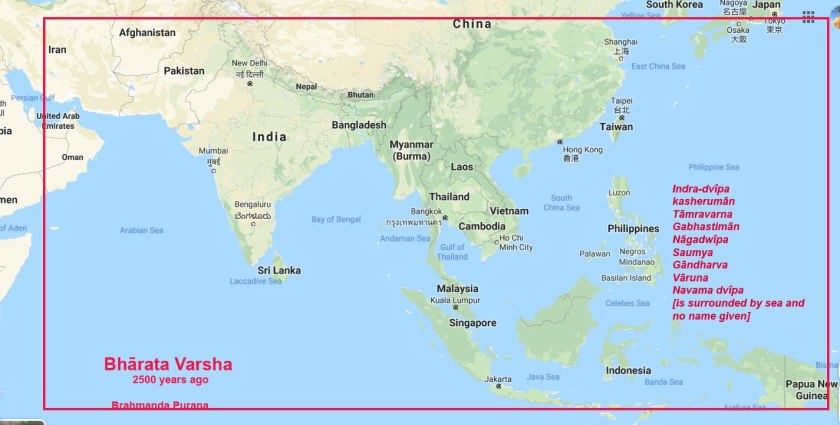


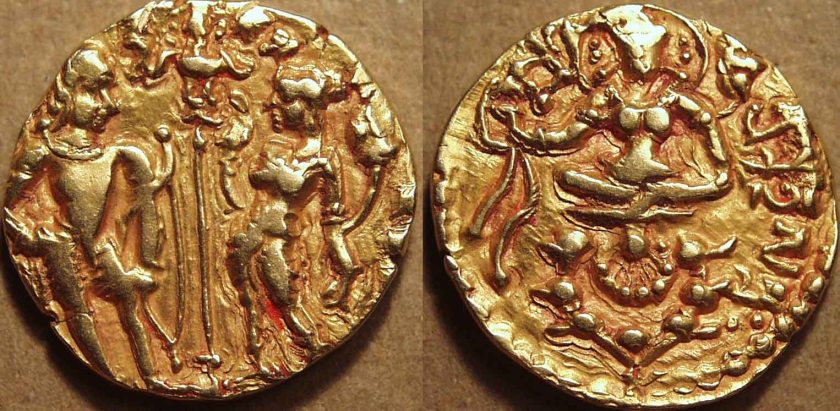 Skandagupta (स्कंदगुप्त)(455 – 467 AD) was successor of Kumargupta I as ruler of the Gupta Empire. Skandagupta is generally considered to be the last of the great Gupta Emperors. He crushed the Pushyamitras who had threatened the imperial authority.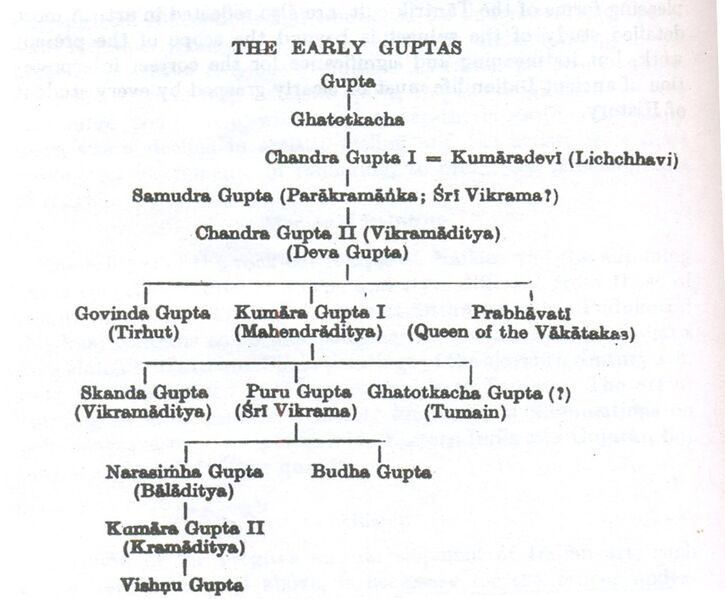

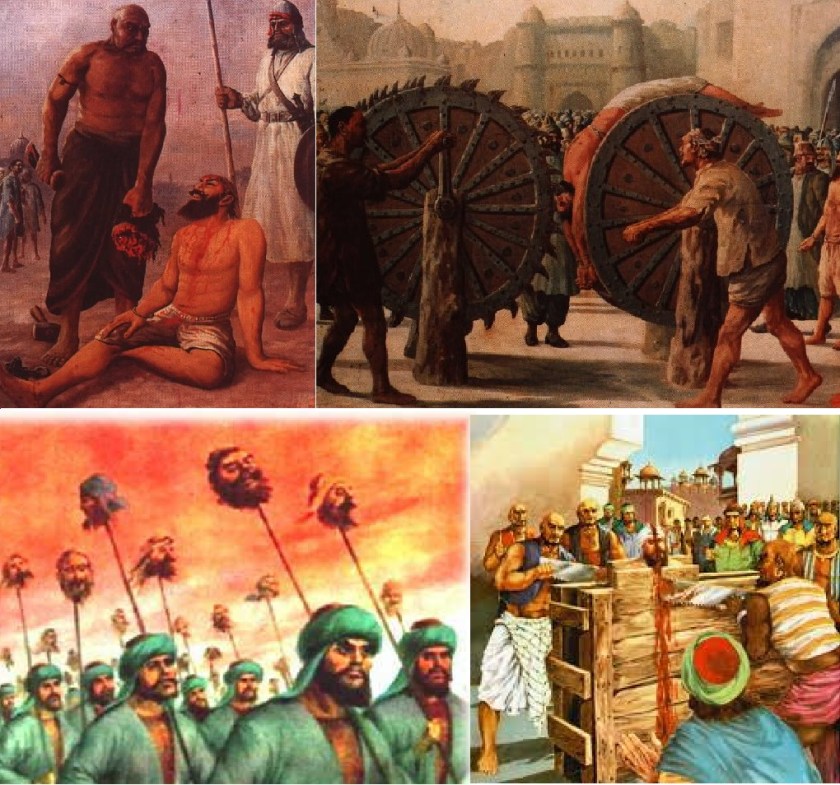 When islamist were doing atrocities, murder,for religious conversion,one elder son of Hindus started making an army , that was called Sikh and these in long run formed Sikh religion, which is basically Hindu religion. They should not distract and forget about Guru Teg Bahadur who fought against Muslim atrocities and terrorism but not gave up. Some Sikhs are not happy for ban on BEEF, as they forgot their origina and started following ISLAMIC teaching of eating BEEF ,although their many ancestors were murdered by same islamist. Beware Sikhs–


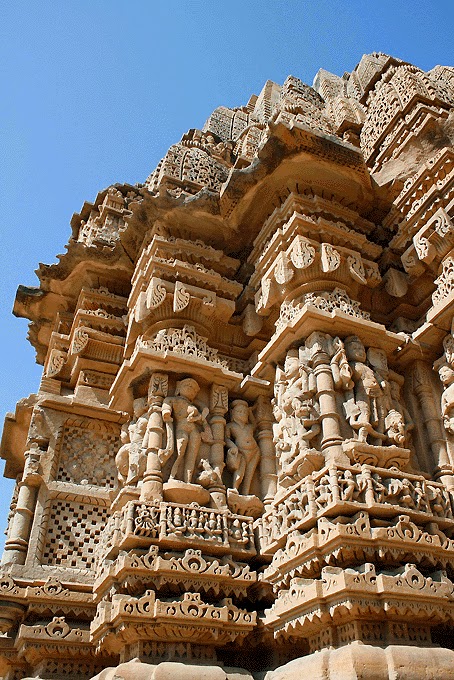

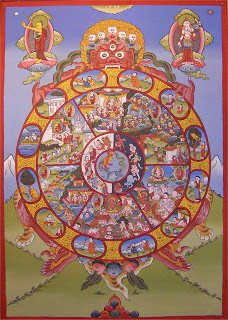


 GLOBAL HINDUISM