Krishna, Vishnu and Mahabharat influence on Ancient China

vaishnava_carvings_quanzhou_china

Apart from Saivism, Vaishnavism was also followed by people on ancient China.
Mahabharata (composed around 3100 BCE) makes a reference to presents brought by the Chinese to the Rajasuya Yajna performed by the Pandavas.
In the Vana Parva of the Mahabharata it is stated that the Pandava brothers crossed the country of the Cinas (China) during their trek through the Himalayan territory north of Badrinath.
They are said to have reached the realm of the Kirata King Subahu. Also in the Mahabharata the Cinas (Chinese), with the Kiratas, are found among the armies of King Bhagadatta of Pragjyotisa, India’s modern Assam region.
In the Sabha Parva this king is described as surrounded by the Kiratas and the Cinas.
The name China and the Chinese were after the Chins of India and proves the Indian origin of the name of China.

In the Bhisma Parva of the Mahabharata, the corps of Bhagadatta, consisting of the Kiratas and the Cinas of yellow color, are said to ‘look like a forest of Karnikaras‘.
In the Artha Sastra(Book on Economics written in 3rd century BCE) of Chanakya, China is mentioned as well. It is theorized that the name China is based upon the name of the kingdom, Ch’in, which was established by Shih Huang Ti in the year 221 BCE, but the word and race of Chin was mentioned in Mahabharata much earlier.

The name China comes from “an ancient Sanskrit name for the regions to the East”. The Chinese word for lion, ‘Shih’, used long before the Chin dynasty, was derived from the Sanskrit word, ‘Simha’.
African Swahili word for lion ‘Simba’ is virtually the same as the Sanskrit ‘Simha’ as well.
The Greek word for China, ‘Tzinista’, appears to be derived from the Sanskrit ‘Chinasthana’.

Magadha was known to the Chinese by the name Mo-kiato, and its capital was recognized by both its Hindu name Kusumpura, for which the Chinese wrote Kia-so-mo-pon-lo and Pataliputra, out of which they made Patoli-tse by translating putra, which means son in Sanskrit, into their own corresponding word, tse.
Such translation of names has thrown a veil of obscurity over many a name of Hindu origin.
Hindu geography has suffered a great loss.
Another clear example of the impact of dialect upon a language in the Sanskrit word ‘Maṇḍala’. In Japan it becomes ‘Mandara’ but in China it is ‘Màntúluó’.

Both Buddhism and Hinduism were patronized by the Chinese rulers. In the 6th century AD, the Chinese royal family was Hindu for two generations. The following Tang dynasty (7th to the 9th century A.D.) also patronized both Hinduism and Buddhism because the latter was but a branch of Hinduism.

Chinese Creation ‘Myth’ involves a ‘Boy of the White Crane‘. He is said to live in the palace of ‘jade emptiness’.
This is believed to represent the ‘Primeval Ocean’ and Lord Brahma who rides a white swan and is born from the navel of Lord Vishnu as he rest in the Primeval Ocean.
Also the “Supreme God in Chinese popular religion” is called ‘Yù-huáng[-dà]-dì’, which translates as “JadeEmperor-Big-Supreme Being“.
Thus we find that, like Quetza-lcoatl, the Supreme Being of the Mayans and
Aztecs, Lord Vishnu, the Supreme Being within the Vedic tradition, the Chinese Supreme Being Yu-Huang di is green as well.
Since this ‘Jade-Green’ is considered to be seacolored green we see yet another Supreme Being connected with the color of water which iconically means the color blue.

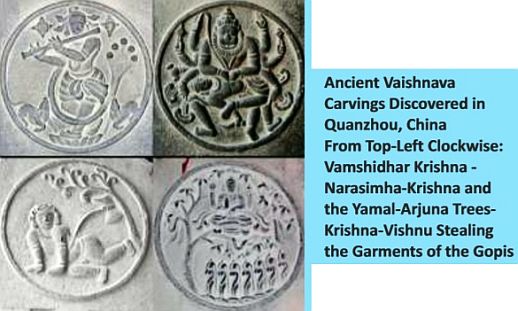
The presence of carvings depicting Krishna’s activities as a child in Vrindavan is quite remarkable. Despite theories that present the evidence of Chinese Vedic
culture as a mere offshoot of the Tamil merchant community, the presence of carvings based on Krishna’s Vrindavan pastimes suggest much more.
The fact is just as Buddhism was adopted and practiced by billions of non-Indians it is highly probable that Vedic culture was just as prevalent.

Taoism similar to Saktism (Śāktaṃ in Vedic tradition)

Chinese Taoism has something in common with Saktism in Vedic tradition.
One text in which the Tung Hsuan Section of the Tao Tsung (Taoist Canon) originated goes by the name Lin PaoChing (Book of the Marvelous Jewel).
Here we can find the influence of Brahmanism and Upanishad (Vedanta) in particular. It has a portrait of Yuan Shih TienTsun (the Highest God of Taoism) based on the portrait of the Maha Brahma of Brahmanism at the numerous kalpas in the unlimited darkness of Chaos.
Thus, He transforms himself into thirty-three devas, asuras, Ten directions of the Universe etc.
Among many other rare insights into Chinese Hinduism, the Monkey King, Sun Wukong, is indeed Hanuman.

Today’s India is still called Bharat but it only represents an extremely truncated Bharat.
True Bharat is the entire world and this Vedic culture is the entire humanity’s heritage.

Read more

Ancient India before buddism and Jainism

महाजनपद :गणराज्य और साम्राज्य

By Aman

भारत में सरस्वती  नदी के सूखने के उपरांत लोग भारत के अनेक इलाको में प्रवास कर बसने लगे।
इनमे अधिकतर गणराज्य या राज्य होता इसीलिए इन्हें महाजनपद कहा गया क्युकी ये लोगो के प्रवास का केंद्र था|
महाजनपद असल में एक बड़े शक्तिशाली राज्य को कहते जो कई छोटे जनपदों को मिलकर बना था ,इसीलिए कई राज्यों ने साम्राज्यवाद अपनाया ताकि खुदके राज्यों को जनपद से उठाकर महाजनपद बना सके और यह उपलब्धि के 16 राज्यों को मिली |
महाजनपद का उल्लेख पहली बार पाणिनि द्वारा किया गया था ,उस वक़्त 22 महाजनपद थे और बाकि के छोटे राज्यों को जनपद कहा गया है।
पर 700 ईसापूर्व के आते आते ये केवल 16 रह गए ।
बोध और जैन में महाजनपदो का उल्लेख है पर बहोत से नाम अलग है।
इनमे मगध,गंधर ,कोसल,काशी और अवन्ती का नाम ही पाया जाता है।
600 ईसापूर्व के आते आते बिम्बिसार और अजातशत्रु  आये जिन्होंने मगध का विस्तार किया और मगध सभी जनपदों में मुख्य बन गया।
इससे पहले यह जगह काशी को प्राप्त थी।
यह वह वक़्त था जब भारत में लहे का उपयोग अधिक बड़ा और संस्कृत में प्रगति हुई।
इसी दौर में वैदिक धर्म दक्मगाने लगा और बोध धर्म का उदय हुआ।
जैन धर्म भी लोगो में काफी प्रशिध हुआ ।
निचे 16 महाजनपदो की सूचि है 700 ईसापूर्व से 300 ईसापूर्व के बिच की।
1. कुरु – मेरठ और थानेश्वर;
राजधानी इन्द्रप्रस्थ और हस्तिनापुर ।

2. पांचाल – बरेली, बदायूं
और फ़र्रुख़ाबाद;
राजधानी अहिच्छत्र तथा
कांपिल्य ।

3. शूरसेन – मथुरा के
आसपास का क्षेत्र;
राजधानी मथुरा।

4. वत्स – इलाहाबाद और
उसके आसपास; राजधानी
कौशांबी ।

5. कोशल – अवध; राजधानी
साकेत और श्रावस्ती ।

6. मल्ल – ज़िला देवरिया;
राजधानी कुशीनगर और
पावा (आधुनिक पडरौना)

7. काशी – वाराणसी;
राजधानी वाराणसी।

8. अंग – भागलपुर; राजधानी
चंपा ।

9. मगध – दक्षिण बिहार,
राजधानी राजगृह और पाटलिपुत्र (नन्द काल में )

10. वृज्जि –
ज़िला दरभंगा और
मुजफ्फरपुर; राजधानी
मिथिला, जनकपुरी और
वैशाली ।

11. चेदि – बुंदेलखंड;
राजधानी शुक्तिमती
(वर्तमान बांदा के पास)।

12. मत्स्य – जयपुर;
राजधानी विराट नगर ।

13. अश्मक – गोदावरी घाटी;
राजधानी पांडन्य ।

14. अवंति – मालवा;
राजधानी उज्जयिनी।

15. गांधार – पाकिस्तान
स्थित पश्चिमोत्तर
क्षेत्र; राजधानी
तक्षशिला ।

16. कंबोज – कदाचित
आधुनिक अफ़ग़ानिस्तान ;
राजधानी राजापुर।

भारत के सोलह महाजनपद

700 ईसापूर्व के आते आते कई कबीलों की जनसँख्या बड़ी। ये कबीला कृषको के थे। इनमे पंचायत राज चलता था इसीलिए जब ये राज्यों के तौर पर उभरे तो गन संघ या गणराज्य आया।
राज्य से उलट इसमें जनता का राज चलता ।
वैशाली गणराज्यो में मुख्य था।
यूनान से पहले और बेहतर लोकतंत्र भारत में था।
अब बात करते है गणराज्यो और राज्यों या साम्राज्यो की।

गणराज्य  


यूनानी लोकतंत्र या गणराज्य को प्रथम क्यों माना जाता है पता नहीं पर भारतीय गणराज्य यूनान से बेहतर थे।
यूनान में आप केवल राजा चुन सकते थे बस पर भारत में बहोत से कम जनता के इशारो पर होता। बाद में गणराज्य कमजोर पड गए और जनता राज चला गया।
गणराज्यो के प्रमुख को नायक या राजा ही कहा जाता।
इनका काम कर वसूलना था और जनता के लिए सड़क आदि बनवाना था।
बहुत से गणराज्यो में गणराज्य के प्रमुख केवल व्यापारी वर्ग के होते और केवल कर वसूलते।
वैशाली  और कलिंग को छोड़ बाकि गणराज्यो में केवल चुनिन्दा वर्ग के लोग ही संघ का हिस्सा बन सकते थे।
वैशाली  और कलिंग में चारो वर्ण को इज़ाज़त थी।
वैशाली  के संघ में 7707 नायक थे।
ये गणराज्य अधिकतर वैश्य वर्ण के लोगो के थे जो ब्राह्मण द्वारा थोपे गए राजा से मुक्ति और जनता का राज्य चाहते थे |
इनकी सभा बैठती थी और हर मसले पर चर्चा होती |
जो चुंगी या कर ये लेते |
बाद में इन्होने सेना की नियुक्ति शुरू कर दी |
वैशाली या वृज्जी गणसंघ 7 गणराज्य से बना था जिसमे से कुछ के नाम ही प्राप्त है |
इनमे से एक गणराज्य शक्य था जिसकी पूरी जनता ही सेना की तरह निपूर्ण थी |
गणराज्य अपने शिष्टाचार के लिए प्रशिध थे |
अधिकतर गणराज्य या गणसंघ बोद्ध धर्मी थे और वहा बोद्ध के नियम ही चलते |
वृज्जी गणसंघ में प्राणदंड की सजा किसी बड़े अपराध पर ही मिलती |यदि देखे तो वृज्जी के गणराज्यो को छोड़ अधिक गणराज्य में कुछ अलग जी नियम थे |
मालक ,शूद्रक और कलिंग में केवल एक ही व्यक्ति चुना जाता जो राजा कहलाता और राजा की तरह ही काम करता |
वृज्जी गणसंघ ,कलिंग ,मालक ,शूद्रक और अन्य कुछ गणराज्यो की नगर प्रणाली और नगर व्यवस्था बिलकुल सरस्वती सिन्धु सभ्यता जैसी थी जो इस बात का प्रमाण देता है की गणराज्य बसने वाले सिधु घटी के थे और आर्य थे नहीं विदेशी |

आप कुछ समानताये देख सकते है सिन्धु घाटी सभ्यता और महाजनपद के सिक्को में

सम्राट अजातशत्रु के काल में गणराज्यो का पतन शुरू हुआ |सम्राट अजातशत्रु ने 36 गणराज्यो को हराया |
मौर्य काल के आते आते के वल कुछ ही गणराज्य रह गए थे |गुप्त काल में वृज्जी के अंत के साथ भारत में गणराज्यो का अंत हुआ |महराज चन्द्रगुप्त ने वृज्जी की राजकुमारी कुमारदेवी से शादी की जिसके बाद वृज्जी एक प्रांत बनकर रह गया |वृज्जी के साथ रिश्ता काफी फायदे का पड़ा महाराज चन्द्रगुप्त क क्युकी वृज्जी के पास उस वक्त मगध का अधिक भाग था जो महाराज चन्द्रगुप्त को मिला |

साम्राज्य गणराज्य से उलट यहाँ महाराज की चलती ,साम्राज्यवादी लोग गणतांत्रिक राज्य वालो को घृणा की दृष्टी से देखते क्युकी उनके लिए गणराज्य के लोग सिर्फ लोभी होते साथ ही गणराज्यो में बोद्ध धर्म की ऐसी धूम मची की वे अधिक बोद्ध धर्म पलने लगे जिसके उपरांत हिन्दू धर्म वालो के लिए केवल साम्राज्य ही सहारा थे |
गणराज्यो में कला और विज्ञानं का उतना महत्व नहीं था जितना साम्राज्यों में थे इसीलिए जब भी भारत किसी साम्राज्य के अधीन रहता तभी कला और विज्ञान का विकास हुआ |
भारत में कई महान साम्राज्य जुए जैसे मौर्य साम्राज्य ,गुप्त साम्राज्य,शुंग साम्राज्य ,सातवाहन साम्राज्य ,विजयनगर साम्राज्य ,मराठा साम्राज्य  और कई अनेक साम्राज्य हुए |विदेशी साम्राज्यवाद से उलट न्हारत के साम्राज्यों ने नेतिकता  और धर्म का साम्राज्य खड़ा किया |
महाजनपदो कशी शुरुआत में सबसे शक्तिशाली था और कशी ने महाजनपदो में साम्राज्यवाद शुरू किया |
आखिरकार बिम्बिसार के काल में शक्ति मगध के हाथ आई ,बिम्बिसार के बाद उनके बेटे अजातशत्रु आये जिन्होंने 36 गणराज्य जीते \
मगध में कई वंश बदले और फिर आया नन्द वंश जिसके केवल दो ही राजाओ ने मगध की सीमा उत्तर में कश्मीर तक ,पूर्व में अरुणाचल प्रदेश तक ,पश्चिम में यमुना तक और दक्षिण में मध्यप्रदेश तक |

नन्द साम्राज्य
मौर्य साम्राज्य अशोक के शाशन में

नन्द वंश के बाद मौर्य वंश आया जिसने पुरे भरत को एक किया |चन्द्रगुप्त मौर्य पहले सम्राट थे मौर्य वंश के ,उन्होंने मगध की सीमाए अफगानिस्तान तक फैलाई ,उत्तर में आज का पूरा कश्मीर ,नेपाल ,तिब्बत के कुछ भाग थे ,दक्षिण कर्णाटक का मौर्य वंश का द्वाज लहराता था |
बिन्दुसार मौर्य  ने 16 छोटे राज्यों को जीता |बिन्दुसार के बाद उनका छोटा लड़का अशोक मौर्य सम्राट बना जिसने कलिंग जीत अखंड भारत पर राज किया |अशोक मौर्य अपनी शांतिप्रियता के लिए जाना जाता है साथ ही बोद्ध धर्म को बढावा देने की वजह से कई बोद्ध लोगो के लिए वह चहेता है |
अशोक मौर्य की मृत्यु के 50 वर्ष बाद ही मौर्य वंश समाप्त हुआ और भारत कई टुकडो में बत गया जिसे फिरसे गुप्तो ने जोड़ा |
मौर्य वंश के साथ ही महाजनपदो का युग खत्म हुआ ,मौर्य साम्राज्य के बाद सिधु नदी के किनारे कई विदेशी राज्यों ने हमला किया साथ ही भारत में कई छोटे छोटे राज्य बसे ,अब किसी को जनपद से महाजनपद नहीं बनना था क्युकी अब सबको साम्राज्य खड़ा करना था |

चुंबकीय उत्तोलन और हिंदू मंदिर (Magnetic levitation and Hindu Temples)

चुंबकीय उत्तोलन और हिंदू मंदिर (Magnetic levitation and Hindu Temples)

आपने जेकी चेन की The Myth नाम की फिल्म तो देखि ही होगी ??
नहीं तो जरुर देखे ,उसमे जेकी चेन एक पुरातत्व विद था जो भारत में एक मंदिर में आता है ।
उस मंदिर में साधू उड़ पा रहे थे क्युकी 2 काले जादुई पत्थर के कारण ।
यह कल्पना नहीं पर सत्य है ,पर साधू के बजाये मुर्तिया हवा में तैरती थी ।

चुम्बक का उल्लेख हिंदू ग्रंथ में
मणिगमनं सूच्यभिसर्पण मित्यदृष्ट कारणं कम्||
वैशेषिक दर्शन ५/१/१५||
अर्थात् तृणो का मणि की ओर चलना ओर सुई
का चुम्बक की ओर चलना,अदृश्य कर्षण
शक्ति के कारण है । सोत्र
यह कणाद मुनि के ग्रंथ  वैशेषिक दर्शन है ,कणाद मुनि 600 ईसापूर्व के थे यानि गौतम बुद्ध के समय का ।
चुंबकीय उत्तोलन या Magnetic Levitation का अर्थ होता है चुंबकीय बल के सहारे तैरना ।
हर चुंबक के 2 ध्रुव होते है उत्तर और दक्षिण
चुंबक का नियम होता है की विपरीत ध्रुव एक दुसरे को आकर्षित करते है और समान ध्रुव एक दुसरे को धकेलते है ।
उधारण :
उत्तर ध्रुव दक्षिण ध्रुव को या दक्षिण ध्रुव उत्तर ध्रुव को आकर्षित करता है
पर
उत्तर ध्रुव उत्तर ध्रुव को या दक्षिण ध्रुव दक्षिण ध्रुव को धकेलता है ।
यही नियम बुलेट ट्रेन में काम आता है ।
2 समान ध्रुव एक दुसरे को धकेलते है जिससे इतना बल पैदा होता है की ट्रेन आगे बड़े ।
इसी का उपयोग हिंदुओ ने अपने मंदिरों में किया ।
मुझे 4 हिंदू मंदिरो का विवरण मिला है जिसमे चुंबकीय उत्तोलन का उपयोग हुआ था ।

सोमनाथ मंदिर (600 इसवी )
गुजरात में स्थित सोमनाथ मंदिर को गुजरात के यादव राजाओ ने बनाया था 600 इसवी में ।
सोमनाथ ज्योतिर्लिंगो में से एक है ।
कई मुस्लमान राजाओ ने इसको तोडा और इसमें स्थित शिव लिंग भी तोड़ दिया ।
स्थानीय लेखो के अनुसार सोमनाथ मंदिर का शिव लिंग हवा में तैरता था ।
हिंदुओ के अलावा मुसलमानों ने भी इसका वर्णन किया ।
क्वाज़िनी अल ज़कारिया सन 1300 इसवी में भारत में आया था ,वे फारसी लेखक थे और दुनिया के अजीब अजीब वस्तुओ पर लिखते थे ।
सोमनाथ के शिवलिंग पर क्वाज़िनी लिखते है :- “सोमनाथ मंदिर के बिच में सोमनाथ की मूर्ति थी ,वह हवा में तैर रही थी ,उसे न ऊपर से सहारा था  न नीचे से ।स्थानीय ही क्या मुस्लमान भी आश्चर्य करेगा ।”
इस विवरण से पुष्टि हो गई है की सोमनाथ मंदिर में शिव लिंग हवा में तैरता था ।
कुछ विद्वानों अनुसार यह आँखों का धोका था ।

सम्राट ललितादित्य मुक्तापिद का विष्णु मंदिर (700 इसवी )
सम्राट ललितादित्य कश्मीर के महान राजा थे जिन्होंने अरब और तिब्बत के हमले को रोक और कन्नौज पर राज किया जो उस समय भारत का केंद्र माना जाता था ।
स्त्री राज्य जो असम में ही कही स्थित था उसे जीतने के बाद सम्राट ललितादित्य ने स्त्री राज्य में ही विष्णु मंदिर की स्थापना की थी ।
विवरणों के अनुसार उस मंदिर में स्थित विष्णु जी की मूर्ति हवा में तैरती थी ।
इस मंदिर की सही स्थिति नहीं पता और इसके अवशेष अभी तक नहीं मिले ।
विद्वानों के अनुसार जिस कदर मुसलमानों ने ललितादित्य का सूर्य मंदिर तोड़ दिया था ठीक वैसे ही इस मंदिर को भी तोड़ा गया था ।

वज्रवराही का मंदिर (800 इसवी )
यह मंदिर है तो बोद्ध पर हिंदू देवी वराही को समर्पित है ।
यह मंदिर भूटान में Chumphu nye में स्थित है ,इस मंदिर के भीतर फोटो लेने की मनाही है इसीलिए वराही देवी की हवा में तैरते हुए फोटो नहीं ।
कई प्रत्यक्षदर्शी मंदिर में जा चुके है और उनके अनुसार वराही देवी की मूर्ति और थल के बिच 1 ऊँगली भर जगह है और मूर्ति बिना सपोर्ट के हवा में है ।
स्थानीय लोगो के अनुसार वह मूर्ति मनुष्य निर्मित नहीं बल्कि प्रकट हुई है ।
कुछ विद्वानों के अनुसार वह मूर्ति चुंबक के कारण हवा में तैर पा रही है ।
क्युकी भूटान और तिब्बत का बोद्ध धर्म बुद्ध के उपदेशो पे कम और हिंदू उपदेशो पर ज्यादा है इसीलिए मंदिर बनाने का यह ज्ञान हिंदुओ से बोद्ध भिक्षुओ को मिला ।
यही एक बची हुई ऐसी मूर्ति है जो सिद्ध करती है की हिंदू मंदिरों में मुर्तिया हवा में तैरती थी ।

कोणार्क का सूर्य मंदिर (1300 इसवी )
इसा के 1300 वर्ष बाद उड़ीसा में पूर्वी गंग राजाओ ने कोणार्क का सूर्य मंदिर बनवाया था ।
स्थानीय कथाओ के अनुसार कोणार्क के सूर्य मंदिर में सूर्य देव की जो मूर्ति थी वह हवा में तैरती थी ।
पुरातात्विक विश्लेषण से पता चला है की मंदिर का मुख्य भाग चुंबक से बना था जो गिर गया था ।
कम से कम 52 टन चुंबक मिलने की बात कही जाती है ।
उसी चुंबक वाले भाग में वह मूर्ति थी ,यह सबसे अच्छा साबुत है हिंदू मंदिरों में चुंबकीय उत्तोलन का क्युकी इस मंदिर में चुंबक मिला है ।
मूर्ति को हवा में उठाने के साथ चुंबक का एक और उपयोग था यानि चुंबकीय चिकित्सा ।
चुंबकीय चिकित्सा का अर्थ है चुंबक की उर्जा से इलाज करना ।
कोणार्क के सूर्य मंदिर का बहोत सा ढाचा गिर गया था जिसमे वह चुंबक से बना भाग भी था ।

भारत में चुंबक का उल्लेख 600 ईसापूर्व से मिलता है ,मुसलमानों के साथ साथ पुरातात्विक सबूत भी हिंदू मंदिरों में चुंबकीय उत्तोलन के सबूत देते है ।

(नीचे फोटो में गणेश जी की मूर्ति हवा में तैर पा रही है चुंबकीय बल के कारण )

जय माँ भारती

Transmigration of the soul through 8,400,000 different forms

If you think you’re in this world for the first time and that God gives you just one lifetime ‘away’ from Him, I’ve got some very bad news for you… Take courage, keep on reading and know your sad destiny…soul
 
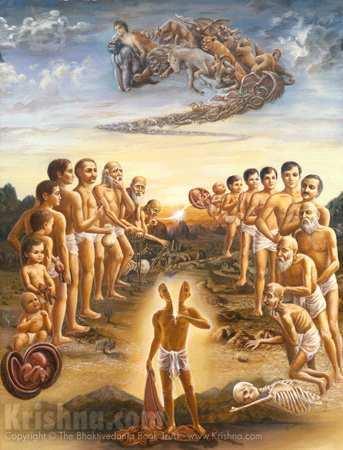
What is the ‘regular’ destiny of each and every individual soul who left God? The destiny is – Transmigration of the soul through 8,400,000 different forms (species) through countless time and space continuums. And that’s not all. We probably have more than one such cycle behind us! There is even more: we don’t remember anything from those cycles; barely one can remember something from his/her past lives, but none us can ever remember all our past lives. That is impossible for ‘ordinary’ soul who is in the cycle of transmigration. This is the subject of special mercy of God, and such mercy can’t get one who don’t give a damn about God, who is Person, not some impersonal energy or concept in our head.
 
So one may think about this fact in the following way: “I’ve passed through millions and millions of life-forms before I was given a chance to obtain human body again and I still don’t know nor understand WHY I’m in this world, HOW I got here, and WHERE will I go after my body drops dead… And I still do what I always did, still chasing rainbows and happiness in this world, from these people, from this or that… I pass my days just like everybody does….”
 
Sincerely, I don’t understand how can one go to sleep without finding out the answers to those basic existential questions posed above? How can one go to sleep without knowing the Truth, the Absolute Truth, that which is eternal and all-pervading?
Moreover, if in this human body one is given the extremely rare chance to get to know the Lord through Vedas and/or from those who personally know Him…. -> how can one throw one more life again? That’s scary… way too scary.
 

***

“Having gone through all the miserable, hellish conditions and having passed in a regular order through the lowest forms of animal life prior to human birth, and having thus been purged of his sins, one is reborn again as a human being on this earth.” Srimad-Bhagavatam 3.30.34 

“In this universe there are limitless living entities in 8,400,000 species, and all are wandering within this universe.” Sri Caitanya Caritamrita Madhya 19.138

PURPORT

This is a challenge to so-called scientists and philosophers who presume that there are living entities on this planet only. So-called scientists are going to the moon, and they say that there is no life there. This does not tally with Sri Caitanya Mahaprabhu‘s version. He says that everywhere within the universe there are unlimited numbers of living entities in 8,400,000 different forms. In the Bhagavad-gita (2.24) we find that the living entities are sarvagata, which means that they can go anywhere. This indicates that there are living entities everywhere. They exist on land, in water, in air, in fire and in ether. Thus there are living entities in all types of material elements. Since the entire material universe is composed of five elements — earth, water, fire, air and ether — why should there be living entities on one planet and not others? Such a foolish version can never be accepted by Vedic students.

From the Vedic literatures we understand that there are living entities on each and every planet, regardless of whether the planet is composed of earth, water, fire or air. These living entities may not have the same forms that are found on this planet earth, but they have different forms composed of different elements. Even on this earth we can see that the forms of land animals are different from the forms of aquatics. According to the circumstance, living conditions differ, but undoubtedly there are living entities everywhere. Why should we deny the existence of living entities on this or that planet? Those who have claimed to have gone to the moon have not gone there, or else with their imperfect vision they cannot actually perceive the particular type of living entities there.

The living entities are described as ananta, or unlimited; nonetheless, they are said to belong to 8,400,000 species. As stated in the Vishnu Purana:

jala-ja nava-lakshani sthavara laksha-vimsati
krimayo rudra-sankhyakah pakshinam dasa-lakshanam
trimsal-lakshani pasavah catur-lakshani manushah
 

There are 900,000 species living in the water. There are also 2,000,000 nonmoving living entities (sthavara), such as trees and plants. There are also 1,100,000 species of insects and reptiles, and there are 1,000,000 species of birds. As far as quadrupeds are concerned, there are 3,000,000 varieties, andthere are 400,000 human species.” Some of these species may exist on one planet and not on another, but in any case within all the planets of the universe — and even in the sun — there are living entities. This is the verdict of the Vedic literatures. As theBhagavad-gita (2.20) confirms:

na jayate mriyate va kadacin
nayam bhutva bhavita va na bhuyah
ajo nityah sasvato ‘yam purano
na hanyate hanyamane sarire
 

“For the soul there is neither birth nor death at any time. He has not come into being, does not come into being, and will not come into being. He is unborn, eternal, ever-existing and primeval. He is not slain when the body is slain.”

Since the living entities are never annihilated, they simply transmigrate from one life form to another. Thus there is an evolution of forms according to the degree of developed consciousness. One experiences different degrees of consciousness in different forms. A dog’s consciousness is different from a man’s. Even within a species we find that a father’s consciousness is different from his son’s and that a child’s consciousness is different from a youth’s. Just as we find different forms, we find different states of consciousness. When we see different states of consciousness, we may take it for granted that the bodies are different. In other words, different types of bodies depend on different states of consciousness. This is also confirmed in theBhagavad-gita (8.6):

yam yam vapi smaran bhavam tyajanty ante kalevaram
tam tam evaiti kaunteya sada tad bhava-bhavitah
 

“One’s consciousness at the time of death determines one’s type of body in the next life.” This is the process of transmigration of the soul. A variety of bodies is already there; we change from one body to another in terms of our consciousness.


Purusha Sukta from Rigveda

INTRO

The Purusha Sukta from Rigveda (Sacred Chants) – beautiful hymn in praise of Supreme Cosmic Being, the Supreme Lord, the Lord of Lords. God, the Father, the Supreme Personality of Godhead  is One, all pervading, Omnipresent, Omniscient, Omnipotent; yet He expands Himself into many, directly or indirectly. His first expansion is Lord Baladeva (as the ‘Son’) from Whom everything is created. The Son’s act of creation is considered His Self-sacrifice (yajna). Purusha means the Original Person, the Supreme Enjoyer; as such, He is the Supreme Enjoyer of all sacrifices and the sacrifice (oblation) Itself. (The term sacrifice means: offering something to God with Love. Anything offered to God with Love is sacrifice. Love and affection is the only valid ingredient of such sacrifice.) He Himself further expands into many, everything is His energy, all universes and ourselves; “For in Him we live and move and exist. As some of your own poets have said, ‘We are His offspring’.” [Acts 17,28] “All of you together are Christ’s Body, and each of you is a part of it.” [1 Cor 12,27]

Content:

Purusha is described as a Primeval gigantic Person, from whose Body the world and the varnas (socioeconomic classes) are built. He is described as having a thousand heads and a thousand feet. He emanated Viraj, the female creative principle, from which he is reborn in turn before the world was made out of his parts.

In the sacrifice of Purusha, the Vedic chants were first created. The horses and cows were born, the Brahmins (Learned men) were made from Purusha’s mouth, the Kshatriyas (Men with strength) from his arms, the Vaishyas (Men with business acumen) from his thighs, and the Shudras (Men who Work) from his feet. [1] The Moon was born from his mind, the Sun from his eyes, the heavens from his skull. Indra and Agni emerged from his mouth.

The hymn finds place in various Vedic texts such as the Atharvaveda (19.6), the Samaveda (6.4), the Yajurveda (VS 31.1-6), the Taittiriya Aranyaka (3.12,13), and it is commented upon in the Shatapatha Brahmana, the Taittiriya Brahmana, the Shvetashvatara Upanishad and the Mudgala Upanishad. It is one of the few Rig vedic hymns still current in contemporary Hinduism like, the Gayatri mantra. The Purusha Sukta is also mentioned with explanations and interpretations in the Vajasaneyi Samhita (31.1-6), the Sama veda Samhita (6.4), and the Atharva veda Samhita (19.6). Among Puranic texts, the Sukta has also been elaborated in the Bhagavata Purana (2.5.35 to 2.6.1-29) and in the Mahabharata.

Peace Invocation

Om taccham yoravrini mahe
ghatun yajnaya
ghatun yajnapataye
daivi svastirastu naha
svastir manushebhyaha
urdhvam jigatu bheshajam
sham no astu dvipade
sham chatushpade
Om shantih shantih shantihi

We worship and pray to the Supreme Lord for the welfare of all beings. May all miseries and shortcomings leave us forever so that we may always sing for the Lord during the holy fire ceremonies. May all medicinal herbs grow in potency so that all diseases may be cured. May the gods rain peace on us. May all the two-legged creatures be happy, and may all the four-legged creatures also be happy. May there be peace in the hearts of all beings in all realms.

Om sahasra shirsha purushaha
sahasrakshas sahasrapat
sa bhumim vishvato vritva
atyatishthad dhashangulam

The Purusha (the Supreme Lord) has a thousand heads, a thousand eyes and a thousand feet. He has enveloped this world from all sides and has (even) transcended it by ten angulas or inches.

purusha evedagam sarvam
yadbhutam yaccha bhavyam
utamritatva syeshanaha
yadanne natirohati

All this is verily the Purusha. All that which existed in the past or will come into being in the future (is also the Purusha). Also, he is the Lord of immortality. That which grows profusely by food (is also the Purusha).

etavanasya mahima
ato jyayagamshcha purushaha
padosya vishva bhutani
tripadasya mritam divi

So much is His greatness. However, the Purusha is greater than this. All the beings form only a quarter (part of) Him. The three-quarter part of His, which is eternal, is established in the spiritual domain.

tripadurdhva udaitpurushaha
padosyeha bhavatpunaha
tato vishvajya kramat
sashana ashane abhi

The Purusha with the three-quarters (of His energy) ascended above (the spiritual energy). His one quarter of material energy becomes this creation again (and again). Then He pervades this universe comprising a variety of sentient beings and insentient objects.

tasmad viradajayata
virajo adhi purushah
sa jato atyarichyata
pashchad bhumimatho puraha

From Him (the Adipurusha or original Supreme Being) was born the Virat (or Virat Purusha, the immense universal form). Making this Virat as the substratum (another) purusha (or being, Brahma) (was born). As soon as he was born, he multiplied himself. Later, he created this earth and then, the bodies (of the living beings).

yatpurushena havisha
deva yajnam atanvata
vasanto asyasidajyam
grishma idhmash sharaddhavihi

When the devas (the demigods or beings of light) performed a yajna (or sacrificial ritual), using the Purusha as the havis (sacrificial material) for the yajna (ritual), the Vasanta (spring) became the ajya (ghee), the Grishma (summer) served as idhma (pieces of wood) and the sharad (autumn) filled the place of havis (oblatory material like the purodasha or rice-cake).

saptasyasan paridhayaha
trissapta samidhah kritaha
deva yadjajnam tanvanaha
abadhnan purusham pashum

For this (yajna or spiritual ceremony) there were seven paridhis (fuel pieces serving as borders). And, twenty-one items were made the samit or sacrificial fuel sticks. When the devas were performing this yajna or ceremony, they tied the Purusha (Himself) as the pashu (sacrificial animal).

tam yajnam barhishipraukshan
purusham jatamagrataha
tena deva ayajantaha
sadhya rishayashchaye

The devas, the sadhyas and the rishis performed the sacrifice by using that Purusha as the means of yajna, the Purusha who had been born in the beginning, after sprinkling him with water by the barhis (or sacrificial grass).

tasmad yajnat sarvahutaha
sambhritam vrishadajyam
pashugamstya gashchakre
vayavyan aranyan gramashcaye

From that yajna (or sacrificial ritual) wherein the Cosmic Being was Himself the oblation, was produced the prasajya (or curds mixed with ghee). Birds flying in the air, wild animals of the forest as also the domesticated animals of the villages were also produced.

tasmad yajnat sarvahutaha
richassamani jijignire
chandhagamsi jijignire tasmat
yajus tasmad ajayata

From that yajna (or sacrifice) wherein the Cosmic Being was Himself the oblation, were born the riks (the mantras of the Rig-veda) and the samans (the mantras of the Sama-veda). From that (yajna) the metres (like Gayatri) were born. From that (yajna again) the yujas (the Yajur-veda) was born.

tasmadashva ajayata
ye ke cobhaya dataha
gavo ha jijignire tasmat
tasmad jnata ajavayaha

From that were born the horses, as also animals (like donkeys and mules) which have two rows of teeth. From that were born the cattle. From that (again) were born goats and sheep.

yatpurusham vyadadhuhu
kadhita vyakalpayan
mukham kimasya kau bahu
kavuru padavuchayate

(Now some questions are raised by the sages:) When the gods decided to (mentally) sacrifice the Viratpurusha (and produce further creation), in how many ways did they do it? What became of his face or mouth? What became of his two arms? What became of His two thighs? What were (the products of) the two feet called?

brahmanosya mukhamasit
bahu rajanyah kritaha
uru tadasya yadvaishyaha
padhyagam shudro ajayata

From His face (or the mouth) came the brahmanas. From His two arms came the rajanya (the kshatriyas). From His two thighs came the vaishyas. From His two feet came the shudras.

chandrama manaso jataha
chakshoh suryo ajayata
mukhad indrash chagnishcha
pranadvayur ajayata

From His mind was born the moon. From His two eyes was born the sun. From His mouth were born Indra and Agni. From His breath was born the air.

nabhya asidanta riksham
shirshno dyauh samavartata
padhyam bhumirdishash shrotrat
tada lokagamm akalpayan

From (His) navel was produced the antariksha (the space between the earth and the heavens). Dyuloka (or heaven) came into existence from His head. The bhumi (the earth) evolved out of His feet, and deek (or spacial directions) from His ears. Similarly (the demigods) produced the worlds (too).

vedahametam purusham mahantam
adityavarnam tamasastu pare
sarvani rupani vichitya dhiraha
namani kritva abhivadan yadaste

I know (through intuitive experience) this great Purusha (the Supreme Lord), the wise one, who, having created the various forms and the nomenclatures (for those forms), deals with them by those names, and who is beyond darkness and is brilliant like the sun.”

dhata purastadya mudajahara
shakrah pravidvan pradishashcha tasraha
tamevam vidvan amrita iha bhavati
nanyah pantha ayanaya vidyate

In the ancient days, Prajapati (Brahma) praised Him. Indra who knows all the four quarters also spoke about Him. Anyone who knows Him thus, will become immortal even in this life. For attaining liberation there is no other path (than knowledge of this Purusha, the Supreme Lord).

yajnena yajnam ayajanta devaha
tani dharmani pradhamanyasan
te ha nakam mahimanas sacante
yatra purve sadhyah santi devaha

The (demi)gods worshiped (the Supreme Creator in the form of) yajna through yajna (sacrifical ceremonies). Those very processes became the primary dharmas (laws guiding humanity). Those great ones attain that heaven where the ancient devas (demigods) and sadhyas live.

adbhyas sambhutah prithivyai rasacca
vishvakarmanas samavartatadhi
tasya tvashta vidadhad rupameti
tatpurushasya vishvamajanamagre

The Viratpurusha manifested Himself from out of (the all-pervading) water as also the essence of the element of earth. This Virat-purusha was born out of the greatness of the Parama-purusha, the Creator. The (Paramapurusha, known as) Tvashta engaged Himself in the act of creating (the fourteen planetary systems), (which form of the expanded) figure (of the Viratpurusha). (Thus) the entire creation (related to the Viratpurusha) came into existence in the very beginning of creation.

vedahametam purusham mahantam
adityavarnam tamasah parastat
tamevam vidvan amrita iha bhavati
nanyah pantha vidyate’yanaya

“I have known that great Purusha (Supreme Lord) who is brilliant like the sun and who is beyond all darkness. One who knows Him thus becomes immortal (even) here. There is no other path for liberation than this.”

prajapatishcharati garbhe antaha
ajayamano bahudha vijayate
tasya dhirah parijananti yonim
marichinam padamicchanti vedhasaha

Prajapati (the Supreme Creator) moves inside the cosmic womb. (Though) unborn He takes birth in a variety of ways. The wise ones know His (real nature) as the origin (of the universe). The (secondary) creators desire to attain the positions of Marichi and others.

yo devebhya atapati
yo devanam purohitaha
purvo yo devebhyo jataha
namo ruchaya brahmaye

Obeisances to Him, the self-luminous Brahman, who shines for the (demi)gods, who is the leader of the rituals of the gods and who was born even before the gods.

rucham brahmam janayantaha
deva agre tadabruvan
yastvaivam brahmano vidyat
tasya deva asanvashe

In the beginning of creation, the gods, manifesting the light of Brahman, addressed Brahman thus: “That brahmana who realizes (You) thus, all the gods will come under his control.”

hrishcha te lakshmishcha patnyau
ahoratre parshve
nakshatrani rupam
ashvinau vyattam
ishtam manishana
amun manishana
sarvam manishana
Om shanti shanti shantihi

O Purusha! The goddesses Hri (modesty) and Sri (Lakshmi, wealth) are Your consorts. Day and night are Your lateral limbs. The stars are Your form. The Ashvins are your widely opened (mouth). (O Purusha) fulfill our desire for self-knowledge as also our desire for the enjoyments of this world (like longevity, cows, and horses). Give us all that we need. Om, let there be peace, peace, peace.

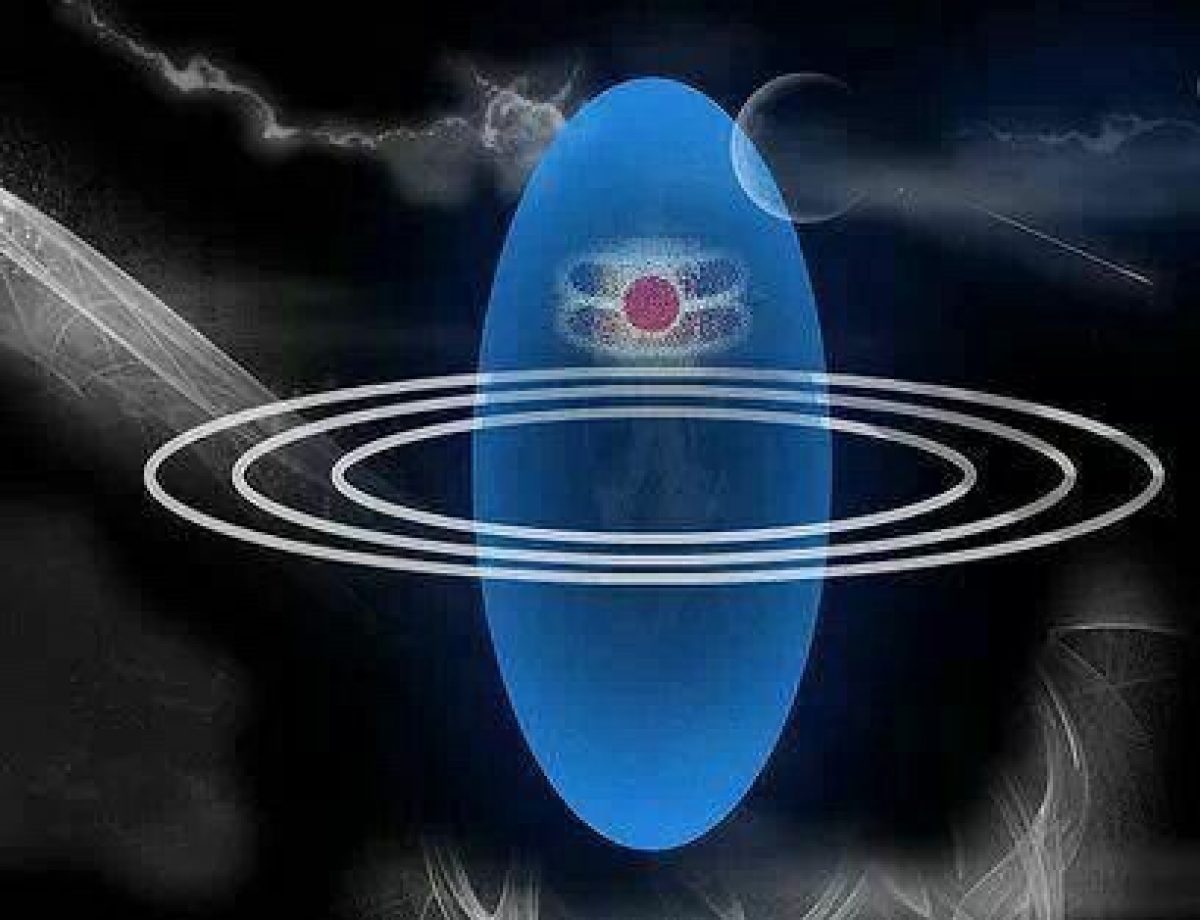
The Size of this Universe

The The Size of this Universe – from Śrīmad-Bhāgavatam 3.11.40-42 

SB 3.11.40This phenomenal material world is expanded to a diameter of four billion miles, as a combination of eight material elements transformed into sixteen further categories, within and without, as follows.

The analytical studies of the material world are the subject matter of Sāṅkhya philosophy. The first sixteen diversities are the eleven senses and five sense objects, and the eight elements are the gross and subtle matter, namely earth, water, fire, air, sky, mind, intelligence and ego. All these combined together are distributed throughout the entire universe, which extends diametrically to four billion miles. Besides this universe of our experience, there are innumerable other universes. Some of them are bigger than the present one, and all of them are clustered together under similar material elements as described below.

SB 3.11.41The layers or elements covering the universes are each ten times thicker than the one before, and all the universes clustered together appear like atoms in a huge combination.

The coverings of the universes are also constituted of the elements of earth, water, fire, air and ether, and each is ten times thicker than the one before. The first covering of the universe is earth, and it is ten times thicker than the universe itself. If the universe is four billion miles in size, then the size of the earthly covering of the universe is four billion times ten. The covering of water is ten times greater than the earthly covering, the covering of fire is ten times greater than the watery covering, the covering of air is ten times greater than that of the fire, the covering of ether is ten times greater still than that of air, and so on. The universe within the coverings of matter appears to be like an atom in comparison to the coverings, and the number of universes is unknown even to those who can estimate the coverings of the universes.

SB 3.11.42The Supreme Personality of Godhead, Śrī Kṛṣṇa, is therefore said to be the original cause of all causes. Thus the spiritual abode of Viṣṇu is eternal without a doubt, and it is also the abode of Mahā-Viṣṇu, the origin of all manifestations.

Lord Mahā-Viṣṇu, who is resting in yoga-nidrā on the Causal Ocean and creating innumerable universes by His breathing process, only temporarily appears in the mahat-tattva for the temporary manifestation of the material worlds. He is a plenary portion of Lord Śrī Kṛṣṇa, and thus although He is nondifferent from Lord Kṛṣṇa, His formal appearance in the material world as an incarnation is temporary. The original form of the Personality of Godhead is actually the svarūpa, or real form, and He eternally resides in the Vaikuṇṭha world (Viṣṇuloka). The word mahātmanaḥ is used here to indicate Mahā-Viṣṇu, and His real manifestation is Lord Kṛṣṇa, who is called parama, as confirmed in the Brahma-saṁhitā:

īśvaraḥ paramaḥ kṛṣṇaḥ
sac-cid-ānanda-vigrahaḥ
anādir ādir govindaḥ
sarva-kāraṇa-kāraṇam

“The Supreme Lord is Kṛṣṇa, the original Personality of Godhead, known as Govinda. His form is eternal, full of bliss and knowledge, and He is the original cause of all causes

Link

Krishna Temple in Pakistan


This ancient Krishna temple in Pakistan, which is now used as a storage to keep straw, still contains some extremely beautiful ancient paintings of Lord Krishna. Just go through the pictures. However, the dilapidated condition of the temple is very painful.

Peape tree or Ficus Religosa and sweet water well in Garden area or Bagh of the Krishna Mandir and Gurdwara of Kallar Syedan 1830 AD — in Kallar Saidan, Punjab, Pakistan.

Vedic God Indra is worshipped as God Thagyamin by the Buddhists

The Vedic God Indra is worshipped as God Thagyamin by the Buddhists of Burma/ Myanmar. Here are some beautiful statues of the Vedic God Indra in the Burmese style.

oldest Hindu Temple is Cambodia- Akkor Vat

The Oldest Hindu Temple? We all know that Ankor Vat (built in 12th century) in Cambodia is the biggest Hindu temple complex in the world (in fact, it is the biggest religious structure in the world!!!). But where is the oldest Hindu temple? The question of finding an answer to the oldest Hindu temple is a bit difficult. Each temple that is considered to be the oldest is questioned by another set of people claiming their temple to be the oldest one. Early worships used to take place in caves, so it is quite probable that the most ancient temple has to be a cave temple. Therefore, here I present a possible candidate: Cave No. 19 of the Bhaja Caves, Lonavala, Maharashtra. Even though the 2200 years old Bhaja Caves are primarily a Theravada Buddhist site, it seems that, like is the case with many other ancient cave temples, these caves too were shared by Buddhists and Hindus alike. In cave no. 19 we find 2200 years old rock carvings of Surya (the Vedic Sun God) on his chariot, Indra (the Vedic Thunder God) on his Airavata elephant and Lord Parashurama, an incarnation of Lord Vishnu, which is enough evidence for us to speculate that cave no. 19 was used as a temple by people following the Vedic traditions. This makes it most probably the most ancient Hindu temple to be found intact today.
Pic: 1. 2200 years old rock carvings of Surya (the Vedic Sun God) on his chariot, Indra (the Vedic Thunder God) on his Airavata elephent in cave no. 19, Bhaja Caves, Lonavala, Maharashtra. 2. Buddhist Chaitya at the main cave entrance, Bhaja Caves, Lonavala, Maharashtra.

Yazidi Hindus in Iraq,Syria

See this video of how a Yazidi priest is giving Tilaka to a visiting devotee in the same way like Hindu priests make Tilaka to visiting devotees all over India, one Tilaka mark on the forehead, on the Ajna Chakra, and the second on the throat. on the Vishuddhi Cakra. Amazing. They also have a caste system, walk around sacred objects 3 times which is called “Parikrama” in Hinduism and consider trees holy.