
INTRO
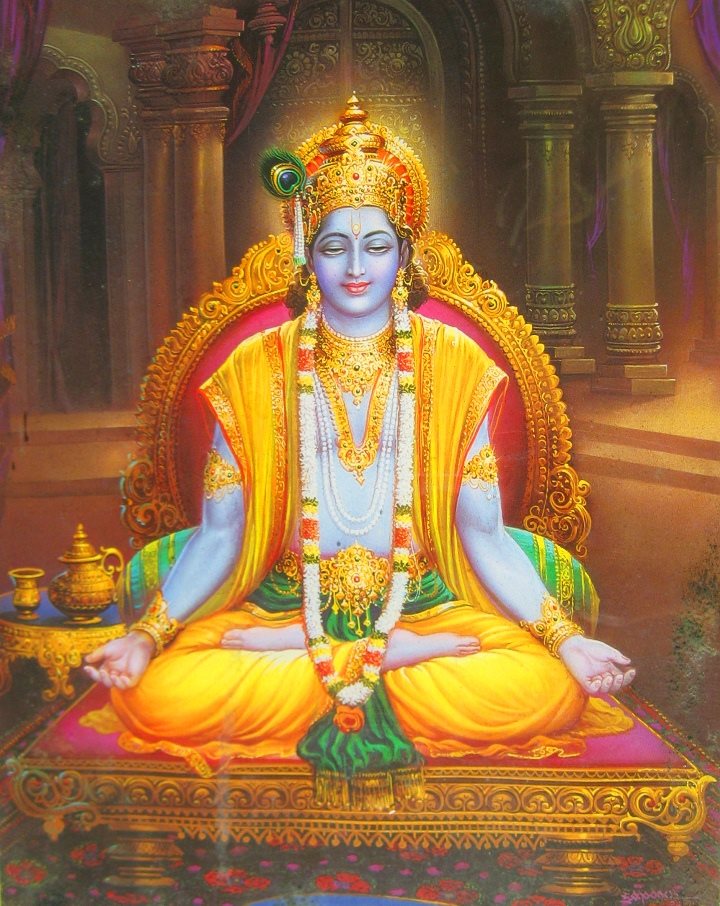
The Purusha Sukta from Rigveda (Sacred Chants) – beautiful hymn in praise of Supreme Cosmic Being, the Supreme Lord, the Lord of Lords. God, the Father, the Supreme Personality of Godhead is One, all pervading, Omnipresent, Omniscient, Omnipotent; yet He expands Himself into many, directly or indirectly. His first expansion is Lord Baladeva (as the ‘Son’) from Whom everything is created. The Son’s act of creation is considered His Self-sacrifice (yajna). Purusha means the Original Person, the Supreme Enjoyer; as such, He is the Supreme Enjoyer of all sacrifices and the sacrifice (oblation) Itself. (The term sacrifice means: offering something to God with Love. Anything offered to God with Love is sacrifice. Love and affection is the only valid ingredient of such sacrifice.) He Himself further expands into many, everything is His energy, all universes and ourselves; “For in Him we live and move and exist. As some of your own poets have said, ‘We are His offspring’.” [Acts 17,28] “All of you together are Christ’s Body, and each of you is a part of it.” [1 Cor 12,27]
Content:
Purusha is described as a Primeval gigantic Person, from whose Body the world and the varnas (socioeconomic classes) are built. He is described as having a thousand heads and a thousand feet. He emanated Viraj, the female creative principle, from which he is reborn in turn before the world was made out of his parts.
In the sacrifice of Purusha, the Vedic chants were first created. The horses and cows were born, the Brahmins (Learned men) were made from Purusha’s mouth, the Kshatriyas (Men with strength) from his arms, the Vaishyas (Men with business acumen) from his thighs, and the Shudras (Men who Work) from his feet. [1] The Moon was born from his mind, the Sun from his eyes, the heavens from his skull. Indra and Agni emerged from his mouth.
The hymn finds place in various Vedic texts such as the Atharvaveda (19.6), the Samaveda (6.4), the Yajurveda (VS 31.1-6), the Taittiriya Aranyaka (3.12,13), and it is commented upon in the Shatapatha Brahmana, the Taittiriya Brahmana, the Shvetashvatara Upanishad and the Mudgala Upanishad. It is one of the few Rig vedic hymns still current in contemporary Hinduism like, the Gayatri mantra. The Purusha Sukta is also mentioned with explanations and interpretations in the Vajasaneyi Samhita (31.1-6), the Sama veda Samhita (6.4), and the Atharva veda Samhita (19.6). Among Puranic texts, the Sukta has also been elaborated in the Bhagavata Purana (2.5.35 to 2.6.1-29) and in the Mahabharata.
Peace Invocation
Om taccham yoravrini mahe
ghatun yajnaya
ghatun yajnapataye
daivi svastirastu naha
svastir manushebhyaha
urdhvam jigatu bheshajam
sham no astu dvipade
sham chatushpade
Om shantih shantih shantihi
We worship and pray to the Supreme Lord for the welfare of all beings. May all miseries and shortcomings leave us forever so that we may always sing for the Lord during the holy fire ceremonies. May all medicinal herbs grow in potency so that all diseases may be cured. May the gods rain peace on us. May all the two-legged creatures be happy, and may all the four-legged creatures also be happy. May there be peace in the hearts of all beings in all realms.
Om sahasra shirsha purushaha
sahasrakshas sahasrapat
sa bhumim vishvato vritva
atyatishthad dhashangulam
The Purusha (the Supreme Lord) has a thousand heads, a thousand eyes and a thousand feet. He has enveloped this world from all sides and has (even) transcended it by ten angulas or inches.
purusha evedagam sarvam
yadbhutam yaccha bhavyam
utamritatva syeshanaha
yadanne natirohati
All this is verily the Purusha. All that which existed in the past or will come into being in the future (is also the Purusha). Also, he is the Lord of immortality. That which grows profusely by food (is also the Purusha).
etavanasya mahima
ato jyayagamshcha purushaha
padosya vishva bhutani
tripadasya mritam divi
So much is His greatness. However, the Purusha is greater than this. All the beings form only a quarter (part of) Him. The three-quarter part of His, which is eternal, is established in the spiritual domain.
tripadurdhva udaitpurushaha
padosyeha bhavatpunaha
tato vishvajya kramat
sashana ashane abhi
The Purusha with the three-quarters (of His energy) ascended above (the spiritual energy). His one quarter of material energy becomes this creation again (and again). Then He pervades this universe comprising a variety of sentient beings and insentient objects.
tasmad viradajayata
virajo adhi purushah
sa jato atyarichyata
pashchad bhumimatho puraha
From Him (the Adipurusha or original Supreme Being) was born the Virat (or Virat Purusha, the immense universal form). Making this Virat as the substratum (another) purusha (or being, Brahma) (was born). As soon as he was born, he multiplied himself. Later, he created this earth and then, the bodies (of the living beings).
yatpurushena havisha
deva yajnam atanvata
vasanto asyasidajyam
grishma idhmash sharaddhavihi
When the devas (the demigods or beings of light) performed a yajna (or sacrificial ritual), using the Purusha as the havis (sacrificial material) for the yajna (ritual), the Vasanta (spring) became the ajya (ghee), the Grishma (summer) served as idhma (pieces of wood) and the sharad (autumn) filled the place of havis (oblatory material like the purodasha or rice-cake).
saptasyasan paridhayaha
trissapta samidhah kritaha
deva yadjajnam tanvanaha
abadhnan purusham pashum
For this (yajna or spiritual ceremony) there were seven paridhis (fuel pieces serving as borders). And, twenty-one items were made the samit or sacrificial fuel sticks. When the devas were performing this yajna or ceremony, they tied the Purusha (Himself) as the pashu (sacrificial animal).
tam yajnam barhishipraukshan
purusham jatamagrataha
tena deva ayajantaha
sadhya rishayashchaye
The devas, the sadhyas and the rishis performed the sacrifice by using that Purusha as the means of yajna, the Purusha who had been born in the beginning, after sprinkling him with water by the barhis (or sacrificial grass).
tasmad yajnat sarvahutaha
sambhritam vrishadajyam
pashugamstya gashchakre
vayavyan aranyan gramashcaye
From that yajna (or sacrificial ritual) wherein the Cosmic Being was Himself the oblation, was produced the prasajya (or curds mixed with ghee). Birds flying in the air, wild animals of the forest as also the domesticated animals of the villages were also produced.
tasmad yajnat sarvahutaha
richassamani jijignire
chandhagamsi jijignire tasmat
yajus tasmad ajayata
From that yajna (or sacrifice) wherein the Cosmic Being was Himself the oblation, were born the riks (the mantras of the Rig-veda) and the samans (the mantras of the Sama-veda). From that (yajna) the metres (like Gayatri) were born. From that (yajna again) the yujas (the Yajur-veda) was born.
tasmadashva ajayata
ye ke cobhaya dataha
gavo ha jijignire tasmat
tasmad jnata ajavayaha
From that were born the horses, as also animals (like donkeys and mules) which have two rows of teeth. From that were born the cattle. From that (again) were born goats and sheep.
yatpurusham vyadadhuhu
kadhita vyakalpayan
mukham kimasya kau bahu
kavuru padavuchayate
(Now some questions are raised by the sages:) When the gods decided to (mentally) sacrifice the Viratpurusha (and produce further creation), in how many ways did they do it? What became of his face or mouth? What became of his two arms? What became of His two thighs? What were (the products of) the two feet called?
brahmanosya mukhamasit
bahu rajanyah kritaha
uru tadasya yadvaishyaha
padhyagam shudro ajayata
From His face (or the mouth) came the brahmanas. From His two arms came the rajanya (the kshatriyas). From His two thighs came the vaishyas. From His two feet came the shudras.
chandrama manaso jataha
chakshoh suryo ajayata
mukhad indrash chagnishcha
pranadvayur ajayata
From His mind was born the moon. From His two eyes was born the sun. From His mouth were born Indra and Agni. From His breath was born the air.
nabhya asidanta riksham
shirshno dyauh samavartata
padhyam bhumirdishash shrotrat
tada lokagamm akalpayan
From (His) navel was produced the antariksha (the space between the earth and the heavens). Dyuloka (or heaven) came into existence from His head. The bhumi (the earth) evolved out of His feet, and deek (or spacial directions) from His ears. Similarly (the demigods) produced the worlds (too).
vedahametam purusham mahantam
adityavarnam tamasastu pare
sarvani rupani vichitya dhiraha
namani kritva abhivadan yadaste
“I know (through intuitive experience) this great Purusha (the Supreme Lord), the wise one, who, having created the various forms and the nomenclatures (for those forms), deals with them by those names, and who is beyond darkness and is brilliant like the sun.”
dhata purastadya mudajahara
shakrah pravidvan pradishashcha tasraha
tamevam vidvan amrita iha bhavati
nanyah pantha ayanaya vidyate
In the ancient days, Prajapati (Brahma) praised Him. Indra who knows all the four quarters also spoke about Him. Anyone who knows Him thus, will become immortal even in this life. For attaining liberation there is no other path (than knowledge of this Purusha, the Supreme Lord).
yajnena yajnam ayajanta devaha
tani dharmani pradhamanyasan
te ha nakam mahimanas sacante
yatra purve sadhyah santi devaha
The (demi)gods worshiped (the Supreme Creator in the form of) yajna through yajna (sacrifical ceremonies). Those very processes became the primary dharmas (laws guiding humanity). Those great ones attain that heaven where the ancient devas (demigods) and sadhyas live.
adbhyas sambhutah prithivyai rasacca
vishvakarmanas samavartatadhi
tasya tvashta vidadhad rupameti
tatpurushasya vishvamajanamagre
The Viratpurusha manifested Himself from out of (the all-pervading) water as also the essence of the element of earth. This Virat-purusha was born out of the greatness of the Parama-purusha, the Creator. The (Paramapurusha, known as) Tvashta engaged Himself in the act of creating (the fourteen planetary systems), (which form of the expanded) figure (of the Viratpurusha). (Thus) the entire creation (related to the Viratpurusha) came into existence in the very beginning of creation.
vedahametam purusham mahantam
adityavarnam tamasah parastat
tamevam vidvan amrita iha bhavati
nanyah pantha vidyate’yanaya
“I have known that great Purusha (Supreme Lord) who is brilliant like the sun and who is beyond all darkness. One who knows Him thus becomes immortal (even) here. There is no other path for liberation than this.”
prajapatishcharati garbhe antaha
ajayamano bahudha vijayate
tasya dhirah parijananti yonim
marichinam padamicchanti vedhasaha
Prajapati (the Supreme Creator) moves inside the cosmic womb. (Though) unborn He takes birth in a variety of ways. The wise ones know His (real nature) as the origin (of the universe). The (secondary) creators desire to attain the positions of Marichi and others.
yo devebhya atapati
yo devanam purohitaha
purvo yo devebhyo jataha
namo ruchaya brahmaye
Obeisances to Him, the self-luminous Brahman, who shines for the (demi)gods, who is the leader of the rituals of the gods and who was born even before the gods.
rucham brahmam janayantaha
deva agre tadabruvan
yastvaivam brahmano vidyat
tasya deva asanvashe
In the beginning of creation, the gods, manifesting the light of Brahman, addressed Brahman thus: “That brahmana who realizes (You) thus, all the gods will come under his control.”
hrishcha te lakshmishcha patnyau
ahoratre parshve
nakshatrani rupam
ashvinau vyattam
ishtam manishana
amun manishana
sarvam manishana
Om shanti shanti shantihi
O Purusha! The goddesses Hri (modesty) and Sri (Lakshmi, wealth) are Your consorts. Day and night are Your lateral limbs. The stars are Your form. The Ashvins are your widely opened (mouth). (O Purusha) fulfill our desire for self-knowledge as also our desire for the enjoyments of this world (like longevity, cows, and horses). Give us all that we need. Om, let there be peace, peace, peace.