The Concept Of Infinity In Sanatan Dharma :

Sanatan Dharm and Hinduism's avatarHINDUISM AND SANATAN DHARMA

The Concept Of Infinity In Sanatan Dharma :
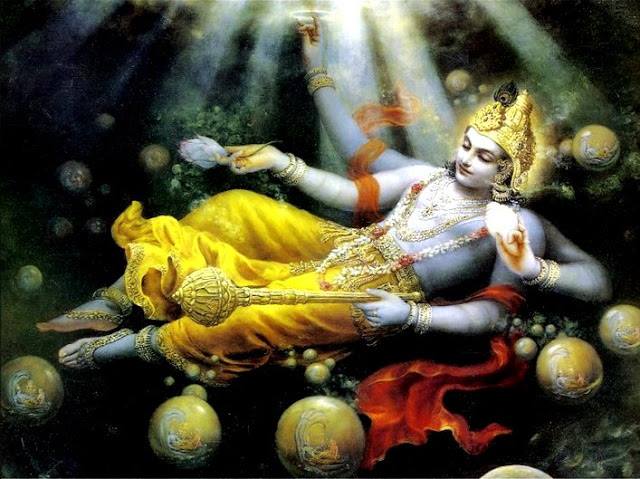
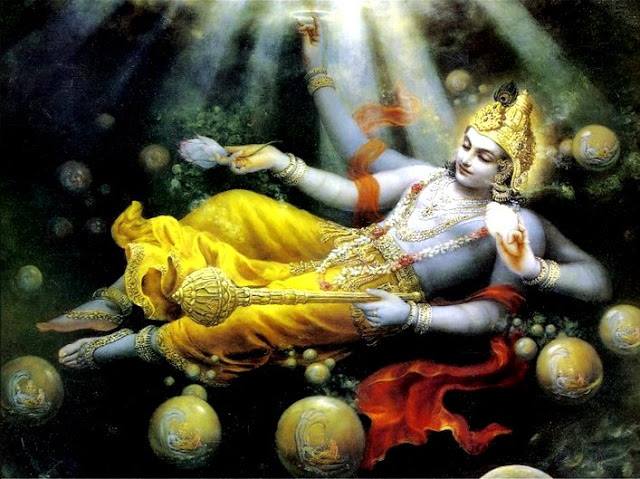
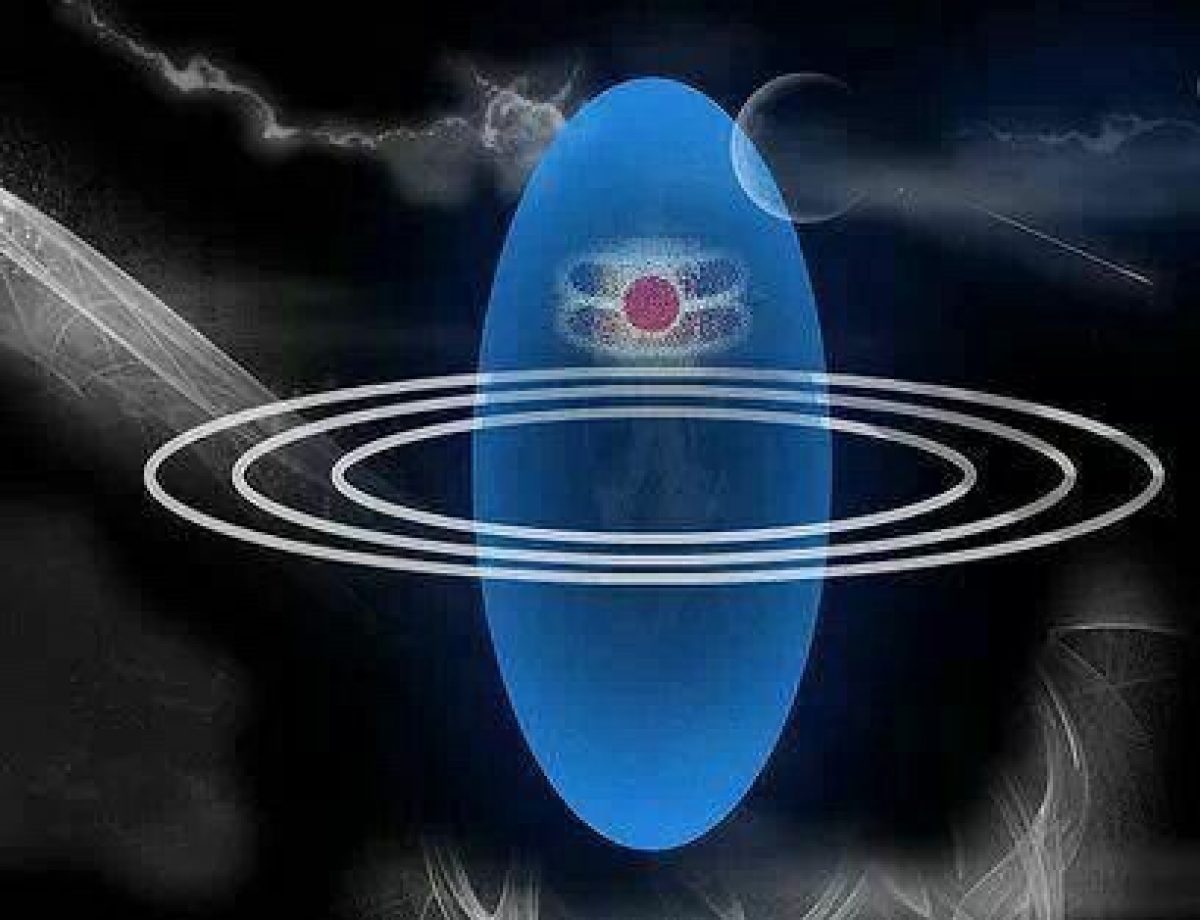
Photo: The Concept Of Infinity In Sanatan Dharma : God is infinite. But let us have a clear understanding of the meaning of this word infinite ; and use it in its proper sense.  That which is not limited by time and space and not subject to the law of causation, which is above time, space, and beyond all laws is infinite.  God is not limited by time or space, neither has He any cause. He is absolute. The infinite again must be one, otherwise it is finite. If there be any other thing beside that infinite then it is no longer infinite; it is limited by that object, consequently it has become finite. Thus if we admit that God is infinite, we deny the existence of any other thing besides God; other wise He would be limited by that thing, and be subject to time, space and the law of causation. If we say that matter exists separate from and outside of God, we have made Him limited by matter, we have made Him finite and perishable.  If we think of ourselves as separate from God, as independent of His Being, then in our thought we have denied His illimitable nature. There is for the same reason, not a single particle of matter in the universe that can exist independent of God s existence or outside of God.  If He is infinite and one, our bodies and every thing of the universe from the minutest atom to the largest planetary system, from the lowest animalcule to the highest Being, exists in and through that Infinite Existence.  This may be startling to many, but the fact cannot be denied. If we wish to be logical, if the word infinite conveys any meaning at all, we cannot avoid the logical conclusion which must inevitably follow. If, on the contrary, we use the word infinite meaning something finite, how foolish and illogical shall we be !  The conclusion is this :  If God is infinite and one, then mind and matter, subject and object, creator and creation, and all relative dual existences are within that Being, and not outside of it. The whole universe is in God and God is in it; it is inseparable from God. I am in Him and He is in me; each one of us is inseparable from His being; if one atom of my body exists, that existence cannot be separated from His existence.    Now we know that the universal Soul is infinite. How can infinity have parts ? How can it be broken up, divided ?  It may be very poetic to say that I am a spark of the Infinite, but it is absurd to the thinking mind. What is meant by dividing Infinity ? Is it something material that you can part or separate it into pieces ? Infinite can never be divided. If that were possible, it would be no more Infinite. Again, there can be no two infinites. If there be two infinites, how would you demarcate their respective spheres ?  (Objection) : Why ? Space and Time are two infinite entities.  (Reply) : Space is infinite, but it passes our understanding how time can be infinite. Einstein’s definition of Time is a gap between two sequential events in space, observed by an observer who does not change with time. Two simultaneous events define space and two sequential events define time.  Vedanta defines time more subjectively, since ‘subject’ is included in the perception of time too. Time is the sequence of two experiences by the same experiencer who does not change with the experience. Each event-observation is counted as one experience. By bringing the experiencer and the mind associated with it to observe and record the experience, time is reduced to a concept in the mind.   Time exists in mind. What is time ?  Time, for instance , means "succession," which is a condition of thought; and space means "coexistence." The activities of mind, being either in succession or simultaneous, produce the ideas of time and space; they are conditions, or, as Kant calls them, forms of thought. One thought following another gives us a conception of intervals which we call time. Time means succession in thought. When one thought rises after another, the interval between them is what we call Time, so it is subject to mental activity. When two ideas rise simultaneously, that which separates them is what we call space. Thus, that which exists between the idea " me " and the idea " sun " we classify as space ; yet it is purely a mental concept, having no existence outside the mind; for who knows any concrete thing designated space ? Hence, since these ideas of time and space are merely conditions of thought, they must be subject to change, because our thought is continually changing. Hence perception of time depends on the mind too. When there is no mind, or to put it more accurately when there are no thoughts, there is no time either. This is what we experience in the deep-sleep state, where sleep is considered as only one experience and not two. Hence there is no time or space in the deep-sleep state. They are valid as long as thoughts are there. The paradox of time arises strangely with the notions in the mind.  Anything that is in space has form. Space itself has form. Either you are in space, or space is in you. The soul is beyond all space. Space is in the soul, not the soul in space. Form is confined to time and space and is bound by the law of causation. All time is in us, we are not in time. As the soul is not in time and space, all time and space are within the soul. The soul is therefore omnipresent.   पूर्णमदः पूर्णमिदं पूर्णात्पुर्णमुदच्यते पूर्णश्य पूर्णमादाय पूर्णमेवावशिष्यते ॥  (Brihadaranyak Upanishad 5.1.1)  This passage occurs in the Brihadaranyaka Upanishad. We recite it, chant it every day, but mostly we do not think about what it means when we chant it; it goes as a routine. Purna is fullness. The Upanishad says,  "Purnam adah: that origin of all things is full; purnam idam: this entire creation that has come from that origin of all things is also full; purnat purnam udachyate: from that Full this Full has come; purnasya purnam adaya: having taken away this Full from that Full; purnam evavasisyate: the Full still remains unaffected." If we take something from something, the source is supposed to be diminished in its content to the extent of that which has been taken away from it. This is common arithmetic. If we take something from something, the quantum of content in the original reservoir is lessened. If the world has come from God, some part of God must have gone to constitute this world and, to that extent, God must be less. Is it so ?  The Upanishad says it is not so. If we take away infinite from infinite, the Infinite is not reduced in any way, because one cannot take away anything from the Infinite. Therefore, if this so-called infinite of creation is taken to have emanated from that supreme Fullness of Infinity, it need not follow that there is some diminution of content in the original Fullness. After the emanation of this full universe from the full Origin, the Fullness still continues to be as it was, undiminished.   This is beyond our calculative method. We have never heard such a thing happening anywhere – that we carry away something and yet the source of that thing is as it is, without getting diminished. The reason is the character of Infinity itself. If some part of this finite is taken away, naturally it suffers a loss. If a limb of the body is taken away, to that extent the body has lost a part of itself. But you cannot take away a part of the soul.  Here is the difference. You may take a part of your body, but a part of the soul cannot be removed, because the soul is not a substance. Therefore, it is not a finite thing. Therefore, it is not in any particular place. Therefore, something cannot be taken away from it.  As we have our own soul, God is the Soul of the universe. This Soul is unlimited in its nature.The infinite character of God Almighty explains the reason why anything emanating from this infinite God cannot affect the infinite God. In fact, you cannot take away anything at all from the Infinite. The infinitude of God is not diminished in any way when the infinite universe proceeds, as it were, from God. Actually, nothing proceeds from God. Having done all things, He has done nothing. The idea of proceeding arises only on account of the cause-and-effect relationship that has entered into our minds.  Unless there is space and time, there cannot be cause and effect. Space and time are effects of creation and, therefore, cause and effect, having come after the manifestation of space and time, cannot affect Infinity, which is God.    1. First, would arise the concept of space, here vs. there, me taking up space over here, you taking up space over there.  2. Next would be time, if something is here and not there it has to get from here to there and can’t be in both places at once, therefore, it takes time to travel from one place to another.  3. Finally causation, in space and time one thing seems to be the cause of another. In the relative sense all this is real. In the absolute sense none of it is real.  So, you cannot apply the principle of cause and effect to God Himself. Therefore, creation is not an effect coming from God as a cause. Even the word 'cause' is not a proper term that may be applied to God. He is a causeless cause, no doubt, but He also is not a cause at all.  The Infinite is spaceless and timeless; therefore, it is neither a cause nor an effect. Hence, when the full universe comes from the full Almighty, nothing has happened. It may look as if God has not created the universe at all, if we go deep into it.  All the faults that we generally find with God for having created a bad world – ugliness, evil and sin – will be ruled out in one second if we realise that perhaps He has created nothing. He is exactly in the same glory that He was prior to that action that we are imputing to Him as creation. Having created, He is full. This universe also appears to be full for us in a relative sense. God is Absolute Fullness and the universe is relative fullness. "Om Shanti Shanti Shanti"
God is infinite. But let us have a clear understanding of the meaning of this word infinite ; and use it in its proper sense.

That which is not limited by time and space and not subject to the law of causation, which is above time, space, and beyond all laws is infinite.

God is not limited by time or space, neither has He any cause. He is absolute. The infinite again must be one, otherwise it is finite. If there be any other thing beside that infinite then it is no longer infinite; it is limited by that object, consequently it has become finite. Thus if we admit that God is infinite, we deny the existence of any other thing besides God; other wise He would be limited by that thing, and be subject to time, space and the law of…

View original post 1,656 more words

HINDU SCRIPTURES

Sanatan Dharm and Hinduism's avatarHINDUISM AND SANATAN DHARMA

SANATAN DHARMA/HINDUISM SCRIPTURES/HOLY BOOK

AUM – In the beginning was the Word.

In Hindu belief, creation started with the Divine Syllable – Om. Knowledge was one of the first creations to take place. It is supposed to have radiated from the Mind of Lord Vishnu to that of Lord Brahma and ultimately emanate from his mouth in the form of Vedas.

The tree of knowledge that we call Hinduism is so dense that an uninitiated reader may get lost in its complexities and detail. Hindu texts abound with highly intellectual philosophies with conceptions of impressive range and depth. In one of the most beautiful examples of Vedic thought process, I’m presenting a verse from the Mandukya Upanishad:

Om

The Supreme Brahman is Infinite,

Infinite is the Brahman of a Soul,

The Infinite comes from Infinite,

And on reducing Infinite from the Infinite,

The Infinite still stands Alone!

How beautiful the…

View original post 1,392 more words

Misquoted Verses Of Hindu Scriptures for Meat Eating

Sanatan Dharm and Hinduism's avatarHINDUISM AND SANATAN DHARMA

Misquoted Verses Of Hindu Scriptures for Meat Eating


Image Courtesy : “All Rights Reserved Vimanika Comics”

It is sad that these are the translated version of Foreign writers who do not know how sentence is made
in sanskrit and they are translated Our scriptures without having knowledge and understanding of Sanskrit.
This is their cunningness and I have seen that many of Indian scholars also use these translations in their sites.
These translators are Griffith, wilson etc. In which Griffth is most famous on internet.

For better understanding I am explaining each and every mantra mentioned by you here with comparison with Griffth Translation and actual translation:

Query: “Indra says theat, because, Indra was in desperate condition, therefore he cooked intestines of a dog.

[Rig Vda book 4: hymn 18 mantra or verse 13]

Answer : First thing is that there is nothing like Book, Hymn or verse.
For…

View original post 3,808 more words

Hindu history of Azerbaijan-Ateshgah of Baku-Fire temple

Sanatan Dharm and Hinduism's avatarHINDUISM AND SANATAN DHARMA

Templo de fuego, Baku, Azerbaiyán,

Fire Temple of Baku” is a castle-like religious temple in Surakhani town (in Suraxanı raion)[2], a suburb in BakuAzerbaijan. The pentagonal complex, which has a courtyard surrounded by cells for monks and a tetrapillar-altar in the middle, was built during the 17th and 18th centuries. It was abandoned in the late 19th century, probably due to the dwindling of the Indian population in the area. The Baku Ateshgah was a pilgrimage and philosophical centre of Zoroastrians from Northwestern Indian Subcontinent, who were involved in trade with the Caspian area via the famous “Grand Trunk Road“. The four holy elements of their belief were: ateshi (fire), badi (air), abi (water), and heki (earth). The temple ceased to be a place of worship after 1883 with the installation of petroleum plants (industry) at Surakhany. The complex was turned into a museum in 1975.

The Persian 

View original post 811 more words

>30,000 Yrs old lost Indian civilization found in Maharashtra

Sanatan Dharm and Hinduism's avatarHINDUISM AND SANATAN DHARMA

ANCIENT PETROGLYPH’S FOUND IN MAHARASHTRA PREDATING 30,000BCE OR EARLIER ….SHOWS ANIMALS OF AFRICA ALSO REPRESENTED … which can be proved that same animals were in indian subcontinent like AFRICA and so were the people …. detailed report later.

Archaeologists have uncovered thousands of ancient petroglyphs in India’s western state of Maharashtra The images show human figures and animals, including African animals such as hippos and rhinoceroses. Experts have no idea how they would have come in contact with these animals while living in India. It’s thought they could have migrated from Africa, or that the animals could have roamed a larger territory.
https://www.bbc.com/news/av/embed/p06mdb4t/45559300

All sorts of animals are depicted in the petroglyphs, including sharks, whales, and turtles. They also show human figures and geometrical designs. But, according to the researchers, some of the images include animals that are not found in India, such as hippos and rhinoceroses.

WHAT EXAMPLES OF EARLY…

View original post 189 more words

Astro Bhagavatam-Ancient India

Sanatan Dharm and Hinduism's avatarHINDUISM AND SANATAN DHARMA

visnu

Astro-Hinduism —-The Knowledge of Bhagavatam.

There is a wealth of Astronomical data available in ancient Hindu scriptures. I’ll first share our current knowledge about Astronomy and then we can compare it with the details provided in our ancient texts to get a clear picture about where we stand.
Modern Astronomy talks about a Single Universe comprising of Dark Matter and brighter Heavenly bodies like the Galaxies, Stars, Planets, Asteroids, Satellites etc.

This entire matter (and anti-matter) is believed to have emerged about 14 Billion Years ago in time, from a momentous explosion called the Big Bang.

Many of us may have encountered the number 108 in various ancient cultures.. There are 108 gopis of Vrindavan, Mukhya Shivaganas are 108 in number, Zen priests wear 108 bead rosaries, Chinese and South-Indian martial arts describe 108 pressure points on the body, Stonehenge is 108 feet in Diameter..

Did you know the…

View original post 2,087 more words

Astronomy-Time in BhagvatGita- Part 2

Sanatan Dharm and Hinduism's avatarHINDUISM AND SANATAN DHARMA

This part 2 of BhagvatGita about Vedic astronomy and Lokas , multiple Universe. Part one is Here

Calculation of Time, from the Atom

Srimad-Bhagavatam Canto 3 Chapter 11

By His Divine Grace A C Bhaktivedanta Swami Prabhupada

TEXT 1

TRANSLATION

The material manifestation’s ultimate particle, which is indivisible and not formed into a body, is called the atom. It exists always as an invisible identity, even after the dissolution of all forms.

The material body is but a combination of such atoms, but it is misunderstood by the common man.

PURPORT

The atomic description of the Śrīmad-Bhāgavatam is almost the same as the modern science of atomism, and this is further described in the Paramāṇu-vāda of Kaṇāda.

In modern science also, the atom is accepted as the ultimate indivisible particle of which the universe is composed.

Śrīmad-Bhāgavatam is the full text of all descriptions of knowledge, including the theory of atomism…

View original post 4,499 more words

Quantum theory Is Vedic theory

Sanatan Dharm and Hinduism's avatarHINDUISM AND SANATAN DHARMA

Bohr, Heisenberg and Schrödinger regularly read Vedic texts. Heisenberg stated, “Quantum theory will not look ridiculous to people who have read Vedanta.” Vedanta is the conclusion of Vedic thought.Schrodinger wrote in his book Meine Weltansicht-

“This life of yours which you are living is not merely a piece of this entire existence, but in a certain sense the whole; only this whole is not so constituted that it can be surveyed in one single glance. This, as we know, is what the Brahmins [wise men or priests in the Vedic tradition] express in that sacred, mystic formula which is yet really so simple and so clear; tat tvam asi, this is you. Or, again, in such words as “I am in the east and the west, I am above and below, I am this entire world.”

ब्रह्मैवेदममृतं पुरस्तात् ब्रह्म पश्चात् ब्रह्म उत्तरतो दक्षिणतश्चोत्तरेण ।

अधश्चोर्ध्वं च प्रसृतं ब्रह्मैवेदं विश्वमिदं वरिष्ठम्…

View original post 3,598 more words

Rare book of Bhaskar’s Bijganit(Algebra)

Sanatan Dharm and Hinduism's avatarHINDUISM AND SANATAN DHARMA


Digital Rare Book:Bhaskara’s BIJA GANITA or The Algebra of the Hindus

By Edward Strachey

Of The East India Company’s Bengal Civil Service

Published by Black, Parry and Co., Leadenhall Street, London – 1813
Read Book Online:
http://bit.ly/13Xcxdn
Download pdf Book:
http://bit.ly/1yzPEdA
Bhaskara (1114 – 1185),also known as Bhaskara II and Bhaskara Achārya (“Bhaskara the teacher”)) was an Indian mathematician and astronomer. He was born near Bijjada Bida (in present day Bijapur district, Karnataka state, South India) into the Deshastha Brahmin family. Bhaskara was head of an astronomical observatory at Ujjain, the leading mathematical centre of ancient India. His predecessors in this post had included both the noted Indian mathematician Brahmagupta (598–c. 665) and Varahamihira. He lived in the Sahyadri region.
Bhaskara and his works represent a significant contribution to mathematical and astronomical knowledge in the 12th century. His main works were the Lilavati (dealing with arithmetic), Bijaganita (Algebra) and Siddhanta…

View original post 347 more words

ANCIENT KNOWLEDGE OF INFINITY BY ANCIENT INDIANS

Sanatan Dharm and Hinduism's avatarHINDUISM AND SANATAN DHARMA

KNOWLEDGE ON INFINITY

“Asmin vikara khahare na raasaavapi praveshteshvapi ni: srutheshu bahushvapi syaallaya srushtikaalenanthe chyuthe bhoothaganeshu yaddhath” ||

Nothing happens to the (huge number) infinity, when any number enters (added) or leaves (subtrcated) the infinity. During pralaya many things get dissolved in Mahavishnu and after pralaya, during srushti all those things get out of him. This happens without affecting the lord himself. Like that, whatever number is added to infinity or whatever is subtracted from it, the infinity remains unchanged.

BRAHMAGUPTHA IN BRAHMASPHUTA SIDDHANTA 600 AD

BHAKARACHARYA II – BEEJAGANITA 1148 AD —

Brahmagupta was Bhaskara’s role model and inspirer. To Brahmagupta he pays homage at the beginning of his Siddhanta-siromani and most of his astronomical elements are taken from the Brahmasphuta siddhanta or the Rajamrganka belonging to the same school. Bhaskara improved upon him not through any great original contribution but by the thoroughness with which he could and…

View original post 11 more words