Terrorist Aurangzeb was Curse on Humanity: Killer of 4.6 Million Hindus
aurangzeb
From krishnabhakt.com
Aurangzeb was a religious bigot, very cunning, cruel and wicked towards Hindus; true to the teachings of koran. He reversed in every respect some of the regime friendly policies of his predecessors which were based on Hindu texts.
After killing his own brothers who were bit moderate compared to aurangzeb and putting his father behind bars; barbaric aurangzeb took full control of regime and continued his fanatic way of leading a life of a terrorist muslim by forcibly converting Hindus into islam and killing those who wanted to follow Hinduism.
Why Talibans and terrorists of today revere aurangzeb can be known from the fact that he outlawed music and other performances in 1668. All artists were forbidden to sing, play musical instruments or to dance or paint or practice art. Anything that had to with moral plays, kathas even Ram Leelas were deemed illegal by fanatic aurangzeb.
Contents
1 Destructed Hindu Temples
2 Ruining Vedic Symbols for Islamization
3 Aurangzeb Followed Legacy of Terrorism Taught by his Cruel Muslim Ancestors and Islam
4 Terrorist Aurangzeb Conducted Brutal Killings of Brave Sikhs and Over 4.6 Million of Hindus
5 Raja Shambhaji (son of Shivaji) Killed on Aurungzeb’s Orders
6 The Image Below Shows Global Population Decline by Massacre – Flashbacking Hundreds of Years
7 Accounts of Temple Destruction by Historians of Aurangzeb
8 1. “Mir’at-i-Alam” by Bakhtawar Khan Account on Temple Destruction by Terrorist Aurangzeb
9 2. “Alamgir-Nama” by Mirza Muhammad Kazim Account on Temple Destruction by Terrorist Aurangzeb
10 3. “Mas’ir-i-‘Alamgiri” by Saqi Must’ad Khan Account on Temple Destruction by Terrorist Aurangzeb
11 4. “Akhbarat” Account on Temple Destruction by Terrorist Aurangzeb
12 5. “Fathiyya-i-‘Ibriyya” Account on Temple Destruction by Terrorist Aurangzeb
13 6. “Kalimat-i-Tayyibat” Account on Temple Destruction by Terrorist Aurangzeb by ‘Inayatullah
14 7. “Ganj-i-Arshadi” Account on Temple Destruction by Terrorist Aurangzeb
15 8. “Kalimat-i-Aurangzeb” Account on Temple Destruction by Terrorist Aurangzeb by ‘Inayatullah
16 9. “Muraq’at-i-Abu’I Hasan” Account on Temple Destruction by Terrorist Aurangzeb by Maulana Abu’l Hasan
17 10. “Futuhat-i-Alamgiri” Account on Temple Destruction by Terrorist Aurangzeb by Ishwardas Nagar
18 How a Hindu Ruler Followed Vedic Ritual Contrary to Cruel Islamic Belief
19 Surprise Me More:
Destructed Hindu Temples
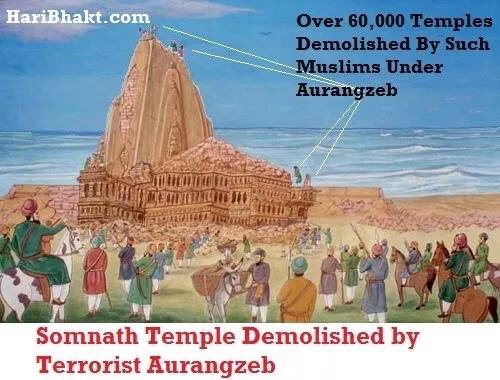
In 1669, on hearing that certain Brahmins were giving religious lectures at Multan and Benares, he ordered ‘all governors of provinces to destroy with a willing hand the schools and temples of the Hindus. Inconsequence, the temple of Vishwanath at Benares was destroyed [Maasiri Alamgiri, which recorded numerous orders for and reports of destructions of temples. Its entry for 2 September 1669 details: “News came to court that in accordance with the Emperor’s command his officers had demolished the temple of Vishvanath at Banaras”]. Moreover, till today, the old Kashi Vishvanath temple wall is visible as a part of the walls of the Gyanvapi mosque which Aurangzeb had built at the site.
[Root Cause is Islam and 164 Terrorism Verses of Koran]
In 1672 a Hindu religious sect called the Satnamis rebelled, and was crushed with ruthless severity. In 1675, Tegh Bahadur, the ninth of the sikh gurus was taken and executed because he refused to embrace Islam.
The history of his islamic reign was over a period of nearly fifty years, spent mostly in hatred towards Hindus. Terrorist aurangzeb’s rule was gory saga of loot, r@pe, killing and genocide of Hindus.
Aurangzeb Rotting in Hell for killing Hindus and Demolishing Hindu Temples
In 1678, Raja Jaswant Singh of Marwar died. The emperor tried to seize his children and have them brought up as fanatic muslims. He adopted the same policy towards the young Maratha Prince Shahu. Finally in 1679 he induced heavy jizya or poll-tax to earn revenues from Hindus. His one track mind of hating Hindus but not administrating the regime properly paved the way for the British conquest of India.
Ruining Vedic Symbols for Islamization








Muntakhabu-l Lubab by Khafi Khan:
How much Aurangzeb Hated Hindus
1. “In the former reigns one side of the coins had been adorned with the words of the creed and the names of the first four Caliphs; but as the coins pass into many unworthy places, and may fall under feet of Hindus, it was ordered that this superscription should be changed.”
How Scientific calendar representing Vedic fire worshipping format was changed to less accurate Mohammedan calendar
2. “Since the reign of Emperor Akbar the official year of account and the years of the reign had been reckoned from the Ist Farwadi, when the sun enters Aries, to the end of Isfandiyar, and the year and the months were called Ilahi; but resembled the system of the fire worshippers, the Emperor in his zeal for upholding the Muhameddan rule, emphasis added) directed that the year of the reign should be reckoned by the Arab lunar year and months, and that the revenue accounts also the lunar year should be preferred to the solar. The festival of the solar new year was completely abolished.”
Aurangzeb Followed Legacy of Terrorism Taught by his Cruel Muslim Ancestors and Islam
Contemporary history leaves no doubt that Aurangzeb conducted the affairs of the State in accordance with the dictates of Islam. And for that matter Aurangzeb was not unique in destroying the temples of the Hindus and neither was it limited to India. A practice of demolishing or breaking idols started by founder of islam, Mohammed, has continued to this day. The recent manifestation being destruction of Buddha statues at Bamiyan in Afghanistan and demolition of hundreds of Hindu, non-muslim temples in pakistan, bangladesh and burma.
Hindus get united and aggressive so that no aurangzeb can rise again
Islamic literary sources provide far more extensive evidence of temple destruction by the Muslim invaders of India in medieval times. They also cover a large area, from Sinkiang and Transoxiana in the North to Tamil Nadu in the South, and from Siestan province of present day Iran in the West to Assam in the East. This vast area, which was long the cradle of hindu culture, came to be littered with the ruins of temples and monasteries, belonging to all schools of Santana Dharma – Baudhha, Jaina, Shaiva, Sakta, Vaishnava, and the rest. Archaeological explorations and excavations in modern times have proved unmistakably that most of the mosques, mazars, ziarats and dargahs which were built in this area, stood on the sites of and were made from the materials of deliberately demolished Hindu monuments.
Hundreds of medieval muslim historians who flourished in India and elsewhere in the world of Islam, have written detailed accounts of what their heroes did in various parts of the extensive Hindu homeland as they were invaded one after another. It is alear from the literary evidence collected alone that all Muslim rulers destroyed or desecrated Hindu temples whenever and wherever they could. Archaeological evidence from various Muslim monuments, particularly mosques and dargahs, not only confirms the literary evidence but also adds the names of some Muslim rulers whom Muslim historians have failed to credit with this pious performance.
Terrorist Aurangzeb Conducted Brutal Killings of Brave Sikhs and Over 4.6 Million of Hindus
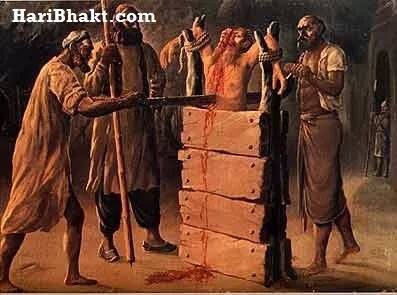
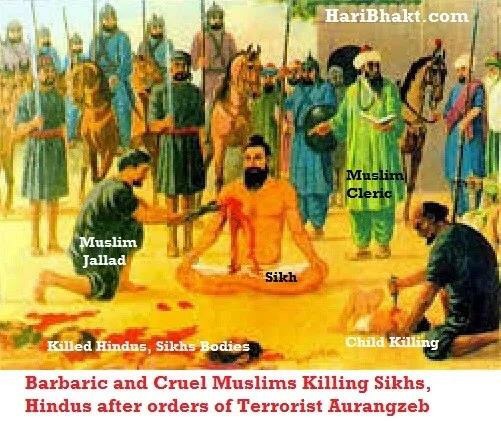
Dyal Das, Mati Das and Sati Das as well as the Guru were brought to the open space in front of the Kotwali (Mati Das and Sati das were brothers, they were former Brahmins and belong to the area of Jammu, instead of converting to islam favored Sikhism). First of all Bhai Mati das was asked to become a Muslim. He replied that Sikhism was true and Islam was false. If God had favoured Islam, he would have created all men circumised. He was at once tied between two posts, and while standing erect, was sawn across from head to loins. He faced the savage operation with such compusure tranquility and fortitude that Sikh theologians included his name in the daily prayers (Ardas).
Bhai Mati Das Killed by aurangzeb
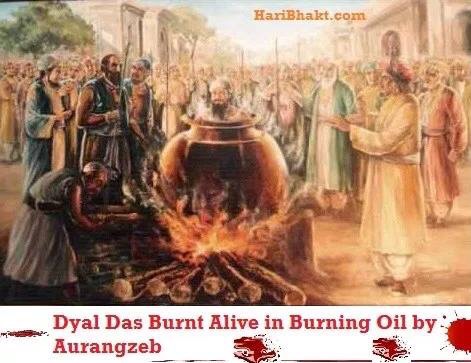
Dyal Das abused the Emperor and his courtiers at this atrocious act. He was tied up like a bundle with an iron chain and was put into large cauldron of bowling oil. He was roasted alive into a block of charcoal. Sati Das condemned the brutalities. He was hacked to pieces limb by limb. Jaita a Rangreta sikh of delhi collected the remains of these martyrs and consigned them to the river Yamuna flowing at a stone’s throw.
Dyal Das Killed by aurangzeb
Guru Tegh Bahadur Singh Killed by aurangzeb
Raja Shambhaji (son of Shivaji) Killed on Aurungzeb’s Orders
Succeeding his great father Chhatrapati Shivaji Maharaj in April 1680, his elder son Shambhaji continued the fight against the Mughals most spiritedly for the preservation and also extension of Swarajya.
Unfortunately, a single but grave mistake and over confidence in his own safe and secure position at Sangameshwar, nestling amidst the Western Ghats, led to his chance capture along with Kavikalash and a number of other Marathas who were with him.
[Akabar Was Barbaric, Cruel and Anti-Hindu King]
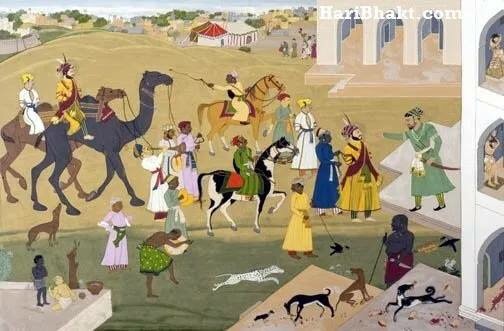
On the 15th February 1689, Shambhaji and Kavi Kalash were brought to the Imperial camp dressed as buffons with long fool’s caps and bells placed on their heads, mounted on camels, with drums beating, with thousands of onlookers lining the roads. Aurangzeb was sitting in full darbar, and, at the sight of the prisoners, “descended from the throne and kneeling down on the carpet bowed his head to the ground in double thankfulness to the (anti-god) allah for this crowning victory”. Shambhaji spurned at the offer of life and loosened his tongue in abuse of the Emperor. That very night his eyes were blinded and next day the tongue of Kavi Kalash was cut out. The Muslim clerics decreed that Shambhaji should be put to death.
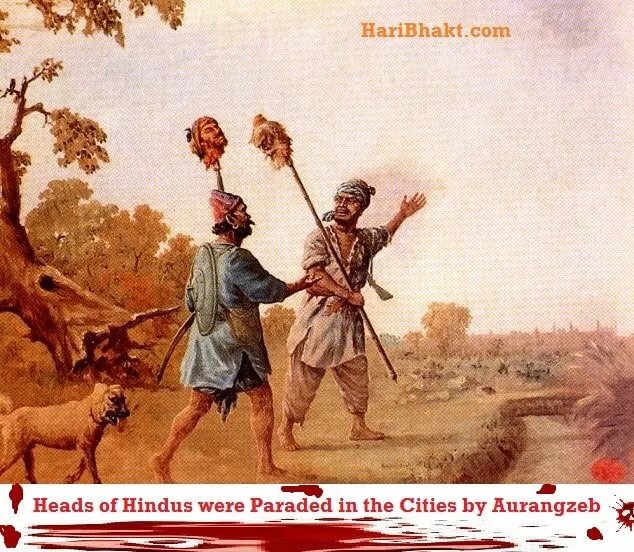
After undergoing a fortnight of torture and insult, on February,1689, the captives were put to a cruel and painful death on the 11th March, their limbs being hacked off one by one and their flesh thrown to the dogs. Their severed heads were stuffed with straw and exhibited in all the chief cities of the Deccan to the accompaniment of drum and trumpet (Maasir-i-‘Alamgiri, 320-25; Muntakhab-ul-Lubab, 386-88, Sarkar, Aurangzeb, IV, pp.340-44).
Sambhaji Killed by Terrorist Aurangzeb
In the painting, the entire sequence of events after Shambhaji’s arrival in the camp, his cruel death and barbaric manner in which his body was cut into pieces and fed to dogs of tulapur, have been brought out alive. The courageous manner in which Shambhaji braved death made him a martyr and washed of his earlier mistakes and actions in the eyes of the people.
The Image Below Shows Global Population Decline by Massacre – Flashbacking Hundreds of Years
Click on the image for an enlarged View
Hindus get united and aggressive so that no aurangzeb can rise again
The Image below is closeup snapshot of main image showing that Aurangzeb killed 4.6 millions of Hindus
4.6 millions of Hindus were killed by jihadi aurangzeb for koran and islam
Accounts of Temple Destruction by Historians of Aurangzeb
Some of the literary evidence of temple destruction during Aurangzeb’s rule is listed below.
1. “Mir’at-i-Alam” by Bakhtawar Khan Account on Temple Destruction by Terrorist Aurangzeb
The author was a nobleman of Aurangzeb’s court. He died in AD 1684. the history ascribed to him was really compiled by Muhammad Baqa of Saharanpur who gave the name of his friend as its author. Baqa was a prolific writer who was invited by Bakhtawar Khan to Aurangzeb’s court and given a respectable rank. He died in AD 1683.
Excerpts:
Muhiyu’d-Din Muhammad Aurangzeb ‘Alamgir Padshah Ghazi (1658-1707) General Order
” …Hindu writers have been entirely excluded from holding public offices, and ALL THE WORSHIPPING PLACES OF THE INFIDELS AND GREAT TEMPLES of these infamous people HAVE BEEN THROWN DOWN AND DESTROYED in a manner which excites astonishment at the successful completion of so difficult a task. His Majesty personally teaches the sacred kalima to many infidels with success. … All mosques in the empire are repaired at public expense…”
2. “Alamgir-Nama” by Mirza Muhammad Kazim Account on Temple Destruction by Terrorist Aurangzeb
This work, written in AD 1688 contains a history of the first ten years of Aurangzeb’s reign.
Excerpts:
Muhiyu’d-Din Muhammad Aurangzeb ‘Alamgir Padshah Ghazi (1658-1707) Palamau (Bihar)
” …In 1661 Aurangzeb in his zeal to uphold the law of Islam sent orders to his viceroy in Bihar, Daud Khan, to conquer Palamau. In the military operations that followed MANY TEMPLES WERE DESTROYED…”
Koch Bihar (Bengal)
” …Towards the end of the same year when Mir Jumla made a war on the Raja of Kuch Bihar, the MUGHALS DESTROYED MANY TEMPLES during the course of their operations. IDOLS WERE BROKEN AND SOME TEMPLES WERE CONVERTED INTO MOSQUES. …”
3. “Mas’ir-i-‘Alamgiri” by Saqi Must’ad Khan Account on Temple Destruction by Terrorist Aurangzeb
The author completed this history in 1710 at the behest of Inayatu”llah Khan Kashmiri, Aurangzeb’s last secretary and favorite disciple in state policy and religiosity. The materials which Must’ad Khan used in this history of Aurangzeb’s reign came mostly from the State archives.
Excerpts:
Muhiyu’d-Din Muhammad Aurangzeb ‘Alamgir Padshah Ghazi (1658-1707) General Order
“…The Lord Cherisher of the faith learnt that in the provinces of Tatta, Multan, and especially at Benaras, the Brahmin misbelievers used to teach their false books in their established schools, and that admirers and students both Hindu and Muslim, used to come from great distances to these misguided men in order to acquire this vile learning. His majesty, eager to establish Islam, issues orders to the governors of all the provinces TO DEMOLISH THE SCHOOLS AND TEMPLES OF THE INFIDELS and with utmost urgency put down the teaching and the public practice of the religion of these misbelievers…”
Varanasi (Uttar Pradesh)
” …It was reported that, according to the Emperor’s command, his officers HAD DEMOLISHED THE TEMPLE OF VISHWANATH AT KASHI. …” Mathura (Uttar Pradesh)
” … During this month of Ramzan abounding in miracles, the Emperor as the promoter of justice and overthrower of mischief, as the knower of truth and destroyer of oppression, as the zephyr of the garden of victory and the reviver of the faith of the Prophet, ISSUED ORDERS FOR THE DEMOLITION OF THE TEMPLE SITUATED IN MATHURA FAMOUS AS THE DEHRA OF KESHO RAI. In the short time by the great exertions of his officers the DESTRUCTION OF THIS STRONG FOUNDATION OF INFIDELITY WAS ACCOMPLISHED AND ON ITS SITE A LOFTY MOSQUE WAS BUILT at the expenditure of a large sum…”
” …Praised be the August God of the faith of Islam, that in the auspicious reign of this DESTROYER OF INFIDELITY AND TURBULENCE, such a wonderful and seemingly impossible work was successfully accomplished. On seeing this instance of strength of the Emperor’s faith and the grandeur of his devotion to God, the proud Rajas were stifled and in amazement they stood like images facing the wall. THE IDOLS, LARGE AND SMALL SET WITH COSTLY JEWELS WHIC HAD BEEN SET UP IN THE TEMPLE WERE BROUGHT TO AGRA AND BURIED UNDER THE STEPS OF THE MOSQUE OF BEGUM SAHIB, IN ORDER TO BE CONTINUALLY TRODDEN UPON. The name of Mathura was changed to Islamabad. …”
Khandela (Rajasthan)
” … Darab Khan who had been sent with a strong force to punish the Rajputs of Khandela and TO DEMOLISH THE GREAT TEMPLE OF THE PLACE, attacked on March 8th/Safar 5th, and slew the three hundred and odd men who made a bold defence, not one of them escaping alive. THE TEMPLES OF KHANDELA AND SANULA AND ALL OTHER TEMPLES IN THE NEIGHBOURHOOD WERE DEMOLISHED …”
Jodhpur (Rajasthan)
” … On 24th Rabi S. (Sunday, May 25th), Khan Jahan Bahadur came from Jodhpur, AFTER DEMOLISHING THE TEMPLES and bringing with himself some cart-loads of idols, and had audience of the Emperor, who higly praised him and ordered that the idols, which were mostly jewelled, golden, silver, bronze, copper, or stone, should be cast in the yard (jilaukhanah) of the Court AND UNDER THE STEPS OF THE JAMA MOSQUE, TO BE TRODDEN UPON…”
Udaipur (Rajasthan)
” … Ruhullah Khan and Ekkataz Khan WENT TO DEMOLISH THE GREAT TEMPLE in front of the Rana’s palace, which was one of the rarest buildings of the age and the chief cause of the destruction of the life and property of the despised worshippers. Twenty ‘machator’ Rajputs who were sitting in the Temple vowed to give up their lives; first one of them came out to fight, killed some and was them himself slain, then came out another and so on, until every one of the twenty perished, after killing a large number of the imperialists including the trusted slave Ikhlas. The Temple was found empty. THE HEWERS BROKE THE IMAGES. …”
” …On Saturday, the 24th January, 1680 (2nd Muharram), the Emperor went to view lake Udaisagar, constructed by the Rana, AND ORDERED ALL THE THREE TEMPLES ON ITS BANKS TO BE DEMOLISHED. …”
” …On the 29th January/7th Muharram, Hasan Ali Khan brought to the Emperor twenty camel-loads of tents and other things captured from the Rana’s Palace and REPORTED THAT ONE HUNDRED AND SEVENTY-TWO OTHER TEMPLES IN THE ENVIRONS OF UDAIPUR HAD BEEN DESTROYED. The Khan received the title of Bahadur Alamgirshahi…”
Amber (Rajasthan)
“… Abu Turab, who had been SENT TO DEMOLISH THE TEMPLES of AMBER, returned to the Court on Tuesday August 10th (Rajab 24th), and reported that HE HAD PULLED DOWN SIXTY-SIX TEMPLES. …”
Bijapur (Karnataka)
” … Hamiduddin Khan Bahadur WHO HAD GONE TO DEMOLISH A TEMPLE AND BUILD A MOSQUE (IN ITS PLACE) in Bijapur, having excellently carried his orders, came to court and gained praise and the post of darogha of gusulkhanah, which brought him near the Emperor’s person…”
General Text
“…LARGE NUMBERS OF PLACES OF WORSHIP OF THE INFIDELS AND GREAT TEMPLES OF THESE WICKED PEOPLE HAVE BEEN THROWN DOWN AND DESOLATED. Men who can see only the outside of things are filled with wonder at the successful accomplishment of such a seemingly difficult task. AND ON THE SITES OF THE TEMPLES LOFTY MOSQUES HAVE BEEN BUILT…”
Cruel Muslims Killing Hindus, Sikhs under aurangzeb
4. “Akhbarat” Account on Temple Destruction by Terrorist Aurangzeb
These were reports from different provinces compiled in the reign of Aurangzeb.
Excerpts:
Muhiyu’d-Din Muhammad Aurangzeb ‘Alamgir Padshah Ghazi (1658-1707)
Mathura (Uttar Pradesh)
” … The emporer learning that in the temple of Keshav Rai at Mathura there was a stone railing presented by Dara Shikoh, remarked, ‘In the Muslim faith it is a sin even to look at a temple, and this Dara Shikoh had restored a railing in a temple. This fact is not creditable to the Muhammadans. REMOVE THE RAILING.’ By his order Abdun Nabi Khan (the faujdar of Mathura) REMOVED IT…”
Ujjain (Madhya Pradesh)
[Why Hindus Should Never Trust Muslims]
” … News came from Malwa that Wazir Khan had sent Gada Beg, a slave, with 400 troopers, TO DESTROY ALL TEMPLES AROUND UJJAIN… A Rawat of the place resisted and slew Gada Beg with 121 of his men…”
Aurangabad (Maharashtra)
“…… The Emperor learnt from a secret news writer of Delhi that in Jaisinghpura Bairagis used to worship idols, and that the Censor on hearing of it had gone there, arrested Sri Krishna Bairagis and taken him with 15 idols away to his house; then the Rajputs had assembled, flocked to the Censor’s house, wounded three footmen of the Censor and tried to seize the Censor himself; so that the latter set the Bairagis free and sent the copper idols to the local subahdar …”
Pandharpur (Maharashtra)
“… The Emperor, summoning Muhammad Khalil and Khidmat Rai, the darogha of hatchet-men …. ORDERED THEM TO DEMOLISH THE TEMPLE OF PANDHARPUR, and to take the butchers of the camp there AND SLAUGHTER COWS IN THE TEMPLE … It was done…”
On Way to the Deccan
” … When the war with the Rajputs was over, Aurangzeb decided to leave for the Deccan. His march seems to have been marked with A DESTRUCTION TO MANY TEMPLES on the way. On May 21, 1681, the superintendent of the labourers WAS ORDERED TO DESTROY ALL THE TEMPLES on the route…”
Lakheri ( ? – means the place is not traceable today )
” … On 27 Sept., 1681, the emperor issued orders FOR THE DESTRUCTION OF THE TEMPLES at Lakheri…”
Rasulpur ( ? )
“… About this time, April 14, 1692, orders were issued to the provincial governor and the district faujdar TO DEMOLISH THE TEMPLES at Rasulpur…”
Sheogaon ( ? )
” … Sankar, a messenger, was sent TO DEMOLISH A TEMPLE near Sheogaon..”
Ajmer (Rajasthan)
“… Bijai Singh and several other Hindus were reported to be carrying on public worship of idols in a temple in the neighborhood of Ajmer. On 23 June, 1694, THE GOVERNER OF AJMER WAS ORDERED TO DESTROY THE TEMPLE and stop the public adoration of idol worship there…”
Wakenkhera ( ? )
” … The TEMPLE OF WAKENKHERA IN THE FORT WAS DEMOLISHED ON 2 MARCH, 1705. …”
Bhagwant Garh (Rajasthan)
“… The newswriter of Ranthambore REPORTED THE DESTRUCTION OF A TEMPLE IN PARGANAH BHAGWANT GARH. Gaj Singh Gor had repaired the temple and made some additions thereto…”
Malpura (Rajasthan)
” … Royal orders FOR THE DESTRUCTION OF TEMPLES IN MALPURA TODA were received and the officers were assigned for this work…”
remove road names on mughal rulers name no aurangzeb road
5. “Fathiyya-i-‘Ibriyya” Account on Temple Destruction by Terrorist Aurangzeb
This is a diary of Mir Jumla’s campaigns in Kuch Bihar and Assam. “By looting,” writes Jadunath Sarkar, “the temples of the South and hunting out buried treasures, Mir Jumla amassed a vast fortune. The huge Hindu idols of copper were brought away in large numbers to be melted and cast into cannon. …”
Excerpts:
Muhiyu’d-Din Muhammad Aurangzeb ‘Alamgir Padshah Ghazi (AD 1658-1707)
Koch Bihar (Bengal)
” … Mir Jumla made his way into Kuch Bihar by an obscure and neglected highway. …. In six days the Mughal Army reached the capital (19th December) which had been deserted by the Rajah and his people in terror. The name of the town was changed to Alamgirnagar; the muslim call to prayer, so long forbidden in the city, was chanted from the lofty roof of the palace, and a mosque was built by DEMOLISHING THE PRINCIPLE TEMPLE…”
6. “Kalimat-i-Tayyibat” Account on Temple Destruction by Terrorist Aurangzeb by ‘Inayatullah
This is a collection of letters and orders of Aurangzeb compiled by ‘Inayatullah in AD 1719 and covers the years 1699-1704 of Aurangzeb’s reign.
Muhiyu’d-Din Muhammad Aurangzeb ‘Alamgir Padshah Ghazi (AD 1658-1707)
Somnath (Gujarat)
“… The TEMPLE OF SOMNATH WAS DEMOLISHED early in my reign and idol worship (there) put down. It is not known what the state of things there is at present. If the idolators have again taken to the worship of images at the place, THEN DESTROY THE TEMPLE IN SUCH A WAY THAT NO TRACE OF THE BUILDING MAY BE LEFT, and also expel them (the worshippers) from the place. …”
Satara (Maharashtra)
“… The village of Sattara near Aurangabad was my hunting ground. Here on the top of the hill, STOOD A TEMPLE WITH AN IMAGE OF KHANDE RAI. BY GOD’S GRACE I DEMOLISHED IT, AND FORBADE THE TEMPLE DANCERS (muralis) to ply their shameful profession…”
General Observation “… THE DEMOLITION OF A TEMPLE IS POSSIBLE AT ANY TIME, as it cannot walk away from its place. …”
Sirhind (Punjab)
“… In a small village in the sarkar of Sirhind, A SIKH TEMPLE WAS DEMOLISHED AND CONVERTED INTO A MOSQUE. An imam was appointed who was subsequently killed. …”
7. “Ganj-i-Arshadi” Account on Temple Destruction by Terrorist Aurangzeb
It is a contemporary account of the destruction of Hindu temples at Varanasi in the reign of Aurangzeb.
Excerpts:
Muhiyu’d-Din Muhammad Aurangzeb ‘Alamgir Padshah Ghazi (AD 1658-1707)
Varanasi (Uttar Pradesh)
“… The infidels demolished a mosque that was under construction and wounded the artisans. When the news reached Shah Yasin, he came to Banaras from Mandyawa and collecting the Muslim weavers, DEMOLISHED THE BIG TEMPLE. A Sayyid who was an artisan by profession agreed with one Abdul Rasul to build a mosque at Banaras and accordingly the foundation was laid. Near the place there was a temple and many houses belonging to it were in the occupation of the Rajputs. The infidels decided that the construction of a mosque in the locality was not proper and that it should be razed to the ground. At night the walls of the mosque were found demolished. next day the wall was rebuilt but it was again destroyed. This happened three or four times. At last the Sayyid his himself in the corner. With the advent of night the infidels came to achieve their nefarious purpose. When Abdul Rasul gave the alarm, the infidels began to fight and the Sayyid was wounded by the Rajputs. In the meantime, the Musalman residents of the neighborhood arrived at the spot and the infidels took to their heels. The wounded muslims were taken to Shah Yasin who determined to vindicate the cause of Islam. When he came to the mosque, people collected from the neighborhood. the civil officers were outwardly inclined to side with the saint, but in reality they were afraid of the Royal displeasure on the account of the Raja, who was a courtier of the Emperor and had built the temple (near which the mosque was under construction). Shah Yasin, however, took up the sword and started for Jihad. The civil officers sent him a message that such a grave step should not be taken without the Emperor’s permission. Shah Yasin, paying no heed, sallied forth till he reached Bazar Chau Khamba through a fusillade of stones …… THE DOORS (OF TEMPLES) WERE FORCED OPEN AND THE IDOLS THROWN DOWN. THE WEAVERS AND OTHER MUSALMANS DEMOLISHED ABOUT 500 TEMPLES. They desired to destroy the temple of Beni Madho, but as lanes were barricaded, they desisted from going further….”
Hindus get united and aggressive so that no aurangzeb can rise again
8. “Kalimat-i-Aurangzeb” Account on Temple Destruction by Terrorist Aurangzeb by ‘Inayatullah
This is another compilation of letters and orders by ‘Inayatu’llah covering the years 1703-06 of Aurangzeb’s reign.
Muhiyu’d-Din Muhammad Aurangzeb ‘Alamgir Padshah Ghazi (AD 1658-1707) Maharashtra
“…The houses of this country (Maharashtra) are exceedingly strong and built solely of stone and iron. The hatchet-men of the Govt. in the course of my marching do not get sufficient strength and power (i.e. time) TO DESTROY AND RAZE THE TEMPLES OF THE INFIDELS that meet the eye on the way. You should appoint an orthodox inspector (darogha) who may afterwards DESTROY THEM AT LEISURE AND DIG UP THEIR FOUNDATIONS…”
9. “Muraq’at-i-Abu’I Hasan” Account on Temple Destruction by Terrorist Aurangzeb by Maulana Abu’l Hasan
This is a collection of records and documents compiled by (the above named author) one of Aurangzeb’s officers in Bengal and Orissa during AD 1655-67.
[Modus Operandi of Muslims to Islamize a Country]
Excerpts:
Muhiyu’d-Din Muhammad Aurangzeb ‘Alamgir Padshah Ghazi (AD 1658-1707)
Bengal and Orissa
“…Order issued on all faujdars of thanas, civil officers (mutasaddis), agents of jagirdars, kroris, and amlas from Katak to Medinipur on the frontier of Orissa :- The imperial paymaster Asad Khan has sent a letter written by order of the Emperor, to say, that the Emperor learning from the newsletters of the province of Orissa that at the village of Tilkuti in Medinipur a temple has been (newly) built, HAS ISSUED HIS AUGUST MANDATE FOR ITS DESTRUCTION, and THE DESTRUCTION OF ALL TEMPLES BUILT ANYWHERE IN THIS PROVINCE BY THE WORTHLESS INFIDELS. Therefore, you are commanded with extreme urgency that immediately on the receipt of this letter YOU SHOULD DESTROY THE ABOVE MENTIONED TEMPLES. EVERY IDOL-HOUSE BUILT DURING THE LAST 10 or 12 YEARS, WHETHER WITH BRICK OR CLAY, SHOULD BE DEMOLISHED WITHOUT DELAY. ALSO, DO NOT ALLOW THE CRUSHED HINDUS AND DESPICABLE INFIDELS TO REPAIR THEIR OLD TEMPLES. REPORTS OF THE DESTRUCTION OF TEMPLES SHOULD BE SENT TO THE COURT UNDER THE SEAL OF THE QAZIS and attested by PIOUS SHAIKHS…”
10. “Futuhat-i-Alamgiri” Account on Temple Destruction by Terrorist Aurangzeb by Ishwardas Nagar
The author was a Brahman from Gujarat, born around AD 1654. Till the age of thirty he was in the service of the Chief Qazi of the empire under Aurangzeb. Later on, he took up a post under Shujat Khan, the governor of Gujarat, who appointed him Amin in the pargana of Jodhpur. His history covers almost half a century of Aurangzeb’s reign, from 1657 to 1700. There is nothing in his style which may mark him out as a Hindu.
Excerpts:
Muhiyu’d-Din Muhammad Aurangzeb ‘Alamgir Padshah Ghazi (AD 1658-1707)
Mathura (Uttar Pradesh)
” … When the imperial army was encamping at Mathura, a holy city of the Hindus, the state of affairs with regard to temples of Mathura was brought to the notice of His Majesty. Thus, HE ORDERED THE FAUJDAR OF THE CITY, ABDUL NABI KHAN, TO RAZE TO THE GROUND EVERY TEMPLE AND TO CONSTRUCT BIG MOSQUES (over their demolished sites)…”
Udaipur (Rajasthan)
“… The Emperor, within a short time, reached Udaipur AND DESTROYED THE GATE OF DEHBARI, THE PALACES OF RANA AND THE TEMPLES OF UDAIPUR. Apart from it, the trees of his gardens were also destroyed…”
islamic jihadis should be killed…aurangzebs are there in India
How a Hindu Ruler Followed Vedic Ritual Contrary to Cruel Islamic Belief
Secularism is farce in today’s world and has no meaning because no single country in this world follows it as it makes the country leader coward and less aggressive but Hindu rulers kept balance on aggression and secularism. Shivaji gave fitting reply to muslims but never harmed innocent citizens even mlecchas (muslims). He knew the fact that muslims can never be trusted because they follow koran which teaches them to hate Hindus and non-muslims.
Now compare this to the anecdotes written by Khafi Khan, the Mohammedan historian, who certainly was not biased in the favour of Great Chatrapati Shivaji Maharaj:
‘He made it a rule that, wherever his followers went plundering, they should do no harm to mosques, the Book of God, or anyone’s women. Whenever a copy of the holy Koran cam into his hands, he treated it with respect, and gave it to some of his Mussulman followers. When the women of any Hindu or Mohammedan were taken prisoners by his men and they had no friend to protect them, he watched over them.’
Hindu Aggression
Ref:
1. Ahmad, Qeyamuddin (ed.), “Patna through the Ages”, New Delhi, 1988.
2. “Alberuni’s India”, translated by E.C. Sachau, New Delhi Reprint, 1983.
3. Attar, Shykh Faridu’d-Din, “Tadhkirat al-Awliya”, translated into Urdu by Maulana Z.A. Usmani.
4. Bloch J., “Indian Studies”, London, 1931.
5. Chuvin, Pierre, “A Chronicle of the Last Pagans”, Harvard, 1990.
6. Durrant, Will, “The Story of Civilization”, New York, 1972.
7. Elliot and Dowson, “History of India as told by its own Historians”, 8 volumes, Allahbad Reprint, 1964.
8. “First Encyclopedia of Islam”
9. “Futuhat-i-Alamgiri” by Ishwardas Nagar, trans. into English by Tasneem Ahmad, Delhi, 1978.
10. Growse, F.S. “Mathura: A District Memoir”, Reprint, Ahmedabad, 1978.
11. Hosain, Saiyid Safdar, ” The Early History of Islam,” Vol. I, Delhi Reprint, 1985.
12. “Jami Tirmizi,” Arabic text with Urdu translation by Badi’al-Zaman, Vol. I, New Delhi, 1983.
13. “Kitab Futuh Al-Buldan” of Al-Biladhuri, translated into English by F.C. Murgotte, New York, 1924.
14. “Maasir-i-Alamgiri” of Saqi Must’ad Khan, translated into English and annotated by Sir Jadunath Sarkar, Calcutta, 1947.
15. “Makke Madine di Goshati”, edited by Dr. Kulwant Singh, Patiala, 1988.
16. “The Rehala of Ibn Battuta,” translated into English by Mahdi Hussain, Baroda, 1976.
17. Sarkar, Jadunath, “History of Aurangzeb,” 3 Volumes, Calcutta, 1972, 73.
















 GLOBAL HINDUISM