The Distorted History of Taj Mahal
By Dr Radhasyam Brahmachari
There is no doubt that Taj Mahal in Agra is the most beautiful architectural marvel in the entire world and hence it is called one of the great wonders of the world. But who is the author of this excellent exhibit of architecture? Opinions in this regard are highly contentious. The general notion is that, it is the creation of Mughal Emperor Shah Jahan. In previous articles, we have seen how the authorship of excellent pieces of architecture in Delhi, Agra and Fatehpur Sikri are being falsely attributed to the foreign Muslim invaders, who occupied and ruled India for nearly eight centuries. So, the question naturally arises – Is the claim of Shah Jahan’s authorship of Taj Mahal true? Or the said view is merely a part of the process of distortion of Indian history, to appease the Muslims? In this article, we shall try to find a plausible reply to these questions.
In this regard, the Encyclopedia Britannica states, “Taj Mahal is a mausoleum complex in Agra, in western Uttar Pradesh state, in northern India, on the southern bank of the Yamuna (Jumna) River. …the Taj Mahal is distinguished as the finest example of Mughal architecture, a blend of Indian, Persian, and Islamic styles. One of the most beautiful structural compositions in the world, the Taj Mahal was designated a UNESCO World Heritage site in 1983. It was built by the Mughal emperor Shah Jahān (reigned 1628–58) to immortalize his wife Mumtāz Mahal (“Chosen One of the Palace”). The name Taj Mahal is a derivation of her name. She died in childbirth in 1631, after having been the emperor’s inseparable companion since their marriage in 1612. The plans for the complex have been attributed to various architects of the period, though the chief architect was probably Ustad Ahmad Lahawrī, an Indian of Persian descent.” [1]
The Wikipedia Encyclopedia maintains a similar view and says, “The Taj Mahal (pronounced /tɑdʒ məˈhɑl) is a mausoleum located in Agra, India, built by Mughal Emperor Shah Jahan in memory of his favorite wife, Mumtaz Mahal. The Taj Mahal (also “the Taj”) is considered the finest example of Mughal architecture, a style that combines elements from Persian, Indian, and Islamic architectural styles. In 1983, the Taj Mahal became a UNESCO World Heritage Site and was cited as “the jewel of Muslim art in India and one of the universally admired masterpieces of the world’s heritage.” [2]
In this context, we should mention what the India ’s historians have to say in this matter. Historian R C Majumdar, in this regard, writes, “The Taj Mahal, a splendid mausoleum built by Shah Jahan, at a cost of fifty lacs of rupees, over the grave of his beloved wife, Mumtaz Mahal, is rightly regarded as one of the wonders of the world for its beauty and magnificence.” [3] Another historian S K Saraswati writes, “But all the above architectural creations of Shah Jahan are thrown into shade by that superb conception of the mausoleum that the emperor raised up at Agra to enshrine the mortal remains of his beloved consort, Arjumand Banu Begam, better known as Mumtaz Mahal. The Taj Mahal, as it is called after the title of the empress, stands on an elevated ground on a bend of the river Jamuna so that it has a fine view from whatever angle it is seen.” [4]
As a result of this worldwide propaganda, Shahjahan’s authorship of Taj Mahal, mixed with story of romantic love between Shah Jahan and his wife, has become so pervasive that it has become a universal symbol of love between a husband and his wife. Even a common man, at first instance, refuses to admit any other version, even if it is more convincing and rational. Even the Nobel Laureate Poet Rabindranath Tagore, being swayed by the above story, described the Taj Mahal, in one of his poems, as a drop of tears of the grief-stricken Emperor Shahjahan.
The True History of Taj Mahal:
But according to Stephen Knapp, a well known researcher on Taj Mahal, it was not built by Shah Jahan and he writes, “There is ample evidence that the Taj Mahal was never built by Shah Jahan. Some say the Taj Mahal pre-dates Shah Jahan by several centuries and was originally built as a Hindu or Vedic temple/palace complex and Shah Jahan merely acquired it (by brute force) from its previous owner, the Hindu King Jai Singh.” [5] Not only Stephen Knapp but many other researchers like Yogesh Saxena, V S Godbole and Prushottam Nagesh Oak (or P N Oak) hold a similar view and P N Oak is the most prominent and pioneer among scholars who worked to discover the real author of Taj Mahal.
It is well known that Emperor Akbar got Akbarnama, a history of his reign, written by his court-chronicler Abul Fazl and in a similar manner, Shahjahan had the history of his reign titled Badshahnama written by his court-chronicler Abdul Hamid Lahori. The original Badshahnama was written in Persian using Arabic alphabets and in 1963, P N Oak made a startling discovery the the pages 402 and 403 of the edition of Badshahnama, published by the Asiatic Society of Bengal (see the fascimile of the page 402 and 403 of the edition in Figure-1), contain the true history of the building now known as Taj Mahal. An English translation of the contents from line 21 of page 402 to line 41 on page 403 of Badshahnama is given below.
Meanwhile, we should notice another important point. It is well known that the two British historians, H M Elliot and J Dowson, have done the great job of writing history of India, under Muslim rule, starting from the attack on Sindh by Mohammed bin Kasim in the 8th century to the fall of Marathas in the 19th century, a period, covering nearly 1200 years. It has been written, based on chronicles of the court chroniclers of the Muslim rulers only. The work of Elliot and Dowson’s was published in 8 volumes during 1867 to 1877 and the Volume 7 of their work deals with the reigns of Shahjahan and Aurangzeb. But it is really astonishing that there is not even a mentioning of Taj Mahal in the said work.
Many Muslim chroniclers have described the times of Shah Jahan and Aurangzeb, e.g.
(1) Badshahnama by Abdul Hamid Lahori,
(2) Wakiyat Jahangiri by emperor Jahangir,
(3) Shahjahan-nama by Enayet Khan,
(4) Tarikh-i- Mufajjali by Mufajjal Khan,
(5) Mirat-i-Alam by Bakhtyar Khan,
(6) Alamgirnama by Muhammad Qazim and
(7) Mustakhab-ul-Lubab by Kafi Khan.
But in none of above works, there is even mentioning of Taj Mahal, except Badshahnama by Lahori and that too as a palace of Jai Singh
While commenting on this point, Dr Yogesh Saxena, writes, “The authors should have said, “Though we have presented history of Shahjahan based on his official chronicle Badshahnama, we did not find any reference to Taj Mahal in it.” They did no such thing. And Historians have kept even this information from us for the last 130 years.” [6] It was Professor P N Oak, who, for the first time, made the startling discovery that there is mentioning of the building now called Taj Mahal, but as a palace of the Hindu king Jai Singh, in Badshahnama.
There is another important point to note. There is a well established rumour that Shah Jahan engaged 20,000 labours who toiled for 20 (or 22) years to complete the construction of Taj Mahal, originates by the French traveler Jean Baptiste Tavernier. It is really unthinkable that, Shah Jahan completed such a gigantic job, spending so much money, employing so many people throughout so many years, but it escaped the attention of his sycophant chroniclers, and they did not even say a single word about the said job in their works. So, the logical conclusion is that, the said gigantic construction never took place during the reign of Shah Jahan and Badshahnama confirms this fact.
The original Badshahnama was written in Persian using Arabic alphabets and the pages 402 and 403 of the edition published by the Asiatic Society of Bengal (see the fascimile of the page 402 and 403 of Vol-I of the edition given above) contain the true history of the building now known as Taj Mahal. Professor Oak got the two pages translated into English by a scholar of Persian language and said trnslation of the contents from line 21 of page 402 to line 41 on page 403 of Vol-I of Badshahnama is given below.
“Friday, 15th Jamadiulawal, the sacred dead body of the traveller to the kingdom of holiness Hazrat Mumtazul Zamani, who was temporarily buried, was brought, accompanied by Prince Mohammad Shah, Suja bahadur, Wazir Khan and Satiunnesa Khanam, who knew the pemperament of the deceased intimately and was well versed in view of that Queen of the Queens used to hold, was brought to the capital Akbarabad (Agra) and an order was issued that very day coins be distributed among the beggers and fakirs. The site covered with a majestic garden, to the south of the great city (of Agra) and amidst which the building known as the palace of Raja Man Singh, at present owned by Raja Jai asingh, grandson of Man Singh, was selected for the burial of the Queen, whose abode is in heaven. Although Raja Jai Singh valued it greatly as his ancestral heritage and property, yet he agreed to part with it gratis for Emperor Shahjahan, still out of sheer scrupulousness and religious sanctity, he (Jai Singh) was granted Sharifabad in exchange of that grand palace (Ali Manzil). After the arrival of the deadbody in that great city (of Agra), next year that illustrious body of the Queen was laid to rest and the officials of the capital, according to royal order, hid the body of that pious lady from the eyes of the world and the palace so majestic (imarat-e-alishan) and capped with a dome (wa gumbaje) was turned into a sky-high lofty mausoleum”. [7]
Many historians try to convince that Shah Jahan purchased a piece of land from Raja Jai Singh and erected Taj Mahal on that land. But the lines 29 and 30 of page 403 of Vol-I of Badshahnama reads, “Pesh az ein Manzil-e-Rajah Mansingh bud wadari waqt ba Rajah Jaisingh (29) Nabirae taalluq dasht barae madfan e an bahisht muwattan bar guzeedand .. (30).” According to experts, the correct translation of the phrase “Manzil-e-Rajah Mansingh bud wadari waqt ba Rajah Jaisingh”is “.. the building known as the palace of Raja Man Singh, at present owned by Raja Jai asingh”. So, it is evident that it cannot be a transaction of land but of a magnificent palace. In line 37, further clarification has been made and said that it was a transaction of an imarat-e-alishan (i.e. a gigantic building) and not of land
In 1964, when Prof P N Oak started to disclose his doubts about Shah Jahan’s authorship of Taj Mahal and presented the document in Badshahnama as the proof, many of his opponents said that his translation of Badshahnama was not correct. One of his bitter critiques was a Kashmiri Pandit. He was also a scholar of Persian language. To narrate the incident Dr Yogesh Saxena writes, “One of his opponents was a Kashmiri Pandit. Eventually they went to Government of India Archives. At the suggestion of the Librarian there the Pandit started to read Badshahnama, soon he came to Volume I, page 403. One line read – va pesh azin manzil-e-Raja Mansingh bood, vadari vakt ba Raja Jaisingh. He confessed that Shah Jahan took over Raja Mansingh’s palace for burial of Mumtaz. We owe so much to this honest opponent of Mr Oak. He gave word by word translation of pages 402 and 403 to Mr Oak who promptly published it in his book Taj Mahal is a Hindu Palace (1968). However, Mr Oak never stated that the translation was his. It was done for him by a Persian expert.” [6]
The name of the Queen, in whose memory the Taj Mahal is being said to have been erected, was Arjumand Banu. She was married to Shahjahan in 1612 A.D. and within 18 years of her married life she gave birth to 14 children and in fact she died in 1630 (or in 1631) while she was delivering her 14th child. According to Badshahnama she was buried temporarily at Burhanpur and in the same year her body was brought from Burhanpur to Agra and the next year her body was permanently buried at the majestic palace of Raja Man Singh.. From the Badshahnama it becomes evident the edifice, now known as Taj Mahal, was not authored by Emperor Shahjahan.
Who was The Author of Building called Taj Mahal:
So, according to the narrations of Badshanama and from other evidence, it becomes clear that the edifice, now known as Taj Mahal, was not authored by emperor Shah Jahan. The question, therefore, naturally arises – Who built that magnificent building?
A locality, nearly 4 km away from Taj Mahal, is called Bateswar and in 1900 A.D., General Alexander Cuningham, the then Director of the Archaeological Survey of India (ASI), conducted an excavation at Bateswar and discovered an edict, now known as the Munj Bateswar Edict and kept at the Lucknow Museum. The epigraph contains 34 verses written in Sanskrit, out of which 25th, 26th and 34th verses are important in the present context. The original Sankrit text and English translation of the above verses are given below –
Prasādo vaiṣṇavastena nirnimitotavahan hari /
Murdhn āspriśati yo nityaṃ padamasaiva madhyamam // (25)
“He built a marble temple which is the abode of Lord Vishnu and the King bows down to touch His feet” (25).
Akāryacca sphatikāvadātamasāvidam mandiramindumauleḥ /
Na jātuyasminnibsnsadevah kailāsvasayacakara cetaḥ // (26)
“The King has built another marble temple which has been dedicated to the Lord Who has the moon as His ornament on His forehead and Who, getting such a beautiful abode, has forgotten to return to Kailash ” (26).
Pakṣa tryakṣamukhāditya saṃkhye vikramavatsare /
Aśvina śukla pañcmyāṃ bāsare vāsave śitu // (34)
“Today, the 5th day of the bright half in the month of Ashwin, the Sunday, in the year 1212 of the Vikram Samvat, the edict is being laid” (34).
Mr. D. J. Kale, a well known archaeologist, has mentioned the said Munj Bateswar Edict in his celebrated work Epigraphica India. On page 124 of the said work, Mr. Kale writes, “The sais Munj Bateswar Edict was laid by King Paramardidev of the Chandratreya dynasty on Sukla Panchami in the month of Ashwin, in the year 1212 Vikram Samvat (or A.D. 1156). … King Paramardidev built two magnificent temples with white marble , one for Lords Vishnu and the other for Lord Shiva and they were desecrated later on by the Muslim invaders. Perhaps a farsighted man took the edict to a safer place at Bateswar and buries it beneath the ground”.[8] Perhaps, after the said desecration, the temples were no longer used as religious places and due to this reason Abdul Hamid Lahori mentioned them as palaces, not as temples. According to the renowned historian Mr. R. C. Majumdar, the other name of the Chandratreya or Chandel King Paramardidev was Paramal and their kingdom was known as Bundelkhand, a.k.a.Jejakabhukti [9]
Today, there are two marble palaces in Agra, one is the Mausoleum of Idmat-ud-Daula, the father of Noorjahan and the other is Taj Mahal, and it is evident from the Munj Bateswar edict that, once upon a time, one of them was the temple of Lord Vishnu and the other was a temple of Lord Shiva. Experts believe that it is the temple of Lord Vishnu that has been made the mausoleum of Idmat-ud-Daula, and the temple of Lord Shiva has been converted into the mausoleum of the queen Arjumand Banu. There are so many evidence that support of this conclusion and we shall try to discuss them in future installments of this article.
References:
[1] http://www.britannica.com/EBchecked/topic/581007/Taj-Mahal
[2] (http://en.wikipedia.org/wiki/Taj_Mahal)
[3] R. C. Majumdar, H. C. Raychaudhury and K. Datta, An Advanced History of India, MacMillan & Co (1980),586..
[4] R. C. Majumdar (Gen Ed), History & Culture of the Indian People (in 12 Volumes), Bharatiya Vidya Bhavan, Mumbai (1996), VII, 793.
[5] Stephen Knapp,Taj Mahal: Was it a Vedic Temple ? The Photographic Evidence ( http://www.stephen-knapp.com/was_the_taj_mahal_a_vedic_temple.htm )
[6] Yogesh Saxena Taj Mahal – It is time to tell the truth, (http://agrasen.blogspot.com/2009/04/hidden- facts-in-indian-history.html )
[7] P N Oak, Tajmahal – The True Story, Published by A Ghosh, p 9-12.
[8] D J Kale, Epigraphica India , published by S D Kale & M D Kale, I, 270-274.
[9] R C Majumdar, ibid, Bharatiya Vidya Bhavan, Vol-5, p-122
_________________________

Taj Mahal – Time to Tell the Truth
By Dr. V. S. Godbole
There are many legends about the Taj Mahal. But one sentence is common in all of them. “For the construction, 20,000 men worked for 22 years.” This is well known throughout the world. The simple question is – where do these figures come from?
These figures come from a book called “Travels in India” by J B Tavernier, a French jewel merchant. He was a great adventurer who made six voyages to India in the days of Shivaji (1638 to 1668). Tavernier says, “I witnessed the commencement and completion of this monument (Taj Mahal) on which 20,000 men worked incessantly for 22 years.”
Tavernier’s book was first published in French in 1675. In those days, it was a great adventure for a single man to travel over such a long distance, face many difficulties, deal with peoples of many cultures and languages, adjust to their customs and traditions, and come home safely – that in itself was incredible. In addition Tavernier carried out a trade in precious stones like diamonds. He completed such voyages, not once but six times. His book was therefore a great sensation at that time. It was naturally translated into English and during 1677 to 1811; nine editions of the English translation were published, whereas during the same period twenty-two editions of the French book were printed.
In 1889, Dr. Ball translated the original French book into English, corrected some mistakes in earlier translation and provided extensive footnotes. He also studied Tavernier’s movements thoroughly and provided details of his six voyages. From this it is clear that Tavernier came to Agra only twice – in the winter of 1640-41 and in 1665. This raises another interesting question.
Historians say that Mumtaz, wife of Shahjahan died in 1631 and the construction of Taj Mahal started immediately. But if that is the case Tavernier could not have seen the commencement of Taj Mahal, as he came to Agra nearly 10 years later.
Aurangzeb had imprisoned his father Shahjahan in the Red Fort of Agra since 1658 and usurped power. No historian claims that Aurangzeb completed Taj Mahal. So, Tavernier could not have seen the completion of Taj Mahal either. And that being the case his statement that 20,000 men worked on it incessantly is meaningless.
Why have historians kept this truth from us for the last 117 years? The reason is simple. It strikes at the heart of the legend.
Badshahnama – What Does it Say?
British Historians have proclaimed that in India, Hindu Kings had no historical sense. Historical records were kept only by the Muslim rulers. Fair enough, then let us turn to the Badshahnama which was written during the reign of Shahjahan. The Asiatic Society of Bengal published the Persian text of Badshahnama in two parts, part I in 1867 and part II in 1868. The compilation was done by two Maulavis, under the superintendence of an English Major. The funny thing is that no one quotes Badshahnama to explain how the Taj Mahal was built. Why?
Elliot and Dowson, two English gentlemen undertook the formidable task of writing history of India from the attack on Sindh by Mohammed bin Kasim in the 8th century to the fall of Marathas in the 19th century. A period covering some 1200 years. But it was written, based on chronicles of Muslim rulers only. Elliot and Dowson’s work was published in 8 volumes during 1867 to 1877. Volume 7 deals with the reigns of Shahjahan and Aurangzeb. And yet in the entire volume we do not find the word ‘Taj Mahal.’ The authors should have said, “Though we have presented history of Shahjahan based on his official chronicle Badshahnama, we did not find any reference to Taj Mahal in it.” They did no such thing. And Historians have kept even this information from us for the last 130 years.
In 1896 Khan Bahaddur Syed Muhammad Latif wrote a book entitled “Agra Historical and Descriptive.” He refers to Badshahnama many times but does not quote specific page numbers. On page 105 he says, “The site selected for the mausoleum was originally a palace of Raja Mansingh but it was now the property of his grandson Raja Jaisingh.” Many authors have referred to Latif in their bibliography but have not cared to see what he has said. This truth was also hidden away from us by our Historians.
In 1905, H. R. Nevill, ICS, compiled Agra District Gazetteer. In it he changed the words “Raja Mansingh’s Palace” to “Raja Mansingh’s piece of land.” Ever since all historians have followed suit and repeated “Shahjahan purchased Raja Mansingh’s piece of land, at that time in the possession of his grandson Raja Jaisingh.” This deception has been going on for more than a century.
One may ask, “Why would an English officer be interested in playing such a mischief?” Well if we look at the events of those times the reason is clear cut.
1901
Viceroy Lord Curzon separated some districts from Punjab to create a Muslim majority North West Frontier Province. Hindus became an insignificant minority in this province and that marked the beginning of their misfortune.
1903
Curzon declared his intention to partition Bengal to create a Muslim majority province of East Bengal.
1905
Curzon resigned but put into effect the partition of Bengal.
1906
A Muslim delegation led by Agakhan called upon new Viceroy Lord Minto. Muslims pleaded that in any political reforms they should be treated separately and favourably. This move was obviously engineered by the British rulers.
December – Muslim League was started in Dacca.
1909
In the Morley – Minto reforms, Muslims were granted separate electorates.
We should also remember that during 1873 and 1914, some English officers had translated into English the Persian texts of Babur-nama. Humayun-nama, Akbar-nama, Ain-e-Akbari and Tazuk – i – Jehangiri, but NOT Badshahnama. Judging from above events it is obvious why Mr Nevill played the mischief when compiling Agra District Gazetteer in 1905.
It is astonishing that though Maulavi Ahmad (History of Taj, 1905) and Sir Jadunath Sarkar (Anecdotes of Aurangzeb, 1912) repeat that Raja Mansingh’s piece of land was purchased by Shahjahan, they also provide a reference – Badshahnama.
Volume I page 403. Strange as it may sound, no one had bothered to see what is written on that page.
In 1964, Mr. P. N. Oak of New Delhi started having his doubts about Taj Mahal. He put forward an argument that it was originally a Hindu Palace. Oak had to cross swords with many historians. One of his opponents was a Kashmiri Pandit. Eventually they went to Government of India Archives. At the suggestion of the Librarian there the Pandit started to read Badshahnama, soon he came to Volume I page 403. One line read – “va pesh azin manzil-e-Raja Mansingh bood, vadari vakt ba Raja Jaisingh.” He confessed that Shahjahan took over Raja Mansingh’s palace for burial of Mumtaz. We owe so much to this honest opponent of Mr. Oak. He gave word by word translation of pages 402 and 403 to Mr. Oak who promptly published it in his book “Taj Mahal is a Hindu Palace” (1968). However, Mr. Oak never stated that the translation was NOT his. It was done for him by a Persian expert. That made life of his opponents easy. They said, “Mr Oak’s translation is wrong.”
I obtained Oak’s book in London in 1977. I made a study for one year. First of all I read all the references generally quoted by Historians and writers.That was made possible by my being in England. Mr. Oak did not have that facility. All the references led to the same conclusion that the Taj Mahal is a Hindu Palace and it was NOT built by Shahjahan. My booklet entitled – “Taj Mahal: Simple Analysis of a Great Deception” was published in 1986. In 1981, while going through some references, I started suspecting that the British knew the true nature of the Taj Mahal for a long time but had deliberately suppressed the truth. Eventually, my research was published in 10 parts in the Quarterly “Itihas Patrika” of Thane (India). I collected all the information available on Taj Mahal over the 200 year period from 1784 to 1984, and shown how the British suppressed vital pieces of evidence or twisted the truth. My research continued and was published in 1996 under the title – “Taj Mahal and the Great British Conspiracy.”
Taj Legend Exposed in England in 1980
Royal Institute of British Architects (RIBA) is a reputable Institution in London. In1980, in their monthly Journal, they published two letters challenging the validity of the usual Taj Legend. One was by Mr. Oak, the other by me. No one has refuted our arguments. Mr. Oak refers to Badshahnama, Volume I page 403. What have I disclosed in my letter?
What was Agra City like before Shahjahan came to power? That is the question dodged by all historians. In the 17th century, the Dutch like the English were trying to trade in India. They had a Factory (trading post) in Agra. Fransisco Pelsaert was their Senior Factor (Merchant) at Agra from 1620 to 1627. In 1626, he prepared a commercial report for his directors in Holland. By strange coincidence, he describes Agra City at that time. He says, “The city is narrow and long, because all the rich and influential people have built their palaces on the river bank and this stretches for 10 ½ miles. I will mention some of the well known ones. Starting from the North there is the palace of Bahadur Khan, Raja Bhoj, ……. Then comes the Red Fort. (Pelsaert then describes the Fort) beyond it is Nakhas – a great market, then follow the palaces of great Lords – Mirza Abdulla, Aga Naur …… Mahabat Khan, Late Raja Mansingh, Raja Madho Singh.”
English translation of this report was available since 1925. And yet no Historian refers to it. Why? The reason is simple. In 1626, Pelsaert has said that 10 ½ mile stretch of the river-bank was full of palaces, the late Raja Mansingh’s Palace being the last one. The Badshahnama says that Shahjahan took over this palace for burying his wife Mumtaz. Thus, what we call Taj Mahal today is nothing but Late Raja Mansingh’s Palace. That is the truth which Historians have kept away from us.
My efforts had one effect. In 1982, the Archaeological Survey of India published a booklet entitled “Taj Museum.” Though the authors repeat the usual legend, they say “Mumtaz died in Burhanpur and was buried there. Six months later Shahjahan exhumed her body and sent her coffin to Agra, on that site until then stood Late Raja Mansingh’s Palace……”
Today that palace is called the Taj Mahal. Nothing could be simpler. What building work is needed for burying a corpse in a Palace?
Dr. V. S. Godbole, April 2007
14 Turnberry Walk Akshaya Tritiya
Bedford
MK41, 8AZ
U.K.
v.godbole3@yahoo.co.uk
___________________________
Picture 6: The full scale figure of the pinnacle on the dome has been inlaid on the red stone courtyard of the Taj Mahal. One may see it to the east at the foot of the riverside arch of the flanking building wrongly dubbed as Jamiat Khana (community hall) by Muslim usurpers. Such floor sketches in courtyards are a common Hindu trait. In Fatehpur Sikri it is the backgammon board which is sketched on a central courtyard. The coconut top and the bent mango leaves underneath, resting on a kalash (i.e. a water pot) is a sacred Hindu motif. Hindu shrines in the Himalayan foothills have identical pinnacles [especially noticed at Kedarnath, a prominent Shiva temple]. The eastern location of the sketch is also typically Hindu. The length measures almost 32 ft.

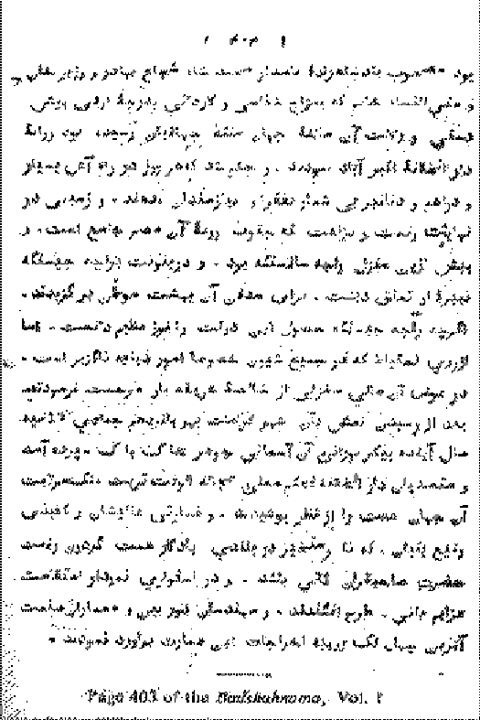
The Badshahnama
Here is a copy of one of the pages of the Badshahnama, the history of Shah Jahan, the so-called builder of the Taj Mahal. This is from the Government of India’s National Archives, and available from the institutional libraries dealing with the medieval history of India.
This is supposed to have been written by the emperor’s chronicler, the Mullah Abdul Hamid Lahori. It describes the site of the Taj Mahal as being full of majestic and lush gardens just south of the city (Agra). It goes on to say that the palace of Raja Mansingh, which was owned by his grandson Raja Jaisingh, was selected as the place for the burial of the queen Mumtaz. This means, of course, that Shah Jahan never built the Taj Mahal but only acquired it from the previous owner, who was Jaisingh.
___________________________
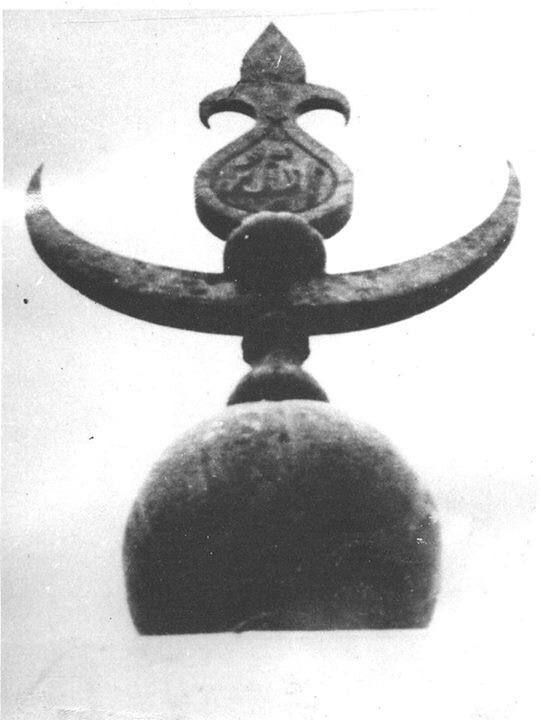
Picture 5: A close up of the upper portion of the pinnacle of the Taj Mahal, photographed from the parapet beneath the dome. The Hindu horizontal crescent and the coconut top together look like a trident from the garden level. Islamic crescents are always oblique. Moreover they are almost always complete circles leaving a little opening for a star. This Hindu pinnacle had all these centuries been misinterpreted as an Islamic crescent and star or a lightning conductor installed by the British. The word “Allah” etched here by Shahjahan is absent in the courtyard replica. The coconut, the bent mango leaves under it and the supporting Kalash (water pot) are exclusive Hindu motifs.
The Letter of Aurangzeb
This is supposed to be a copy of the original letter from Aurangzeb himself written in 1652, complaining of the extensive repairs that are in need of being done on the Taj Mahal. He says that several rooms on the second storey, the secret rooms and tops of the seven storey ceilings have all absorbed water through seepage and are so old that they were all leaking, and the dome had developed a crack on the northern side. This was in spite of the fact that the rumor is that the Taj was finished being built in 1653. The logic of this is that Mumtaz was supposed to have died around 1631, and it is said that it took 22 years to build the Taj. However, in the letter herein Aurangzeb ordered immediate repairs at his expense while recommending to the emperor that more elaborate repairs such as the roof be opened up and redone with mortar, bricks and stone.
Aurangzeb’s letter is recorded in at least three chronicles titled ‘Aadaab-e-alamgiri ‘, ‘Yaadgaarnama ‘and the ‘ Muraaqqa-I-Akbarabadi ‘ (edited by Said Ahmad, Agra, 1931, page 43, footnotes 2).
In any case, if the Taj was a new building, there would no doubt not be any need for such extensive repairs.
Picture 4:
The dome of the Taj Mahal bearing a trident pinnacle made of a non-rusting eight-metal Hindu alloy. The pinnacle served as a lightning deflector too.
This pinnacle has been blindly assumed by many to be an Islamic crescent and star, or a lightning conductor installed by the British. This is a measure of the careless manner in which Indian history has been studied till now. Visually identifiable things like this pinnacle too have been misinterpreted with impunity. The flower top of the dome, below the pinnacle, is an unmistakable Hindu sign. A full scale figure of this pinnacle is inlaid in the eastern courtyard.
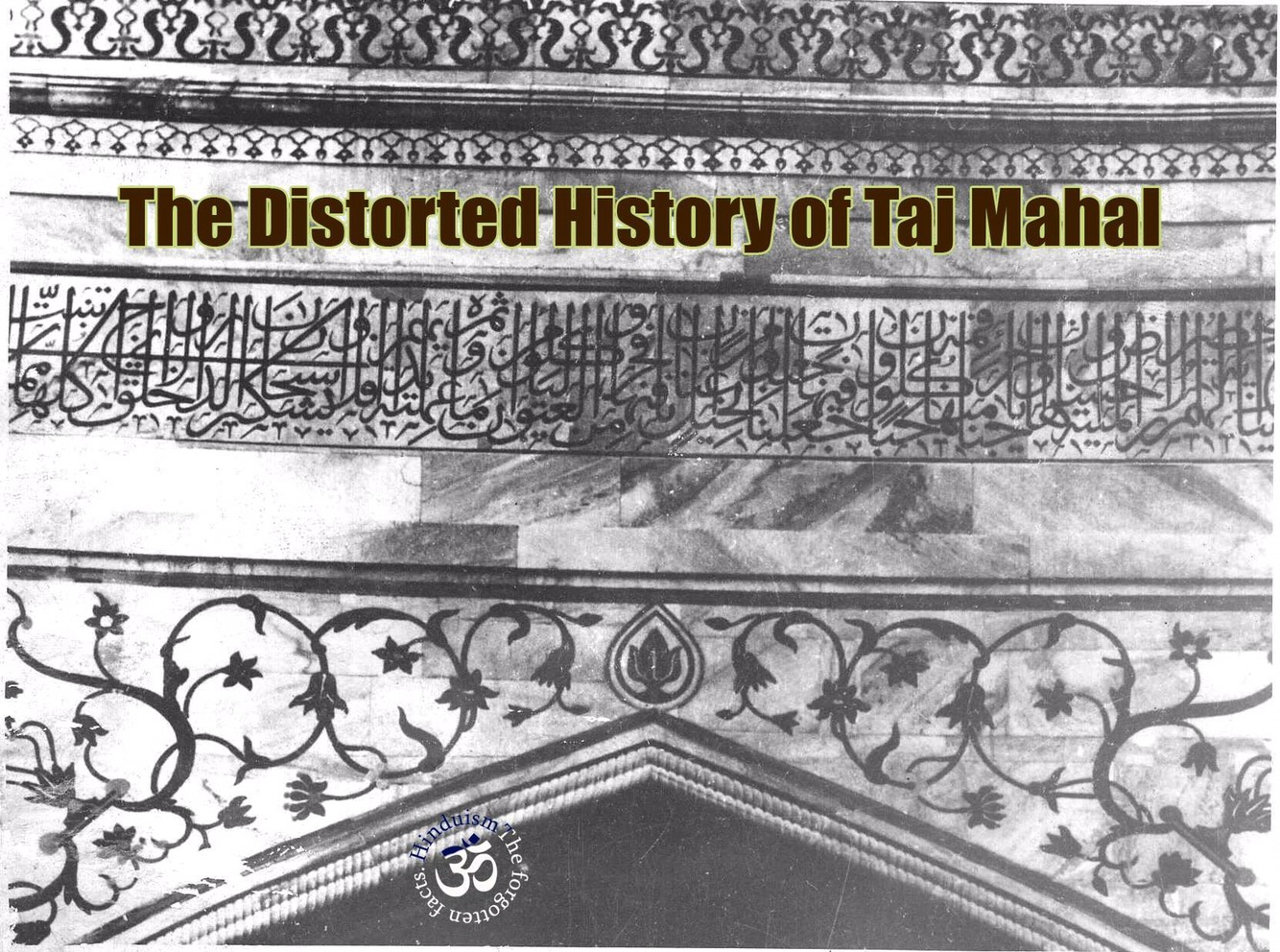
Picture 7: The apex of the lofty entrance arch on all four sides of the Taj Mahal bears this red lotus and white trident–indicating that the building originated as a Hindu temple. The Koranic lettering forming the middle strip was grafted after Shahjahan seized the building from Jaipur state’s Hindu ruler.

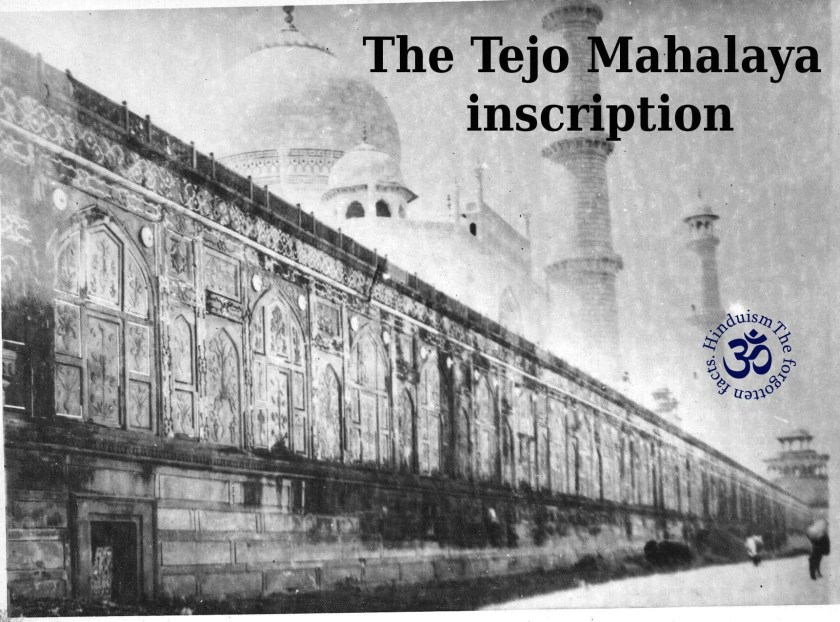
The Tejo Mahalaya inscription
Sanskrit inscription (known as the Bateshwar inscription) it is currently preserved in the Lucknow museum. It refers to the raising of a “Crystal white Shiva temple so alluring that Lord Shiva once enshrined in it decided never to return to Mount Kailas—his usual abode”. This inscription was found within a radius of about 36 miles from the Taj Mahal. The inscription is dated 1155 A.D. and was removed from the Taj Mahal garden at Shah Jahan’s orders. Historians and Archaeologists have blundered in terming the inscription the “Bateshwar inscription” when the record doesn’t say that it was found by Bateshwar. It ought, in fact, to be called “The Tejo Mahalaya inscription” because it was originally installed in the Taj garden before it was uprooted and cast away at Shah Jahan’s command. From this it is clear that the Taj Mahal was built at least 500 years before Shah Jahan.
European Visitor’s and pre-Shahjahan’s Accounts
Vincent Smith records in his book titled “Akbar the Great Moghul” that “Babur’s turbulent life came to an end in his garden palace in Agra in 1630”. That palace was none other than the Taj Mahal. Babur’s daughter Gulbadan Begum in her chronicle titled ‘Humayun Nama’ refers to the Taj as the Mystic House. Babur himself refers to the Taj in his memoirs as the palace captured by Ibrahim Lodi containing a central octagonal chamber and having pillars on the four sides. All these historical references allude to the Taj 100 years before Shahjahan.
Peter Mundy, an English visitor to Agra recorded in 1632 (within only a year of Mumtaz’s death) that ‘the places of note in and around Agra, included Taj-e-Mahal’s tomb, gardens and bazaars’.He, therefore, confirms that that the Tajmahal had been a noteworthy building even before Shahjahan.
De Laet, a Dutch official has listed Mansingh’s palace about a mile from Agra fort, as an outstanding building of pre-shahjahan’s time. Shahjahan’s court chronicle, the Badshahnama records, Mumtaz’s burial in the same Mansingh’s palace.
Bernier, a contemporary French visitor has noted that non muslim’s were barred entry into the basement (at the time when Shahjahan requisitioned Mansingh’s palace) which contained a dazzling light. Obviously, he reffered to the silver doors, gold railing, the gem studded lattice and strings of pearl hanging over Shiva’s idol. Shahjahan comandeered the building to grab all the wealth, making Mumtaz’s death a convineant pretext.
Johan Albert Mandelslo, who describes life in agra in 1638 (only 7 years after mumtaz’s death) in detail (in his ‘Voyages and Travels to West-Indies’, published by John Starkey and John Basset, London), makes no mention of the Tajmahal being under constuction though it is commonly erringly asserted or assumed that the Taj was being built from 1631 to 1653.
Fabrication of History
Probably there is none who has not been duped at least once in a life time. But can the whole world be duped? This may seem impossible. But in the matter of Indian history the world has been duped in many respects for hundreds of years and still continues to be duped.
The world famous Taj Mahal in Agra is a glaring instance. For all the time, money and energy that people the world over spend in visiting the Taj Mahal they are dished out a concoction. Contrary to what visitors are made to believe the Taj Mahal is not an Islamic mausoleum but an ancient Shiva temple known as Tejo Mahalaya which the 5th generation Mogul emperor Shah Jahan commandeered from the then Maharaja of Jaipur. Therefore the Taj Mahal must be viewed as a temple-palace complex and not as a tomb.
The famous historian Shri P.N. Oak has proven that Taj Mahal is actually Tejo Mahalaya — a shiv temple-palace. His work was published in 1965 in the book, Taj Mahal – The True Story. However, we have not heard much about it because it was banned by the corrupt and power crazed Congress government of Bharat who did not want to alienate their precious vote bank—the Muslims.
Stories of Shah Jahan’s exclusive infatuation for Mumtaz’s are concoctions. They have no basis in history nor has any book ever written on their fancied love affairs. Those stories have been invented as an afterthought to make Shah Jahan’s authorship of the Taj look plausible. Historical evidence indicates that the Taj Mahal was already ancient at the time of Shah Jahan. And the discussion upon the architecture leads to the conclusion that the general layout of the Taj Complex resembles a Shiva temple.
Presently an attempt is being made to celebrate the 350th anniversary of Taj Mahal as the present distorted Indian history bestows the credit of building the edifice to Emperor Shah Jahan and claims that he completed the task of building Taj Mahal in 16**. But according to the Munj Bateswar Edict, the age of the building is 848 years and hence the said effort of celebrating 350th anniversary of the 848 year old Taj Mahal would be totally nonsensical and extremely ridiculous. At the same time, the Muslims of this country are demanding to declare the same as a Wakf Property and hand the building over to them. So, before taking any decision regarding the building, it is highly necessary for the Central Government in Delhi to undertake elaborate archaeological and scientific tests to ascertain the true antiquity of Taj Mahal.
Hidden, locked and sealed chambers
The Taj is a seven storied building. Prince Aurangzeb also mentions this in his letter to Shahjahan. The marble edifice comprises four stories including the lone, tall circular hall inside the top, and the lone chamber in the basement. In between are two floors each containing 12 to 15 palatial rooms. Below the marble plinth reaching down to the river at the rear are two more stories in red stone. They may be seen from the river bank. The seventh storey must be below the ground (river) level since every ancient Hindu building had a subterranian storey.
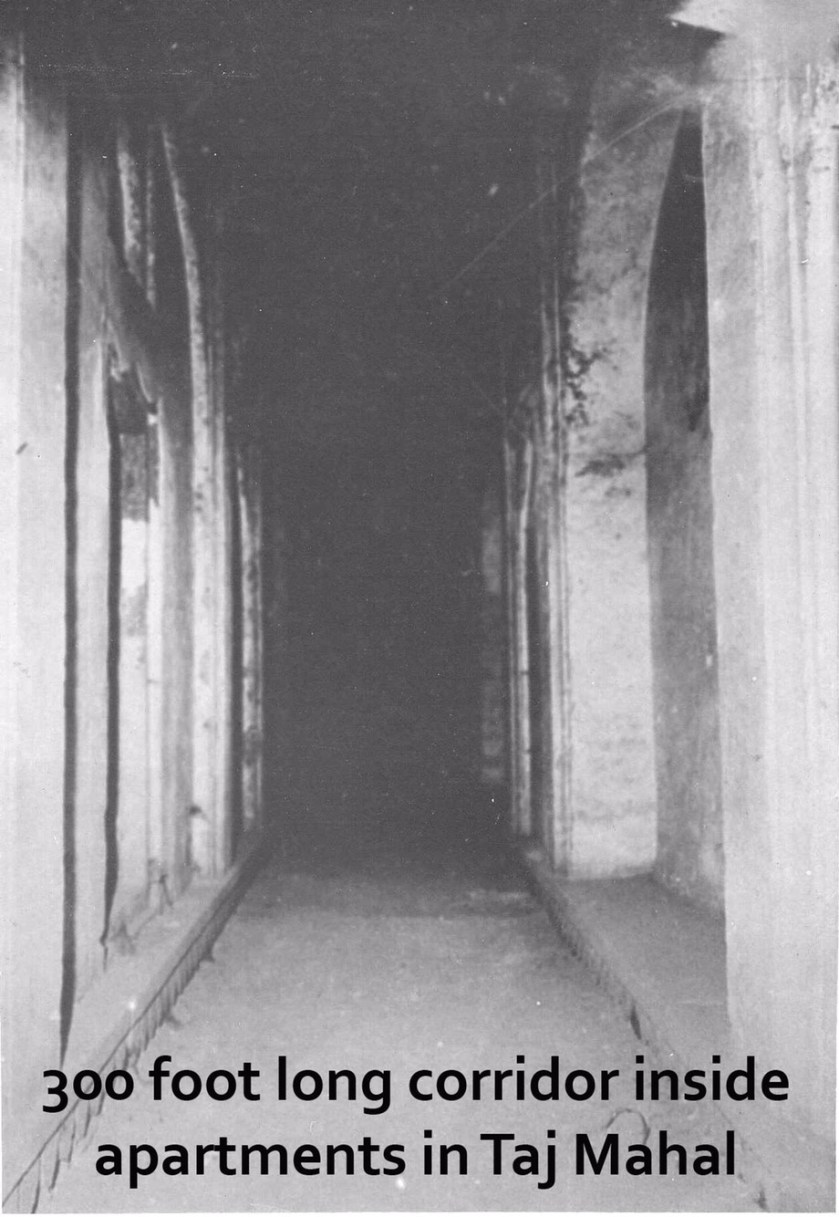
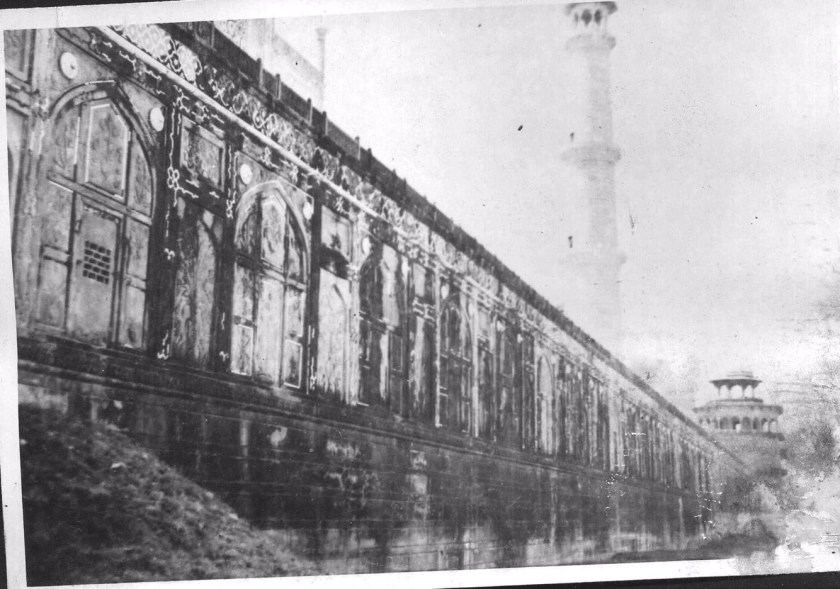
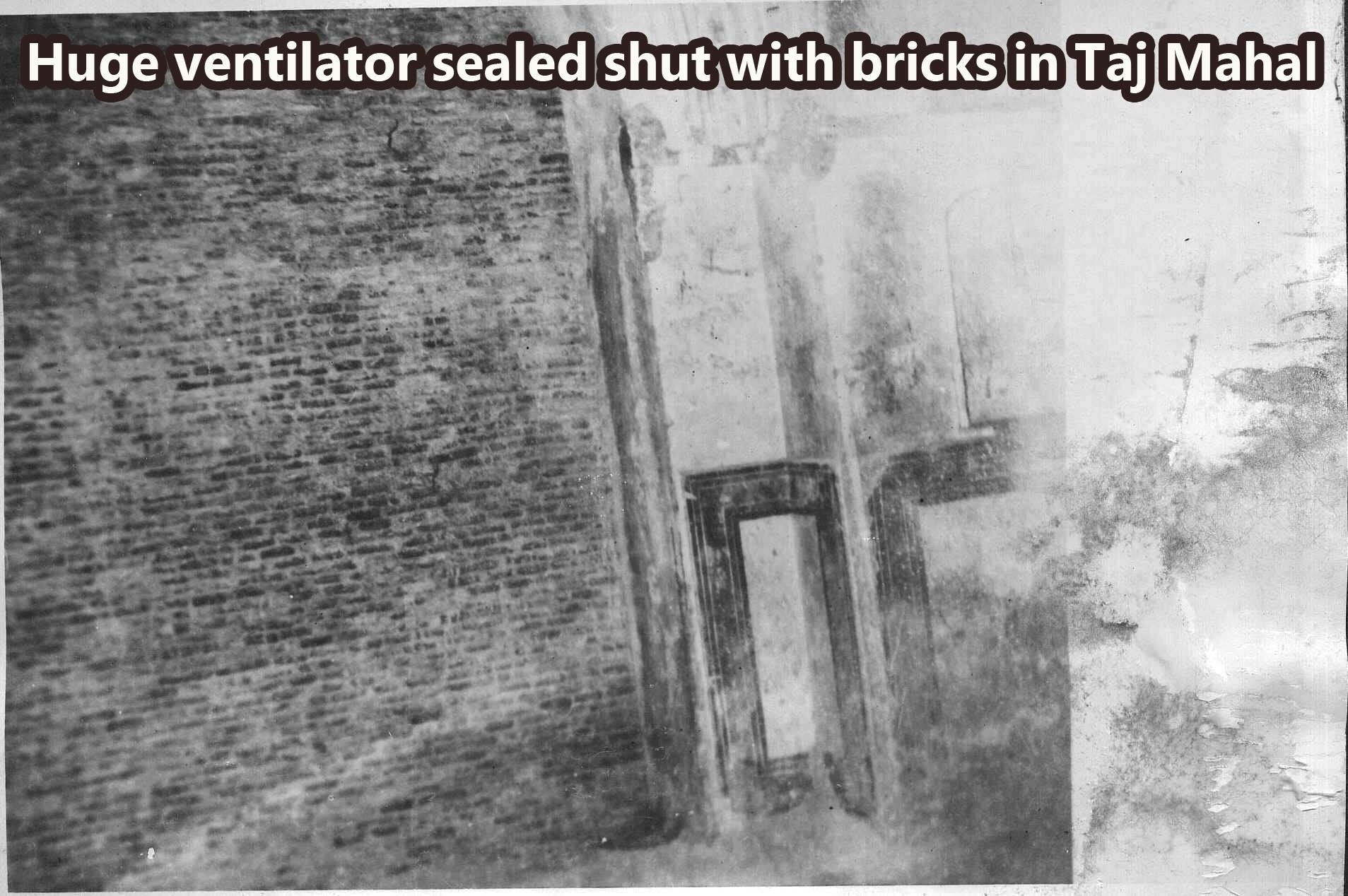
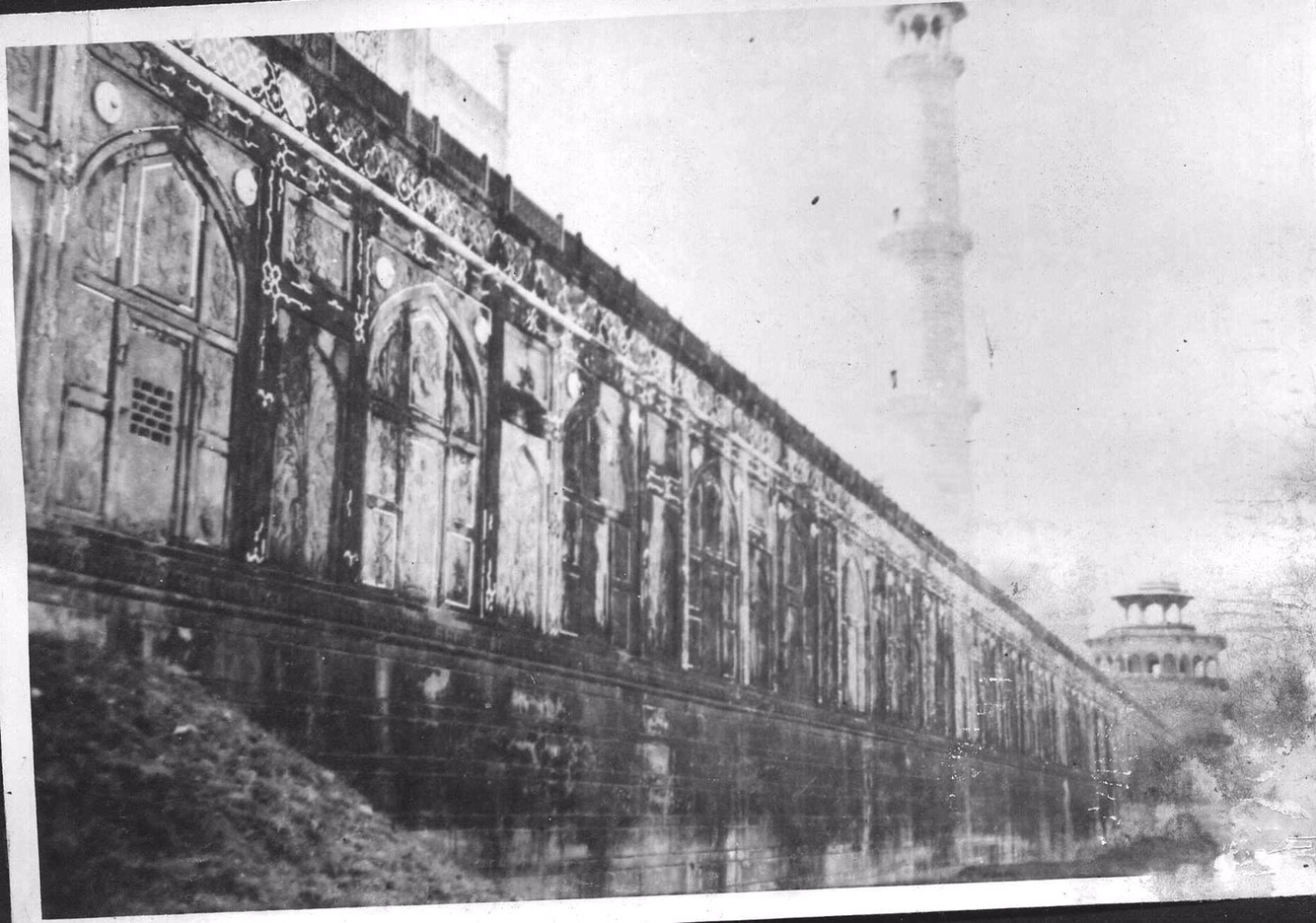
Immediately bellow the marble plinth on the river flank are 22 rooms in red stone with their ventilators all walled up by Shahjahan. Those rooms, made uninhibitably by Shahjahan, are kept locked by Archealogy Department of India. The lay visitor is kept in the dark about them. Those 22 rooms still bear ancient Hindu paint on their walls and ceilings. On their side is a nearly 33 feet long corridor. There are two door frames one at either end ofthe corridor. But those doors are intriguingly sealed with brick and lime.
Apparently those doorways originally sealed by Shahjahan have been since unsealed and again walled up several times. In 1934 a resident of Delhi took a peep inside from an opening in the upper part of the doorway. To his dismay he saw huge hall inside. It contained many statues huddled around a central beheaded image of Lord Shiva. It could be that, in there, are Sanskrit inscriptions too. All the seven stories of the Tajmahal need to be unsealed and scoured to ascertain what evidence they may be hiding in the form of Hindu images, Sanskrit inscriptions, scriptures, coins and utensils.
Apart from Hindu images hidden in the sealed stories it is also learnt that Hindu images are also stored in the massive walls of the Taj. Between 1959 and 1962 when Mr. S.R. Rao was the Archealogical Superintendent in Agra, he happened to notice a deep and wide crack in the wall of the central octagonal chamber of the Taj. When a part of the wall was dismantled to study the crack out popped two or three marble images. The matter was hushed up and the images were reburied where they had been embedded at Shahjahan’s behest. Confirmation of this has been obtained from several sources. Its walls and sealed chambers still hide in Hindu idols that were consecrated in it before Shahjahan’s seizure of the Taj.
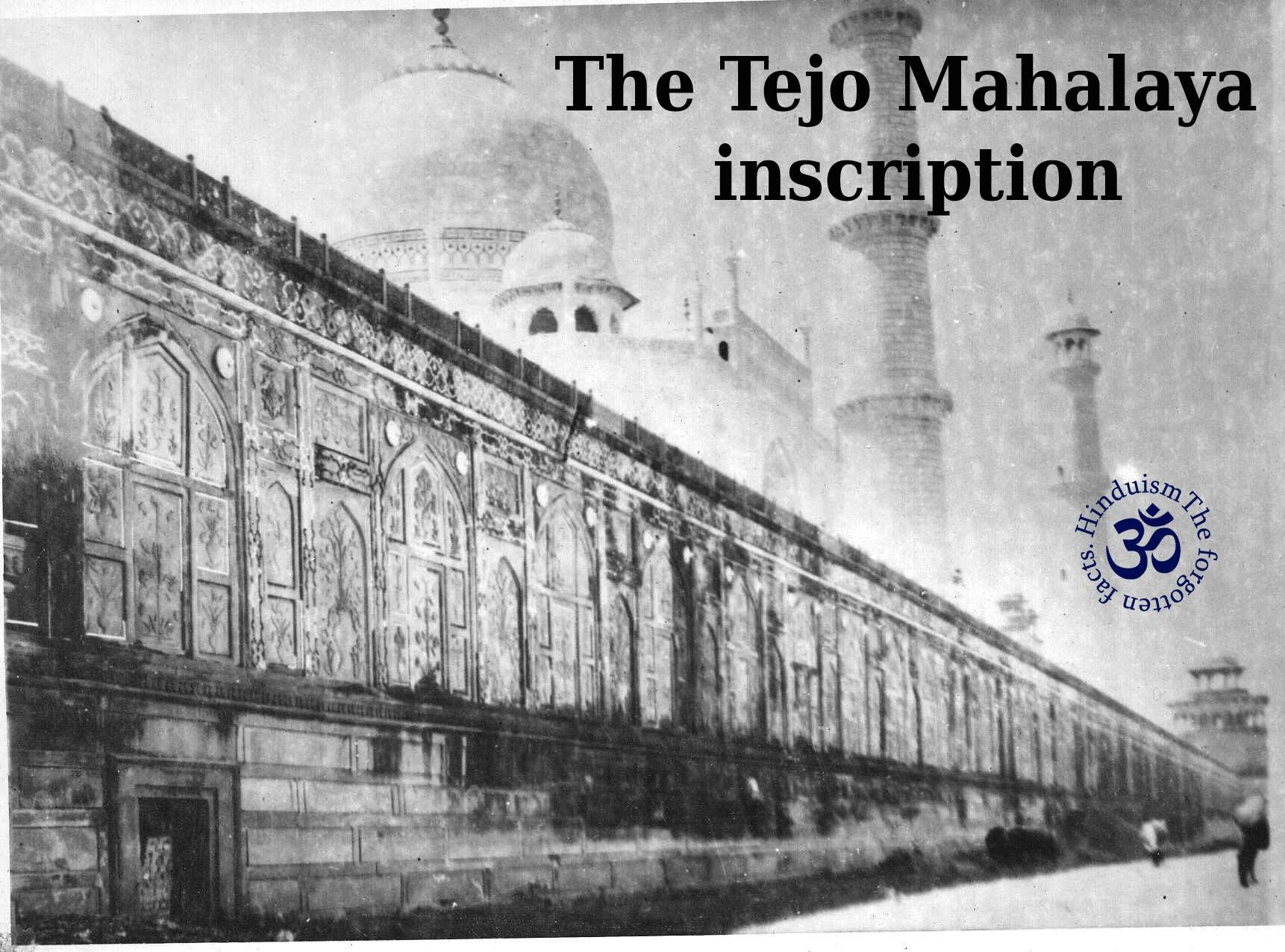
Picrure 8: This is a riverside view of the Taj Mahal. The four storied marble structure above has under it these two stories reaching down to the river level. The 22 rooms shown in other photos are behind that line of arches seen in the middle. Each arch is flanked by Hindu lotus discs in white marble. Just above the ground level is the plinth. In the left corner of the plinth is a doorway indicating inside the plinth are many rooms sealed by Shahjahan. One could step out to the river bank from the door at the left. The 7th storey is surmised to be under the plinth below the ground because every ancient Hindu mansion had a basement. Excavation to reach the basement chamber should start under this door.


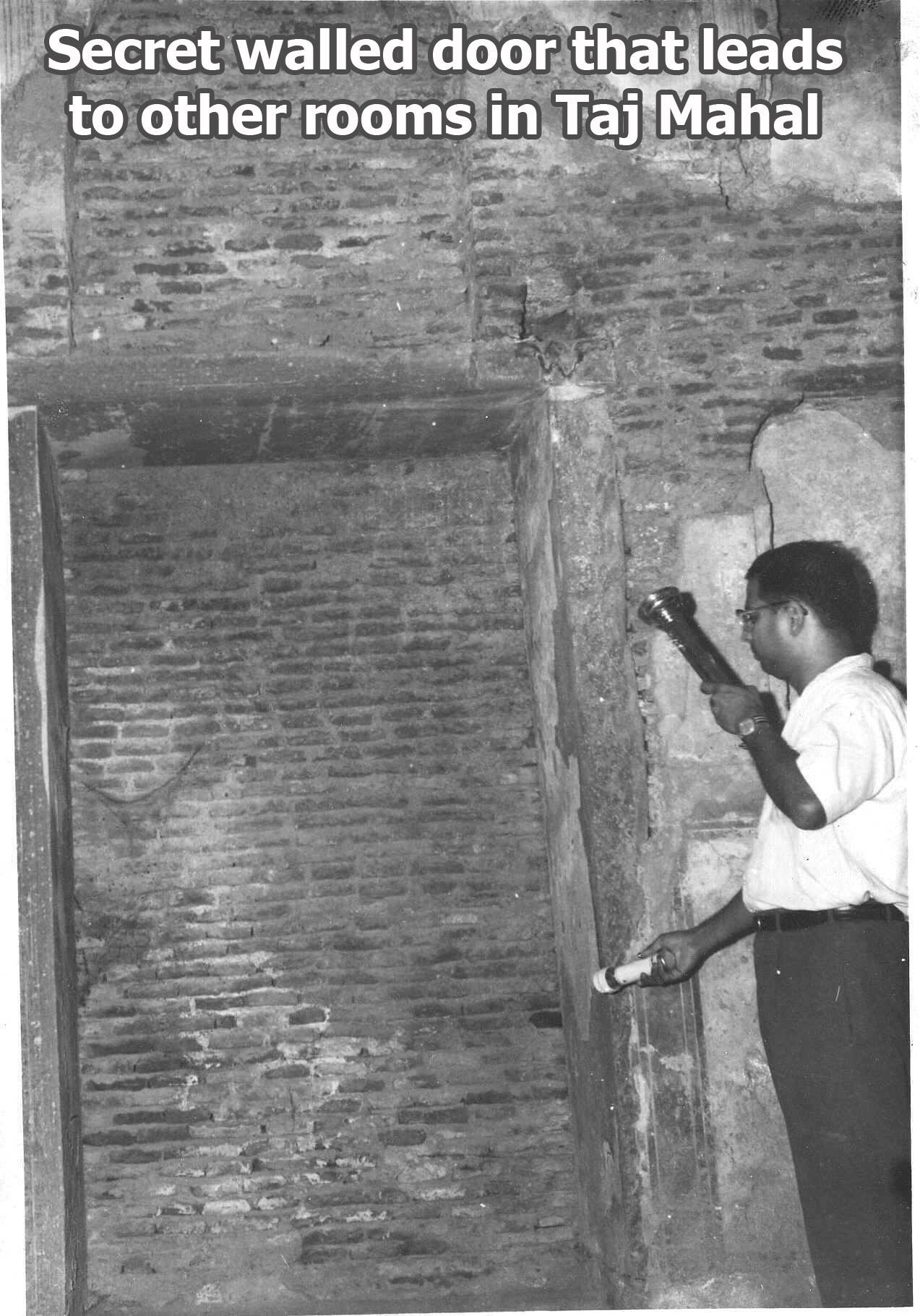
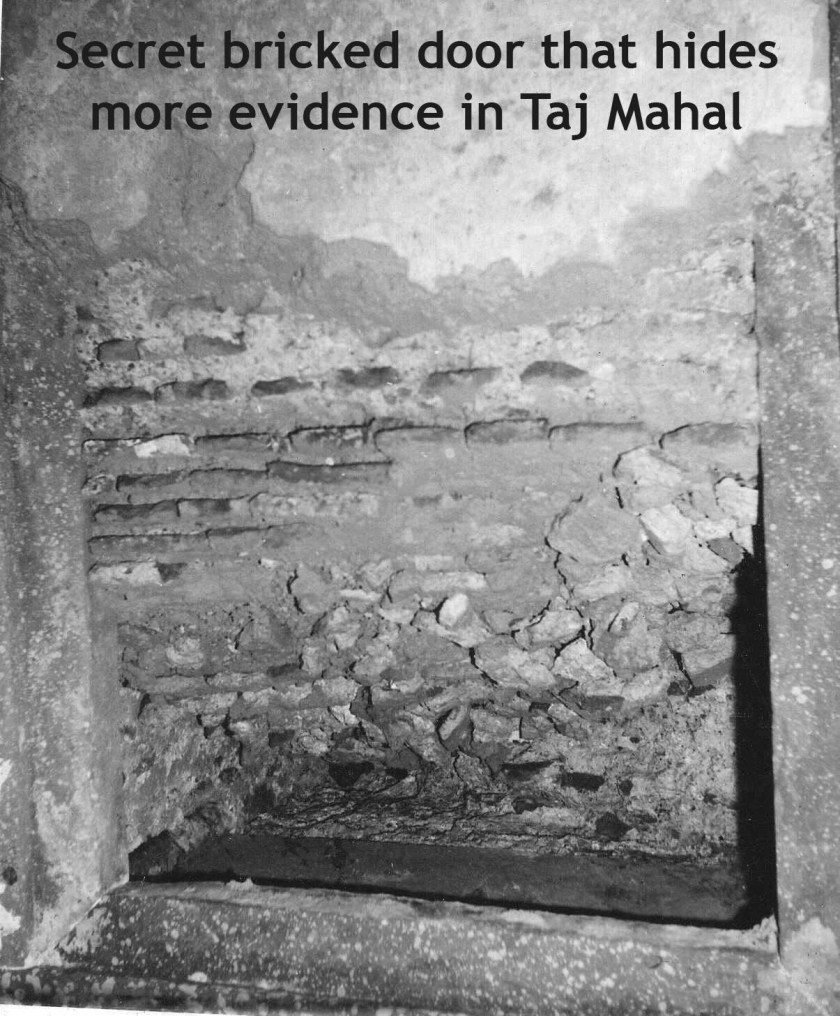 Secret bricked door that hides more evidence in Taj Mahal
Many such doorways of chambers in secret stories underneath the Taj Mahal have been sealed with brick and lime. Concealed inside could be valuable evidence such as Sanskrit inscriptions, Hindu idols, the original Hindu model of the Taj, the desecrated Shiva Linga, Hindu scriptures and temple equipment. Besides such sealed chambers there are many which are kept locked by the Government. The Public must raise its voice to have these opened or it should institute legal proceedings. Shree P. N. Sharma of Green Park, New Delhi who peeped through an aperture in these chambers in 1934 A.D. saw a pillared hall with images carved on the pillars.
Secret walled door that leads to other rooms in Taj Mahal
One of the 22 riverside rooms in a secret storey of the Taj Mahal, unknown to the public. Shahjahan, far from building the shining marble Taj, wantonly disfigured it. Here he has crudely walled up a doorway. Such imperial Mogul vandalism lies hidden from the public. This room is in the red stone storey immediately below the marble platform. Indian history has been turned topsy turvy in lauding destroyers as great builders.
Huge ventilator sealed shut with bricks in Taj Mahal
A huge ventilator of one of the 22 rooms in a secret storey of the Taj, is seen here crudely sealed with unplastered bricks by Shahjahan. History has been so perverted and inverted that alien Muslims like Shahjahan who spoiled, damaged, desecrated and destroyed historic Hindu buildings, are being falsely paraded as great builders.
Vedic design on ceiling of a locked room in Taj Mahal
This esoteric Hindu design is painted on the ceiling of some of the 22 locked rooms in the secret storey below the marble platform of the Taj Mahal in Agra. Had Shahjahan built the Taj Mahal he would not have kept such elaborately painted rooms sealed and barred to the public. Even now one can enter these rooms only if one can influence the archaeology department to remove the locks.
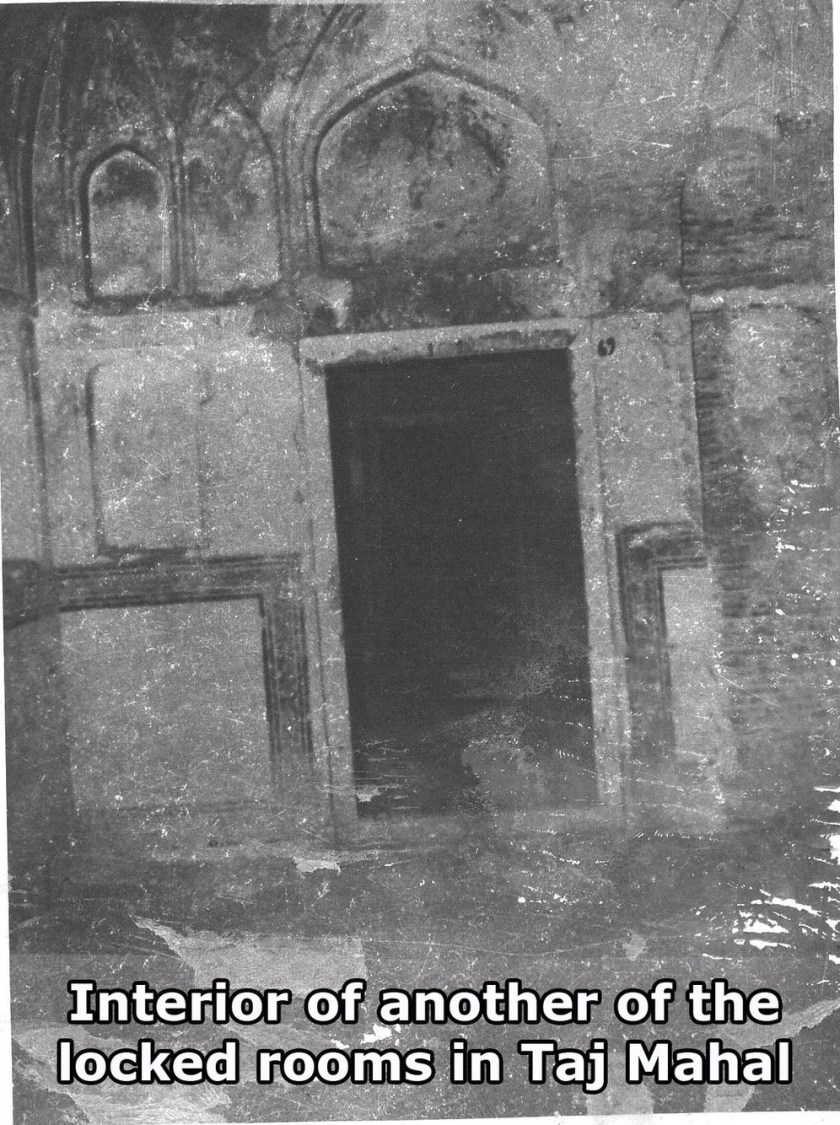
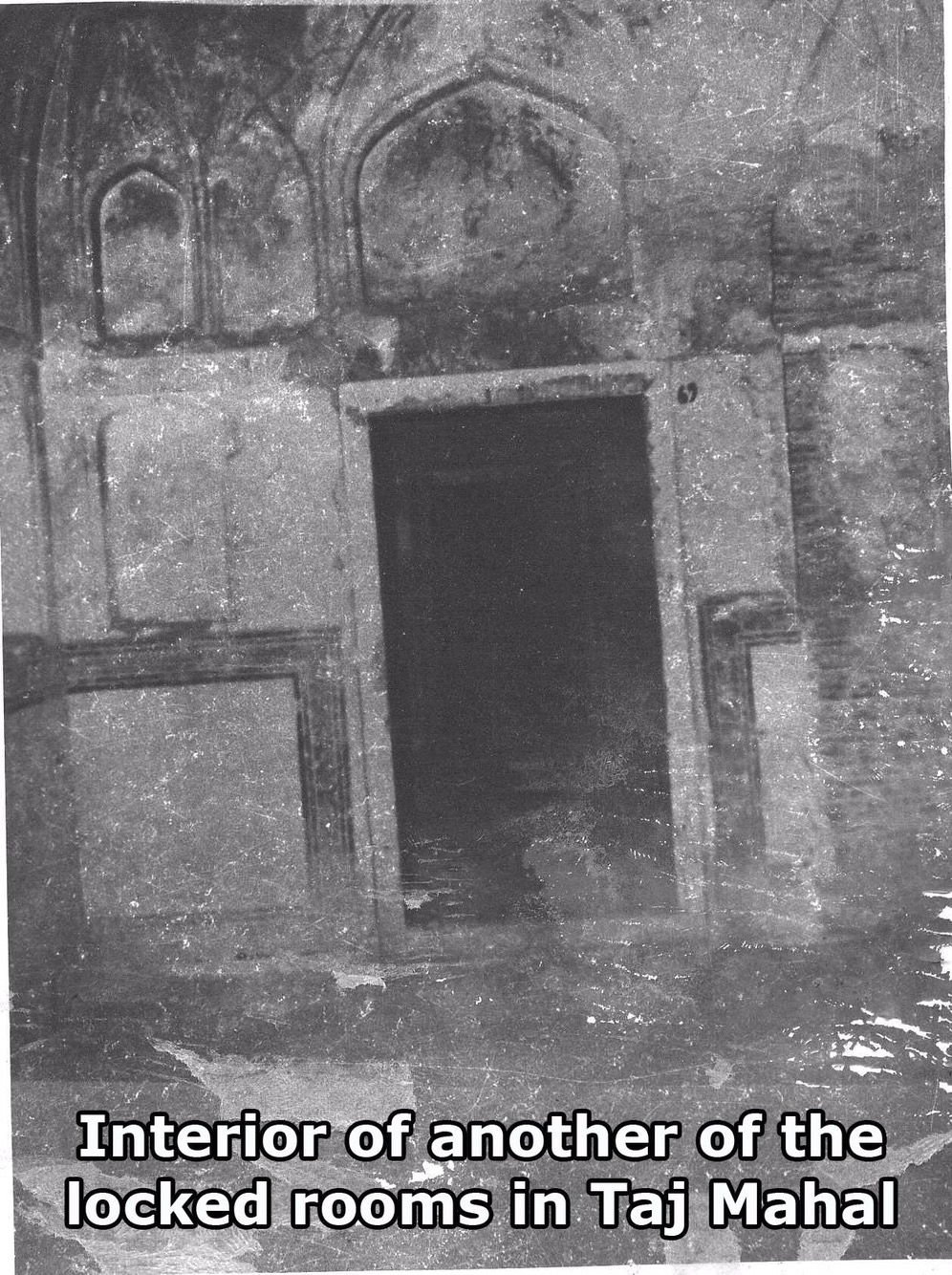
Interior of another of the locked rooms in Taj Mahal
One of the 22 locked rooms in the secret storey beneath the marble platform of the Taj Mahal. Strips of ancient Hindu paint are seen on the wall flanking the doorway. The niches above had paintings of Hindu idols, obviously rubbed off by Muslim desecraters. The rooms may be seen door within door in a row. If the public knew that the Taj Mahal is a structure hiding hundreds of rooms, they would insist on seeing the whole of it. At present they only peep into the grave chamber and walk away.
300 foot long corridor inside apartments in Taj Mahal
On the inner flank of the 22 locked rooms (in the secret storey in red stone below the marble platform) is this corridor about 12 ft. broad and 300 ft. long. Note the scallop design at the base of the plinth supporting the arches. This is the Hindu decoration which enables one to identify even a bare plinth.
Staircase that leads to the lower levels in Taj Mahal
This staircase and another symmetrical one at the other end lead down to the storey beneath the marble platform. Visitors may go to the back of the marble plinth at the eastern or western end and descend down the staircase because it is open to the sky. But at the foot the archaeology department has set up an iron door which it keeps locked. Yet one may peep inside from the iron gate in the upper part of the door. Shahjahan had sealed even these two staircases. It was the British who opened them. But from Shahjahan’s time the stories below and above the marble ground floor have been barred to visitors. We are still following Mogul dictates though long free from Mogul rule.

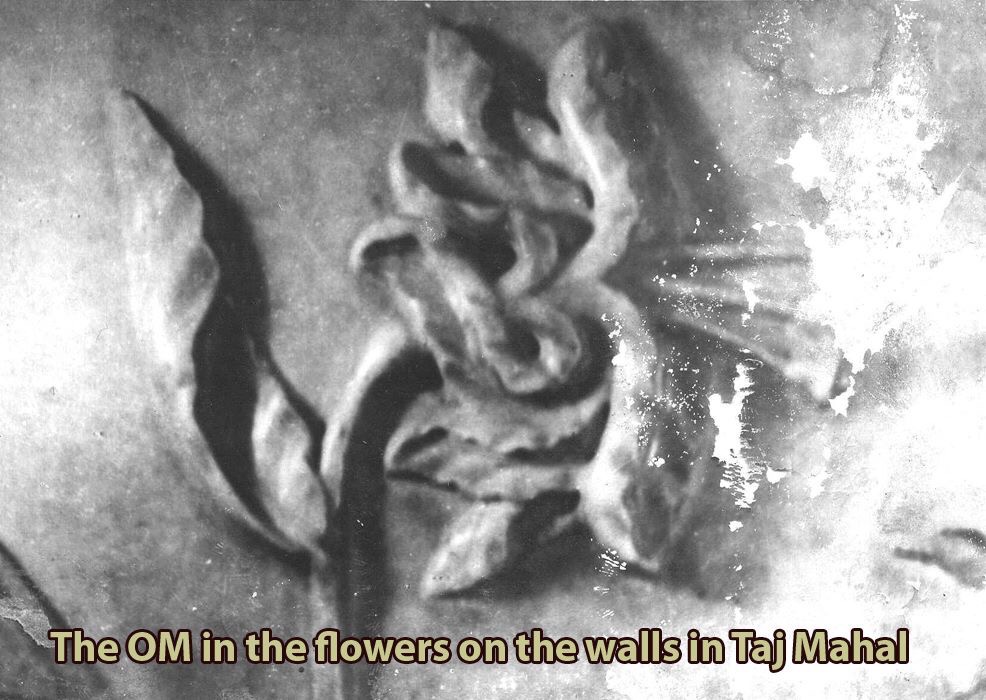
The OM in the flowers on the walls in Taj Mahal
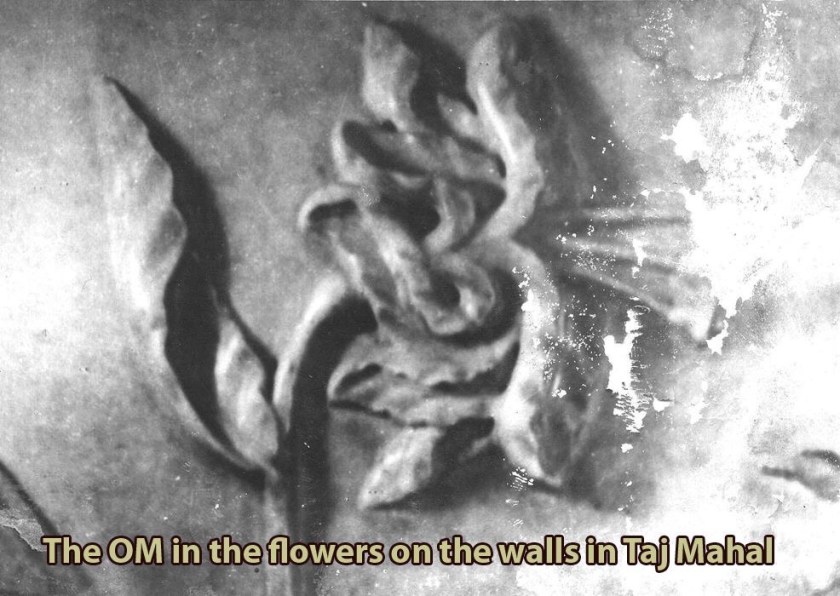
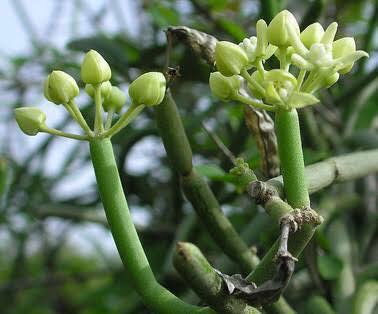
This is the Dhatura flower essential for Hindu Shiva worship. The flower is depicted in the shape of the sacred, esoteric Hindu incantation ‘OM.’ Embossed designs of this blooming ‘OM’ are drawn over the exterior of the octagonal central sanctorum of Shiva where now a fake grave in Mumtaz’s has been planted. While perambulating around the central chamber one may see such ‘OM’ designs.
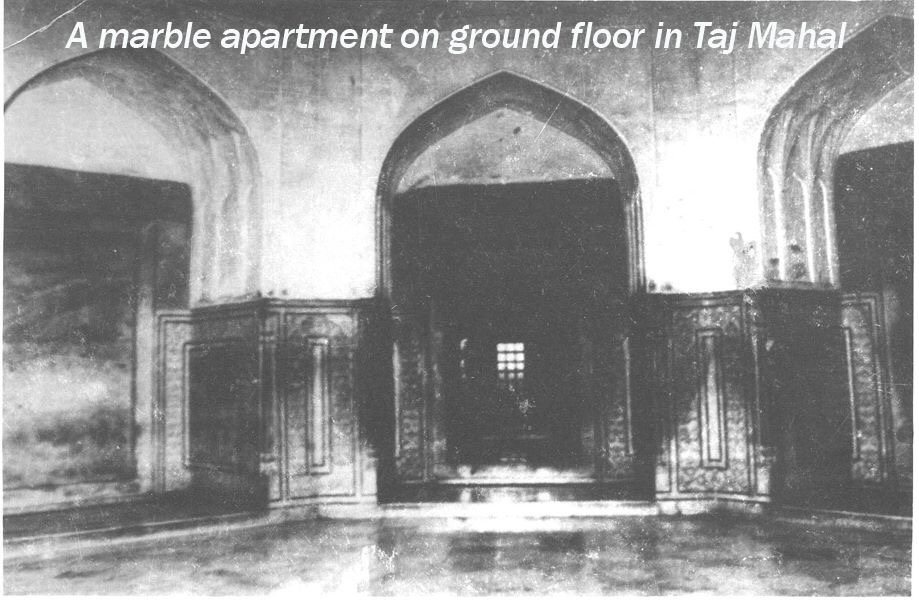
A marble apartment on ground floor
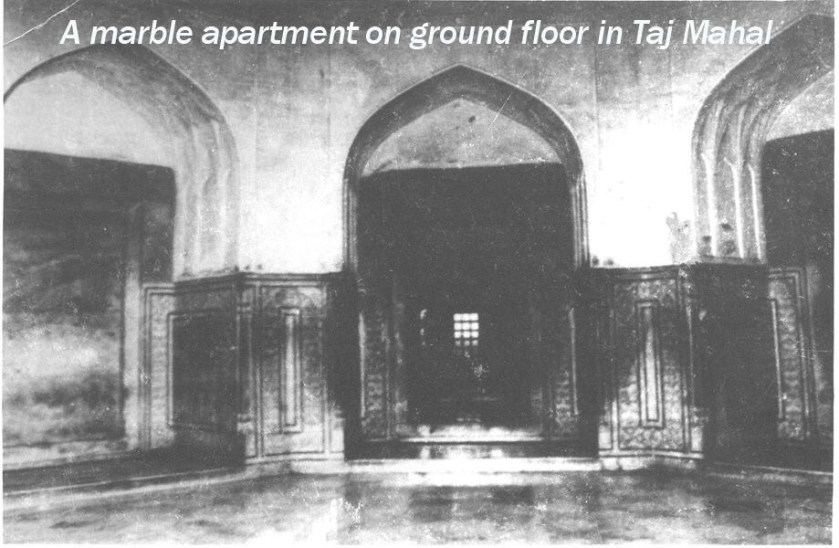
Such are the magnificent marble-paved, shining, cool, white bright rooms of the Taj Mahal temple palace’s marble ground floor. Even the lower third portion of the walls is covered with magnificent marble mosaic. The doorway at the left looks suspiciously closed with a stone slab. One can perambulate through these rooms around the central octagonal sanctorum, now occupied by Mumtaz’s fake grave. The aperture, seen through of the central door, enabled perambulating devotees to keep their eyes fixed on the Shiva Linga in the central chamber. Hindu Shiva Lingas are consecrated in two chambers, one above the other. Therefore, Shahjahan had to raise two graves in the name of Mumtaz–one in the marble basement and the other on the ground floor to desecrate and hide both the Shiva emblems from public view. [The famous Shiva temple in Ujjain also has an underground chamber for one of its Shiva-lingams.]
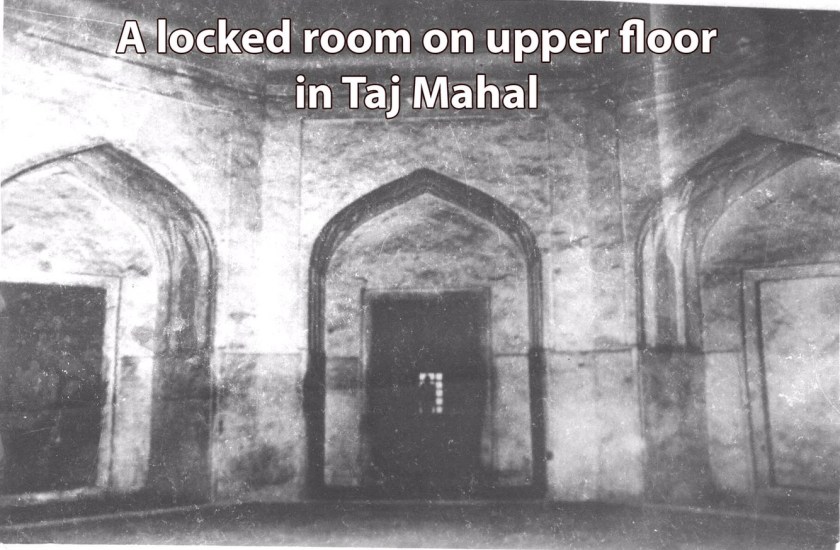
Such are the rooms on the 1st floor of the marble structure of the Taj Mahal. The two staircases leading to this upper floor are kept locked and barred since Shahjahan’s time. The floor and the marble walls of such upper floor rooms can be seen in the picture to have been stripped of its marble panels. Shahjahan used that uprooted marble from the upper floor for constructing graves and engraving the Koran because he did not know wherefrom to procure marble matching the splendour of the rest of the Taj Mahal. He was also so stingy as not to want to spend much even on converting a robbed Hindu temple into an Islamic mausoleum.
This Naqqar Khana alias Music House in the Taj Mahal garden is an incongruity if the Taj Mahal were an Islamic tomb. Close by on the right is the building which Muslims claim to be a mosque. The proximity of a mosque to the Music House is incongruous with Muslim tradition. In India, Muslims have a tradition of pelting stones on Hindu music processions passing over a mosque. Moreover a mausoleum needs silence. A dead person’s repose is never to be disturbed. Who would then provide a band house for a dead Mumtaz? Contrarily Hindu temples and palaces have a music house because morning and evening Hindu chores begin to the sweet strains of sacred music.

Picture 9: These corridors at the approach of the Taj Mahal are typically Hindu. They may be seen in any ancient Hindu capital. Note the two octagonal tower cupolas at the right and left top. Only Hindus have special names for the eight directions and celestial guards assigned to each. Any octagonal feature in historic buildings should convince the visitor of their Hindu origin. Guards, palanquin bearers and other attendants resided in hundreds of rooms along numerous such corridors when the Taj Mahal was a Hindu temple palace. Thus the Taj was more magnificent and majestic before it was reduced to a sombre Islamic cemetery.

Picture 8: Most people content to see Mumtaz’s grave inside the Taj fail to go to the rear riverside. This is the riverside view. From here one may notice that the four-storied marble structure on top has below it two more stories in red stone. Note the window aperture in the arch at the left. That indicates that there are rooms inside. Inside the row of arches in the upper part of the wall are 22 rooms. In addition to the four stories in marble, this one shows red stone arches in the 5th storey. The 6th storey lies in the plinth in the lower portion of the photo. In another photo a doorway would be seen in the left corner of the plinth, indicating the presence of apartments inside, from where one could emerge on the river for a bath.
From Hinduism forgotten facts
























 GLOBAL HINDUISM