The Size of this Universe

The The Size of this Universe – from Śrīmad-Bhāgavatam 3.11.40-42 

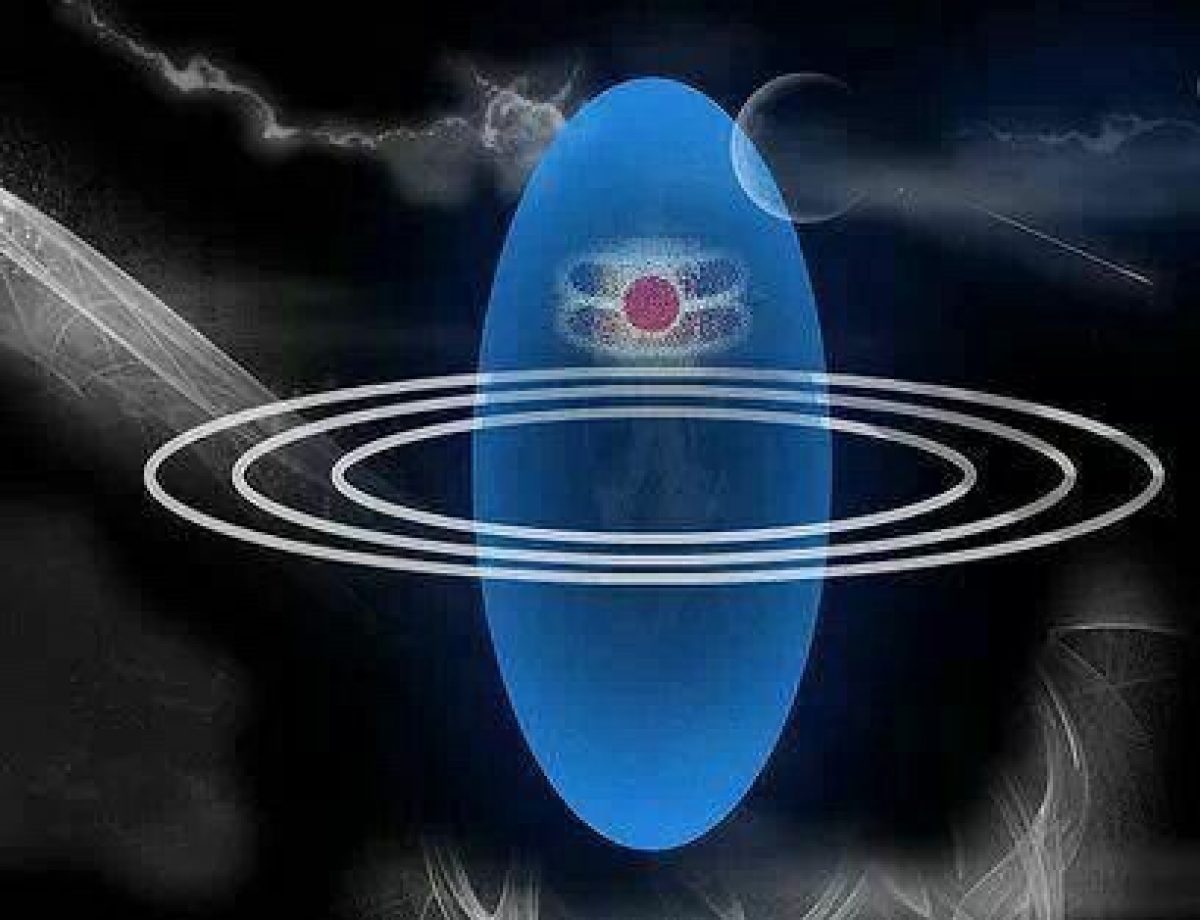
SB 3.11.40This phenomenal material world is expanded to a diameter of four billion miles, as a combination of eight material elements transformed into sixteen further categories, within and without, as follows.

The analytical studies of the material world are the subject matter of Sāṅkhya philosophy. The first sixteen diversities are the eleven senses and five sense objects, and the eight elements are the gross and subtle matter, namely earth, water, fire, air, sky, mind, intelligence and ego. All these combined together are distributed throughout the entire universe, which extends diametrically to four billion miles. Besides this universe of our experience, there are innumerable other universes. Some of them are bigger than the present one, and all of them are clustered together under similar material elements as described below.

SB 3.11.41The layers or elements covering the universes are each ten times thicker than the one before, and all the universes clustered together appear like atoms in a huge combination.

The coverings of the universes are also constituted of the elements of earth, water, fire, air and ether, and each is ten times thicker than the one before. The first covering of the universe is earth, and it is ten times thicker than the universe itself. If the universe is four billion miles in size, then the size of the earthly covering of the universe is four billion times ten. The covering of water is ten times greater than the earthly covering, the covering of fire is ten times greater than the watery covering, the covering of air is ten times greater than that of the fire, the covering of ether is ten times greater still than that of air, and so on. The universe within the coverings of matter appears to be like an atom in comparison to the coverings, and the number of universes is unknown even to those who can estimate the coverings of the universes.

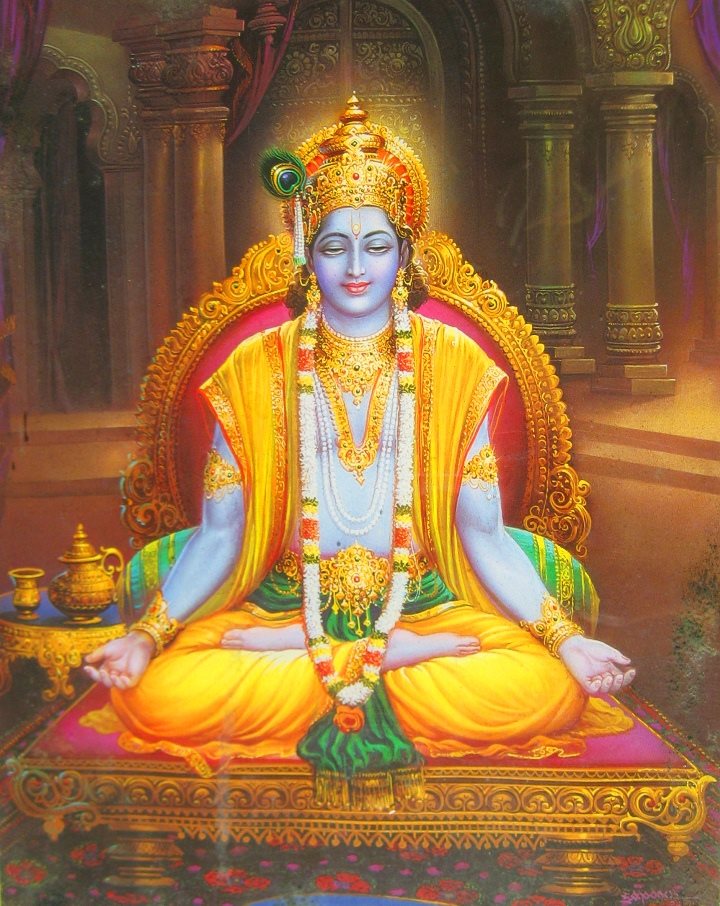
SB 3.11.42The Supreme Personality of Godhead, Śrī Kṛṣṇa, is therefore said to be the original cause of all causes. Thus the spiritual abode of Viṣṇu is eternal without a doubt, and it is also the abode of Mahā-Viṣṇu, the origin of all manifestations.

Lord Mahā-Viṣṇu, who is resting in yoga-nidrā on the Causal Ocean and creating innumerable universes by His breathing process, only temporarily appears in the mahat-tattva for the temporary manifestation of the material worlds. He is a plenary portion of Lord Śrī Kṛṣṇa, and thus although He is nondifferent from Lord Kṛṣṇa, His formal appearance in the material world as an incarnation is temporary. The original form of the Personality of Godhead is actually the svarūpa, or real form, and He eternally resides in the Vaikuṇṭha world (Viṣṇuloka). The word mahātmanaḥ is used here to indicate Mahā-Viṣṇu, and His real manifestation is Lord Kṛṣṇa, who is called parama, as confirmed in the Brahma-saṁhitā:

īśvaraḥ paramaḥ kṛṣṇaḥ
sac-cid-ānanda-vigrahaḥ
anādir ādir govindaḥ
sarva-kāraṇa-kāraṇam

“The Supreme Lord is Kṛṣṇa, the original Personality of Godhead, known as Govinda. His form is eternal, full of bliss and knowledge, and He is the original cause of all causes

Link

Krishna Temple in Pakistan


This ancient Krishna temple in Pakistan, which is now used as a storage to keep straw, still contains some extremely beautiful ancient paintings of Lord Krishna. Just go through the pictures. However, the dilapidated condition of the temple is very painful.

Peape tree or Ficus Religosa and sweet water well in Garden area or Bagh of the Krishna Mandir and Gurdwara of Kallar Syedan 1830 AD — in Kallar Saidan, Punjab, Pakistan.

oldest Hindu Temple is Cambodia- Akkor Vat

The Oldest Hindu Temple? We all know that Ankor Vat (built in 12th century) in Cambodia is the biggest Hindu temple complex in the world (in fact, it is the biggest religious structure in the world!!!). But where is the oldest Hindu temple? The question of finding an answer to the oldest Hindu temple is a bit difficult. Each temple that is considered to be the oldest is questioned by another set of people claiming their temple to be the oldest one. Early worships used to take place in caves, so it is quite probable that the most ancient temple has to be a cave temple. Therefore, here I present a possible candidate: Cave No. 19 of the Bhaja Caves, Lonavala, Maharashtra. Even though the 2200 years old Bhaja Caves are primarily a Theravada Buddhist site, it seems that, like is the case with many other ancient cave temples, these caves too were shared by Buddhists and Hindus alike. In cave no. 19 we find 2200 years old rock carvings of Surya (the Vedic Sun God) on his chariot, Indra (the Vedic Thunder God) on his Airavata elephant and Lord Parashurama, an incarnation of Lord Vishnu, which is enough evidence for us to speculate that cave no. 19 was used as a temple by people following the Vedic traditions. This makes it most probably the most ancient Hindu temple to be found intact today.
Pic: 1. 2200 years old rock carvings of Surya (the Vedic Sun God) on his chariot, Indra (the Vedic Thunder God) on his Airavata elephent in cave no. 19, Bhaja Caves, Lonavala, Maharashtra. 2. Buddhist Chaitya at the main cave entrance, Bhaja Caves, Lonavala, Maharashtra.

Syria was ruled by Hindu King 3300 years ago

A King named Dasharatha ruled over Syria and Iraq 3300 years ago: The Arya Kingdom of Mittani comprised of what is known today as Syria and parts of south-eastern Turkey and Iraq between 1500-1300 BC. It is well-known to historians that the Mittani kingdom was founded by an Arya ruling class, whose names are of Indic origin and who worshipped Vedic Gods, such as Mitra, Varuna, Indra and Nasatya (Ashvini-Kumaras) etc. Look at the names of some of their kings: The first Mitanni king was Sutarna I (“good sun” – सुतर्ण). He was followed by Paratarna I (“great sun” – परतर्ण), Parashukshatra (“ruler with axe” – परशुक्षत्र), Saukshatra (“son of Sukshatra, the good ruler” – सौक्षत्र), Paratarna II, Artatama or Ritadharma (“abiding in cosmic law” – ऋतधर्म), Sutarna II, Tushratta or Dasharatha (दशरथ), and finally Mativaja (Matiwazza, “whose wealth is prayer” – मतिवाज). For more info read Pr. Subhash Kak’s well-researched informative article: http://creative.sulekha.com/the-sun-king-and-dasharatha_103…
Pic: 1. A letter from King Dasharatha (Tushratta) of Mittani written to King Akhenaton of Egypt, Tell El Amarna letters (tablets). 2. The extent of the Mittani kingdom in 1400 BC.

Lord Brahma in Thailand.

Lord Brahma is a very popular deity in Thailand. He is known as Phra Phrom in local Thai language which is derived from Sanskrit “Vara Bhrama” (वर ब्रह्मा). Shrines dedicated to Him can be found in various places of Thailand. Thailand also has a small native Hindu Brahmana priesthood, which take care of these Hindu deities in the country. Pandit Vamadeva Muni, the royal priest of Thailand (Rajapurohita), is the head of all these Hindu Brahmana priests.

Lord Narsimha In China Museum

This ancient Hindu relief, housed at Quanzhou Museum in China, features the image of Lord Narasimha, one of Lord Vishnu’s ten incarnations, destroying the evil Hiranyakashipu.

Ramayana in Phillipines

Ramayana in the Philippines.
The famous dance of Singkil from the Philippines is inspired from the Ramayana of the Philippines.
PDF version of a detailed study on Maharadia Lawana, the ancient Ramayana from the Philippines, can be downloaded from here…
http://www.asj.upd.edu.ph/…/ASJ-07-02-1969/franciso-maharad…

फिलिपीन्स में रामायण –
फिलिपीन्स का प्रसिद्ध सिङ्किल नृत्य वहां की राम-कथा पर ही आधारित होता है। प्राचीन फिलिपीन्स द्वीप समूहों में वहां की भाषा में लिखित राम-कथा को ‘महाराडिया लवन’ के नाम से जाना जाता है।

God Vishnu in Nepal

Ancient statue of Lord Vishvarupa (the universal form of the Divine) as described in the 11th chapter of the Bhagavad Gita. Excavated from Changu Narayan Temple, Licchavi, Nepal.
भगवान् नारायण के विश्वरूप का श्रीविग्रह, जिसका निरूपण भगवद् गीता के ११वें अध्याय में किया गया है। यह मूर्ति चांगू नारायण मन्दिर, लिच्छवी, नेपाल से प्राप्त हुई है।

Source: https://twitter.com/blog_supplement

God Ram and his Guru-Maryada Purushottam

Even if we think that we know everything, we shouldn’t feel reluctant in approaching our masters and learn the secrets of righteousness and the inner reality from them. This is what Lord Rama teaches us by doing it himself. The depth of the Vedic teachings is such that every time a person comes back to it, however a great scholar he might be, he receives a new and fresh insight into his own life through them.
Picture: Lord Rama seated at the lotus feet of his master MaharshiVasishtha.
भले ही हम यह सोचते हों कि हमें तो सब कुछ पता है, फिर भी गुरुजनों की सन्निधि में जा कर और उनके चरणों में बैठ कर धर्म तथा अध्यात्म के गुह्य रहस्यों का ज्ञान प्राप्त करते ही रहना चाहिये। स्वयं भगवान् राम सर्वज्ञ होते हुए भी केवल बाल्यावस्था में ही अध्ययन करने के लिये गुरुजनों के पास नहीं गये, अपितु वनवास से वापस आकर अयोध्यापति बन जाने के उपरान्त भी गुरुजनों की सन्निधि में बैठ कर उनके उपदेश सुना करते थे। गोस्वामी तुलसीदास जी कहते हैं – “बेद पुरान बसिष्ट बखानहिं। सुनहिं राम जद्यपि सब जानहिं” (श्रीरामचरितमानस उत्तरकाण्ड २५.१) अर्थात् ‘महर्षि वसिष्ठ जी वेद और पुराणों की कथायें वर्णन करते हैं और श्री राम जी सुनते हैं, यद्यपि वे सब जानते हैं’। वास्तविकता यह है कि हमारे प्राचीन वेदों के मन्त्रों का गाम्भीर्य ही कुछ ऐसा है कि चाहें बड़े से बड़ा विद्वान ही क्यों न हो, हर बार जब वह उन्हें सुनता है और उनकी गहराई में प्रवेश करने का प्रयत्न करता है, तो उसमें से अपने जीवन व आन्तरिक विकास के लिये ज्ञान व अनुभूति के कोई न कोई अमूल्य मोती लेकर ही लौटता है। अतः इनका अध्ययन व श्रवण करने के लिये सदैव ज्ञानी महापुरुषों की सन्निधि में जाना ही चाहिये; इसी में ही अपना एवं समाज का कल्याण है। ॐ
चित्र: अपने गुरुदेव महर्षि वसिष्ठ के चरणों में बैठे भगवान् श्री राम॥

God Shiva in Hotan, Xinjiang Province, Western China.

Lord Shiva from Khotan, close to modern day Hotan, Xinjiang Province, Western China.
खोतान से प्राप्त भगवान् सदाशिव का प्राचीन चित्र। प्राचीन खोतान आधुनिक होतान नगर के समीप विद्यमान था, जो आज पश्चिमी चीन के शिन्-जिआंग राज्य में पड़ता है।
साभार-https://twitter.com/blog_supplement