

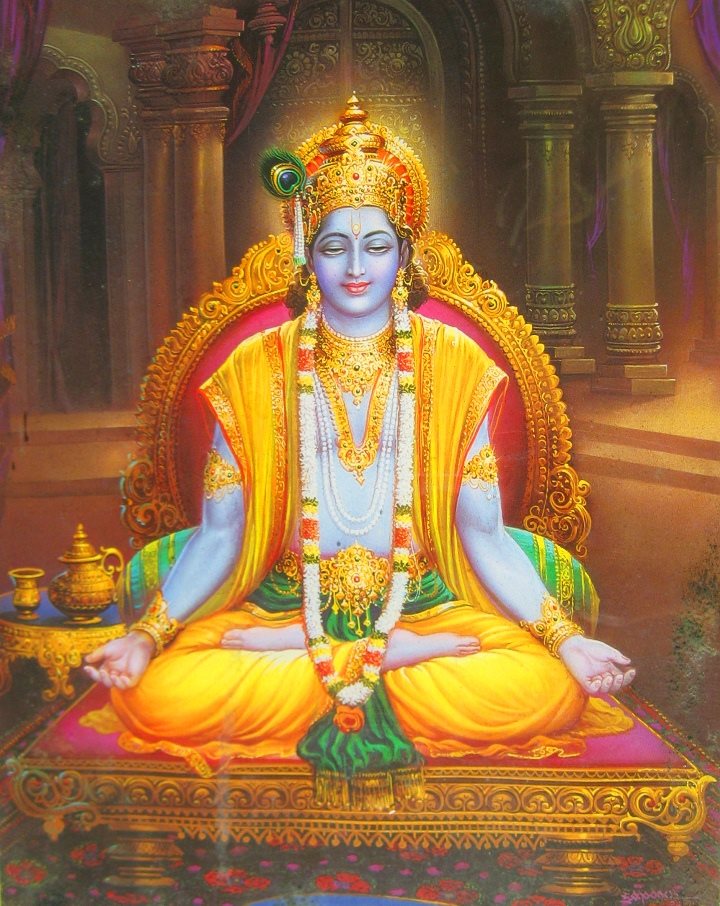
The The Size of this Universe – from Śrīmad-Bhāgavatam 3.11.40-42
SB 3.11.40—This phenomenal material world is expanded to a diameter of four billion miles, as a combination of eight material elements transformed into sixteen further categories, within and without, as follows.


The analytical studies of the material world are the subject matter of Sāṅkhya philosophy. The first sixteen diversities are the eleven senses and five sense objects, and the eight elements are the gross and subtle matter, namely earth, water, fire, air, sky, mind, intelligence and ego. All these combined together are distributed throughout the entire universe, which extends diametrically to four billion miles. Besides this universe of our experience, there are innumerable other universes. Some of them are bigger than the present one, and all of them are clustered together under similar material elements as described below.
SB 3.11.41—The layers or elements covering the universes are each ten times thicker than the one before, and all the universes clustered together appear like atoms in a huge combination.
The coverings of the universes are also constituted of the elements of earth, water, fire, air and ether, and each is ten times thicker than the one before. The first covering of the universe is earth, and it is ten times thicker than the universe itself. If the universe is four billion miles in size, then the size of the earthly covering of the universe is four billion times ten. The covering of water is ten times greater than the earthly covering, the covering of fire is ten times greater than the watery covering, the covering of air is ten times greater than that of the fire, the covering of ether is ten times greater still than that of air, and so on. The universe within the coverings of matter appears to be like an atom in comparison to the coverings, and the number of universes is unknown even to those who can estimate the coverings of the universes.
SB 3.11.42—The Supreme Personality of Godhead, Śrī Kṛṣṇa, is therefore said to be the original cause of all causes. Thus the spiritual abode of Viṣṇu is eternal without a doubt, and it is also the abode of Mahā-Viṣṇu, the origin of all manifestations.
Lord Mahā-Viṣṇu, who is resting in yoga-nidrā on the Causal Ocean and creating innumerable universes by His breathing process, only temporarily appears in the mahat-tattva for the temporary manifestation of the material worlds. He is a plenary portion of Lord Śrī Kṛṣṇa, and thus although He is nondifferent from Lord Kṛṣṇa, His formal appearance in the material world as an incarnation is temporary. The original form of the Personality of Godhead is actually the svarūpa, or real form, and He eternally resides in the Vaikuṇṭha world (Viṣṇuloka). The word mahātmanaḥ is used here to indicate Mahā-Viṣṇu, and His real manifestation is Lord Kṛṣṇa, who is called parama, as confirmed in the Brahma-saṁhitā:
īśvaraḥ paramaḥ kṛṣṇaḥ
sac-cid-ānanda-vigrahaḥ
anādir ādir govindaḥ
sarva-kāraṇa-kāraṇam
“The Supreme Lord is Kṛṣṇa, the original Personality of Godhead, known as Govinda. His form is eternal, full of bliss and knowledge, and He is the original cause of all causes


![Photo: JEWELS OF BHARATAM ....SERIES[TM]</p>
<p>SHRI RAMA ...WAS REAL KING ...WHO LIVED AS EXAMPLE OF DHARMA ...</p>
<p>Sri Rama was on this earth in 5114 BCE +/- 26,000 years before that or the similar period before that or the one before and so on and so forth.. </p>
<p>A solution to the apparent mismatch of dates can be found if we realize that because of a phenomenon known as the 'Precession of Equinoxes', stars as visualized from Earth, regain the same positions every 26,000 years! </p>
<p>Outside India, the millenia old story of Rama is still sung by people all over Asia. While traveling to different countries in this part of the world, there are many versions that are even older than the regional ones in India!!</p>
<p> In China, collection of Jatak stories relating to various events of Ramayana, belonging to 251 AD were compiled by Kang Seng Hua based on the Buddhist texts mentioned earlier.</p>
<p> Kumardasa, who ruled Srilanka in 617 BCE wrote the text called ‘Janakiharan’ which is the oldest Sanskrit literature available in Sri lanka. </p>
<p> Oldest written version of Ramayana, in Nepal is from 1075 BCE. </p>
<p> Yama Zatdaw in Myanmar is considered the National epic and is a Burmese version of the story of Rama which has again given theme to dance and art forms including tapestries and puppets.(In fact Burmese people even stress that it is the true history of their land).</p>
<p> Hikayat Seri Rama in Malaysia makes Dashrath the great-grandson of Adam, the first man! (which is not too far from the truth as both Dashrath and Manu, the First Man were from the Suryavanshi/Solar dynasty!), </p>
<p> In the Phra Lak Phra Lam of Laos, Buddha is regarded as an incarnation of Rama (again not completely false as both are incarnations of Lord Vishnu!).</p>
<p> Reamker, is the most famous story of Khmer Literature of Cambodia and is the source of classical dance, theater, poetry and of course the famous sculptures of Angkor Wat. Various rock inscriptions belonging to about 700 CE are also found in the Khmer region of Cambodia. </p>
<p> Maradia Lawana in the Phillipines is based on the Ramayana, </p>
<p> Ramakavaca in Bali is a major source of moral and spiritual guidance for the island and forms the basic story line of Balinese traditional dance, </p>
<p> Kakawin Ramayana in Java, Indonesia (9th century CE) is a mixture of Sanskrit and Kawi languages and is the basis of traditional Indonesian ballet and performances that are famous the world over.</p>
<p>Ramakien in Thailand is again considered the National epic and adds an element of incest to the story by making Sita the daughter of Ravan and Mandodari who is thrown away in the Sea as she is prophesied to bring destruction to Ravan's Kingdom!!](https://fbcdn-sphotos-a-a.akamaihd.net/hphotos-ak-xaf1/v/t1.0-9/p552x414/1471791_858432687511637_8080927430545710148_n.jpg?oh=07a52735827f58f5f601cf68d60b6aa0&oe=54F6F832&__gda__=1424834903_4ea442041497eb3f0a1744f1b52236b5)

![Photo: JEWELS OF BHARATAM .........SERIES [TM]</p>
<p>[SHARE IF YOU CARE ]</p>
<p>Q. WERE HINDU GODDESSES WORSHIPPED IN PREISLAMIC ARABIA ?</p>
<p>A. YES !! Manāt was worshipped by </p>
<p>HINDU GODESS OF PREISLAMIC ARABIA : </p>
<p>In pure scientific study about the Historical Muhammad raises basic questions concerning the prophet's role as a moral paragon; the sources of Islamic law; and the God-given nature of the Koran. The scientists even doubt the existence of Muhammad. Scientists say that the Koran is a not a product of Muhammad or even of Arabia, but a collection of materials stitched together to meet the needs of a later age. There was no Islam until two or three hundred years after the traditional version at around 830CE. The Arab tribesmen who conquered in the seventh century vast territory were not Moslems, but were persons who worshiped idols and are scientists call them pagans.</p>
<p>Even though Prophet Muhammad was born in the full light of history the earliest document date about a century and a half after his death. Not only does this long lapse of time cast doubt on their accuracy, but internal evidence strongly suggests the Arabic sources were composed in the context of intense partisan quarrels over the prophet's life. The earliest sources like papyri, inscriptions, and coins on the prophet's life, contradict the standard biography.</p>
<p> An inscription and a Greek account fix Muhammad's birth in 552, not 570. Muhammad's career took place not in Mecca but hundreds of kilometers to the north. Yehuda Nevo. The classical Arabic language was developed not in today's Saudi Arabia but in the Levant.</p>
<p>Long before Islam came in to existence, Kaaba, in Mecca in Saudi Arabia was a pilgrimage site. The word Kaaba might have come from the Tamil Language which originated around 1700BC. In Tamil Nadu Kabaalishwaran temple is Lord Shiva’s temple and Kabaali refers to Lord Shiva. The black stone at Kaaba is held sacred and holy in Islam and is called "Hajre Aswad" from the Sanskrit word Sanghey Ashweta or Non-white stone. The Shiva Lingam is also called Sanghey Ashweta. So what is in Kaaba could be the same what Hindus worship. </p>
<p>The pedestal Maqam-E-Ibrahim at the centre of the Kaaba is octagonal in shape. In Hinduism, the pedestal of Brahma the creator is also octagonal in shape. Muslim pilgrims visiting the Kaaba temple go around it seven times. In no other mosque does the circumambulation prevail. Hindus invariably circumambulate or Pradakshina, around their deities. This is yet another proof that the Kaaba shrine is a pre-Islamic. In Shiva temples Hindus always practice circumambulation or Pradakshina. Just as in Hinduism, the custom of circumambulation by muslim pilgrims around the entire Kaaba building seven times shows that the claim that in Islam they don’t worship stones is not true](https://fbcdn-sphotos-h-a.akamaihd.net/hphotos-ak-xap1/v/t1.0-9/p480x480/1798547_855013041186935_8012518421180765395_n.jpg?oh=a391390130b8adc6fabbedd93386a281&oe=54ADF7A9&__gda__=1425288320_0d2e00058aca69e01556033262e4406c)

![Photo: JEWELS OF BHARATAM ....SERIES [TM]</p>
<p>[ SHARE IF YOU CARE ] </p>
<p>Q. HOW MANY CENTRES OF LEARNING WERE ESTABLISHED BY ISLAMIC CONQUERORS ?</p>
<p>A. NONE ... THEY DESTROYED WHENEVER THEY FOUND ANY CENTRE OF LEARNING ... eg. Nalanda (Sanskrit: नालंदा Nālandā) was an acclaimed Mahāvihāra, a large Buddhist monastery in ancient Magadha (modern-day Bihar), India. The site is located about 95 kilometres southeast of Patna, and was a religious centre of learning from the fifth century CE to c. 1197 CE.Historians often characterize Nalanda as a university as the school attracted scholars and students from as far away as Tibet, China, Korea, and Central Asia. </p>
<p>Nalanda flourished under the patronage of the Gupta Empire as well as emperors like Harsha and later, the rulers of the Pala Empire. </p>
<p>The destruction of Nālandā is in one of the greatest acts of cultural vandalism by Muslim invaders of India. The final dissolution of this once outstanding international university was evident in the 13th century when the world lost an unparalleled and inimitable institution of the ancient world that promoted globally, the path of virtue, compassion and wisdom.</p>
<p>In the year 1193, these invaders led by Mohammad Bakhtiar Khilji, attacked and burnt down and demolished this great Centre of Learning that existed for some 700 years. They destroyed its magnificent buildings and massacred its inmates, who at the time were mostly Buddhist monks.</p>
<p>Mirjah-i-Siraj the famous Persian Muslim historian in his chronicle Tabaquat-I-Nasiri has left a detailed horrid account of Khilji’s vandalism and violence. He reports that the gigantic library complex of Nalanda containing a total of over 9 million invaluable treasures of books, mostly manuscripts were set on fire and the burning continued for over six months.</p>
<p>He says that "…smoke from the burning manuscripts hung for days like a dark pall over the low hills”. This invaluable collection of works that were destroyed was the products of centuries of scholastic studies. A few monks managed to escape with a few manuscripts to Tibet, Nepal and other neighboring countries.</p>
<p>Mirjah-i-Siraj reports that thousands of Buddhist monks were burned alive and thousands beheaded as Khilji who tried his best to uproot Buddhism and plant Islam by the sword. He says that Buddhism virtually disappeared under the brutal impact of Muslim fanaticism. Nalanda which was a true spearhead of Buddhist learning in the world for several centuries became a deserted and desolate place and its ruins were covered by jungle.](https://scontent-a-ord.xx.fbcdn.net/hphotos-xfa1/v/t1.0-9/p403x403/1384147_852801254741447_6830825703810556909_n.jpg?oh=ecf6f81119cfe5d90f580ee634f59bd4&oe=54F13172)


 GLOBAL HINDUISM