From World’s Education Capital to Depths of Illiteracy – Part III

Ancient Indian education -By Miss Singh

Indian architecture

Deathly blow to Indian universities

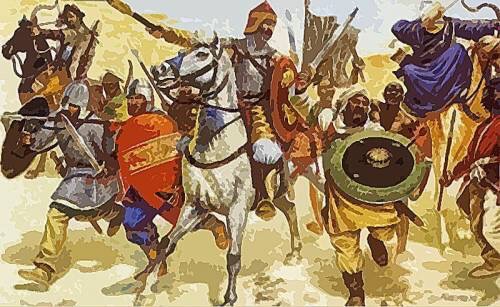
Imagine a group of horsemen riding into the campus of a world-famous university, mowing down students and professors until their bodies lie scattered everywhere. Imagine the same scene repeated at other universities, one after the other. And imagine all this in a time when there were no computers, no digital storage devices and no clouds to save the knowledge accumulated over generations. Mindless violence unleashed on the foremost universities of the time – Nalanda, Vikramshila and Odantapuri by Mohammad Bakhtyar Khilji and his men sent shock waves through Indic lands in the 13th century. The sacredness associated with institutions and persons of learning was violated in a manner never seen in India before.

The attack was chronicled by Minhaj-i-Siraj, principal historian of the Delhi Sultans in Tabaqat-i-Nasiri, who described the slaughter of thousands of “Brahmins” with shaven heads.

“There were a great number of books there; and, when all these books came under the observation of the Musalmans, they summoned a number of Hindus that they might give them information respecting the import of those books; but the whole of the Hindus had been killed.” (A.S.Altekar, 1944)

It is ironic that Bakhtyar Khilji hailed from a tribe in what is known as Afghanistan today, which practised Buddhism for centuries before being overrun by Ghaznavids and converting to Islam. In subsequent years, as Muslim rule spread and consolidated in different parts of India, many more universities were destroyed, such as Jagaddala, Somapura, Valabhi, Kashmir and others.  As the news spread, scholars abandoned their colleges even before the Muslim invaders appeared. In Banaras, one of India’s ancient centres of education, when several hundreds of temples were destroyed by Qutubuddin Aibak in the 12th century, many learned Brahmins who taught there fled to southern India along with their families (A.S.Altekar, 1944). Some of the scholars who escaped from Vikramshila and other universities, such as Sakya Sribhadra and Vibhutichandra made their way to Tibet, another hub of higher learning (Mookerjee, 1960). Records maintained by Buddhist monks at Tibet give accounts of the destruction of Indian universities. Translations of Sanskrit texts preserved in Tibet help to give some idea of the books that were found in the libraries of the great Indian universities (Sharma R. N., 2012).
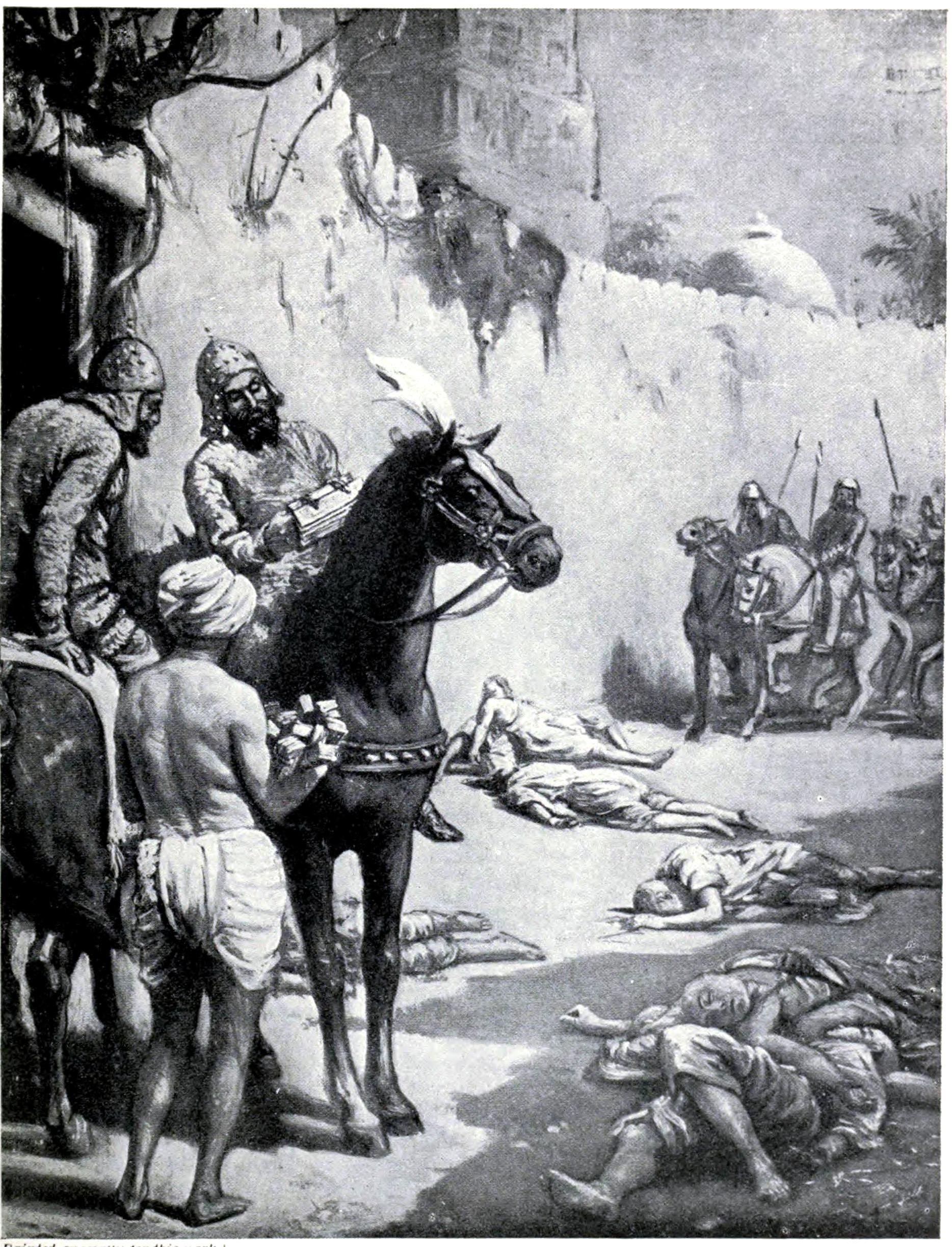
Picture captioned “The end of Buddhist Monks, A.D. 1193” in Hutchinson’s Story of the Nations (Pg 169) shows Bakhtyar Khilji trying to make sense of the manuscripts that fell into his hands, Wikimedia Commons.

Had the rulers of India learned lessons from the earlier destruction of libraries in Alexandria, Cordoba, Persia and Ghazni (many of which contained texts that originated in India itself), and put their differences aside, perhaps India would boast of the world’s longest running universities today. More importantly, India would have retained its link with ancient works in Sanskrit, especially the ones on science and medicine. The destruction of key centres of higher education in India, including temples and the persecution of Hindus, Buddhists and other followers of Dharmic faiths during the centuries of Muslim domination affected the progress of Sanskrit scholarship considerably. The writing of new smritis and their revisions suffered a setback.

Historian A.L Srivastava has described the “325 years of Turko-Afghan rule” as a period of great suffering for Hindus, which were clearly not conducive to education, especially female education.

Not only were they deprived of their position as rulers, ministers, governors and commanders of troops, but were also treated contemptuously. The Turkish Sultans and their principal followers sought their brides from well-to-do Hindu families and compelled the proud chiefs to part with their daughters. In accordance with the Muslim law, the Hindu girls were first deprived of their religion, converted to Islam, and then married. (A.L.Srivastava, 1964)

The accounts of Brahmins fleeing to different parts of India to escape Muslim persecution are too many to be missed. Despite attempts by scholars to regroup in distant locations, and even to rebuild some of the destroyed universities, the old glory of Indic educational institutions could not be restored. The absence of science education that was noted by British chroniclers in a later era can be linked to the Muslim invasions of India. Sanskrit works of scientists and mathematicians of earlier periods began to be forgotten in their land of origin, even as their Arabic and Latin translations as well as plagiarised versions became the basis of science, mathematics and technology in Europe (See Part 2 of this article series).

Emphasis on Islamic Education
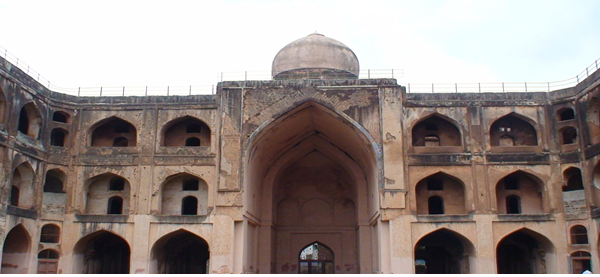
Madrasa built by Mahmud Gawan in Bidar, Karnataka. Photo: Syed Suhaib Mustafa, Wikimedia Commons

As the various Muslim dynasties got entrenched within India, education with the aim of imparting Islamic teachings became the norm. Muktabs and madrasas attached to mosques began to impart training in Islamic traditions. Says M.A. Khan in “Islamic Jihad: A Legacy of Forced Conversion, Imperialism and Slavery”:

Muslim rulers in India built only Islamic schools, namely muktabs and madrasas, often linked to mosques, solely for training Muslim students in their religion and other crafts for administrative and military duty, useful for the Muslim state. Learning Arabic and Persian language and memorizing the Quran, prophetic tradition and Islamic laws were the major subjects of study. Limited training was also given in agriculture, accountancy, astrology, astronomy, history, geography and mathematics, needed for running the state.

Muslim education was patronised by rulers from the Mamluk, Tughlaq and Lodhi dynasty as well as the Mughals and Bahmani Sultans. Delhi became one of the most important centres of Islamic learning (A.L.Srivastava, 1964). Other towns such as Jalandhar, Agra, Firozabad and provincial capitals also began to teach literature, philosophy and various humanities. The Islamic schools that used Persian as a medium of instruction were out of bounds for Hindu students. The lack of state support for education for Hindus led to a drastic decline in their higher education even though primary schools in villages continued to function wherever unjust taxation had not crippled finances completely. Many Hindus converted to Islam and learned Persian as a way of gaining respectable positions and to avoid the Jaziya tax imposed on non-Muslims. This was also a time when caste stratification became more rigid amongst Hindus in order to retain identities and preserve traditions.

Keeping Sanskrit and regional languages alive

Rich businessmen, Hindu Rajas and local communities kept the flame of learning alight for Hindus (Dwivedi, 1994). During the reign of Mughal emperor Akbar (16th century), Sanskrit received some amount of royal patronage since the ruler was interested in harmonising relationships between his Muslim and Hindu subjects. The first Sanskrit-Persian dictionary was compiled during Akbar’s reign (Mehta, 1984). Many works were produced in Sanskrit, Hindi-Urdu and regional languages such as Bengali and Marathi. It was the age of Tulsidas and Rahim. Akbar was keen for students to not solely restrict themselves to theology and classical literature. In Ain-i-Akbari, which chronicles the reign of Akbar, it is stated:

Everybody ought to read books on morals, arithmetic, the notation peculiar to arithmetic, agriculture, mensuration, geometry, astronomy, physiognomy (the art of discerning character from the features of the face), household matters, the rules of government, medicine, logic, Tabiyi (natural science), Riyazi (higher mathematics) and Ilahi (metaphysics and theology), and history; all of which may be gradually acquired.

In studying Sanskrit, students ought to learn the Vyakarana, Nyaya, Vedanta and Patanjali. No one should be allowed to neglect these things which the present time requires” (Dwivedi, 1994).

Akbar also encouraged the opening up of Madrasas for Hindu children so that Hindus and Muslims could study side by side. He introduced the study of Sanskrit in many madrasas. His imperial library in Agra housed as many as 24,000 manuscripts. The books had attractive bindings and were beautifully illustrated. The king loved to listen to readings of books on a variety of subjects. Jain monks produced a number of Sanskrit works during Akbar’s reign. (Mehta, 1984)

To some extent, the encouragement of literature in Sanskrit and regional languages continued under the reign of Jahangir and Shah Jahan. Sanskrit poets such as Panditaraja Jagannatha and Kavindra Acharya Saraswati were patronized by Shah Jahan (Sarma, 1994). A new language emerged from the amalgamation of Persian, Arabic and Hindustani, which was similar to today’s Urdu and Hindi.
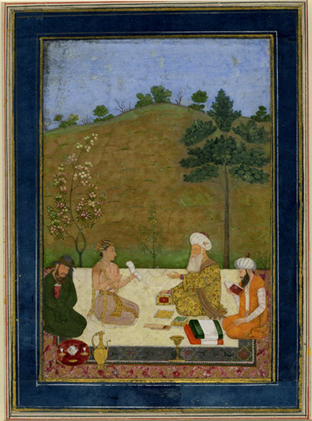
Dara Shikoh in the company of holy men. This painting is ascribed to Dal Chand. Courtesy Wikimedia Commons.

However, Aurangzeb reversed the inclusiveness that Akbar had ushered in during his reign. An Islamic fanatic, he persecuted Hindus and built new maktabs and madrasas on the ruins of demolished temples. (Riaz, 2008) On hearing that Brahmins at Thatta, Multan, Sindh and specially Varanasi were attracting Muslims to their discourses, he ordered all their temples and schools to be demolished (Mukhia, 2004). He killed his elder brother Dara Shikoh, the rightful heir to the throne, who was a Sanskrit scholar himself. With the help of pandits, Dara had translated Ramayana, Gita, Upanishads and Yogavasisthas to Persian; all of which constituted blasphemous acts in the eyes of his brother.

Dara’s Persian translation of Upanishads was translated to Latin in the beginning of the 19th century and created a renewed interest in the Upanishads among learned Europeans (Figueira, 1955). Had Dara become the emperor instead of Aurangzeb, India’s destiny could have been vastly different.

Neglect of sciences in the Mughal reign

The Mughals did not build on the leading-edge concepts presented by Hindu scholars of an earlier era to become the world leader in science and mathematics. While madrasas proliferated and students became adept in the finer details of the Quran and Hadiths in Muslim India, the western world was making advances in science and technology. Of course, these advances were considerably assisted by the Toledo school translations of Arabic works that were derived from India. (See Part 2 of this article). The Mughal kings missed the opportunity to ride the wave of technological discoveries in the west despite ruling over the richest land in the world. When Portuguese missionaries presented printed papers to Akbar, he was least interested in the potential of the printing press to transform education. His son Jahangir was similarly indifferent to a mechanical clock presented to him by the royal French delegation. (Riaz, 2008)

“The Mughal Empire has not produced a single worthwhile text on crafts or agriculture, how many volumes of poetry or histories it might have to its credit,” writes Irfan Habib (Habib, 2008). Apart from printing press and clocks, Mughal rulers were aware of nautical instruments, telescopes, pumps, various mechanical gadgets and wheelbarrows. Yet, these did not excite any desire for indigenous adaptation (Qaisar, 1982). The marvels of Mughal architecture were achieved without the aid of wheelbarrows (Kumar & Desai, 1982).

Arrival of the colonialists

Meanwhile, the Europeans who had been coming to India via the sea route from the 15th century onwards were battling amongst themselves for cornering the trade with India. The British East India Company emerged victorious after pushing the Portuguese, French and Dutch to the periphery and began spreading its tentacles within India. At first, the British did not bother themselves with education of the “natives” and focused on playing politics with different rulers and enriching themselves. Over time, they realised that “their dominion in India could not last long unless education – especially western – was diffused among the inhabitants of the land” (Basu, 1922).

A Mohammedan and a Sanskrit college were set up in Kolkata and Banaras respectively in the late 18thcentury “to provide a regular supply of qualified Hindu and Mohammedan law officers for the judicial administration” (Trevelyan, 1838). The British did not have any noble motives of education of the masses when they set up institutes of learning. These were the same people who imposed serious punishment on black slaves in America and passed laws to the effect that “assemblage of negroes for the purpose of instruction in reading or writing shall be an unlawful assembly” (Basu, 1922).

Anglicists versus Orientalists and their disdain for Indian knowledge

Many of us are familiar with Macaulay’s memorandum or “minute” on Indian Education, which was circulated by him prior to the passing of the English Education Act of 1835. That act gave effect to Governor-General William Bentinck’s decision of reallocating of funds towards a western curriculum with English as the language of instruction.

Thomas Babington Macaulay’s minute is a classic that needs to be read by every “educated” Indian:

“We must at present do our best to form a class who may be interpreters between us and the millions whom we govern – a class of persons Indian in blood and colour, but English in tastes, in opinions, in morals and in intellect. To that class we may leave it to refine the vernacular dialects of the country, to enrich those dialects with terms of science borrowed from the Western nomenclature, and to render them by degrees fit vehicles for conveying knowledge to the great mass of the population.”

Macaulay’s minute and the English Education Act came after a 15-year debate between the older faction of Orientalists and the later Anglicists. The Orientalists argued that government funds should be used to support colleges for the teaching of Arabic and Sanskrit, to pay stipends to the students at these colleges, and to translate works into Arabic and Sanskrit. The Anglicists on the other hand, advocated that these government funds should be spent on teaching English, with no stipends or translations at all. (Clive, 1971)

Most Orientalists and Anglicists had one thing in common – their belief in the “innate inferiority of the Indian culture” and the need to educate the elites (Clive, 1971). They only differed on how best to “improve” the minds of Indians, how to “correct” their beliefs and make them more useful as subjects of the British Empire.

Orientalists such as John Tytler believed in gradual reform via teaching in Arabic and Sanskrit so that the British could understand Indian culture and then prove it wrong. This method would lead to Indians themselves “correcting their countrymen”. (Clive, 1971)

Charles Trevelyan, brother-in-law of Macaulay and an avowed Anglicist, said before the Select Committee of the House of Lords on the Government of Indian Territories that both “Hindoos and Mahomedans” regarded the British as “usurping foreigners” who had “taken the country from them” and excluded them from “the avenues to wealth and distinction”. He argued that European learning “would give an entirely new turn to the native mind”. The natives would cease to “strive after independence in the native model” and would not regard the British as “enemies and usurpers”, but as “friends and patrons, and powerful beneficent persons”. (Basu, 1922)

Trevelyan’s arguments against Sanskrit and Arabic as a means of instruction sound Kautilyan in strategy. Arabic literature would keep reminding Muslims that the British were “infidel usurpers” while Sanskrit texts would inform Hindus that their foreign rulers were “unclean beasts”. He pointed out that already in the army, there was a clear distinction between the English officers and the native sepoys. Not “one native out of 500” educated in Arabic in a seminary would be interested in enlisting in the army. Therefore, it was important to educate “sepoys” in English at the elementary level (Trevelyan, 1838). For the elites, English literature would do the trick. Familiarly acquainted with literature, the Indian youth would speak of great Englishmen with the “same enthusiasm” as the British themselves. They would reject the teachings of Brahmin priests. “The natives will not rise against us because we shall stoop to raise them,” he explained.  Also, he noted that those educated in English would “cling” to the British rule because they would have everything to fear from a native government, which could mark them out for persecution. This last surmise of Trevelyan’s was clearly wrong, as the subsequent freedom movement of India proved.

Many Anglicists emphasised on the convenience attached to having English-speaking natives. Given that a large number of British officers were constantly being deputed in India, it was troublesome for them to understand the various languages and dialects of the natives. Also, it was a costly and time-consuming affair to translate various English books into native languages. In other words, the interests of the people of the land became subservient to convenience.

In addition to the Anglicists, there were the Vernacularists, who rejected Sanskrit and Persian in favour of regional languages. They championed the teaching of European knowledge in “vernacular” languages. The term “vernacular” itself has a derogatory meaning in the sense of being a language that is less cultured or refined.

Christian evangelism as a driver of education

It must be noted that spreading Christianity was a desirable goal for most Anglicists, Orientalists as well as Vernacularists. Dr Alexander Duff, an Anglicist, who opened a popular school in Calcutta was against “heathen” institutions. Macaulay himself wrote in a letter to his father, “No Hindoo who has received an English education ever remains sincerely attached to his religion.” He expressed his “firm belief” that if his plans of education were followed up, “there will not be a single idolator amongst the respectable classes in Bengal thirty years hence.” (Basu, 1922)

JC Marshman who made a sincere plea for retaining “Bengalee” as a medium of instruction gave the example of Serampore missionaries whose “labours” in “civilization and evangelization of the province of Bengal” had led to the establishing of 40 printing presses in a few decades and selling of 30,000 books in just one year. (Basu, 1922)

Many Christian missionaries learned regional languages such as Tamil and Kannada, published dictionaries in them and translated the Bible for evangelization activities. They appropriated several aspects of Hinduism into Christianity in order to make it more palatable to the locals and wean them away from traditional Sanatana Dharma.

English language struck roots in the land as the English Education Act began to take effect and the missionary schools that mushroomed across the country made English the “first language”.

Many Indians were Anglicists

An important argument made by Anglicists in favour of standardising English-medium education was that the Indian natives themselves were eager to learn English. “A taste for English has been widely disseminated,” said Trevelyan. He happily noted that a “loud call” arose from the natives themselves to be instructed in English. Schools teaching in English were extremely popular and English books were selling far more rapidly than books in Sanskrit and Arabic (Trevelyan, 1838). This is not surprising, since a good knowledge of English opened opportunities for government jobs all over the country. Besides, the vacuum in science and disconnect with Sanskrit works on science and mathematics caused by the Muslim rule made many Indians feel backward in comparison to the Europeans.
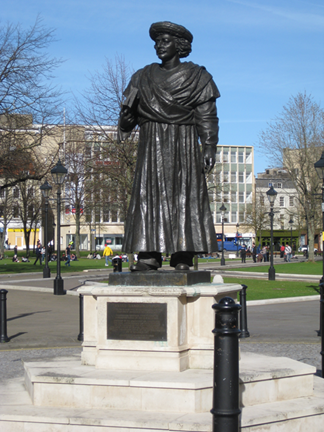
Raja Rammohan Roy's statue in Bristol

Raja Rammohan Roy is one of the most notable Indian Anglicists, who petitioned for the teaching of the “arts and sciences of modern Europe” and argued against establishing a new Sanskrit college in Calcutta in his letter to Lord Amherst. “The Sanskrit language, so difficult that almost a lifetime is necessary for its acquisition, is well known to have been for ages a lamentable check on the diffusion of knowledge; and the learning concealed under this almost impervious veil is far from sufficient to reward the labour of acquiring it,” he wrote. A new Sanskrit college, which taught the same things that were taught “two thousand years ago” would not help since ‘no improvement can be expected from inducing young men to consume a dozen of years of the most valuable period of their lives in acquiring the niceties of Byakaran or Sanskrit grammar,” he felt. Roy believed that giving allowances to the teachers engaged in teaching Sanskrit in different parts of India would be enough to keep the language alive and no new Sanskrit colleges were necessary. He was instrumental in the establishment of the Hindoo College in 1817 for imparting secular and scientific education, which later came to be known as the famous Presidency College of Kolkata. The alumni of the institute include outstanding personalities such as Bankim Chandra Chatterjee, Satyendranath Bose and Meghnad Saha.

Dharampal’s revelations of astounding data on India’s popular schooling system

When India was embroiled in the education debate, England was itself languishing in illiteracy. A minuscule fraction of the children in England went to school, and the only book most literate people had read was the Bible. In the 1960s, Dharampal, a Gandhian thinker came across archival material of extreme significance in London. He discovered documents related to a series of surveys commissioned by the British government in the 19th century to assess the level of indigenous education in India. This set him on the path of pioneering research, which brought up startling data. He discovered Thomas Munro’s statement that almost every village in India had a pathshala (school). There were 100,000 village schools reported in Bengal and Bihar alone in the 1830s. Reading, writing, arithmetic, epics and more were being taught. William Adams, one of the surveyors has written that he could not recollect studying in his village school in Scotland anything that had more “direct bearing” upon daily life than what was taught in the “humbler village schools of Bengal”. (Dharampal, 2000)

From different parts of India came reports of dedicated teachers, superior methods of teaching and high school attendance. But what simply challenged every stereotype was that in a large number of schools, “Soodras” were in majority while the Brahmins and “Vysees” were in minority. In Tamil-speaking areas, the Shudras ranged from 70% in Salem and Tinnevelly to over 84% in South Arcot. In Malayalam-speaking Malabar, Brahmin students constituted only 20% of schools, while Shudras were 54% and Muslims were 27%. The same trend was reported in Kannada-speaking Bellary and Oriya-speaking Ganjam. Only in the Telegu-speaking districts, the dwija castes formed the majority of students. Some collectors who furnished data spoke about poor Brahmins who taught children with no expectation of compensation. Girls were mostly home-schooled. However, in the Malabar district as well as “Jeypoor Zamindari of Vizagapatam district”, the percentage of girls was close to 30%, a very high number.  (Dharampal, 2000)

It must be remembered that schooling was not the only way of transmitting basic education. Artisans, craftsmen and agriculturalists taught their skills to apprentices via a separate system of education.

A.D.Campbell, the collector for Bellary applauded the “economical” teaching methods in Indian schools and the system of “more advanced scholars” teaching the “less advanced” thereby confirming their own knowledge. He mentioned that this method “well deserved the imitation it had received in England”. He was referring to the “Madras Method” of teaching, which was introduced by Reverend Andrew Bell in England. Dr Bell had been impressed by little children in Madras writing with their fingers on sand, which “after the fashion of such schools had been strewn before them for that purpose”. He saw a system of children learning from peers. After Dr Bell published his paper on Madras Method, he was in great demand to introduce this in British schools. By 1821, 300,000 children were reportedly being educated under Dr Bell’s principles and his ideas were adopted in Europe, West Indies and even Bogota, Colombia. (Tooley, 2009)

The Beautiful Ecosystem is uprooted

As the British rule progressed in India, villages got increasingly impoverished. For example, when the British with the Nawab of Arcot attacked Thanjavur in 1771 and imposed taxes as high as 59% of gross produce, they created mass poverty overnight! The entire British administrative apparatus was geared towards fleecing the citizens and even the designations of officers such as “District Collectors” indicated that the only aim of the government was to collect taxes. One collector of Bellary was so moved by the plight of the people that he wrote a letter to the authorities that the degeneration of education was attributable to the “transfer of capital of the country from the native government…to the Europeans, restricting it by law from employing it even temporarily in India and daily draining it from the land.” Further, he wrote, “The means of the manufacturing classes have been greatly diminished by the introduction of our own European manufactures.”(Dharampal, 2000)

The British educational policies also sounded the death knell for regional languages as the rush for English-medium education intensified. With every subject being taught in English and mother-tongues being relegated to “second language” the quality of literature in regional languages began sinking. Illiteracy and low self-confidence began to be associated with absence of English proficiency. M.K.Gandhi said in 1931 that the British had left India more illiterate than it was a hundred years ago. Today, India has the largest number of illiterate in the world.

Disturbingly, India’s self-gaze is still through alien eyes. The past heritage lies buried in regional and Sanskrit literature, awaiting illumination. When India became independent from the British in 1947, there was a fresh opportunity to write a new chapter of decolonization.

India is still waiting.

The author would like to acknowledge the critical inputs of the members of Indian History Awareness and Research (IHAR). She would also like to express gratitude to Rare Book Society of India and Nikhil Dureja for generously sharing books that provided key references for writing this article.

Works Cited

A.L.Srivastava. (1964). The Sultanate of Delhi 711 to 1526 AD. Shiva Lal Agarwala.

A.S.Altekar. (1944). Education in Ancient India. Nand Kishore and Bros.

Apte, D. Universities in Ancient India.

Basu, B. D. (1922). History of Education in India Under the Rule of the East India Company. The Modern Review Office.

Bose, M. (1990). A Social and Cultural History of Ancient India. Concept Publishing Company.

Clive, J. (1971). The debate on Indian education: Anglicists, Orientalists and the ideology of Empire.

Dharampal. (2000). The Beautiful Tree. Other India Press.

Dwivedi, B. L. (1994). Evolution of Educational Thought in India. Nothern Book Centre.

Figueira, D. M. (1955). Translating the Orient- The Reception of Sakuntala in Nineteenth Century Europe. State University of New York Press.

Habib, I. (2008). Technology in Medieval India. Tulika Books.

Kumar, D., & Desai, M. (1982). The Cambridge Economic History of India Vol 2. Cambridge University Press.

Mehta, J. (1984). Advanced Study in the History of Medieval India. Sterling Publishers Pvt Ltd.

Mookerjee, R. K. (1960). Ancient Indian Education – Brahminical and Buddhist. Motilal Banarsidass.

Mukhia, H. (2004). The Mughals of India. Blackwell Publishing.

Qaisar, A. (1982). Indian Responses to European Technology and Culture. Oxford Universoty Press.

Riaz, A. (2008). Faithful Education: Madrassahs in South Asia. Rutgers University Press.

Sarma, N. (1994). Panditaraja Jagannatha – The Renowned Sanskrit Poet of Medieval India. Mittal Publications.

Sharma, R. N. (2000). History of Education in India. Atlantic Publishers.

Sharma, R. N. (2012). Libraries in the early 21st century, volume 2: An international perspective. De Gruyter Saur.

Tooley, J. (2009). The Beautiful Tree – A personal journey into how the world’s poorest people are educating themselves. Cato Institute.

Trevelyan, C. E. (1838). On the Education of the People of India.

Feature Image Credit: Erik Törner

Disclaimer: The facts and opinions expressed within this article are the personal opinions of the author. IndiaFacts does not assume any responsibility or liability for the accuracy, completeness, suitability, or validity of any information in this article.
Sahana Singh writes on Indian history. She is a member of Indian History Awareness and Research (IHAR), and has recently authored “The Educational Heritage of Ancient India – How An Ecosystem of Learning Was Laid to Waste”.

तुलसीदास जी ने भी बाबरी मस्जिद का उल्लेख किया है

तुलसीदास जी ने भी बाबरी मस्जिद का उल्लेख किया है !!!

सच ये है कि कई लोग तुलसीदास जी की सभी रचनाओं से अनभिज्ञ हैं और अज्ञानतावश ऐसी बातें करते हैं l

वस्तुतः रामचरित मानस के अलावा तुलसीदास जी ने कई अन्य ग्रंथो की भी रचना की है।

तुलसीदास जी ने “तुलसी शतक” में इस घंटना का विस्तार से विवरण भी दिया है।

हमारे वामपंथी विचारकों तथा इतिहासकारों ने ये भ्रम की स्थिति उत्पन्न की, कि रामचरितमानस में ऐसी कोई घटना का वर्णन नहीं है।

श्री नित्यानंद मिश्रा ने जिज्ञासु के एक पत्र व्यवहार में “तुलसी दोहा शतक” का अर्थ इलाहाबाद हाई कोर्ट में प्रस्तुत किया है। हमने भी उन अर्थों को आप तक पहुंचने का प्रयास किया है।

प्रत्येक दोहे का अर्थ उनके नीचे दिया गया है, ध्यान से पढ़ें:-

(1)

मन्त्र उपनिषद ब्राह्मनहुँ बहु पुरान इतिहास।

जवन जराये रोष भरि करि तुलसी परिहास॥

श्री तुलसीदास जी कहते हैं कि क्रोध से ओतप्रोत यवनों ने बहुत सारे मन्त्र (संहिता), उपनिषद, ब्राह्मणग्रन्थों (जो वेद के अंग होते हैं) तथा पुराण और इतिहास सम्बन्धी ग्रन्थों का उपहास करते हुये उन्हें जला दिया।

(2)

सिखा सूत्र से हीन करि बल ते हिन्दू लोग।

भमरि भगाये देश ते तुलसी कठिन कुजोग॥

श्री तुलसीदास जी कहते हैं कि ताकत से हिंदुओं की शिखा (चोटी) और यग्योपवीत से रहित करके उनको गृहविहीन कर अपने पैतृक देश से भगा दिया।

(3)

बाबर बर्बर आइके कर लीन्हे करवाल।

हने पचारि पचारि जन तुलसी काल कराल॥

श्री तुलसीदास जी कहते हैं कि हाँथ में तलवार लिये हुये बर्बर बाबर आया और लोगों को ललकार ललकार कर हत्या की। यह समय अत्यन्त भीषण था।

(4)

सम्बत सर वसु बान नभ ग्रीष्म ऋतु अनुमानि।

तुलसी अवधहिं जड़ जवन अनरथ किये अनखानि॥

(इस दोहा में ज्योतिषीय काल गणना में अंक दायें से बाईं ओर लिखे जाते थे, सर (शर) = 5, वसु = 8, बान (बाण) = 5, नभ = 1 अर्थात विक्रम सम्वत 1585 और विक्रम सम्वत में से 57 वर्ष घटा देने से ईस्वी सन 1528 आता है।

श्री तुलसीदास जी कहते हैं कि सम्वत् 1585 विक्रमी (सन 1528 ई) अनुमानतः ग्रीष्मकाल में जड़ यवनों अवध में वर्णनातीत अनर्थ किये। (वर्णन न करने योग्य)।

(5)

राम जनम महि मंदरहिं, तोरि मसीत बनाय।

जवहिं बहुत हिन्दू हते, तुलसी कीन्ही हाय॥

जन्मभूमि का मन्दिर नष्ट करके, उन्होंने एक मस्जिद बनाई। साथ ही तेज गति उन्होंने बहुत से हिंदुओं की हत्या की। इसे सोचकर तुलसीदास शोकाकुल हुये।

(6)

दल्यो मीरबाकी अवध मन्दिर रामसमाज।

तुलसी रोवत ह्रदय हति त्राहि त्राहि रघुराज॥

मीर बाकी ने मन्दिर तथा रामसमाज (राम दरबार की मूर्तियों) को नष्ट किया। राम से रक्षा की याचना करते हुए विदीर्ण ह्रदय तुलसी रोये।

(7)

राम जनम मन्दिर जहाँ तसत अवध के बीच।

तुलसी रची मसीत तहँ मीरबाकी खाल नीच॥

तुलसीदास जी कहते हैं कि अयोध्या के मध्य जहाँ राममन्दिर था वहाँ नीच मीर बाकी ने मस्जिद बनाई।

(8)

रामायन घरि घट जँह, श्रुति पुरान उपखान।

तुलसी जवन अजान तँह, कइयों कुरान अज़ान॥

श्री तुलसीदास जी कहते हैं कि जहाँ रामायण, श्रुति, वेद, पुराण से सम्बंधित प्रवचन होते थे, घण्टे, घड़ियाल बजते थे, वहाँ अज्ञानी यवनों की कुरआन और अज़ान होने लगे।

अब यह स्पष्ट हो गया कि गोस्वामी तुलसीदास जी की इस रचना में जन्मभूमि विध्वंस का विस्तृत रूप से वर्णन किया किया है !

सभी से विनम्र निवेदन है कि सभी देशवासियों को अपने सभ्यता के स्वर्णिम युग के गौरवशाली अतीत के बारे में बताइये।

🕉 🌹 🕉

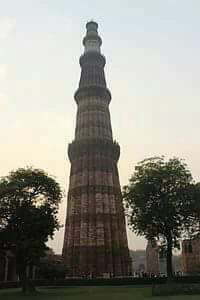
कुतुबुद्दीन ऐबक और क़ुतुबमीनार

कुतुबुद्दीन ऐबक और क़ुतुबमीनार—

किसी भी देश पर शासन करना है तो उस देश के लोगों का ऐसा ब्रेनवाश कर दो कि वो अपने देश, अपनी संस्कृति और अपने पूर्वजों पर गर्व करना छोड़ दें. इस्लामी हमलावरों और उनके बाद अंग्रेजों ने भी भारत में यही किया. हम अपने पूर्वजों पर गर्व करना भूलकर उन अत्याचारियों को महान समझने लगे जिन्होंने भारत पर बेहिसाब जुल्म किये थे।

अगर आप दिल्ली घुमने गए है तो आपने कभी विष्णू स्तम्भ (क़ुतुबमीनार) को भी अवश्य देखा होगा. जिसके बारे में बताया जाता है कि उसे कुतुबुद्दीन ऐबक ने बनबाया था. हम कभी जानने की कोशिश भी नहीं करते हैं कि कुतुबुद्दीन कौन था, उसने कितने बर्ष दिल्ली पर शासन किया, उसने कब विष्णू स्तम्भ (क़ुतुबमीनार) को बनवाया या विष्णू स्तम्भ (कुतूबमीनार) से पहले वो और क्या क्या बनवा चुका था ?

कुतुबुद्दीन ऐबक, मोहम्मद गौरी का खरीदा हुआ गुलाम था. मोहम्मद गौरी भारत पर कई हमले कर चुका था मगर हर बार उसे हारकर वापस जाना पडा था. ख्वाजा मोइनुद्दीन चिश्ती की जासूसी और कुतुबुद्दीन की रणनीति के कारण मोहम्मद गौरी, तराइन की लड़ाई में पृथ्वीराज चौहान को हराने में कामयाबी रहा और अजमेर / दिल्ली पर उसका कब्जा हो गया।

अजमेर पर कब्जा होने के बाद मोहम्मद गौरी ने चिश्ती से इनाम मांगने को कहा. तब चिश्ती ने अपनी जासूसी का इनाम मांगते हुए, एक भव्य मंदिर की तरफ इशारा करके गौरी से कहा कि तीन दिन में इस मंदिर को तोड़कर मस्जिद बना कर दो. तब कुतुबुद्दीन ने कहा आप तीन दिन कह रहे हैं मैं यह काम ढाई दिन में कर के आपको दूंगा।

कुतुबुद्दीन ने ढाई दिन में उस मंदिर को तोड़कर मस्जिद में बदल दिया. आज भी यह जगह “अढाई दिन का झोपड़ा” के नाम से जानी जाती है. जीत के बाद मोहम्मद गौरी, पश्चिमी भारत की जिम्मेदारी “कुतुबुद्दीन” को और पूर्वी भारत की जिम्मेदारी अपने दुसरे सेनापति “बख्तियार खिलजी” (जिसने नालंदा को जलाया था) को सौंप कर वापस चला गय था।

कुतुबुद्दीन कुल चार साल (१२०६ से १२१० तक) दिल्ली का शासक रहा. इन चार साल में वो अपने राज्य का विस्तार, इस्लाम के प्रचार और बुतपरस्ती का खात्मा करने में लगा रहा. हांसी, कन्नौज, बदायूं, मेरठ, अलीगढ़, कालिंजर, महोबा, आदि को उसने जीता. अजमेर के विद्रोह को दबाने के साथ राजस्थान के भी कई इलाकों में उसने काफी आतंक मचाया।

जिसे क़ुतुबमीनार कहते हैं वो महाराजा वीर विक्रमादित्य की वेदशाला थी. जहा बैठकर खगोलशास्त्री वराहमिहर ने ग्रहों, नक्षत्रों, तारों का अध्ययन कर, भारतीय कैलेण्डर “विक्रम संवत” का आविष्कार किया था. यहाँ पर २७ छोटे छोटे भवन (मंदिर) थे जो २७ नक्षत्रों के प्रतीक थे और मध्य में विष्णू स्तम्भ था, जिसको ध्रुव स्तम्भ भी कहा जाता था।

दिल्ली पर कब्जा करने के बाद उसने उन २७ मंदिरों को तोड दिया।विशाल विष्णु स्तम्भ को तोड़ने का तरीका समझ न आने पर उसने उसको तोड़ने के बजाय अपना नाम दे दिया। तब से उसे क़ुतुबमीनार कहा जाने लगा. कालान्तर में यह यह झूठ प्रचारित किया गया कि क़ुतुब मीनार को कुतुबुद्दीन ने बनबाया था. जबकि वो एक विध्वंशक था न कि कोई निर्माता।

अब बात करते हैं कुतुबुद्दीन की मौत की।इतिहास की किताबो में लिखा है कि उसकी मौत पोलो खेलते समय घोड़े से गिरने पर से हुई. ये अफगान / तुर्क लोग “पोलो” नहीं खेलते थे, पोलो खेल अंग्रेजों ने शुरू किया. अफगान / तुर्क लोग बुजकशी खेलते हैं जिसमे एक बकरे को मारकर उसे लेकर घोड़े पर भागते है, जो उसे लेकर मंजिल तक पहुंचता है, वो जीतता है।

कुतबुद्दीन ने अजमेर के विद्रोह को कुचलने के बाद राजस्थान के अनेकों इलाकों में कहर बरपाया था. उसका सबसे कडा विरोध उदयपुर के राजा ने किया, परन्तु कुतुबद्दीन उसको हराने में कामयाब रहा. उसने धोखे से राजकुंवर कर्णसिंह को बंदी बनाकर और उनको जान से मारने की धमकी देकर, राजकुंवर और उनके घोड़े शुभ्रक को पकड कर लाहौर ले आया।

एक दिन राजकुंवर ने कैद से भागने की कोशिश की, लेकिन पकड़ा गया. इस पर क्रोधित होकर कुतुबुद्दीन ने उसका सर काटने का हुकुम दिया. दरिंदगी दिखाने के लिए उसने कहा कि बुजकशी खेला जाएगा लेकिन इसमें बकरे की जगह राजकुंवर का कटा हुआ सर इस्तेमाल होगा. कुतुबुद्दीन ने इस काम के लिए, अपने लिए घोड़ा भी राजकुंवर का “शुभ्रक” चुना।

कुतुबुद्दीन “शुभ्रक” घोडे पर सवार होकर अपनी टोली के साथ जन्नत बाग में पहुंचा. राजकुंवर को भी जंजीरों में बांधकर वहां लाया गया. राजकुंवर का सर काटने के लिए जैसे ही उनकी जंजीरों को खोला गया, शुभ्रक घोडे ने उछलकर कुतुबुद्दीन को अपनी पीठ से नीचे गिरा दिया और अपने पैरों से उसकी छाती पर क् बार किये, जिससे कुतुबुद्दीन वहीं पर मर गया।

इससे पहले कि सिपाही कुछ समझ पाते राजकुवर शुभ्रक घोडे पर सवार होकर वहां से निकल गए. कुतुबुदीन के सैनिको ने उनका पीछा किया मगर वो उनको पकड न सके. शुभ्रक कई दिन और कई रात दौड़ता रहा और अपने स्वामी को लेकर उदयपुर के महल के सामने आ कर रुका. वहां पहुंचकर जब राजकुंवर ने उतर कर पुचकारा तो वो मूर्ति की तरह शांत खडा रहा।

वो मर चुका था, सर पर हाथ फेरते ही उसका निष्प्राण शरीर लुढ़क गया. कुतुबुद्दीन की मौत और शुभ्रक की स्वामिभक्ति की इस घटना के बारे में हमारे स्कूलों में नहीं पढ़ाया जाता है लेकिन इस घटना के बारे में फारसी के प्राचीन लेखकों ने काफी लिखा है. *धन्य है भारत की भूमि जहाँ इंसान तो क्या जानवर भी अपनी स्वामी भक्ति के लिए प्राण दांव पर लगा देते हैं।

।।साभार।।

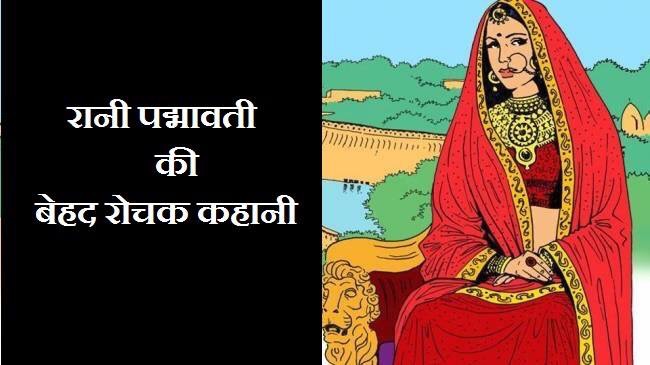
Queen Padmavati- real history in Hindi 

रानी पद्मावती का रोचक इतिहास व कहानी | Rani Padmavati रानी पद्मिनी / रानी पद्मावती का इतिहास व कहानी 


Rani Padmavati History in Hindi
भारतीय इतिहास के पन्नों में अत्यंत सुंदर और साहसी रानी; रानी पद्मावती का उल्लेख है। रानी पद्मावती को रानी पद्मिनी के नाम से भी जाना जाता है। रानी पद्मावती के पिता सिंघल प्रांत (श्रीलंका) के राजा थे। उनका नाम गंधर्वसेन था। और उनकी माता का नाम चंपावती था। पद्मावती बाल्य काल से ही दिखने में अत्यंत सुंदर और आकर्षक थीं। उनके माता-पिता नें उन्हे बड़े लाड़-प्यार से बड़ा किया था। कहा जाता है बचपन में पद्मावती के पास एक बोलता तोता था जिसका नाम हीरामणि रखा गया था।
रानी पद्मावती का स्वयंवर

महाराज गंधर्वसेन नें अपनी पुत्री पद्मावती के विवाह के लिए उनका स्वयंवर रचाया था जिस में भाग लेने के लिए भारत के अगल अलग हिन्दू राज्यों के राजा-महाराजा आए थे। गंधर्वसेन के राज दरबार में लगी राजा-महाराजाओं की भीड़ में एक छोटे से राज्य का पराक्रमी राजा मल्खान सिंह भी आया था। उसी स्वयंवर में विवाहित राजा रावल रत्न सिंह भी मौजूद थे। उन्होनें मल्खान सिंह को स्वयंवर में परास्त कर के रानी पद्मिनी पर अपना अधिकार सिद्ध किया और उनसे धाम-धूम से विवाह रचा लिया। इस तरह राजा रावल रत्न सिंह अपनी दूसरी पत्नी रानी पद्मावती को स्वयंवर में जीत कर अपनी राजधानी चित्तौड़ वापस लौट गये।
 

चित्तौड़ राज्य

प्रजा प्रेमी और न्याय पालक राजा रावल रत्न सिंह चित्तौड़ राज्य को बड़े कुशल तरीके से चला रहे थे। उनके शासन में वहाँ की प्रजा हर तरह से सुखी समपन्न थीं। राजा रावल रत्न सिंह रण कौशल और राजनीति में निपुण थे। उनका भव्य दरबार एक से बढ़कर एक महावीर योद्धाओं से भरा हुआ था। चित्तौड़ की सैन्य शक्ति और युद्ध कला दूर-दूर तक मशहूर थी।
ये भी पढ़ें: खूब लड़ी मर्दानी वो तो झांसी वाली रानी थी

चित्तौड़ का प्रवीण संगीतकार राघव चेतन

चित्तौड़ राज्य में राघव चेतन नाम का संगीतकार बहुत प्रसिद्ध था। महाराज रावल रत्न सिंह उन्हे बहुत मानते थे इसीलिये राज दरबार में राघव चेतन को विशेष स्थान दिया गया था। चित्तौड़ प्रजा और वहाँ के महाराज को उन दिनों यह बात मालूम नहीं थी की राघव चेतन संगीत कला के अतिरिक्त जादू-टोना भी जनता था। ऐसा कहा जाता है की राघव चेतन अपनी इस आसुरी प्रतिभा का उपयोग शत्रु को परास्त करने और अपने कार्य सिद्ध करने में करता था। एक दिन राघव चेतन जब अपना कोई तांत्रिक कार्य कर रहा था तब उसे रंगे हाथों पकड़ लिया गया और राजदरबार में राजा रावल रत्न सिंह के समक्ष पेश कर दिया गया। सभी साक्ष्य और फरियादी पक्ष की दलील सुन कर महाराज नें चेतन राघव को दोषी पाया और तुरंत उसका मुंह काला करा कर गधे पर बैठा कर देश निकाला दे दिया।
अलाउद्दीन खिलजी से मिला राघव चेतन

अपने अपमान और राज्य से निर्वासित किये जाने पर राघव चेतन बदला लेने पर आमादा हो गया। अब उसके जीवन का एक ही लक्ष्य रहे गया था और वह था चित्तौड़ के महाराज रावल रत्न सिंह का सम्पूर्ण विनाश। अपने इसी उद्देश के साथ वह दिल्ली राज्य चला गया। वहां जाने का उसका मकसद दिल्ली के बादशाह अलाउद्दीन खिलजी को उकसा कर चित्तौड़ पर आक्रमण करवा कर अपना प्रतिशोध पूरा करने का था।
12वीं और 13वीं सदी में दिल्ली की गद्दी पर अलाउद्दीन खिलजी का राज था। उन दिनों दिल्ली के बादशाह से मिलना इतना आसान कार्य नहीं था। इसीलिए राघव चेतन दिल्ली के पास स्थित एक जंगल में अपना डेरा डाल कर रहने लगता है क्योंकि वह जानता था कि दिल्ली का बादशाह अलाउद्दीन खिलजी शिकार का शौक़ीन है और वहाँ पर उसकी भेंट ज़रूर अलाउद्दीन खिलजी से हो जाएगी। कुछ दिन इंतज़ार करने के बाद आखिर उसे सब्र का फल मिल जाता है।
 

एक दिन अलाउद्दीन खिलजी अपने खास सुरक्षा कर्मी लड़ाकू दस्ते के साथ घने जंगल में शिकार खेलने पहुँचता है। मौका पा कर ठीक उसी वक्त राघव चेतन अपनी बांसुरी बजाना शुरू करता है। कुछ ही देर में बांसुरी के सुर बादशाह अलाउद्दीन खिलजी और उसके दस्ते के सिपाहियों के कानों में पड़ते हैं। अलाउद्दीन खिलजी फ़ौरन राघव चेतन को अपने पास बुला लेता है राज दरबार में आ कर अपना हुनर प्रदर्शित करने का प्रस्ताव देता है। तभी चालाक राघव चेतन अलाउद्दीन खिलजी से कहता है-
आप मुझ जैसे साधारण कलकार को अपनें राज्य दरबार की शोभा बना कर क्या पाएंगे, अगर हासिल ही करना है तो अन्य समपन्न राज्यों की ओर नज़र दौड़ाइये जहां एक से बढ़ कर एक बेशकीमती नगीने मौजूद हैं और उन्हे जीतना और हासिल करना भी सहज है।
अलाउद्दीन खिलजी तुरंत राघव चेतन को पहेलिया बुझानें की बजाए साफ-साफ अपनी बात बताने को कहता हैं। तब राघव चेतन चित्तौड़ राज्य की सैन्य शक्ति, चित्तौड़ गढ़ की सुरक्षा और वहाँ की सम्पदा से जुड़ा एक-एक राज़ खोल देता है और राजा रावल रत्न सिंह की धर्म पत्नी रानी पद्मावती के अद्भुत सौन्दर्य का बखान भी कर देता है। यह सब बातें जान कर अलाउद्दीन खिलजी चित्तौड़ राज्य पर आक्रमण कर के वहाँ की सम्पदा लूटने, वहाँ कब्ज़ा करने और परम तेजस्वी रूप रूप की अंबार रानी पद्मावती को हासिल करने का मन बना लेता है।
अलाउद्दीन खिलजी की चित्तौड़ राज्य पर आक्रमण की योजना

Rani Padmavati Biography in Hindi
राघव चेतन की बातें सुन कर अलाउद्दीन खिलजी नें कुछ ही दिनों में चित्तौड़ राज्य पर आक्रमण करने का मन बना लिया और अपनी एक विशाल सेना चित्तौड़ राज्य की और रवाना कर दी। अलाउद्दीन खिलजी की सेना चित्तौड़ तक पहुँच तो गयी पर चित्तौड़ के किले की अभेद्य सुरक्षा देख कर अलाउद्दीन खिलजी की पूरी सेना स्तब्ध हो गयी। उन्होने वहीं किले के आस पास अपने पड़ाव डाल लिए और चित्तौड़ राज्य के किले की सुरक्षा भेदने का उपाय ढूँढने लगे।
अलाउद्दीन खिलजी नें राजा रावल रत्न सिंह को भेजा कपट संदेश

जब से राजा रावल रत्न सिंह नें रूप सुंदरी रानी पद्मावती को स्वयमर में जीता था तभी से पद्मावती अपनी सुंदरता के लिये दूर-दूर तक चर्चा का विषय बनी हुई थी। इस बात का फायदा उठाते हुए कपटी अलाउद्दीन खिलजी नें चित्तौड़ किले के अंदर राजा रावल रत्न सिंह के पास एक संदेश भिजवाया कि वह रानी पद्मावती की सुंदरता का बखान सुन कर उनके दीदार के लिये दिल्ली से यहाँ तक आये हैं और अब एक बार रूप सुंदरी रानी पद्मावती को दूर से देखने का अवसर चाहते हैं।
अलाउद्दीन खिलजी नें यहाँ तक कहा की वह रानी पद्मावती को अपनी बहन समान मानते हैं और वह सिर्फ उसे दूर से एक नज़र देखने की ही तमन्ना रखते हैं।
चित्तौड़ के महाराज रावल रत्न सिंह का अलाउद्दीन खिलजी को जवाब

अलाउद्दीन खिलजी की इस अजीब मांग को राजपूत मर्यादा के विरुद्ध बता कर राजा रावल रत्न सिंह नें ठुकरा दिया। पर फिर भी अलाउद्दीन खिलजी नें रानी पद्मावती को बहन समान बताया था इसलिये उस समय एक रास्ता निकाला गया। पर्दे के पीछे रानी पद्मावती सीढ़ियों के पास से गुज़रेंगी और सामने एक विशाल काय शीशा रखा जाएगा जिसमें रानी पद्मावती का प्रतिबिंम अलाउद्दीन खिलजी देख सकते हैं। इस तरह राजपूतना मर्यादा भी भंग ना होगी और अलाउद्दीन खिलजी की बात भी रह जायेगी।
अलाउद्दीन खिलजी नें दिया धोखा

शर्त अनुसार चित्तौड़ के महाराज ने अलाउद्दीन खिलजी को आईने में रानी पद्मावती का प्रतिबिंब दिखला दिया और फिर अलाउद्दीन खिलजी को खिला-पिला कर पूरी महेमान नवाज़ी के साथ चित्तौड़ किले के सातों दरवाज़े पार करा कर उनकी सेना के पास छोड़ने खुद गये। इसी अवसर का लाभ ले कर कपटी अलाउद्दीन खिलजी नें राजा रावल रत्न सिंह को बंदी बना लिया और किले के बाहर अपनी छावनी में कैद कर दिया।
 इसके बाद संदेश भिजवा दिया गया कि –
अगर महाराज रावल रत्न सिंह को जीवित देखना है तो रानी पद्मावती को फौरन अलाउद्दीन खिलजी की खिदमद में किले के बाहर भेज दिया जाये।
रानी पद्मावती, चौहान राजपूत सेनापति गौरा और बादल की युक्ति

चित्तौड़ राज्य के महाराज को अलाउद्दीन खिलजी की गिरफ्त से सकुशल मुक्त कराने के लिये रानी पद्मावती, गौरा और बादल नें मिल कर एक योजना बनाई। इस योजना के तहत किले के बाहर मौजूद अलाउद्दीन खिलजी तक यह पैगाम भेजना था की रानी पद्मावती समर्पण करने के लिये तैयार है और पालकी में बैठ कर किले के बाहर आने को राज़ी है। और फिर पालकी में रानी पद्मावती और उनकी सैकड़ों दासीयों की जगह नारी भेष में लड़ाके योद्धा भेज कर बाहर मौजूद दिल्ली की सेना पर आक्रमण कर दिया जाए और इसी अफरातफरी में राजा रावल रत्न सिंह को अलाउद्दीन खिलजी की कैद से मुक्त करा लिया जाये।
 

रानी पद्मावती के इंतज़ार में बावरा हुआ अलाउद्दीन खिलजी

कहा जाता है की वासना और लालच इन्सान की बुद्धि हर लेती है। अलाउद्दीन खिलजी के साथ भी ऐसा ही हुआ। जब चित्तौड़ किले के दरवाज़े एक के बाद एक खुले तब अंदर से एक की जगह सैकड़ों पालकियाँ बाहर आने लगी। जब यह पूछा गया की इतनी सारी पालकियाँ क्यूँ साथ हैं तब अलाउद्दीन खिलजी को यह उत्तर दिया गया की यह सब रानी पद्मावती की खास दासीयों का काफिला है जो हमेशा उनके साथ जाता है।
अलाउद्दीन खिलजी रानी पद्मावती पर इतना मोहित था की उसने इस बात की पड़ताल करना भी ज़रूरी नहीं समझा की सभी पालकियों को रुकवा कर यह देखे कि उनमें वाकई में दासियाँ ही है। और इस तरह चित्तौड़ का एक पूरा लड़ाकू दस्ता नारी भेष में किले के बाहर आ पहुंचा। कुछ ही देर में अलाउद्दीन खिलजी नें रानी पद्मावती की पालकी अलग करवा दी और परदा हटा कर उनका दीदार करना चाहा। तो उसमें से राजपूत सेनापति गौरा निकले और उन्होने आक्रमण कर दिया। उसी वक्त चित्तौड़ सिपाहीयों नें भी हमला कर दिया और वहाँ मची अफरातफरी में बादल नें राजा रावल रत्न सिंह को बंधन मुक्त करा लिया और उन्हे अलाउद्दीन खिलजी के अस्तबल से चुराये हुए घोड़े पर बैठा कर सुरक्षित चित्तौड़ किले के अंदर पहुंचा दिया। इस लड़ाई मे राजपूत सेनापति गौरा और पालकी के संग बाहर आये सभी योद्धा शहीद हो गये।
अलाउद्दीन खिलजी का आक्रमण

अपनी युक्ति नाकाम हो जाने की वजह से बादशाह अलाउद्दीन खिलजी झल्ला उठा उसनें उसी वक्त चित्तौड़ किले पर आक्रमण कर दिया पर वे उस अभेद्य किले में दाखिल नहीं हो सके। तब उन्होने किले में खाद्य और अन्य ज़रूरी चीजों के खत्म होने तक इंतज़ार करने का फैसला लिया। कुछ दिनों में किले के अंदर खाद्य आपूर्ति समाप्त हो गयी और वहाँ के निवासी किले की सुरक्षा से बाहर आ कर लड़ मरने को मजबूर हो गये। अंत में रावल रत्न सिंह नें द्वार खोल कर आर- पार की लड़ाई लड़ने का फैसला कर लिया और किले के दरवाज़े खोल दिये। किले की घेराबंदी कर के राह देख रहे मौका परस्त अलाउद्दीन खिलजी ने और उसकी सेना नें दरवाज़ा खुलते ही तुरंत आक्रमण कर दिया।
इस भीषण युद्ध में पराक्रमी राजा रावल रत्न सिंह वीर गति हो प्राप्त हुए और उनकी पूरी सेना भी हार गयी। अलाउद्दीन खिलजी नें एक-एक कर के सभी राजपूत योद्धाओं को मार दिया और किले के अंदर घुसने की तैयारी कर ली।
चित्तौड़ की महारानी पद्मावती और नगर की सभी महिलाओं नें लिया जौहर करने का फैसला

Rani Padmavati Story in Hindi
युद्ध में राजा रावल रत्न सिंह के मारे जाने और चित्तौड़ सेना के समाप्त हो जाने की सूचना पाने के बाद रानी पद्मावती जान चुकी थी कि अब अलाउद्दीन खिलजी की सेना किले में दाखिल होते ही चित्तौड़ के आम नागरिक पुरुषों और बच्चों को मौत के घाट उतार देगी और औरतों को गुलाम बना कर उन पर अत्याचार करेगी। इसलिये राजपूतना रीति अनुसार वहाँ की सभी महिलाओं नें जौहर करने का फैसला लिया।
जौहर की रीति निभाने के लिए नगर के बीच एक बड़ा सा अग्नि कुंड बनाया गया और रानी पद्मावती और अन्य महिलाओं ने एक के बाद एक महिलायेँ उस धधकती चिता में कूद कर अपने प्राणों की बलि दे दी।
इतिहास में राजा रावल रत्न सिंह, रानी और पद्मावती, सेना पति गौरा और बादल का नाम सुनहरे अक्षरों में लिखा गया है और चित्तौड़ की सेना वहाँ के आम नागरिक भी सम्मान के साथ याद किये जाते हैं जिनहोने अपनी जन्म भूमि की रक्षा के खातिर अपने प्राणों का बलिदान दिया।

We are grateful to Mr. Paresh Barai for sharing Rani Padmavati Histoy in Hindi.
Note: The Rani Padmavti Biography in Hindi is based upon Malik Muhammad Jayasi’s poem Padmavati written in the 15th century. However, many historians believe it to be a work of fiction.
Note: Padmavati is also an upcoming Indian movie directed by Sanjay Leela Bhansali. Deepika Padukone will be playing the role of Padmavati in this film. Although its story may not be same as mentioned in this article.

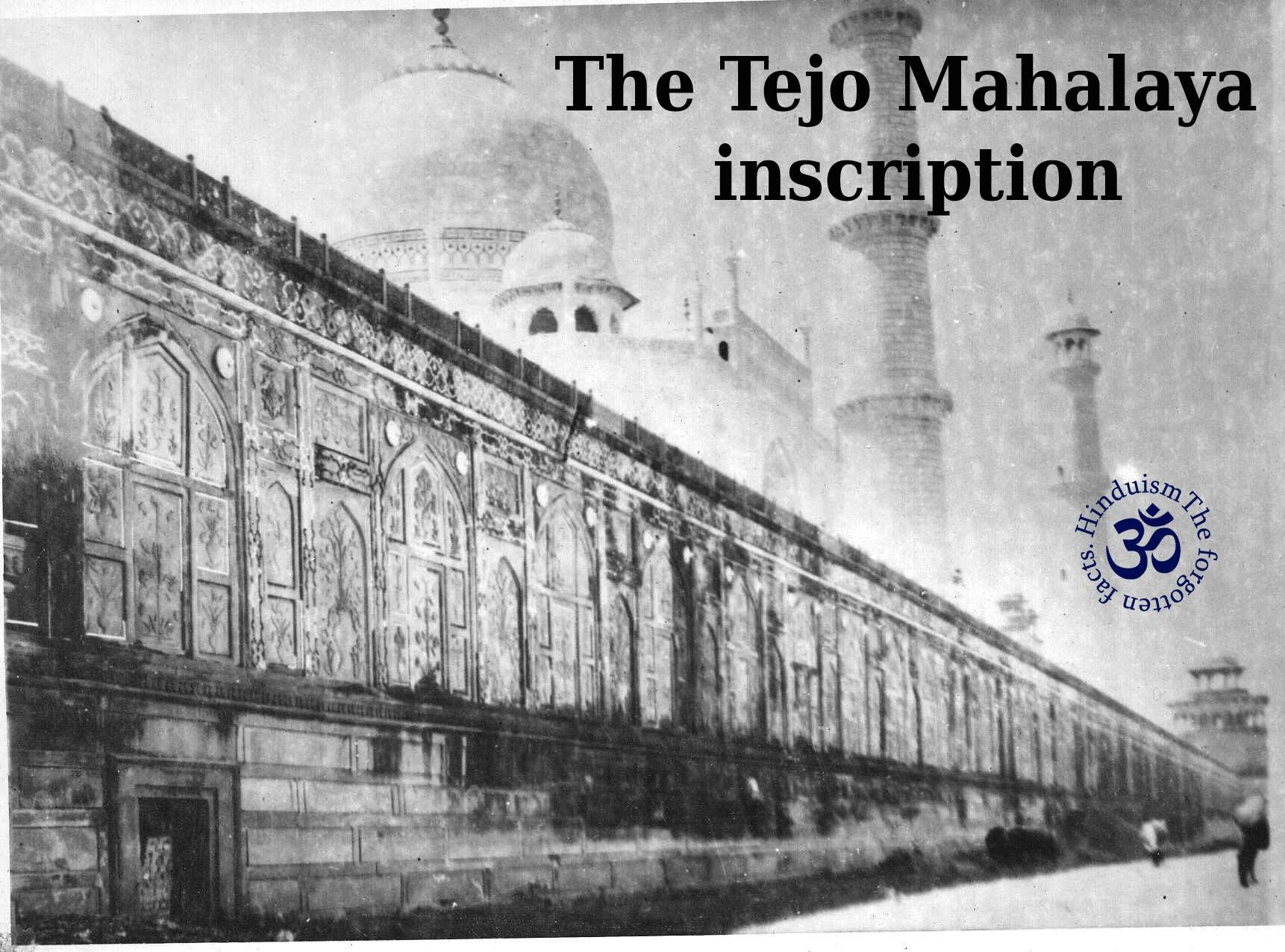
Tajmahal- original Hindu temple converted to Musoleum-Facts of distorted history


The Distorted History of Taj Mahal
By Dr Radhasyam Brahmachari
There is no doubt that Taj Mahal in Agra is the most beautiful architectural marvel in the entire world and hence it is called one of the great wonders of the world. But who is the author of this excellent exhibit of architecture? Opinions in this regard are highly contentious. The general notion is that, it is the creation of Mughal Emperor Shah Jahan. In previous articles, we have seen how the authorship of excellent pieces of architecture in Delhi, Agra and Fatehpur Sikri are being falsely attributed to the foreign Muslim invaders, who occupied and ruled India for nearly eight centuries. So, the question naturally arises – Is the claim of Shah Jahan’s authorship of Taj Mahal true? Or the said view is merely a part of the process of distortion of Indian history, to appease the Muslims? In this article, we shall try to find a plausible reply to these questions.
In this regard, the Encyclopedia Britannica states, “Taj Mahal is a mausoleum complex in Agra, in western Uttar Pradesh state, in northern India, on the southern bank of the Yamuna (Jumna) River. …the Taj Mahal is distinguished as the finest example of Mughal architecture, a blend of Indian, Persian, and Islamic styles. One of the most beautiful structural compositions in the world, the Taj Mahal was designated a UNESCO World Heritage site in 1983. It was built by the Mughal emperor Shah Jahān (reigned 1628–58) to immortalize his wife Mumtāz Mahal (“Chosen One of the Palace”). The name Taj Mahal is a derivation of her name. She died in childbirth in 1631, after having been the emperor’s inseparable companion since their marriage in 1612. The plans for the complex have been attributed to various architects of the period, though the chief architect was probably Ustad Ahmad Lahawrī, an Indian of Persian descent.” [1] 
The Wikipedia Encyclopedia maintains a similar view and says, “The Taj Mahal (pronounced /tɑdʒ məˈhɑl) is a mausoleum located in Agra, India, built by Mughal Emperor Shah Jahan in memory of his favorite wife, Mumtaz Mahal. The Taj Mahal (also “the Taj”) is considered the finest example of Mughal architecture, a style that combines elements from Persian, Indian, and Islamic architectural styles. In 1983, the Taj Mahal became a UNESCO World Heritage Site and was cited as “the jewel of Muslim art in India and one of the universally admired masterpieces of the world’s heritage.” [2]
 In this context, we should mention what the India ’s historians have to say in this matter. Historian R C Majumdar, in this regard, writes, “The Taj Mahal, a splendid mausoleum built by Shah Jahan, at a cost of fifty lacs of rupees, over the grave of his beloved wife, Mumtaz Mahal, is rightly regarded as one of the wonders of the world for its beauty and magnificence.” [3] Another historian S K Saraswati writes, “But all the above architectural creations of Shah Jahan are thrown into shade by that superb conception of the mausoleum that the emperor raised up at Agra to enshrine the mortal remains of his beloved consort, Arjumand Banu Begam, better known as Mumtaz Mahal. The Taj Mahal, as it is called after the title of the empress, stands on an elevated ground on a bend of the river Jamuna so that it has a fine view from whatever angle it is seen.” [4]
As a result of this worldwide propaganda, Shahjahan’s authorship of Taj Mahal, mixed with story of romantic love between Shah Jahan and his wife, has become so pervasive that it has become a universal symbol of love between a husband and his wife. Even a common man, at first instance, refuses to admit any other version, even if it is more convincing and rational. Even the Nobel Laureate Poet Rabindranath Tagore, being swayed by the above story, described the Taj Mahal, in one of his poems, as a drop of tears of the grief-stricken Emperor Shahjahan.
The True History of Taj Mahal:
But according to Stephen Knapp, a well known researcher on Taj Mahal, it was not built by Shah Jahan and he writes, “There is ample evidence that the Taj Mahal was never built by Shah Jahan. Some say the Taj Mahal pre-dates Shah Jahan by several centuries and was originally built as a Hindu or Vedic temple/palace complex and Shah Jahan merely acquired it (by brute force) from its previous owner, the Hindu King Jai Singh.” [5] Not only Stephen Knapp but many other researchers like Yogesh Saxena, V S Godbole and Prushottam Nagesh Oak (or P N Oak) hold a similar view and P N Oak is the most prominent and pioneer among scholars who worked to discover the real author of Taj Mahal.
It is well known that Emperor Akbar got Akbarnama, a history of his reign, written by his court-chronicler Abul Fazl and in a similar manner, Shahjahan had the history of his reign titled Badshahnama written by his court-chronicler Abdul Hamid Lahori. The original Badshahnama was written in Persian using Arabic alphabets and in 1963, P N Oak made a startling discovery the the pages 402 and 403 of the edition of Badshahnama, published by the Asiatic Society of Bengal (see the fascimile of the page 402 and 403 of the edition in Figure-1), contain the true history of the building now known as Taj Mahal. An English translation of the contents from line 21 of page 402 to line 41 on page 403 of Badshahnama is given below.
Meanwhile, we should notice another important point. It is well known that the two British historians, H M Elliot and J Dowson, have done the great job of writing history of India, under Muslim rule, starting from the attack on Sindh by Mohammed bin Kasim in the 8th century to the fall of Marathas in the 19th century, a period, covering nearly 1200 years. It has been written, based on chronicles of the court chroniclers of the Muslim rulers only. The work of Elliot and Dowson’s was published in 8 volumes during 1867 to 1877 and the Volume 7 of their work deals with the reigns of Shahjahan and Aurangzeb. But it is really astonishing that there is not even a mentioning of Taj Mahal in the said work.
Many Muslim chroniclers have described the times of Shah Jahan and Aurangzeb, e.g.
(1) Badshahnama by Abdul Hamid Lahori,
(2) Wakiyat Jahangiri by emperor Jahangir,
(3) Shahjahan-nama by Enayet Khan,
(4) Tarikh-i- Mufajjali by Mufajjal Khan,
(5) Mirat-i-Alam by Bakhtyar Khan,
(6) Alamgirnama by Muhammad Qazim and
(7) Mustakhab-ul-Lubab by Kafi Khan.
But in none of above works, there is even mentioning of Taj Mahal, except Badshahnama by Lahori and that too as a palace of Jai Singh
While commenting on this point, Dr Yogesh Saxena, writes, “The authors should have said, “Though we have presented history of Shahjahan based on his official chronicle Badshahnama, we did not find any reference to Taj Mahal in it.” They did no such thing. And Historians have kept even this information from us for the last 130 years.” [6] It was Professor P N Oak, who, for the first time, made the startling discovery that there is mentioning of the building now called Taj Mahal, but as a palace of the Hindu king Jai Singh, in Badshahnama.
There is another important point to note. There is a well established rumour that Shah Jahan engaged 20,000 labours who toiled for 20 (or 22) years to complete the construction of Taj Mahal, originates by the French traveler Jean Baptiste Tavernier. It is really unthinkable that, Shah Jahan completed such a gigantic job, spending so much money, employing so many people throughout so many years, but it escaped the attention of his sycophant chroniclers, and they did not even say a single word about the said job in their works. So, the logical conclusion is that, the said gigantic construction never took place during the reign of Shah Jahan and Badshahnama confirms this fact.
The original Badshahnama was written in Persian using Arabic alphabets and the pages 402 and 403 of the edition published by the Asiatic Society of Bengal (see the fascimile of the page 402 and 403 of Vol-I of the edition given above) contain the true history of the building now known as Taj Mahal. Professor Oak got the two pages translated into English by a scholar of Persian language and said trnslation of the contents from line 21 of page 402 to line 41 on page 403 of Vol-I of Badshahnama is given below.
“Friday, 15th Jamadiulawal, the sacred dead body of the traveller to the kingdom of holiness Hazrat Mumtazul Zamani, who was temporarily buried, was brought, accompanied by Prince Mohammad Shah, Suja bahadur, Wazir Khan and Satiunnesa Khanam, who knew the pemperament of the deceased intimately and was well versed in view of that Queen of the Queens used to hold, was brought to the capital Akbarabad (Agra) and an order was issued that very day coins be distributed among the beggers and fakirs. The site covered with a majestic garden, to the south of the great city (of Agra) and amidst which the building known as the palace of Raja Man Singh, at present owned by Raja Jai asingh, grandson of Man Singh, was selected for the burial of the Queen, whose abode is in heaven. Although Raja Jai Singh valued it greatly as his ancestral heritage and property, yet he agreed to part with it gratis for Emperor Shahjahan, still out of sheer scrupulousness and religious sanctity, he (Jai Singh) was granted Sharifabad in exchange of that grand palace (Ali Manzil). After the arrival of the deadbody in that great city (of Agra), next year that illustrious body of the Queen was laid to rest and the officials of the capital, according to royal order, hid the body of that pious lady from the eyes of the world and the palace so majestic (imarat-e-alishan) and capped with a dome (wa gumbaje) was turned into a sky-high lofty mausoleum”. [7]
Many historians try to convince that Shah Jahan purchased a piece of land from Raja Jai Singh and erected Taj Mahal on that land. But the lines 29 and 30 of page 403 of Vol-I of Badshahnama reads, “Pesh az ein Manzil-e-Rajah Mansingh bud wadari waqt ba Rajah Jaisingh (29) Nabirae taalluq dasht barae madfan e an bahisht muwattan bar guzeedand .. (30).” According to experts, the correct translation of the phrase “Manzil-e-Rajah Mansingh bud wadari waqt ba Rajah Jaisingh”is “.. the building known as the palace of Raja Man Singh, at present owned by Raja Jai asingh”. So, it is evident that it cannot be a transaction of land but of a magnificent palace. In line 37, further clarification has been made and said that it was a transaction of an imarat-e-alishan (i.e. a gigantic building) and not of land
In 1964, when Prof P N Oak started to disclose his doubts about Shah Jahan’s authorship of Taj Mahal and presented the document in Badshahnama as the proof, many of his opponents said that his translation of Badshahnama was not correct. One of his bitter critiques was a Kashmiri Pandit. He was also a scholar of Persian language. To narrate the incident Dr Yogesh Saxena writes, “One of his opponents was a Kashmiri Pandit. Eventually they went to Government of India Archives. At the suggestion of the Librarian there the Pandit started to read Badshahnama, soon he came to Volume I, page 403. One line read – va pesh azin manzil-e-Raja Mansingh bood, vadari vakt ba Raja Jaisingh. He confessed that Shah Jahan took over Raja Mansingh’s palace for burial of Mumtaz. We owe so much to this honest opponent of Mr Oak. He gave word by word translation of pages 402 and 403 to Mr Oak who promptly published it in his book Taj Mahal is a Hindu Palace (1968). However, Mr Oak never stated that the translation was his. It was done for him by a Persian expert.” [6]
The name of the Queen, in whose memory the Taj Mahal is being said to have been erected, was Arjumand Banu. She was married to Shahjahan in 1612 A.D. and within 18 years of her married life she gave birth to 14 children and in fact she died in 1630 (or in 1631) while she was delivering her 14th child. According to Badshahnama she was buried temporarily at Burhanpur and in the same year her body was brought from Burhanpur to Agra and the next year her body was permanently buried at the majestic palace of Raja Man Singh.. From the Badshahnama it becomes evident the edifice, now known as Taj Mahal, was not authored by Emperor Shahjahan.
Who was The Author of Building called Taj Mahal:
So, according to the narrations of Badshanama and from other evidence, it becomes clear that the edifice, now known as Taj Mahal, was not authored by emperor Shah Jahan. The question, therefore, naturally arises – Who built that magnificent building?
A locality, nearly 4 km away from Taj Mahal, is called Bateswar and in 1900 A.D., General Alexander Cuningham, the then Director of the Archaeological Survey of India (ASI), conducted an excavation at Bateswar and discovered an edict, now known as the Munj Bateswar Edict and kept at the Lucknow Museum. The epigraph contains 34 verses written in Sanskrit, out of which 25th, 26th and 34th verses are important in the present context. The original Sankrit text and English translation of the above verses are given below –
Prasādo vaiṣṇavastena nirnimitotavahan hari /
Murdhn āspriśati yo nityaṃ padamasaiva madhyamam // (25)
“He built a marble temple which is the abode of Lord Vishnu and the King bows down to touch His feet” (25).
Akāryacca sphatikāvadātamasāvidam mandiramindumauleḥ /
Na jātuyasminnibsnsadevah kailāsvasayacakara cetaḥ // (26)
“The King has built another marble temple which has been dedicated to the Lord Who has the moon as His ornament on His forehead and Who, getting such a beautiful abode, has forgotten to return to Kailash ” (26).
Pakṣa tryakṣamukhāditya saṃkhye vikramavatsare /
Aśvina śukla pañcmyāṃ bāsare vāsave śitu // (34)
“Today, the 5th day of the bright half in the month of Ashwin, the Sunday, in the year 1212 of the Vikram Samvat, the edict is being laid” (34).
Mr. D. J. Kale, a well known archaeologist, has mentioned the said Munj Bateswar Edict in his celebrated work Epigraphica India. On page 124 of the said work, Mr. Kale writes, “The sais Munj Bateswar Edict was laid by King Paramardidev of the Chandratreya dynasty on Sukla Panchami in the month of Ashwin, in the year 1212 Vikram Samvat (or A.D. 1156). … King Paramardidev built two magnificent temples with white marble , one for Lords Vishnu and the other for Lord Shiva and they were desecrated later on by the Muslim invaders. Perhaps a farsighted man took the edict to a safer place at Bateswar and buries it beneath the ground”.[8] Perhaps, after the said desecration, the temples were no longer used as religious places and due to this reason Abdul Hamid Lahori mentioned them as palaces, not as temples. According to the renowned historian Mr. R. C. Majumdar, the other name of the Chandratreya or Chandel King Paramardidev was Paramal and their kingdom was known as Bundelkhand, a.k.a.Jejakabhukti [9]
Today, there are two marble palaces in Agra, one is the Mausoleum of Idmat-ud-Daula, the father of Noorjahan and the other is Taj Mahal, and it is evident from the Munj Bateswar edict that, once upon a time, one of them was the temple of Lord Vishnu and the other was a temple of Lord Shiva. Experts believe that it is the temple of Lord Vishnu that has been made the mausoleum of Idmat-ud-Daula, and the temple of Lord Shiva has been converted into the mausoleum of the queen Arjumand Banu. There are so many evidence that support of this conclusion and we shall try to discuss them in future installments of this article.
 References:
 [1] http://www.britannica.com/EBchecked/topic/581007/Taj-Mahal
[2] (http://en.wikipedia.org/wiki/Taj_Mahal)
[3] R. C. Majumdar, H. C. Raychaudhury and K. Datta, An Advanced History of India, MacMillan & Co (1980),586..
[4] R. C. Majumdar (Gen Ed), History & Culture of the Indian People (in 12 Volumes), Bharatiya Vidya Bhavan, Mumbai (1996), VII, 793.
[5] Stephen Knapp,Taj Mahal: Was it a Vedic Temple ? The Photographic Evidence ( http://www.stephen-knapp.com/was_the_taj_mahal_a_vedic_temple.htm )
[6] Yogesh Saxena Taj Mahal – It is time to tell the truth, (http://agrasen.blogspot.com/2009/04/hidden- facts-in-indian-history.html )
[7] P N Oak, Tajmahal – The True Story, Published by A Ghosh, p 9-12.
[8] D J Kale, Epigraphica India , published by S D Kale & M D Kale, I, 270-274.
[9] R C Majumdar, ibid, Bharatiya Vidya Bhavan, Vol-5, p-122

_________________________


Taj Mahal – Time to Tell the Truth

By Dr. V. S. Godbole
There are many legends about the Taj Mahal. But one sentence is common in all of them. “For the construction, 20,000 men worked for 22 years.” This is well known throughout the world. The simple question is – where do these figures come from?
These figures come from a book called “Travels in India” by J B Tavernier, a French jewel merchant. He was a great adventurer who made six voyages to India in the days of Shivaji (1638 to 1668). Tavernier says, “I witnessed the commencement and completion of this monument (Taj Mahal) on which 20,000 men worked incessantly for 22 years.”
Tavernier’s book was first published in French in 1675. In those days, it was a great adventure for a single man to travel over such a long distance, face many difficulties, deal with peoples of many cultures and languages, adjust to their customs and traditions, and come home safely – that in itself was incredible. In addition Tavernier carried out a trade in precious stones like diamonds. He completed such voyages, not once but six times. His book was therefore a great sensation at that time. It was naturally translated into English and during 1677 to 1811; nine editions of the English translation were published, whereas during the same period twenty-two editions of the French book were printed.
In 1889, Dr. Ball translated the original French book into English, corrected some mistakes in earlier translation and provided extensive footnotes. He also studied Tavernier’s movements thoroughly and provided details of his six voyages. From this it is clear that Tavernier came to Agra only twice – in the winter of 1640-41 and in 1665. This raises another interesting question.
Historians say that Mumtaz, wife of Shahjahan died in 1631 and the construction of Taj Mahal started immediately. But if that is the case Tavernier could not have seen the commencement of Taj Mahal, as he came to Agra nearly 10 years later.
Aurangzeb had imprisoned his father Shahjahan in the Red Fort of Agra since 1658 and usurped power. No historian claims that Aurangzeb completed Taj Mahal. So, Tavernier could not have seen the completion of Taj Mahal either. And that being the case his statement that 20,000 men worked on it incessantly is meaningless.
Why have historians kept this truth from us for the last 117 years? The reason is simple. It strikes at the heart of the legend.
Badshahnama – What Does it Say?
British Historians have proclaimed that in India, Hindu Kings had no historical sense. Historical records were kept only by the Muslim rulers. Fair enough, then let us turn to the Badshahnama which was written during the reign of Shahjahan. The Asiatic Society of Bengal published the Persian text of Badshahnama in two parts, part I in 1867 and part II in 1868. The compilation was done by two Maulavis, under the superintendence of an English Major. The funny thing is that no one quotes Badshahnama to explain how the Taj Mahal was built. Why?
Elliot and Dowson, two English gentlemen undertook the formidable task of writing history of India from the attack on Sindh by Mohammed bin Kasim in the 8th century to the fall of Marathas in the 19th century. A period covering some 1200 years. But it was written, based on chronicles of Muslim rulers only. Elliot and Dowson’s work was published in 8 volumes during 1867 to 1877. Volume 7 deals with the reigns of Shahjahan and Aurangzeb. And yet in the entire volume we do not find the word ‘Taj Mahal.’ The authors should have said, “Though we have presented history of Shahjahan based on his official chronicle Badshahnama, we did not find any reference to Taj Mahal in it.” They did no such thing. And Historians have kept even this information from us for the last 130 years.
In 1896 Khan Bahaddur Syed Muhammad Latif wrote a book entitled “Agra Historical and Descriptive.” He refers to Badshahnama many times but does not quote specific page numbers. On page 105 he says, “The site selected for the mausoleum was originally a palace of Raja Mansingh but it was now the property of his grandson Raja Jaisingh.” Many authors have referred to Latif in their bibliography but have not cared to see what he has said. This truth was also hidden away from us by our Historians.
In 1905, H. R. Nevill, ICS, compiled Agra District Gazetteer. In it he changed the words “Raja Mansingh’s Palace” to “Raja Mansingh’s piece of land.” Ever since all historians have followed suit and repeated “Shahjahan purchased Raja Mansingh’s piece of land, at that time in the possession of his grandson Raja Jaisingh.” This deception has been going on for more than a century.
One may ask, “Why would an English officer be interested in playing such a mischief?” Well if we look at the events of those times the reason is clear cut.
1901
Viceroy Lord Curzon separated some districts from Punjab to create a Muslim majority North West Frontier Province. Hindus became an insignificant minority in this province and that marked the beginning of their misfortune.
1903
Curzon declared his intention to partition Bengal to create a Muslim majority province of East Bengal.
1905
Curzon resigned but put into effect the partition of Bengal.
1906
A Muslim delegation led by Agakhan called upon new Viceroy Lord Minto. Muslims pleaded that in any political reforms they should be treated separately and favourably. This move was obviously engineered by the British rulers.
December – Muslim League was started in Dacca.
1909
In the Morley – Minto reforms, Muslims were granted separate electorates.
We should also remember that during 1873 and 1914, some English officers had translated into English the Persian texts of Babur-nama. Humayun-nama, Akbar-nama, Ain-e-Akbari and Tazuk – i – Jehangiri, but NOT Badshahnama. Judging from above events it is obvious why Mr Nevill played the mischief when compiling Agra District Gazetteer in 1905.
It is astonishing that though Maulavi Ahmad (History of Taj, 1905) and Sir Jadunath Sarkar (Anecdotes of Aurangzeb, 1912) repeat that Raja Mansingh’s piece of land was purchased by Shahjahan, they also provide a reference – Badshahnama.
Volume I page 403. Strange as it may sound, no one had bothered to see what is written on that page.
In 1964, Mr. P. N. Oak of New Delhi started having his doubts about Taj Mahal. He put forward an argument that it was originally a Hindu Palace. Oak had to cross swords with many historians. One of his opponents was a Kashmiri Pandit. Eventually they went to Government of India Archives. At the suggestion of the Librarian there the Pandit started to read Badshahnama, soon he came to Volume I page 403. One line read – “va pesh azin manzil-e-Raja Mansingh bood, vadari vakt ba Raja Jaisingh.” He confessed that Shahjahan took over Raja Mansingh’s palace for burial of Mumtaz. We owe so much to this honest opponent of Mr. Oak. He gave word by word translation of pages 402 and 403 to Mr. Oak who promptly published it in his book “Taj Mahal is a Hindu Palace” (1968). However, Mr. Oak never stated that the translation was NOT his. It was done for him by a Persian expert. That made life of his opponents easy. They said, “Mr Oak’s translation is wrong.”
I obtained Oak’s book in London in 1977. I made a study for one year. First of all I read all the references generally quoted by Historians and writers.That was made possible by my being in England. Mr. Oak did not have that facility. All the references led to the same conclusion that the Taj Mahal is a Hindu Palace and it was NOT built by Shahjahan. My booklet entitled – “Taj Mahal: Simple Analysis of a Great Deception” was published in 1986. In 1981, while going through some references, I started suspecting that the British knew the true nature of the Taj Mahal for a long time but had deliberately suppressed the truth. Eventually, my research was published in 10 parts in the Quarterly “Itihas Patrika” of Thane (India). I collected all the information available on Taj Mahal over the 200 year period from 1784 to 1984, and shown how the British suppressed vital pieces of evidence or twisted the truth. My research continued and was published in 1996 under the title – “Taj Mahal and the Great British Conspiracy.”
Taj Legend Exposed in England in 1980
Royal Institute of British Architects (RIBA) is a reputable Institution in London. In1980, in their monthly Journal, they published two letters challenging the validity of the usual Taj Legend. One was by Mr. Oak, the other by me. No one has refuted our arguments. Mr. Oak refers to Badshahnama, Volume I page 403. What have I disclosed in my letter?
What was Agra City like before Shahjahan came to power? That is the question dodged by all historians. In the 17th century, the Dutch like the English were trying to trade in India. They had a Factory (trading post) in Agra. Fransisco Pelsaert was their Senior Factor (Merchant) at Agra from 1620 to 1627. In 1626, he prepared a commercial report for his directors in Holland. By strange coincidence, he describes Agra City at that time. He says, “The city is narrow and long, because all the rich and influential people have built their palaces on the river bank and this stretches for 10 ½ miles. I will mention some of the well known ones. Starting from the North there is the palace of Bahadur Khan, Raja Bhoj, ……. Then comes the Red Fort. (Pelsaert then describes the Fort) beyond it is Nakhas – a great market, then follow the palaces of great Lords – Mirza Abdulla, Aga Naur …… Mahabat Khan, Late Raja Mansingh, Raja Madho Singh.”
English translation of this report was available since 1925. And yet no Historian refers to it. Why? The reason is simple. In 1626, Pelsaert has said that 10 ½ mile stretch of the river-bank was full of palaces, the late Raja Mansingh’s Palace being the last one. The Badshahnama says that Shahjahan took over this palace for burying his wife Mumtaz. Thus, what we call Taj Mahal today is nothing but Late Raja Mansingh’s Palace. That is the truth which Historians have kept away from us.
My efforts had one effect. In 1982, the Archaeological Survey of India published a booklet entitled “Taj Museum.” Though the authors repeat the usual legend, they say “Mumtaz died in Burhanpur and was buried there. Six months later Shahjahan exhumed her body and sent her coffin to Agra, on that site until then stood Late Raja Mansingh’s Palace……” 
Today that palace is called the Taj Mahal. Nothing could be simpler. What building work is needed for burying a corpse in a Palace?
Dr. V. S. Godbole, April 2007

14 Turnberry Walk Akshaya Tritiya

Bedford

MK41, 8AZ

U.K.

v.godbole3@yahoo.co.uk 

___________________________
Picture 6: The full scale figure of the pinnacle on the dome has been inlaid on the red stone courtyard of the Taj Mahal. One may see it to the east at the foot of the riverside arch of the flanking building wrongly dubbed as Jamiat Khana (community hall) by Muslim usurpers. Such floor sketches in courtyards are a common Hindu trait. In Fatehpur Sikri it is the backgammon board which is sketched on a central courtyard. The coconut top and the bent mango leaves underneath, resting on a kalash (i.e. a water pot) is a sacred Hindu motif. Hindu shrines in the Himalayan foothills have identical pinnacles [especially noticed at Kedarnath, a prominent Shiva temple]. The eastern location of the sketch is also typically Hindu. The length measures almost 32 ft.


The Badshahnama
Here is a copy of one of the pages of the Badshahnama, the history of Shah Jahan, the so-called builder of the Taj Mahal. This is from the Government of India’s National Archives, and available from the institutional libraries dealing with the medieval history of India.
This is supposed to have been written by the emperor’s chronicler, the Mullah Abdul Hamid Lahori. It describes the site of the Taj Mahal as being full of majestic and lush gardens just south of the city (Agra). It goes on to say that the palace of Raja Mansingh, which was owned by his grandson Raja Jaisingh, was selected as the place for the burial of the queen Mumtaz. This means, of course, that Shah Jahan never built the Taj Mahal but only acquired it from the previous owner, who was Jaisingh.

___________________________

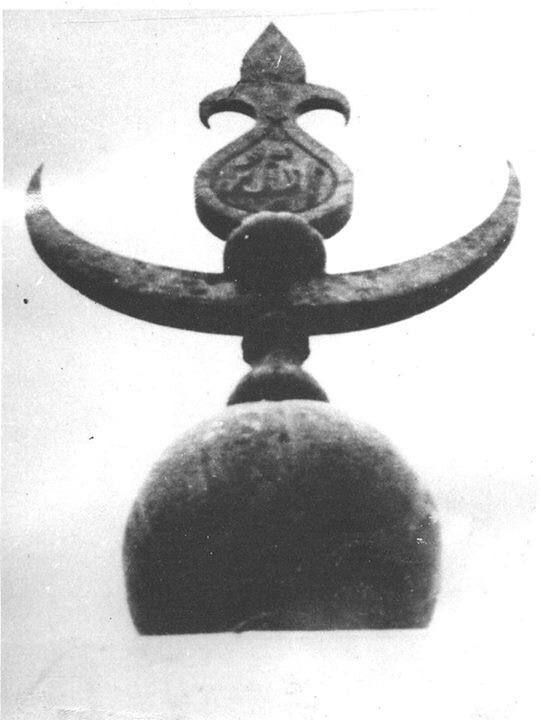
Picture 5: A close up of the upper portion of the pinnacle of the Taj Mahal, photographed from the parapet beneath the dome. The Hindu horizontal crescent and the coconut top together look like a trident from the garden level. Islamic crescents are always oblique. Moreover they are almost always complete circles leaving a little opening for a star. This Hindu pinnacle had all these centuries been misinterpreted as an Islamic crescent and star or a lightning conductor installed by the British. The word “Allah” etched here by Shahjahan is absent in the courtyard replica. The coconut, the bent mango leaves under it and the supporting Kalash (water pot) are exclusive Hindu motifs.

The Letter of Aurangzeb
This is supposed to be a copy of the original letter from Aurangzeb himself written in 1652, complaining of the extensive repairs that are in need of being done on the Taj Mahal. He says that several rooms on the second storey, the secret rooms and tops of the seven storey ceilings have all absorbed water through seepage and are so old that they were all leaking, and the dome had developed a crack on the northern side. This was in spite of the fact that the rumor is that the Taj was finished being built in 1653. The logic of this is that Mumtaz was supposed to have died around 1631, and it is said that it took 22 years to build the Taj. However, in the letter herein Aurangzeb ordered immediate repairs at his expense while recommending to the emperor that more elaborate repairs such as the roof be opened up and redone with mortar, bricks and stone.
Aurangzeb’s letter is recorded in at least three chronicles titled ‘Aadaab-e-alamgiri ‘, ‘Yaadgaarnama ‘and the ‘ Muraaqqa-I-Akbarabadi ‘ (edited by Said Ahmad, Agra, 1931, page 43, footnotes 2).
In any case, if the Taj was a new building, there would no doubt not be any need for such extensive repairs.
Picture 4:

The dome of the Taj Mahal bearing a trident pinnacle made of a non-rusting eight-metal Hindu alloy. The pinnacle served as a lightning deflector too.
This pinnacle has been blindly assumed by many to be an Islamic crescent and star, or a lightning conductor installed by the British. This is a measure of the careless manner in which Indian history has been studied till now. Visually identifiable things like this pinnacle too have been misinterpreted with impunity. The flower top of the dome, below the pinnacle, is an unmistakable Hindu sign. A full scale figure of this pinnacle is inlaid in the eastern courtyard.
Picture 7: The apex of the lofty entrance arch on all four sides of the Taj Mahal bears this red lotus and white trident–indicating that the building originated as a Hindu temple. The Koranic lettering forming the middle strip was grafted after Shahjahan seized the building from Jaipur state’s Hindu ruler.

The Tejo Mahalaya inscription
Sanskrit inscription (known as the Bateshwar inscription) it is currently preserved in the Lucknow museum. It refers to the raising of a “Crystal white Shiva temple so alluring that Lord Shiva once enshrined in it decided never to return to Mount Kailas—his usual abode”. This inscription was found within a radius of about 36 miles from the Taj Mahal. The inscription is dated 1155 A.D. and was removed from the Taj Mahal garden at Shah Jahan’s orders. Historians and Archaeologists have blundered in terming the inscription the “Bateshwar inscription” when the record doesn’t say that it was found by Bateshwar. It ought, in fact, to be called “The Tejo Mahalaya inscription” because it was originally installed in the Taj garden before it was uprooted and cast away at Shah Jahan’s command. From this it is clear that the Taj Mahal was built at least 500 years before Shah Jahan.
European Visitor’s and pre-Shahjahan’s Accounts

Vincent Smith records in his book titled “Akbar the Great Moghul” that “Babur’s turbulent life came to an end in his garden palace in Agra in 1630”. That palace was none other than the Taj Mahal. Babur’s daughter Gulbadan Begum in her chronicle titled ‘Humayun Nama’ refers to the Taj as the Mystic House. Babur himself refers to the Taj in his memoirs as the palace captured by Ibrahim Lodi containing a central octagonal chamber and having pillars on the four sides. All these historical references allude to the Taj 100 years before Shahjahan.
Peter Mundy, an English visitor to Agra recorded in 1632 (within only a year of Mumtaz’s death) that ‘the places of note in and around Agra, included Taj-e-Mahal’s tomb, gardens and bazaars’.He, therefore, confirms that that the Tajmahal had been a noteworthy building even before Shahjahan.
De Laet, a Dutch official has listed Mansingh’s palace about a mile from Agra fort, as an outstanding building of pre-shahjahan’s time. Shahjahan’s court chronicle, the Badshahnama records, Mumtaz’s burial in the same Mansingh’s palace.
Bernier, a contemporary French visitor has noted that non muslim’s were barred entry into the basement (at the time when Shahjahan requisitioned Mansingh’s palace) which contained a dazzling light. Obviously, he reffered to the silver doors, gold railing, the gem studded lattice and strings of pearl hanging over Shiva’s idol. Shahjahan comandeered the building to grab all the wealth, making Mumtaz’s death a convineant pretext.
Johan Albert Mandelslo, who describes life in agra in 1638 (only 7 years after mumtaz’s death) in detail (in his ‘Voyages and Travels to West-Indies’, published by John Starkey and John Basset, London), makes no mention of the Tajmahal being under constuction though it is commonly erringly asserted or assumed that the Taj was being built from 1631 to 1653.
Fabrication of History

Probably there is none who has not been duped at least once in a life time. But can the whole world be duped? This may seem impossible. But in the matter of Indian history the world has been duped in many respects for hundreds of years and still continues to be duped.
The world famous Taj Mahal in Agra is a glaring instance. For all the time, money and energy that people the world over spend in visiting the Taj Mahal they are dished out a concoction. Contrary to what visitors are made to believe the Taj Mahal is not an Islamic mausoleum but an ancient Shiva temple known as Tejo Mahalaya which the 5th generation Mogul emperor Shah Jahan commandeered from the then Maharaja of Jaipur. Therefore the Taj Mahal must be viewed as a temple-palace complex and not as a tomb.
The famous historian Shri P.N. Oak has proven that Taj Mahal is actually Tejo Mahalaya — a shiv temple-palace. His work was published in 1965 in the book, Taj Mahal – The True Story. However, we have not heard much about it because it was banned by the corrupt and power crazed Congress government of Bharat who did not want to alienate their precious vote bank—the Muslims.
Stories of Shah Jahan’s exclusive infatuation for Mumtaz’s are concoctions. They have no basis in history nor has any book ever written on their fancied love affairs. Those stories have been invented as an afterthought to make Shah Jahan’s authorship of the Taj look plausible. Historical evidence indicates that the Taj Mahal was already ancient at the time of Shah Jahan. And the discussion upon the architecture leads to the conclusion that the general layout of the Taj Complex resembles a Shiva temple.
Presently an attempt is being made to celebrate the 350th anniversary of Taj Mahal as the present distorted Indian history bestows the credit of building the edifice to Emperor Shah Jahan and claims that he completed the task of building Taj Mahal in 16**. But according to the Munj Bateswar Edict, the age of the building is 848 years and hence the said effort of celebrating 350th anniversary of the 848 year old Taj Mahal would be totally nonsensical and extremely ridiculous. At the same time, the Muslims of this country are demanding to declare the same as a Wakf Property and hand the building over to them. So, before taking any decision regarding the building, it is highly necessary for the Central Government in Delhi to undertake elaborate archaeological and scientific tests to ascertain the true antiquity of Taj Mahal.
Hidden, locked and sealed chambers
The Taj is a seven storied building. Prince Aurangzeb also mentions this in his letter to Shahjahan. The marble edifice comprises four stories including the lone, tall circular hall inside the top, and the lone chamber in the basement. In between are two floors each containing 12 to 15 palatial rooms. Below the marble plinth reaching down to the river at the rear are two more stories in red stone. They may be seen from the river bank. The seventh storey must be below the ground (river) level since every ancient Hindu building had a subterranian storey.
Immediately bellow the marble plinth on the river flank are 22 rooms in red stone with their ventilators all walled up by Shahjahan. Those rooms, made uninhibitably by Shahjahan, are kept locked by Archealogy Department of India. The lay visitor is kept in the dark about them. Those 22 rooms still bear ancient Hindu paint on their walls and ceilings. On their side is a nearly 33 feet long corridor. There are two door frames one at either end ofthe corridor. But those doors are intriguingly sealed with brick and lime.
Apparently those doorways originally sealed by Shahjahan have been since unsealed and again walled up several times. In 1934 a resident of Delhi took a peep inside from an opening in the upper part of the doorway. To his dismay he saw huge hall inside. It contained many statues huddled around a central beheaded image of Lord Shiva. It could be that, in there, are Sanskrit inscriptions too. All the seven stories of the Tajmahal need to be unsealed and scoured to ascertain what evidence they may be hiding in the form of Hindu images, Sanskrit inscriptions, scriptures, coins and utensils.
Apart from Hindu images hidden in the sealed stories it is also learnt that Hindu images are also stored in the massive walls of the Taj. Between 1959 and 1962 when Mr. S.R. Rao was the Archealogical Superintendent in Agra, he happened to notice a deep and wide crack in the wall of the central octagonal chamber of the Taj. When a part of the wall was dismantled to study the crack out popped two or three marble images. The matter was hushed up and the images were reburied where they had been embedded at Shahjahan’s behest. Confirmation of this has been obtained from several sources. Its walls and sealed chambers still hide in Hindu idols that were consecrated in it before Shahjahan’s seizure of the Taj.
Picrure 8: This is a riverside view of the Taj Mahal. The four storied marble structure above has under it these two stories reaching down to the river level. The 22 rooms shown in other photos are behind that line of arches seen in the middle. Each arch is flanked by Hindu lotus discs in white marble. Just above the ground level is the plinth. In the left corner of the plinth is a doorway indicating inside the plinth are many rooms sealed by Shahjahan. One could step out to the river bank from the door at the left. The 7th storey is surmised to be under the plinth below the ground because every ancient Hindu mansion had a basement. Excavation to reach the basement chamber should start under this door.

Secret bricked door that hides more evidence in Taj Mahal
Many such doorways of chambers in secret stories underneath the Taj Mahal have been sealed with brick and lime. Concealed inside could be valuable evidence such as Sanskrit inscriptions, Hindu idols, the original Hindu model of the Taj, the desecrated Shiva Linga, Hindu scriptures and temple equipment. Besides such sealed chambers there are many which are kept locked by the Government. The Public must raise its voice to have these opened or it should institute legal proceedings. Shree P. N. Sharma of Green Park, New Delhi who peeped through an aperture in these chambers in 1934 A.D. saw a pillared hall with images carved on the pillars.

Secret walled door that leads to other rooms in Taj Mahal
One of the 22 riverside rooms in a secret storey of the Taj Mahal, unknown to the public. Shahjahan, far from building the shining marble Taj, wantonly disfigured it. Here he has crudely walled up a doorway. Such imperial Mogul vandalism lies hidden from the public. This room is in the red stone storey immediately below the marble platform. Indian history has been turned topsy turvy in lauding destroyers as great builders.

Huge ventilator sealed shut with bricks in Taj Mahal
A huge ventilator of one of the 22 rooms in a secret storey of the Taj, is seen here crudely sealed with unplastered bricks by Shahjahan. History has been so perverted and inverted that alien Muslims like Shahjahan who spoiled, damaged, desecrated and destroyed historic Hindu buildings, are being falsely paraded as great builders.

Vedic design on ceiling of a locked room in Taj Mahal
This esoteric Hindu design is painted on the ceiling of some of the 22 locked rooms in the secret storey below the marble platform of the Taj Mahal in Agra. Had Shahjahan built the Taj Mahal he would not have kept such elaborately painted rooms sealed and barred to the public. Even now one can enter these rooms only if one can influence the archaeology department to remove the locks.


Interior of another of the locked rooms in Taj Mahal
One of the 22 locked rooms in the secret storey beneath the marble platform of the Taj Mahal. Strips of ancient Hindu paint are seen on the wall flanking the doorway. The niches above had paintings of Hindu idols, obviously rubbed off by Muslim desecraters. The rooms may be seen door within door in a row. If the public knew that the Taj Mahal is a structure hiding hundreds of rooms, they would insist on seeing the whole of it. At present they only peep into the grave chamber and walk away.


300 foot long corridor inside apartments in Taj Mahal
On the inner flank of the 22 locked rooms (in the secret storey in red stone below the marble platform) is this corridor about 12 ft. broad and 300 ft. long. Note the scallop design at the base of the plinth supporting the arches. This is the Hindu decoration which enables one to identify even a bare plinth.


Staircase that leads to the lower levels in Taj Mahal
This staircase and another symmetrical one at the other end lead down to the storey beneath the marble platform. Visitors may go to the back of the marble plinth at the eastern or western end and descend down the staircase because it is open to the sky. But at the foot the archaeology department has set up an iron door which it keeps locked. Yet one may peep inside from the iron gate in the upper part of the door. Shahjahan had sealed even these two staircases. It was the British who opened them. But from Shahjahan’s time the stories below and above the marble ground floor have been barred to visitors. We are still following Mogul dictates though long free from Mogul rule.


The OM in the flowers on the walls in Taj Mahal
This is the Dhatura flower essential for Hindu Shiva worship. The flower is depicted in the shape of the sacred, esoteric Hindu incantation ‘OM.’ Embossed designs of this blooming ‘OM’ are drawn over the exterior of the octagonal central sanctorum of Shiva where now a fake grave in Mumtaz’s has been planted. While perambulating around the central chamber one may see such ‘OM’ designs.


A marble apartment on ground floor
Such are the magnificent marble-paved, shining, cool, white bright rooms of the Taj Mahal temple palace’s marble ground floor. Even the lower third portion of the walls is covered with magnificent marble mosaic. The doorway at the left looks suspiciously closed with a stone slab. One can perambulate through these rooms around the central octagonal sanctorum, now occupied by Mumtaz’s fake grave. The aperture, seen through of the central door, enabled perambulating devotees to keep their eyes fixed on the Shiva Linga in the central chamber. Hindu Shiva Lingas are consecrated in two chambers, one above the other. Therefore, Shahjahan had to raise two graves in the name of Mumtaz–one in the marble basement and the other on the ground floor to desecrate and hide both the Shiva emblems from public view. [The famous Shiva temple in Ujjain also has an underground chamber for one of its Shiva-lingams.]


Such are the rooms on the 1st floor of the marble structure of the Taj Mahal. The two staircases leading to this upper floor are kept locked and barred since Shahjahan’s time. The floor and the marble walls of such upper floor rooms can be seen in the picture to have been stripped of its marble panels. Shahjahan used that uprooted marble from the upper floor for constructing graves and engraving the Koran because he did not know wherefrom to procure marble matching the splendour of the rest of the Taj Mahal. He was also so stingy as not to want to spend much even on converting a robbed Hindu temple into an Islamic mausoleum.


This Naqqar Khana alias Music House in the Taj Mahal garden is an incongruity if the Taj Mahal were an Islamic tomb. Close by on the right is the building which Muslims claim to be a mosque. The proximity of a mosque to the Music House is incongruous with Muslim tradition. In India, Muslims have a tradition of pelting stones on Hindu music processions passing over a mosque. Moreover a mausoleum needs silence. A dead person’s repose is never to be disturbed. Who would then provide a band house for a dead Mumtaz? Contrarily Hindu temples and palaces have a music house because morning and evening Hindu chores begin to the sweet strains of sacred music.


Picture 9: These corridors at the approach of the Taj Mahal are typically Hindu. They may be seen in any ancient Hindu capital. Note the two octagonal tower cupolas at the right and left top. Only Hindus have special names for the eight directions and celestial guards assigned to each. Any octagonal feature in historic buildings should convince the visitor of their Hindu origin. Guards, palanquin bearers and other attendants resided in hundreds of rooms along numerous such corridors when the Taj Mahal was a Hindu temple palace. Thus the Taj was more magnificent and majestic before it was reduced to a sombre Islamic cemetery.


Picture 8: Most people content to see Mumtaz’s grave inside the Taj fail to go to the rear riverside. This is the riverside view. From here one may notice that the four-storied marble structure on top has below it two more stories in red stone. Note the window aperture in the arch at the left. That indicates that there are rooms inside. Inside the row of arches in the upper part of the wall are 22 rooms. In addition to the four stories in marble, this one shows red stone arches in the 5th storey. The 6th storey lies in the plinth in the lower portion of the photo. In another photo a doorway would be seen in the left corner of the plinth, indicating the presence of apartments inside, from where one could emerge on the river for a bath.

From Hinduism forgotten facts 

ब्राह्मण के साथ भेदभाव, अत्याचार

सवर्णों में एक जाति आती है #ब्राह्मण, जिस पर

सदियों से राक्षस, पिशाच, दैत्य, यवन, मुगल, अंग्रेज, कांग्रेस, सपा, बसपा, वामपंथी, भाजपा, सभी राजनीतिक पार्टियाँ, विभिन्न जातियाँ आक्रमण करते आ रहे हैं।

आरोप ये लगे कि ~ब्राह्मणों ने #जाति का बँटवारा किया।

उत्तर – सबसे प्राचीन ग्रंथ वेद जो अपौरुषेय है और जिसका संकलन वेद व्यास जी ने किया, जो #मल्लाहिन के गर्भ से उत्पन्न हुए थे।

18 पुराण, महाभारत, गीता सब #व्यास जी रचित है

जिसमें वर्णव्यवस्था और जाति व्यवस्था दी गयी है।

रचनाकार व्यास ब्राह्मण जाति से नही थे।

ऐसे ही #कालीदास आदि कई कवि जो वर्णव्यवस्था और जातिव्यवस्था के पक्षधर थे जन्मजात ब्राह्मण नहीं थे।

अब मेरा प्रश्न सभी विरोध करने वालो से—

कोई एक भी ग्रन्थ का नाम बताओ जिसमें जाति

व्यवस्था लिखी गयी हो और उसे ब्राह्मण ने लिखा हो?

शायद एक भी नही मिलेगा। मुझे पता है तुम #मनु स्मृति का ही नाम लोगे, जिसके लेखक मनु महाराज थे, जो कि #क्षत्रिय थे।

मनु स्मृति जिसे आपने कभी पढ़ा ही नही और पढ़ा भी तो टुकड़ों में कुछ श्लोकों को जिसके कहने का प्रयोजन कुछ अन्य होता है और हम समझते अपने विचारानुसार है।

मनु स्मृति पूर्वाग्रह रहित होकर सांगोपांग पढ़े।

छिद्रान्वेषण की अपेक्षा गुणग्राही बनकर पढ़ने पर

स्थिति स्पष्ट हो जाएगी।

अब रही बात ” ब्राह्मणों “ने क्या किया ?तो नीचे पढ़े।

(1)#यन्त्रसर्वस्वम् (इंजीनियरिंग का आदि ग्रन्थ)- भरद्वाज

(2)#वैमानिक शास्त्रम् (विमान बनाने हेतु) – भरद्वाज

(3)#सुश्रुतसंहिता (सर्जरी चिकित्सा)-सुश्रुत

(4)#चरकसंहिता (चिकित्सा)-चरक

(5)#अर्थशास्त्र (जिसमें सैन्यविज्ञान, राजनीति,

युद्धनीति, दण्डविधान, कानून आदि कई महत्वपूर्ण

विषय है)-कौटिल्य

(6)#आर्यभटीयम् (गणित)-आर्यभट्ट

ऐसे ही छन्दशास्त्र, नाट्यशास्त्र, शब्दानुशासन,

परमाणुवाद, खगोल विज्ञान, योगविज्ञान सहित

प्रकृति और मानव कल्याणार्थ समस्त विद्याओं का संचय अनुसंधान एवं प्रयोग हेतु ब्राह्मणों ने अपना पूरा जीवन भयानक जंगलों में, घोर दरिद्रता में बिताए।

उसके पास दुनियाँ के प्रपंच हेतु समय ही कहाँ शेष था?

कोई बताएगा समस्त विद्याओं में प्रवीण होते हुए भी, सर्वशक्तिमान् होते हुए भी ब्राह्मण ने पृथ्वी का भोग करने हेतु गद्दी स्वीकारा हो?

विदेशी मानसिकता से ग्रसित कुछ विचारको ने गलत तरीके से तथ्य पेश किये। आजादी के बाद #इतिहास संरचना इनके हाथों सौपी गयी और ये विदेश संचालित षड्यन्त्रों के तहत देश मे भ्रम फैलाने लगे।

ब्राह्मण हमेशा ये चाहता रहा कि राष्ट्र शक्तिशाली

हो, अखण्ड हो,न्याय व्यवस्था सुदृढ़ हो।

सर्वे भवन्तु सुखिन:सर्वे सन्तु निरामया:

सर्वे भद्राणि पश्यन्तु मा कश्चित् दु:ख भाग्भवेत्।।

का मन्त्र देने वाला ब्राह्मण,वसुधैव कुटुम्बकम् का पालन करने वाला ब्राह्मण, सर्वदा काँधे पर जनेऊ कमर में लंगोटी बाँधे एक गठरी में लेखनी, मसि, पत्ते, कागज और पुस्तक लिए चरैवेति चरैवेति का अनुसरण करता रहा। मन में एक ही भाव था लोक कल्याण।

ऐसा नहीं कि लोक कल्याण हेतु मात्र ब्राह्मणों ने ही काम किया। बहुत सारे ऋषि, मुनि, विद्वान्, महापुरुष अन्य वर्णों के भी हुए जिनका महत् योगदान रहा है।

किन्तु आज ब्राह्मण के विषय में ही इसलिए कह रहा हूँ कि जिस देश की शक्ति के संचार में ब्राह्मणों के त्याग तपस्या का इतना बड़ा योगदान रहा।

जिसने मुगलों यवनों, अंग्रेजों और राक्षसी प्रवृत्ति के लोंगों का भयानक अत्याचार सहकर भी यहाँ की संस्कृति और ज्ञान को बचाए रखा।

वेदों शास्त्रों को जब जलाया जा रहा था तब

ब्राह्मणों ने पूरा का पूरा वेद और शास्त्र #कण्ठस्थ

करके बचा लिया और आज भी वो इसे नई पीढ़ी में संचारित कर रहे है वे सामान्य कैसे हो सकते है?

उन्हे सामान्य जाति का कहकर #आरक्षण के नाम पर सभी सरकारी सुविधाओं से रहित क्यों रखा जाता है ?

ब्राह्मण अपनी रोजी रोटी कैसे चलाये ? ब्राह्मण/

सामान्य वर्ग को देना पड़ता है पढ़ाई के लिए सबसे ज्यादा फीस और सरकारी सारी सुविधाएँ obc, sc, st, अल्पसंख्यक के नाम पर पूँजीपति या गरीब के नाम पर अयोग्य लोंगों को दी जाती है।

मैं अन्य जाति विरोधी नही हूँ लेकिन किसी ने

ब्राह्मण/सामान्य वर्ग से भेद भाव के विरूद्ध अवश्य हूं।

इस देश में गरीबी से नहीं जातियों से लड़ा जाता है। एक ब्राह्मण/सामान्य वर्ग के लिए सरकार कोई रोजगार नही देती कोई सुविधा नही देती।

एक ब्राह्मण बहुत सारे #व्यवसाय नही कर सकता जैसे — पोल्ट्रीफार्म, अण्डा, मांस, मुर्गीपालन, कबूतरपालन, बकरी, गदहा,ऊँट, सूअरपालन, मछलीपालन, जूता,चप्पल, शराब आदि, बैण्डबाजा और विभिन्न जातियों के पैतृक व्यवसाय क्योंकि उसका धर्म एवं समाज दोनों ही इसकी अनुमति नही देते।

ऐसा करने वालों से उनके समाज के लोग सम्बन्ध नहीबनाते।

वो शारीरिक #परिश्रम करके अपना पेट पालना चाहे तो उसे मजदूरी नही मिलती, क्योंकि तमाम लोग ब्राह्मण से सेवा कराना उचित नही समझते है।

हाँ उसे अपना घर छोड़कर दूर मजदूरी, दरवानी आदि करने के लिए जाना पड़ता है। कुछ को मजदूरी मिलती है कुछ को नहीं।

अब सवाल उठता है कि ऐसा हो क्यों रहा है? जिसने संसार के लिए इतनी कठिन तपस्या की उसके साथ इतना बड़ा अन्याय क्यों?जिसने शिक्षा को बचाने के लिए सर्वस्व त्याग दिया उसके साथ इतनी भयानक ईर्ष्या क्यों?

मैं बताना चाहूँगा कि ब्राह्मण को किसी जाति विशेष से द्वेष नही होता है। उन्होंने शास्त्रों को जीने का प्रयास किया है अत: जातिगत छुआछूत को पाप मानते है।

मेरा सबसे निवेदन –गलत तथ्यों के आधार पर उन्हें क्यों सताया जा रहा है ?उनके धर्म के प्रतीक शिखा और #यज्ञोपवीत, वेश भूषा का मजाक क्यों बनाया जा रहा हैं ?

#मन्त्रों और पूजा पद्धति का #उपहास क्यों किया जा रहा है ?

विश्व की सबसे समृद्ध और एकमात्र वैज्ञानिक भाषा #संस्कृत को हम भारतीय हेय दृष्टि से क्यों देखते है?

हर युग में ब्राह्मण के साथ #भेदभाव, #अत्याचार होता

आया है आखिर क्यों?

Ancient India and culture all over world

भारत बहुत प्राचीन देश है। विविधताओं से भरे इस देश में आज बहुत से धर्म, संस्कृतियां और लोग हैं। आज हम जैसा भारत देखते हैं अतीत में भारत ऐसा नहीं था भारत बहुत विशाल देश हुआ करता था। ईरान से इंडोनेशिया तक सारा हिन्दुस्थान ही था। समय के साथ-साथ भारत के टुकड़े होते चले गये जिससे भारत की संस्कृति का अलग-अलग जगहों में बटवारां हो गया। हम आपको उन देशों को नाम बतायेंगे जो कभी भारत के हिस्से थे।
ईरान – ईरान में आर्य संस्कृति का उद्भव 2000 ई. पू. उस वक्त हुआ जब ब्लूचिस्तान के मार्ग से आर्य ईरान पहुंचे और अपनी सभ्यता व संस्कृति का प्रचार वहां किया। उन्हीं के नाम पर इस देश का नाम आर्याना पड़ा। 644 ई. में अरबों ने ईरान पर आक्रमण कर उसे जीत लिया।

कम्बोडिया – प्रथम शताब्दी में कौंडिन्य नामक एक ब्राह्मण ने हिन्दचीन में हिन्दू राज्य की स्थापना की।


वियतनाम – वियतनाम का पुराना नाम चम्पा था। दूसरी शताब्दी में स्थापित चम्पा भारतीय संस्कृति का प्रमुख केंद्र था। यहां के चम लोगों ने भारतीय धर्म, भाषा, सभ्यता ग्रहण की थी। 1825 में चम्पा के महान हिन्दू राज्य का अन्त हुआ।


मलेशिया – प्रथम शताब्दी में साहसी भारतीयों ने मलेशिया पहुंचकर वहां के निवासियों को भारतीय सभ्यता एवं संस्कृति से परिचित करवाया। कालान्तर में मलेशिया में शैव, वैष्णव तथा बौद्ध धर्म का प्रचलन हो गया। 1948 में अंग्रेजों की गुलामी से मुक्त हो यह सम्प्रभुता सम्पन्न राज्य बना।


इण्डोनेशिया – इण्डोनिशिया किसी समय में भारत का एक सम्पन्न राज्य था। आज इण्डोनेशिया में बाली द्वीप को छोड़कर शेष सभी द्वीपों पर मुसलमान बहुसंख्यक हैं। फिर भी हिन्दू देवी-देवताओं से यहां का जनमानस आज भी परंपराओं के माधयम से जुड़ा है।


फिलीपींस – फिलीपींस में किसी समय भारतीय संस्कृति का पूर्ण प्रभाव था पर 15 वीं शताब्दी में मुसलमानों ने आक्रमण कर वहां आधिपत्य जमा लिया। आज भी फिलीपींस में कुछ हिन्दू रीति-रिवाज प्रचलित हैं।


अफगानिस्तान – अफगानिस्तान 350 इ.पू. तक भारत का एक अंग था। सातवीं शताब्दी में इस्लाम के आगमन के बाद अफगानिस्तान धीरे-धीरे राजनीतिक और बाद में सांस्कृतिक रूप से भारत से अलग हो गया।


नेपाल – विश्व का एक मात्र हिन्दू राज्य है, जिसका एकीकरण गोरखा राजा ने 1769 ई. में किया था। पूर्व में यह प्राय: भारतीय राज्यों का ही अंग रहा।


भूटान – प्राचीन काल में भूटान भद्र देश के नाम से जाना जाता था। 8 अगस्त 1949 में भारत-भूटान संधि हुई जिससे स्वतंत्र प्रभुता सम्पन्न भूटान की पहचान बनी।


तिब्बत – तिब्बत का उल्लेख हमारे ग्रन्थों में त्रिविष्टप के नाम से आता है। यहां बौद्ध धर्म का प्रचार चौथी शताब्दी में शुरू हुआ। तिब्बत प्राचीन भारत के सांस्कृतिक प्रभाव क्षेत्र में था। भारतीय शासकों की अदूरदर्शिता के कारण चीन ने 1957 में तिब्बत पर कब्जा कर लिया।


श्रीलंका – श्रीलंका का प्राचीन नाम ताम्रपर्णी था। श्रीलंका भारत का प्रमुख अंग था। 1505 में पुर्तगाली, 1606 में डच और 1795 में अंग्रेजों ने लंका पर अधिकार किया। 1935 ई. में अंग्रेजों ने लंका को भारत से अलग कर दिया।


म्यांमार (बर्मा) – अराकान की अनुश्रुतियों के अनुसार यहां का प्रथम राजा वाराणसी का एक राजकुमार था। 1852 में अंग्रेजों का बर्मा पर अधिकार हो गया। 1937 में भारत से इसे अलग कर दिया गया।


पाकिस्तान – 15 अगस्त, 1947 के पहले पाकिस्तान भारत का एक अंग था। हालांकि बटवारे के बाद पाकिस्तान में बहुत से हिन्दू मंदिर तोड़ दिये गये हैं, जो बचे भी हैं उनकी हालत बहुत ही जर्जर है। 


बांग्लादेश – बांग्लादेश भी 15 अगस्त 1947 के पहले भारत का अंग था। देश विभाजन के बाद पूर्वी पाकिस्तान के रूप में यह भारत से अलग हो गया। 1971 में यह पाकिस्तान से भी अलग हो गया।

India – cradle of civilization 

Article by P.Oleksenko


60 – 70 000 years ago, people went out from Hindustan to settle all over the world!!!! 

See the posting by our russian friend Prof. Alexander Koltypin

“It was concluded that the center point of dispersion, from which came the people who made ancient settlements all around the world, was Hindustan. Streams of people rushed out of Hindustan into the Near East, Europe, Southeast Asia, Oceania and Australia 70-60 thousand years ago.

Prior to this, 80-70 thousand years ago in India and Southeast Asia came the ancestors of the Hindustani people (or, as it can be argued, the present humanity), but where they came from is not clear.

P.Oleksenko is taking seriously the hypothesis that the ancestors of modern people could have come to the peninsula of Hindustan from the mythical continent of Lemuria, which disappeared after the eruption of Toba.”
http://www.earthbeforeflood.com/p_oleksenlo_india_-_cradle_of_humanity_or_transit_point_in_development_of_civilizations_preface_a_koltypin.html

Other materials on Lemuria – in Russian. But they can be viewed with the help of a translator

http://www.dopotopa.com/atlantida_giperborea_lemuria_mu_-_kontinenty_davno_izvestnye_geologam.html

http://www.dopotopa.com/most_ramy_-_artefakt_drevnosti.html

http://www.dopotopa.com/n_rerih_lemuria.html

As a bonus I suggest to see the text in English

http://www.earthbeforeflood.com/most_important_catastrophe_in_history_of_earth_during_which_mankind_appeared_when_it_happened.html

http://www.earthbeforeflood.com/history_of_mankind_began_tens_millions_years_ago_comparison_of_legends_with_geological_data_testifies_it.html

Link of article

Ancient India before buddism and Jainism

महाजनपद :गणराज्य और साम्राज्य

By Aman

भारत में सरस्वती  नदी के सूखने के उपरांत लोग भारत के अनेक इलाको में प्रवास कर बसने लगे।
इनमे अधिकतर गणराज्य या राज्य होता इसीलिए इन्हें महाजनपद कहा गया क्युकी ये लोगो के प्रवास का केंद्र था|
महाजनपद असल में एक बड़े शक्तिशाली राज्य को कहते जो कई छोटे जनपदों को मिलकर बना था ,इसीलिए कई राज्यों ने साम्राज्यवाद अपनाया ताकि खुदके राज्यों को जनपद से उठाकर महाजनपद बना सके और यह उपलब्धि के 16 राज्यों को मिली |
महाजनपद का उल्लेख पहली बार पाणिनि द्वारा किया गया था ,उस वक़्त 22 महाजनपद थे और बाकि के छोटे राज्यों को जनपद कहा गया है।
पर 700 ईसापूर्व के आते आते ये केवल 16 रह गए ।
बोध और जैन में महाजनपदो का उल्लेख है पर बहोत से नाम अलग है।
इनमे मगध,गंधर ,कोसल,काशी और अवन्ती का नाम ही पाया जाता है।
600 ईसापूर्व के आते आते बिम्बिसार और अजातशत्रु  आये जिन्होंने मगध का विस्तार किया और मगध सभी जनपदों में मुख्य बन गया।
इससे पहले यह जगह काशी को प्राप्त थी।
यह वह वक़्त था जब भारत में लहे का उपयोग अधिक बड़ा और संस्कृत में प्रगति हुई।
इसी दौर में वैदिक धर्म दक्मगाने लगा और बोध धर्म का उदय हुआ।
जैन धर्म भी लोगो में काफी प्रशिध हुआ ।
निचे 16 महाजनपदो की सूचि है 700 ईसापूर्व से 300 ईसापूर्व के बिच की।
1. कुरु – मेरठ और थानेश्वर;
राजधानी इन्द्रप्रस्थ और हस्तिनापुर ।

2. पांचाल – बरेली, बदायूं
और फ़र्रुख़ाबाद;
राजधानी अहिच्छत्र तथा
कांपिल्य ।

3. शूरसेन – मथुरा के
आसपास का क्षेत्र;
राजधानी मथुरा।

4. वत्स – इलाहाबाद और
उसके आसपास; राजधानी
कौशांबी ।

5. कोशल – अवध; राजधानी
साकेत और श्रावस्ती ।

6. मल्ल – ज़िला देवरिया;
राजधानी कुशीनगर और
पावा (आधुनिक पडरौना)

7. काशी – वाराणसी;
राजधानी वाराणसी।

8. अंग – भागलपुर; राजधानी
चंपा ।

9. मगध – दक्षिण बिहार,
राजधानी राजगृह और पाटलिपुत्र (नन्द काल में )

10. वृज्जि –
ज़िला दरभंगा और
मुजफ्फरपुर; राजधानी
मिथिला, जनकपुरी और
वैशाली ।

11. चेदि – बुंदेलखंड;
राजधानी शुक्तिमती
(वर्तमान बांदा के पास)।

12. मत्स्य – जयपुर;
राजधानी विराट नगर ।

13. अश्मक – गोदावरी घाटी;
राजधानी पांडन्य ।

14. अवंति – मालवा;
राजधानी उज्जयिनी।

15. गांधार – पाकिस्तान
स्थित पश्चिमोत्तर
क्षेत्र; राजधानी
तक्षशिला ।

16. कंबोज – कदाचित
आधुनिक अफ़ग़ानिस्तान ;
राजधानी राजापुर।

भारत के सोलह महाजनपद

700 ईसापूर्व के आते आते कई कबीलों की जनसँख्या बड़ी। ये कबीला कृषको के थे। इनमे पंचायत राज चलता था इसीलिए जब ये राज्यों के तौर पर उभरे तो गन संघ या गणराज्य आया।
राज्य से उलट इसमें जनता का राज चलता ।
वैशाली गणराज्यो में मुख्य था।
यूनान से पहले और बेहतर लोकतंत्र भारत में था।
अब बात करते है गणराज्यो और राज्यों या साम्राज्यो की।

गणराज्य  


यूनानी लोकतंत्र या गणराज्य को प्रथम क्यों माना जाता है पता नहीं पर भारतीय गणराज्य यूनान से बेहतर थे।
यूनान में आप केवल राजा चुन सकते थे बस पर भारत में बहोत से कम जनता के इशारो पर होता। बाद में गणराज्य कमजोर पड गए और जनता राज चला गया।
गणराज्यो के प्रमुख को नायक या राजा ही कहा जाता।
इनका काम कर वसूलना था और जनता के लिए सड़क आदि बनवाना था।
बहुत से गणराज्यो में गणराज्य के प्रमुख केवल व्यापारी वर्ग के होते और केवल कर वसूलते।
वैशाली  और कलिंग को छोड़ बाकि गणराज्यो में केवल चुनिन्दा वर्ग के लोग ही संघ का हिस्सा बन सकते थे।
वैशाली  और कलिंग में चारो वर्ण को इज़ाज़त थी।
वैशाली  के संघ में 7707 नायक थे।
ये गणराज्य अधिकतर वैश्य वर्ण के लोगो के थे जो ब्राह्मण द्वारा थोपे गए राजा से मुक्ति और जनता का राज्य चाहते थे |
इनकी सभा बैठती थी और हर मसले पर चर्चा होती |
जो चुंगी या कर ये लेते |
बाद में इन्होने सेना की नियुक्ति शुरू कर दी |
वैशाली या वृज्जी गणसंघ 7 गणराज्य से बना था जिसमे से कुछ के नाम ही प्राप्त है |
इनमे से एक गणराज्य शक्य था जिसकी पूरी जनता ही सेना की तरह निपूर्ण थी |
गणराज्य अपने शिष्टाचार के लिए प्रशिध थे |
अधिकतर गणराज्य या गणसंघ बोद्ध धर्मी थे और वहा बोद्ध के नियम ही चलते |
वृज्जी गणसंघ में प्राणदंड की सजा किसी बड़े अपराध पर ही मिलती |यदि देखे तो वृज्जी के गणराज्यो को छोड़ अधिक गणराज्य में कुछ अलग जी नियम थे |
मालक ,शूद्रक और कलिंग में केवल एक ही व्यक्ति चुना जाता जो राजा कहलाता और राजा की तरह ही काम करता |
वृज्जी गणसंघ ,कलिंग ,मालक ,शूद्रक और अन्य कुछ गणराज्यो की नगर प्रणाली और नगर व्यवस्था बिलकुल सरस्वती सिन्धु सभ्यता जैसी थी जो इस बात का प्रमाण देता है की गणराज्य बसने वाले सिधु घटी के थे और आर्य थे नहीं विदेशी |

आप कुछ समानताये देख सकते है सिन्धु घाटी सभ्यता और महाजनपद के सिक्को में

सम्राट अजातशत्रु के काल में गणराज्यो का पतन शुरू हुआ |सम्राट अजातशत्रु ने 36 गणराज्यो को हराया |
मौर्य काल के आते आते के वल कुछ ही गणराज्य रह गए थे |गुप्त काल में वृज्जी के अंत के साथ भारत में गणराज्यो का अंत हुआ |महराज चन्द्रगुप्त ने वृज्जी की राजकुमारी कुमारदेवी से शादी की जिसके बाद वृज्जी एक प्रांत बनकर रह गया |वृज्जी के साथ रिश्ता काफी फायदे का पड़ा महाराज चन्द्रगुप्त क क्युकी वृज्जी के पास उस वक्त मगध का अधिक भाग था जो महाराज चन्द्रगुप्त को मिला |

साम्राज्य गणराज्य से उलट यहाँ महाराज की चलती ,साम्राज्यवादी लोग गणतांत्रिक राज्य वालो को घृणा की दृष्टी से देखते क्युकी उनके लिए गणराज्य के लोग सिर्फ लोभी होते साथ ही गणराज्यो में बोद्ध धर्म की ऐसी धूम मची की वे अधिक बोद्ध धर्म पलने लगे जिसके उपरांत हिन्दू धर्म वालो के लिए केवल साम्राज्य ही सहारा थे |
गणराज्यो में कला और विज्ञानं का उतना महत्व नहीं था जितना साम्राज्यों में थे इसीलिए जब भी भारत किसी साम्राज्य के अधीन रहता तभी कला और विज्ञान का विकास हुआ |
भारत में कई महान साम्राज्य जुए जैसे मौर्य साम्राज्य ,गुप्त साम्राज्य,शुंग साम्राज्य ,सातवाहन साम्राज्य ,विजयनगर साम्राज्य ,मराठा साम्राज्य  और कई अनेक साम्राज्य हुए |विदेशी साम्राज्यवाद से उलट न्हारत के साम्राज्यों ने नेतिकता  और धर्म का साम्राज्य खड़ा किया |
महाजनपदो कशी शुरुआत में सबसे शक्तिशाली था और कशी ने महाजनपदो में साम्राज्यवाद शुरू किया |
आखिरकार बिम्बिसार के काल में शक्ति मगध के हाथ आई ,बिम्बिसार के बाद उनके बेटे अजातशत्रु आये जिन्होंने 36 गणराज्य जीते \
मगध में कई वंश बदले और फिर आया नन्द वंश जिसके केवल दो ही राजाओ ने मगध की सीमा उत्तर में कश्मीर तक ,पूर्व में अरुणाचल प्रदेश तक ,पश्चिम में यमुना तक और दक्षिण में मध्यप्रदेश तक |

नन्द साम्राज्य
मौर्य साम्राज्य अशोक के शाशन में

नन्द वंश के बाद मौर्य वंश आया जिसने पुरे भरत को एक किया |चन्द्रगुप्त मौर्य पहले सम्राट थे मौर्य वंश के ,उन्होंने मगध की सीमाए अफगानिस्तान तक फैलाई ,उत्तर में आज का पूरा कश्मीर ,नेपाल ,तिब्बत के कुछ भाग थे ,दक्षिण कर्णाटक का मौर्य वंश का द्वाज लहराता था |
बिन्दुसार मौर्य  ने 16 छोटे राज्यों को जीता |बिन्दुसार के बाद उनका छोटा लड़का अशोक मौर्य सम्राट बना जिसने कलिंग जीत अखंड भारत पर राज किया |अशोक मौर्य अपनी शांतिप्रियता के लिए जाना जाता है साथ ही बोद्ध धर्म को बढावा देने की वजह से कई बोद्ध लोगो के लिए वह चहेता है |
अशोक मौर्य की मृत्यु के 50 वर्ष बाद ही मौर्य वंश समाप्त हुआ और भारत कई टुकडो में बत गया जिसे फिरसे गुप्तो ने जोड़ा |
मौर्य वंश के साथ ही महाजनपदो का युग खत्म हुआ ,मौर्य साम्राज्य के बाद सिधु नदी के किनारे कई विदेशी राज्यों ने हमला किया साथ ही भारत में कई छोटे छोटे राज्य बसे ,अब किसी को जनपद से महाजनपद नहीं बनना था क्युकी अब सबको साम्राज्य खड़ा करना था |

~ Copying Consumerism: China Opens World’s Largest Commercial Building

In china, building BIG is sign of Success!!…Chengdu, 4th largest city in China with population of 40 millions (4 Crores), now has world’s commercial building “New Century Global Centre” , size of 329 football fields, can accommodates 20 Sydney Opera buildings inside! Size of this Mall is 1.9 million sq meters or more than 20 […]

https://globindian.wordpress.com/2015/12/17/copying-consumerism-china-opens-worlds-largest-commercial-building/